


You're probably doing what most contractors do before a new assignment. You've checked the rate, confirmed whether it's inside IR35, and started comparing umbrella companies. Then the same phrase keeps appearing on provider websites and recruiter emails, FCSA accredited.
That badge matters, but not for the reason many people assume. It isn't there to make an umbrella look more established. It's there because payroll compliance in the contractor market can go wrong in ways that affect your money, your tax position, and your statutory rights at the same time.
We see the same pattern repeatedly. A contractor focuses on take-home pay, misses the detail in the contract, and only later notices unclear deductions, odd wording around holiday pay, or a pay model that sounds more inventive than it should. By that point, switching is disruptive and untangling the issue can be stressful.
If you're weighing up providers, this guide will help you understand what fcsa means in practice, why it carries weight in the umbrella market, and where its limits are. It also explains how to check whether an umbrella is accredited and what warning signs should stop you from proceeding. If you're still comparing the basics, our guide to umbrella companies for contractors is a useful starting point.
Introduction Navigating Your Umbrella Company Choice
Most contractors don't start by asking whether an umbrella follows a professional code. They start with more immediate questions. How much will I be paid? Will this keep me compliant inside IR35? Can I trust this company to handle PAYE properly?
That's exactly where fcsa becomes relevant.
When an umbrella handles your pay, it also affects much more than your payslip. It influences how holiday pay is calculated, how deductions are presented, how pension arrangements are administered, and whether the overall model stands up if HMRC or another authority ever takes a closer look. The difference between a solid provider and a weak one often shows up in small operational details long before it becomes a major problem.
Practical rule: If an umbrella can't explain your pay model clearly before you join, it usually won't become clearer after you join.
A lot of confusion comes from the fact that contractors are often shown broad claims about efficiency or support, but not the underlying compliance method. That's one reason accreditation matters. It gives you a benchmark that goes beyond branding.
What most contractors want to know
At this stage, the essential questions are usually these:
- Is the umbrella operating a normal PAYE model? You want a straightforward arrangement that matches how inside IR35 income should usually be handled.
- Will my employment rights be protected? Holiday pay, pension treatment, and statutory processes should be clear from day one.
- Are the deductions transparent? You should be able to see what's being taken, why it's being taken, and whether it matches the contract.
- Is the provider being independently tested? Internal promises are useful, but external scrutiny matters more.
Those points sit at the heart of the fcsa conversation.
What is the FCSA and What Does It Do
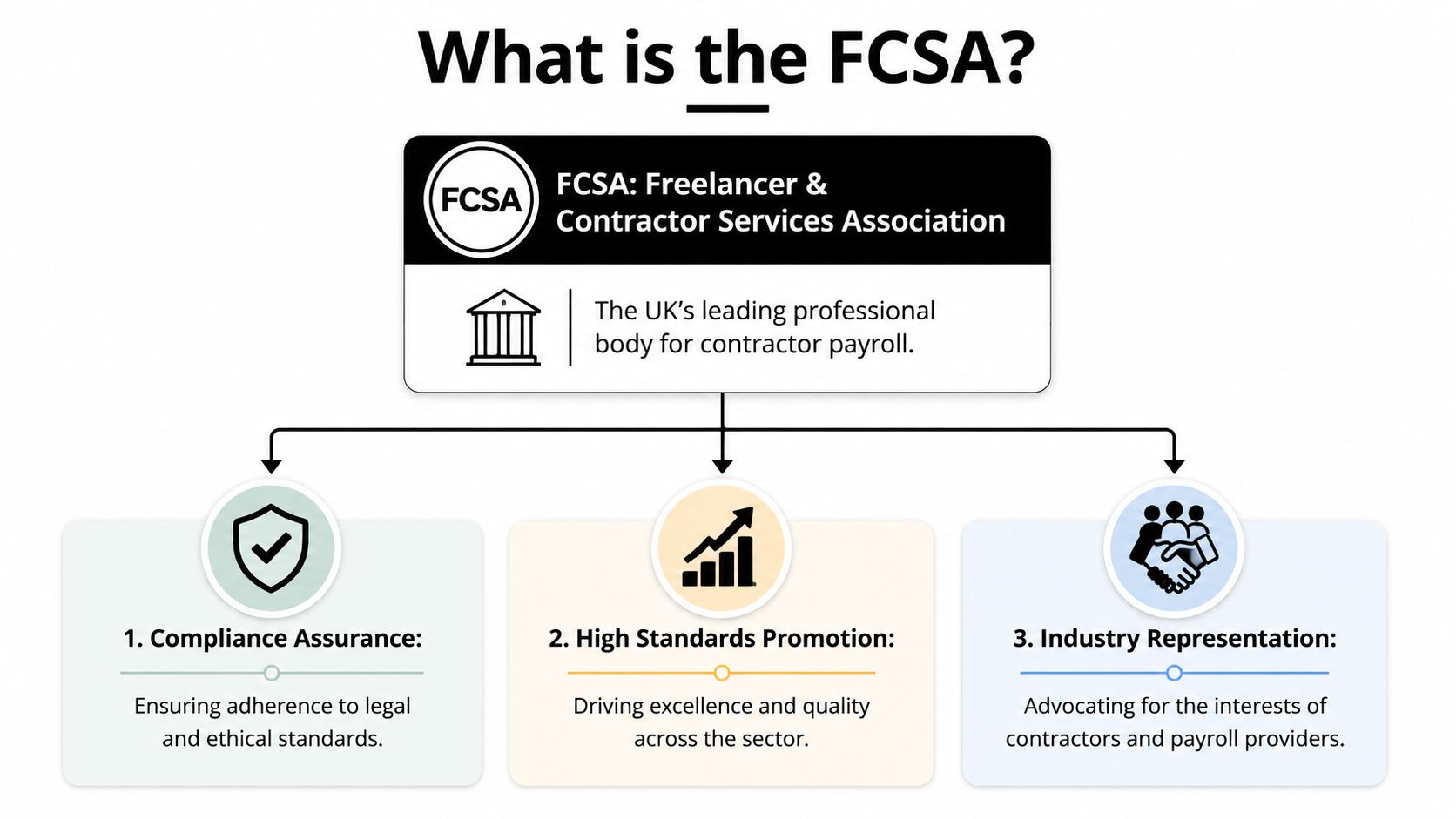
FCSA stands for the Freelancer & Contractor Services Association. It isn't a government body. It's an independent trade body that sets compliance standards for firms operating in the contractor services market, including umbrella companies.
Its role is practical rather than symbolic. It creates codes of compliance, requires applicant members to show evidence that they meet those standards, and uses independent testing by regulated accountants and solicitors. FCSA states that accredited members must also pass annual testing to keep that status, as outlined in the FCSA Codes of Compliance.
Why the organisation exists
The umbrella market contains a mix of strong operators, average operators, and providers that present serious compliance concerns. Contractors usually don't see the back-office processes that determine whether tax is being handled correctly or whether statutory entitlements are being protected properly.
FCSA exists to create a recognised compliance benchmark in that environment.
In simple terms, it asks an umbrella to prove that its processes are lawful, documented, and operated consistently. That includes the way it employs workers, runs payroll, communicates deductions, and deals with legal obligations linked to employment and tax.
What fcsa does for the market
Its work can be understood in three parts:
- Compliance assurance. It checks whether member firms can evidence compliant operation rather than claim it.
- Standards setting. It defines what good practice looks like in areas such as payroll, tax treatment, contracts, and transparency.
- Industry signalling. It gives contractors, agencies, and end clients a shorthand way to identify firms that have been independently assessed.
A useful way to think about fcsa is this. It doesn't remove every risk in the supply chain, but it does reduce the chance that you're walking into an avoidable payroll problem.
That distinction matters. Accreditation isn't a substitute for reading your contract or checking your payslip. It is, however, one of the strongest trust signals available in a market where some providers still rely on confusing wording and over-promising.
The FCSA Accreditation Standards Explained
Accreditation isn't a marketing subscription. A provider has to show that its business stands up across tax, employment law, process control, and worker communication. That's why the fcsa badge carries more weight than a general promise to be “fully compliant”.

The core areas an umbrella has to get right
An accredited umbrella is expected to demonstrate thorough handling of several operational areas.
- Tax processing and PAYE operation. The company must run payroll in line with normal PAYE expectations, with correct deductions and reporting.
- Employment rights administration. It needs proper processes for holiday pay, pension auto-enrolment, and statutory entitlements.
- Contracts and documentation. Worker contracts, assignment schedules, and key terms should be clear enough for a contractor to understand what they are signing.
- Governance and internal control. The umbrella should be able to evidence how it monitors compliance internally rather than relying on ad hoc fixes.
- Transparency in pay. Payslips should show what has happened to your money in a way that can be followed and checked.
Those standards matter because umbrella problems rarely begin with a dramatic failure. More often, they start with a vague payslip, an unclear holiday pay method, or an unexplained salary adjustment that gets normalised over time.
Why these standards matter right now
A significant number of contractors still aren't receiving specific guidance when choosing a compliant payroll route. Fewer than 30% of contractors reported receiving customized advice on compliant payroll structures from their umbrella or recruitment agencies, according to UK contractor surveys from 2023 to 2025 cited by IPSE, highlighted on the IPSE website.
That matters because many contractors are making decisions in a compliance-heavy market with limited support.
The fcsa test in practice
When we assess umbrellas for comparison purposes, the strongest providers usually show the same habits:
- They explain holiday pay before onboarding, not after the first payslip.
- They describe the employer cost structure plainly.
- They don't rely on jargon to blur the difference between gross contract income and taxable pay.
- They can answer direct questions about pensions, statutory pay, and assignment changes without evasion.
What works: straightforward PAYE, clear documents, and support staff who can explain your pay line by line.
What doesn't: clever-sounding packaging that makes the pay model harder to understand than the assignment itself.
The practical value of fcsa is that it pushes providers towards the first group.
Why FCSA Accreditation Matters to You
For a contractor, fcsa matters because payroll mistakes don't stay inside the payroll department. They land with you.
If an umbrella mishandles tax, presents deductions poorly, or structures pay in a way that weakens your statutory position, you're the one who has to live with the consequences. That might mean stress during a contract, difficulty understanding your true earnings, or concern about whether the arrangement would stand up under scrutiny.
It protects more than take-home pay
A common mistake is to judge an umbrella only on the headline net pay illustration. That's too narrow.
A good umbrella protects four things at once:
| Area | Why it matters to you |
|---|---|
| Tax compliance | Reduces the risk of unexpected issues linked to how your pay is processed |
| Employment rights | Helps safeguard holiday pay and other statutory entitlements |
| Clarity | Lets you understand your payslip and challenge errors quickly |
| Operational stability | Gives you confidence that the provider has proper controls behind the scenes |
Accredited providers typically differentiate themselves. They tend to present a normal, understandable employment model instead of dressing up ordinary payroll as a specialist optimisation strategy.
The payslip test
A compliant payslip should be readable. You should be able to identify taxable pay, deductions, the umbrella margin, and how holiday pay is being handled.
If you need a long phone call to understand the basics of your own payslip, that's a warning sign.
The same applies to salary reduction models that are sold as highly efficient but are poorly explained. Existing UK guidance doesn't clearly address how consistently different umbrellas apply FC(S)A-style salary packaging for contractors working inside IR35, especially where flexible benefits, holiday pay crystallisation, and tax-efficient allowances are involved. In practice, most umbrellas still default to standard PAYE rather than actively modelling FC(S)A-style structures, which leaves many contractors unsure whether they are seeing a genuine advantage or a dressed-up variation of ordinary payroll.
Why reassurance matters
Inside IR35 contracting already involves enough admin and enough uncertainty around rates, renewals, and assignment terms. Many contractors do not want payroll to become another moving part.
That's the practical value of fcsa. It doesn't promise a perfect market. It gives you a stronger line of defence against avoidable errors, weak controls, and providers that rely on opacity.
Contractors usually regret the umbrella that looked cheapest on day one and became hardest to understand by week three.
FCSA vs Other Accreditations like Professional Passport
Contractors often ask whether they should prefer fcsa or Professional Passport. The right answer is more balanced than many sales pages suggest.
Both are recognised compliance markers in the umbrella space. Both aim to raise standards. Both are better than relying on an untested claim that a provider is “fully compliant”. The difference is usually in how the accreditation sits within the wider market and how agencies or end clients view it in their own due diligence process.
FCSA vs Professional Passport A Quick Comparison
| Aspect | FCSA (Freelancer & Contractor Services Association) | Professional Passport |
|---|---|---|
| Primary role | Trade body and accreditation framework for contractor service providers | Compliance assessor and industry audit framework used across labour supply chains |
| What it signals | Adherence to a recognised code of compliance and annual testing | Independent review of compliance processes and operational standards |
| Typical market perception | Often seen as a strong contractor-facing trust signal | Often seen as a strong supply-chain and recruiter-facing assurance signal |
| Best use for contractors | Helpful when you want a visible quality mark linked closely to umbrella standards | Helpful when your agency or client places weight on its audit status |
| Practical takeaway | A strong indicator of a serious provider | Also a strong indicator of a serious provider |
How to think about the choice
In practice, an umbrella with either accreditation deserves proper consideration. The more important question is whether the provider can explain its model clearly, evidence compliant operation, and support you properly when something changes during an assignment.
If you're reviewing several options side by side, a detailed umbrella company comparison helps because accreditation is only one part of the picture. Margin clarity, onboarding quality, holiday pay treatment, and responsiveness still matter.
The contractor mistake to avoid is treating this like a brand contest. It isn't. It's a due diligence exercise.
How to Verify an FCSA Provider and Spot Red Flags
A logo on a homepage proves very little on its own. If you're serious about choosing a compliant umbrella, verify the accreditation independently and then pressure-test the provider's pay model.
How to verify the provider
Start with a simple process.
Check the official FCSA directory
Search the provider on the FCSA website. If it isn't listed, treat any accreditation claim as unverified.Match the trading name carefully
Some firms use group names, brand names, or similar-sounding entities. Make sure the business you're joining is the one that's accredited.Ask direct payroll questions
Ask how holiday pay is handled, what deductions appear on the payslip, and whether the model is standard PAYE. A compliant provider should answer plainly.Review the key documents before onboarding
Look at the employment contract, assignment details, and any pay illustration. Don't rely on a verbal summary.
If you want a shortlist focused on this area, our page covering FCSA umbrella companies is designed to help contractors compare vetted options.
The red flags that matter most
Some warning signs appear again and again.
- Unclear salary reduction arrangements. HMRC Spotlights and recent EASI reporting warn against umbrella arrangements that reduce basic salary in exchange for non-taxable benefits. HMRC's published Spotlight guidance on tax avoidance and compliance risks is especially relevant here.
- Holiday pay that isn't explained properly. If the provider can't tell you when it accrues, when it is paid, or what happens when you leave, stop and ask more questions.
- Overly complex payment descriptions. If the pay model relies on unusual labels, multiple unexplained pots, or language that seems designed to avoid saying “salary”, take that seriously.
- Pressure to move quickly. Good umbrellas don't need to rush you past the detail.
Why salary reduction models need extra care
This is one of the most misunderstood areas in the current market. Recent coverage often talks about tax efficiency, but it underplays the employment-law trade-offs.
Existing verified guidance shows concern that FC(S)A-style salary reduction can affect statutory safeguards if it pushes basic salary too low in practice. The compliance risk isn't only tax. It can touch holiday pay calculations, minimum wage questions, and the reality of your employment rights over time.
If a provider spends more time selling the saving than explaining the compliance, you're looking at the wrong part of the proposition.
That's why verification matters. Accreditation is the first filter. Clear answers and understandable documents are the second.
Conclusion Choosing Your FCSA Umbrella Company
Choosing an umbrella is really a decision about trust under pressure. You need a provider to process pay accurately, handle your employment properly, and keep the arrangement steady while you focus on the contract.
That's why fcsa remains one of the most useful benchmarks in the market. It signals that a provider has been tested against recognised compliance standards rather than making broad promises on a website. For contractors, that means a stronger chance of accurate payroll, clearer documentation, and fewer nasty surprises.
It's still worth doing your own checks. Verify the accreditation. Read the contract. Question any pay model you can't explain back in plain English. If the umbrella can't make the arrangement easy to understand, it probably isn't the right fit.
If you're narrowing down options, a comparison of the best umbrella companies in the UK can help you filter providers more confidently and focus on the ones that take compliance seriously.
Choosing the right provider is easier when you can compare vetted options side by side. Umbrella Company helps contractors review trusted umbrella companies based on their needs, including compliance, IR35 status, and support requirements.


