


You've found a contract, the rate looks fine, and the agency asks one simple question, which umbrella company are you using?
That's often the moment contractors realise how hard this choice can be. One provider says it's compliant. Another promises a smoother payroll experience. A third looks cheaper. If you're new to contracting, or returning after time away, it's easy to feel as though you're making a high-stakes decision with partial information.
A sensible place to start is fcsa uk accreditation. It gives you a recognised baseline for compliance in a market where not every provider operates to the same standard. But it's only a starting point. The safest choice isn't just the first company with a badge on its homepage. It's the provider that combines verified compliance with clear fees, solid support, and a setup that suits the way you work.
Choosing a Compliant Umbrella Company Starts Here
Many contractors arrive at this decision after a quick change in circumstances. You might have moved from permanent employment into a fixed-term assignment. You might have accepted a role that sits inside IR35. Or you might be exploring remote and project-based work, where agency introductions and umbrella arrangements are common. If you're weighing up that move, YayRemote's contract job insights offer a useful overview of how contract roles are structured and where umbrella working often fits.
The confusion usually starts with mixed messages. One umbrella company highlights fast onboarding. Another focuses on take-home pay illustrations. A third leads with compliance language that sounds reassuring, but doesn't always tell you what is being checked.
That's why FCSA accreditation should be your baseline, not your final answer. It helps you narrow the field to providers that have been independently assessed against demanding standards. From there, you can make a more informed comparison.
Practical rule: Treat FCSA status as the first filter. Then compare the provider as a service business, not just as a logo.
A simple example makes this clearer. If two umbrellas are both accredited, but one gives you a vague answer on holiday pay and the other explains its margin, contract process, and payroll support clearly, the second one is usually the better fit. Compliance gets you to the shortlist. Good due diligence helps you choose from it.
By the time you finish reading, you should feel more confident about what FCSA means, how to verify it, and how to use it properly when comparing umbrella companies.
What Is the FCSA and Why Does It Matter
You sign with an umbrella because the contract starts on Monday and payroll needs to work first time. A week later, your payslip arrives with deductions you do not fully understand, holiday pay is unclear, and the agency says the umbrella is your employer so you need to raise it there. That is the point at which FCSA stops being an abstract badge and starts to matter in a very practical way.
FCSA stands for the Freelancer and Contractor Services Association. It is a trade body that sets standards for firms serving contractors and freelancers, including umbrella companies. For contractors, the useful part is simple. FCSA accreditation gives you an independent compliance filter before you compare prices, support, and service quality.
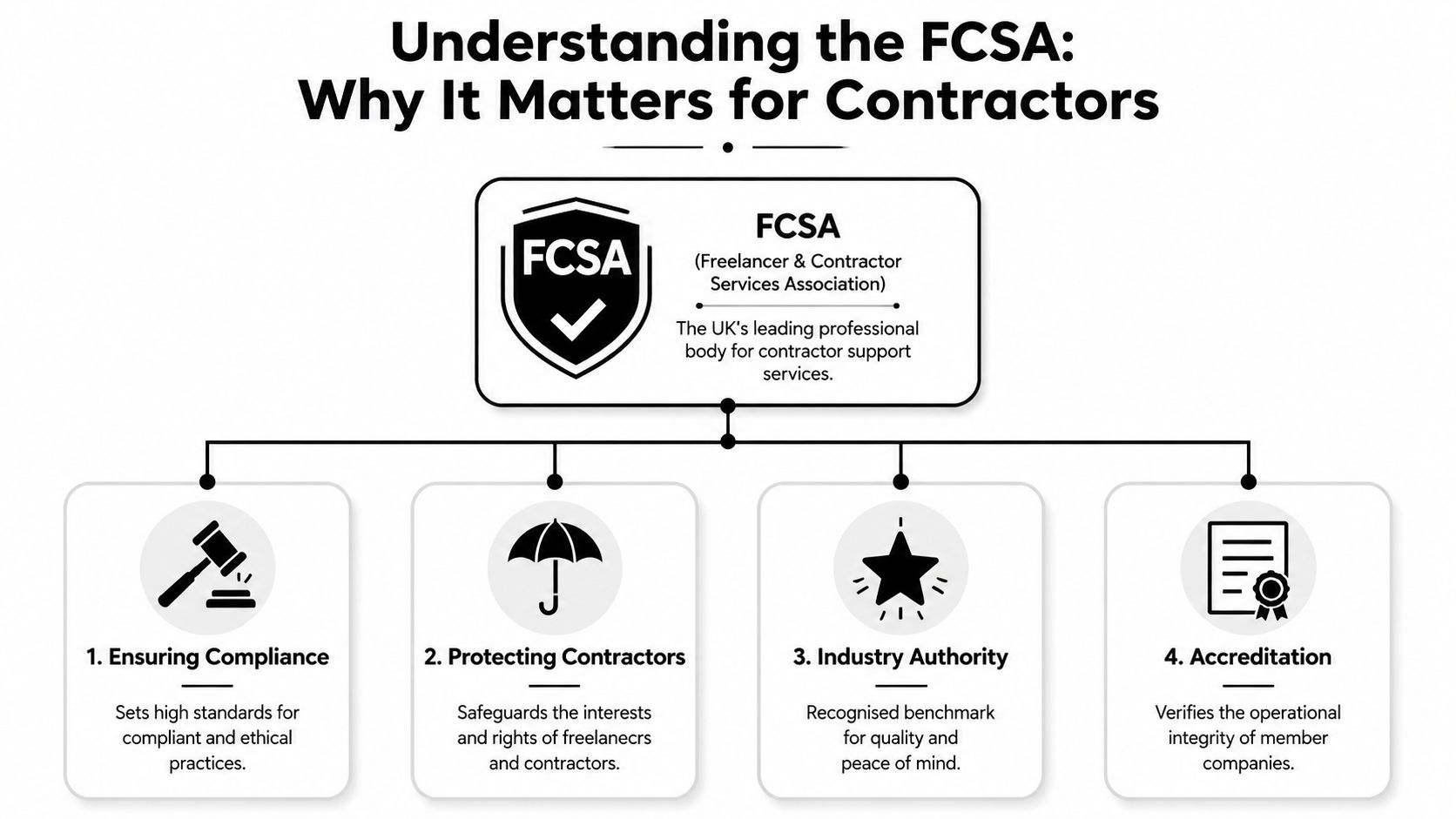
Why contractors pay attention to fcsa uk
Umbrella companies sit between your assignment and your pay. They run PAYE, handle National Insurance, issue employment documents, deal with holiday pay processes, and administer statutory rights tied to your employment. If those foundations are weak, the problems can show up in your income, your tax records, and the amount of chasing you need to do later.
That is why fcsa uk status matters. It gives you a starting point based on defined standards rather than marketing language. According to FCSA guidance for end clients in IT and technology, the organisation represents member firms across the UK temporary labour market, which helps explain why agencies and end clients often recognise the accreditation when reviewing supply chain risk.
If you want to begin with screened options, this list of FCSA umbrella company providers is a practical shortcut. The key point is to treat that shortlist as the start of your comparison, not the finish line.
What it protects in everyday terms
A good way to understand FCSA is to see it as a building regulations check for umbrella working. It does not tell you which house has the best kitchen. It tells you the structure should meet a recognised standard before you move in.
For contractors, that shows up in a few day-to-day areas:
- Payroll accuracy: PAYE should be processed correctly, and your deductions should be explainable in plain English.
- Employment rights: If the umbrella employs you, statutory entitlements need to be handled properly.
- Contract clarity: You should be able to see who employs you, how you are paid, and how holiday pay is treated.
- Business controls: The provider should have proper systems and oversight behind the service, not improvised admin.
A compliant umbrella should never leave you decoding your own payslip.
This is also where many contractors get tripped up. Two umbrellas can both be accredited, yet still feel very different to work with. One may answer questions clearly, set out its margin transparently, and explain holiday pay before you join. Another may meet the standard but communicate poorly. FCSA helps you remove much of the higher-risk end of the market. It does not remove the need to choose carefully between accredited providers.
Why it matters more in a tighter compliance situation
Compliance pressure across labour supply chains has increased, and agencies are paying closer attention to who they work with. The rules on joint and several liability, which came into force on 6 April 2026, made agencies more exposed where PAYE goes unpaid in parts of the chain. That has pushed accredited standards higher up the agenda for everyone involved.
For contractors, the takeaway is reassuring rather than alarming. You do not need to become a tax specialist to make a safer choice. You need a sensible first filter, then a clear comparison of margin, support, pay process, and contract terms.
That is why FCSA matters. It gives you a stronger starting point than a provider calling itself compliant.
The FCSA Accreditation Process Uncovered
You shortlist two umbrella companies. Both say they are compliant. Both sound reassuring on the phone. The difference is that one has been tested against an external standard, and the other is asking you to trust its own marketing.

The process looks past the sales message
FCSA accreditation carries weight because it examines how an umbrella company is built and how it operates in day-to-day practice. It is closer to a building inspection than a shop window check. A provider can have a polished website and still fail on payroll controls, contract wording, or record-keeping.
The review starts with entry conditions around trading history, accounts, financial stability, and the suitability of the people running the business. Those checks are there for a simple reason. Contractors are relying on the umbrella to employ them properly, process pay correctly, and keep statutory obligations in order. Weak foundations tend to show up later in the form of confusion, errors, or poor handling of worker rights.
If you want to compare accredited providers after understanding the standard, a list of FCSA umbrella companies is a useful starting point.
What the audit is examining
The audit goes into the machinery of the umbrella model, not just the headline claims.
It typically examines areas such as:
- PAYE and National Insurance processes, so deductions are handled correctly
- Holiday pay treatment, because this is one of the most common points of misunderstanding for contractors
- Employment contracts and statutory rights, so the worker relationship is set up properly
- Internal controls and record-keeping, which show whether the provider can apply its process consistently
- Operational governance, including whether the business has proper oversight rather than informal workarounds
A helpful comparison is a car MOT. The test does not tell you the car is perfect in every respect, but it does tell you whether the parts that matter for safe operation meet the required standard. FCSA works in a similar way. It checks whether an umbrella can run a compliant employment and payroll model, not whether its customer service style will suit every contractor equally.
Expert view: Strong compliance often feels quiet. You notice its value when a provider can explain your pay, holiday pay, and employment terms clearly under scrutiny.
What accreditation does, and does not, tell you
This is the point many contractors miss. FCSA status gives you a safer baseline. It does not choose the best umbrella for you.
An accredited provider has cleared an important threshold, which helps you avoid a large part of the higher-risk market. After that, your job changes from checking basic legitimacy to comparing fit. One umbrella may be clearer on payslips, faster to answer payroll queries, or better suited to your contract pattern and budget than another.
That is why accreditation should be your starting line, not your finish line.
Your Checklist for Choosing an FCSA Umbrella
Once you've confirmed that a provider is accredited, the actual comparison begins. Many contractors, however, make an avoidable mistake at this stage. They treat FCSA status as the finish line, when it's really the start of proper due diligence.

Start with the baseline, then compare the service
An accredited umbrella has already cleared the compliance threshold. Now ask how well it fits your actual working arrangement.
Focus on questions like these:
- Fee clarity: Ask the provider to explain its margin plainly, including what is and isn't included.
- Payslip transparency: Request a sample payslip or a walkthrough so you can understand each deduction.
- Holiday pay method: Check how holiday pay is handled and when it's paid.
- Support quality: Find out how easy it is to reach payroll or customer support when something needs fixing.
- Sector fit: If you work in IT, healthcare, construction, or another specialist area, ask whether the provider regularly supports contractors like you.
Cost needs careful handling. Verified analysis notes that FCSA status signals regulatory safety, but it does not guarantee the best value, and that independent analysis suggests FCSA members may charge slightly higher margins to cover audit costs, so contractors should compare fees against the services provided, as outlined in this review of why FCSA accreditation matters.
That doesn't make an accredited provider poor value. It means you should judge value properly. A slightly higher margin may be reasonable if the provider offers reliable payroll, clear documentation, and responsive support. A lower fee isn't automatically better if basic answers are vague.
Questions worth asking before you sign
Different questions reveal different things. Some test competence. Others test honesty.
Try asking:
How do you explain deductions to new contractors?
Clear providers answer directly and avoid sales language.What happens if I change assignment or agency?
You want a practical explanation, not a rehearsed script.Who do I contact about payroll issues?
If support routes are hard to pin down, that's worth noticing.Can you explain my employment contract in plain English?
A strong provider should be able to do this without hiding behind jargon.
Here's a helpful explainer if you want to hear common questions discussed in a more conversational format:
Don't choose an umbrella because the website sounds polished. Choose it because the answers stay clear when you ask awkward questions.
Warning signs of a non-compliant umbrella company
Even if you're broadly focused on accredited providers, it helps to know what poor practice looks like.
| Red Flag | Why It's a Problem |
|---|---|
| Promises of unusually high take-home pay | This can indicate a pay model that isn't based on standard PAYE treatment |
| Vague or shifting fee explanations | If the margin isn't clear at the start, it's harder to trust later deductions |
| Poor answers about holiday pay | Holiday pay should never feel mysterious or improvised |
| Pressure to sign quickly | Good providers don't need urgency to stop you asking questions |
| Heavy use of jargon instead of plain explanations | Complexity can be used to hide weak processes |
| An FCSA logo with no easy way to verify membership | Claims should always be checked independently |
Build your shortlist like a buyer, not a browser
A good method is to compare a small number of providers side by side. Write down the margin, support channels, holiday pay explanation, onboarding clarity, and how comfortable you felt with each conversation.
Some contractors also benefit from a simple priority order:
- First, compliance: If this isn't right, stop there.
- Second, clarity: You should understand the service before your first payslip arrives.
- Third, fit: The best provider for a first-time contractor may differ from the best one for a high-volume freelancer who wants fast issue resolution.
That approach keeps the process calm. You don't need to know everything about the market. You only need a reliable way to rule out risk and compare what's left.
How to Verify FCSA Membership in Minutes
A logo on a website isn't proof. Any company can place an image on a homepage. Verification matters because you're checking a formal membership and accreditation status, not a marketing claim.
The quickest way to do this is through the official FCSA member directory on the FCSA website. Search for the company name exactly as it appears on its legal documents and trading materials. If you can't find it, ask the provider to explain the discrepancy before you go any further.
A simple checking routine
Use this routine every time:
- Go to the official directory: Start with the FCSA's own member listing, not a search engine summary.
- Match the name carefully: Check the full business name, because similar trading names can cause confusion.
- Check current status: Don't assume historic membership means current accreditation.
- Save a record: Keep a screenshot or note for your files when you make your decision.
If you're still comparing providers more broadly, this guide to choosing a good umbrella company can help you test the service beyond the badge itself.
Quick check: If a provider becomes evasive when you ask for verification details, take that seriously.
This step only takes a few minutes, but it gives you a much firmer footing. In a market where language can sound reassuring without saying very much, independent checking is one of the simplest ways to stay in control.
FCSA Compared to Other UK Compliance Bodies
FCSA isn't the only name contractors will come across. Other compliance bodies, including Professional Passport, also operate in the umbrella market and promote standards around payroll, process, and legal compliance.
That doesn't mean the schemes are identical. They differ in how they audit, what they emphasise, and how they're recognised across agencies and end clients. Many contractors hear the same question repeatedly, which one matters most? The practical answer is that recognition often depends on the parties in your supply chain as well as your own risk tolerance.

Why FCSA is often treated as the benchmark
FCSA is widely viewed as the stricter shorthand for umbrella compliance because of how visible it is in agency and contractor conversations. In practice, many recruiters know what the badge means, and many contractors use it as their first screening tool.
That doesn't require dismissing other bodies. A sensible view is that different accreditation systems can all contribute to a healthier market. But if you want a straightforward baseline that is commonly recognised, FCSA is often the one contractors start with.
The future-proofing point matters
The compliance environment isn't standing still. Verified guidance notes that with a potential Labour government focusing on the 'tax gap' and HMRC's Making Tax Digital programme set to expand by April 2026, choosing a provider with well-established, audited digital processes, as required by FCSA, is vital for securing your compliance long-term, as set out in FCSA's guidance on the Labour government and freelancers.
That matters because umbrella compliance is no longer only about current payroll practice. It's also about whether a provider can keep pace with tighter reporting expectations and stronger scrutiny.
For contractors comparing several options at once, using an umbrella companies comparison tool can make these differences easier to assess. The key is to compare standards, transparency, and suitability together rather than treating compliance as a box-ticking exercise.
A balanced view
If an agency specifies FCSA, that instruction may narrow your options quickly. If it doesn't, you still need a disciplined way to compare providers.
A useful test is simple. Ask yourself which accreditation gives you the clearest confidence in the provider's controls, and which provider can explain its own processes most plainly. The strongest choice usually combines both.
Making Your Compliant Choice
The safest way to approach fcsa uk is to treat it as your mandatory compliance baseline. It helps you avoid a lot of unnecessary risk, and it gives you a more reliable shortlist from the start.
After that, your decision becomes more personal. You're looking for the provider that explains fees clearly, handles payroll without confusion, supports your working pattern, and answers questions without making you work for basic information. That's where fit and value come in.
There's a useful parallel in wider contract administration. If you want a broader perspective on avoiding errors and keeping working relationships well managed, mastering contract lifecycle best practices is worth a read. The same principle applies here. Strong systems reduce friction long before problems appear.
You don't need to overcomplicate this choice. Verify the accreditation. Compare the service. Ask direct questions. Then choose the provider that gives you both compliance confidence and day-to-day clarity.
If you're ready to compare verified options, Umbrella Company helps contractors and freelancers review umbrella providers by role, pay rate, and support needs, so you can choose with more confidence and less guesswork.


