


You're probably seeing fcsa accredited on umbrella company websites, agency onboarding forms, and contractor forums, and wondering one thing: does it matter to me?
It does, but only if you understand what it covers and what it doesn't.
For a contractor, this isn't just about badges or branding. It's about whether your umbrella company handles tax, pay, holiday pay, and employment processes properly, and whether you can spot problems before they affect your income. If you're working inside IR35, moving from permanent employment into contracting, or choosing between several umbrella providers, that distinction matters even more.
A good compliance check should help you protect your career and your finances. That's why it helps to look at FCSA accreditation as both a quality signal and a starting point for your own due diligence.
What FCSA Accreditation Really Means
FCSA stands for The Freelancer & Contractor Services Association. In simple terms, it's a trade body that sets compliance standards for umbrella companies and related contractor service providers in the UK.
When a provider says it is fcsa accredited, it should mean more than “we take compliance seriously”. It means the business has gone through an audit-backed process designed to test whether its systems and practices meet established standards.
Think of it as a compliance quality mark
A useful way to think about FCSA accreditation is as a kite mark for umbrella compliance. It isn't a guarantee that every experience will be perfect, but it does mean the provider has been checked against a structured standard rather than making claims only on its own website.
That distinction matters. A company can say it is transparent, compliant, or contractor-friendly. An audit-backed accreditation asks for proof.
According to this explanation of FCSA membership criteria, only 64 umbrella providers and 34 CIS providers currently hold accredited membership status. The same source explains that companies typically need at least 2 years of trading, 1 year of audited accounts, support for at least 75 contractors, and net assets exceeding 2.5% of gross profit before they qualify for assessment.
Why contractors should care
For you, the practical point is simple. Accreditation helps separate established, audited providers from businesses that rely mainly on self-description.
Practical rule: Treat FCSA accreditation as evidence that a provider has been independently tested, not as a slogan.
That gives you a better starting point when you're assessing risk. If an umbrella company is handling your pay, tax deductions, employment paperwork, and statutory entitlements, you want more than promises. You want signs of documented governance, financial stability, and repeatable processes.
It's also worth remembering what accreditation is not. It isn't a shortcut that means you can stop asking questions. It's a strong first filter, not your final decision.
The Benefits of Choosing an FCSA Accredited Provider
When contractors ask whether accreditation is worth caring about, the better question is this: what problem does it solve for me?
The answer is risk. Most contractors don't lose sleep over logos. They worry about incorrect PAYE deductions, missing holiday pay, unclear payslips, and being caught up in arrangements they didn't fully understand.
Where the benefit shows up in real life
The strongest value of an fcsa accredited provider is that the audit is built to catch issues before they become your problem. As noted in this overview of FCSA-accredited umbrella companies, the audit is designed to identify failures in PAYE operation, holiday-pay handling, and contractor engagement processes before those failures become liabilities for agencies or end clients.
That matters to you because those same failures can also affect your take-home pay, your tax position, and your access to employment rights.
The main contractor benefits
More confidence in PAYE handling. Your umbrella should process tax and National Insurance through PAYE in the expected way, rather than using unusual structures that create future HMRC risk.
Clearer payslip expectations. Accredited providers are more likely to work within systems that support transparent calculations and easier-to-follow deductions.
Better protection around holiday pay and statutory processes. If holiday pay is mishandled, or if employment processes are weak, you can end up confused about what you've earned and what you're entitled to receive.
Lower supply-chain risk. Agencies and end clients are more comfortable working with providers that can show independent compliance checks.
A stronger first screen when comparing providers. If you're reviewing options, starting with FCSA umbrella companies can help narrow the field to providers that have already passed an external assessment.
Choosing an accredited provider doesn't eliminate every risk. It reduces the chance that basic compliance failures are hiding in the background.
What peace of mind actually means
In practice, peace of mind means fewer nasty surprises. You should still read your contract, check your payslip, and ask questions about deductions. But you're doing that from a stronger position, because the company has already been through independent scrutiny.
For most contractors, that's where the value lies. Not hype. Not a badge. Just a more reliable starting point.
How FCSA Accreditation Affects IR35 and Your Pay
If you work on contracts that fall inside IR35, your umbrella company becomes a central part of how your pay is processed. That's where fcsa accredited status becomes more than a general compliance signal.
Inside IR35 arrangements already involve complex tax treatment. Your umbrella has to run payroll correctly, apply PAYE, deduct National Insurance where appropriate, and present your pay in a way that makes sense. If the provider's processes are weak, confusion follows quickly.
Why IR35 makes umbrella choice more important
An umbrella company doesn't decide whether a role is inside or outside IR35, but it does affect what happens after that status is applied.
If your assignment is inside IR35, you need confidence that the payroll side is being handled properly. That includes understanding the difference between contract rate and taxable pay, checking how deductions appear, and knowing that your employer obligations are being administered through a compliant structure.
If you need a refresher on the wider rules, our guide to umbrella companies and IR35 explains how the relationship works in practice.
Why agencies are paying closer attention
This issue became even more important because, according to FCSA's guidance on 2026 compliance changes, from 6 April 2026 recruitment agencies become directly liable for unpaid PAYE from non-compliant umbrella partners.
That changes behaviour across the supply chain.
Agencies now have a stronger reason to check who they work with. If an umbrella company creates PAYE exposure, the agency may carry part of that risk. As a result, accreditation becomes a practical due-diligence marker, not just a preference.
What this means for your pay conversations
For contractors, this tends to show up in a few ways:
- Agency-approved provider lists may become tighter. Agencies are more likely to prefer umbrella companies with clearly evidenced compliance controls.
- Questions about deductions may become more detailed. That's a good thing if it leads to clearer pay illustrations.
- Inside IR35 onboarding may feel more structured. Again, that usually reflects stronger process rather than unnecessary admin.
If your role is inside IR35, don't just ask “what's the margin?” Ask “how is my pay calculated, and can you show me a clear illustration?”
A practical example
Suppose two umbrella companies quote a similar service. One can explain its payroll process clearly, show how deductions work, and demonstrate accreditation-backed controls. The other talks mainly about take-home pay and gives vague answers about payslips.
For a contractor, the first option is usually safer, even if the second sounds simpler.
If your internal payroll or HR team uses Microsoft systems, it may also help to browse HR compliance tools for Dynamics 365 so you can see how some organisations manage process controls around IR35-related administration. It won't replace umbrella due diligence, but it can help you understand the operational side better.
How to Verify an Umbrella Company is FCSA Accredited
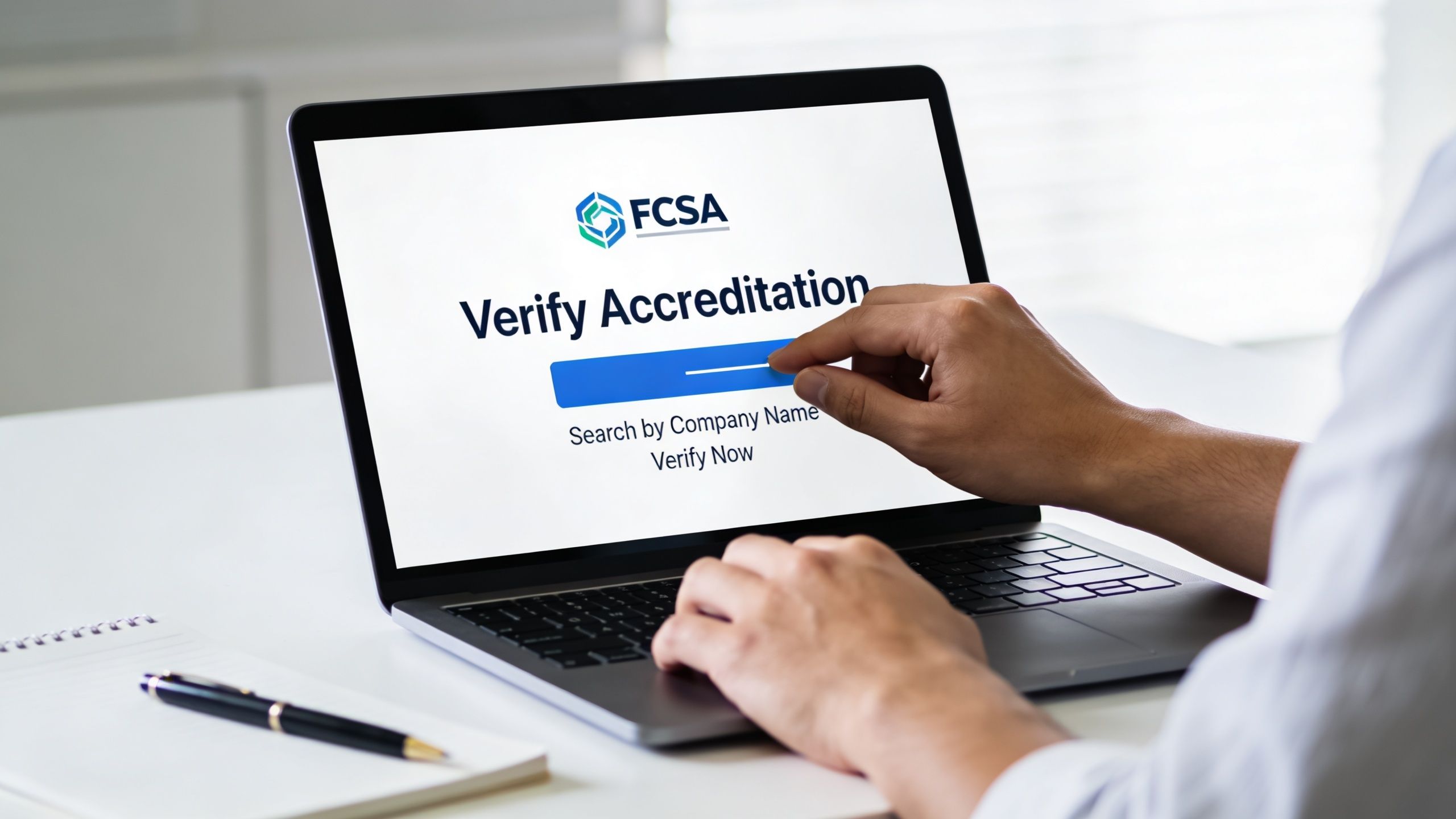
A provider might display the FCSA logo on its website, proposal, or email footer. That's not enough on its own. You should verify the claim independently.
A simple check you can do yourself
Use this approach:
- Go to the official FCSA website. Don't rely only on the umbrella company's own materials.
- Open the member directory. You're looking for the current membership listing, not an old blog post or screenshot.
- Search the provider name carefully. Check spelling, trading name, and any group brand names.
- Confirm the business is listed as an accredited member. If you can't find it, ask the provider to explain.
- Match the details. The company on the FCSA site should match the organisation that will employ and pay you.
If you want a starting point for that wider check, our page on what an FCSA umbrella company is gives useful context before you verify the listing yourself.
What to look for if something feels off
Sometimes the issue isn't outright deception. It's ambiguity.
A group business may talk about accreditation, but only one legal entity in the group may hold it. Or a recruiter may refer to a provider as “FCSA compliant” without saying whether it is accredited. Those aren't the same thing.
Here's a short walkthrough that can help you visualise what to check during your search:
Go back to the legal entity on your contract. That's the name that matters.
Questions worth asking
Ask the umbrella company:
- Which legal entity holds the accreditation?
- Is the accreditation current?
- Will that same entity employ me and process my payroll?
A legitimate provider should answer those questions directly. If the response is evasive, treat that as a warning sign.
Your Due Diligence Checklist and Red Flags
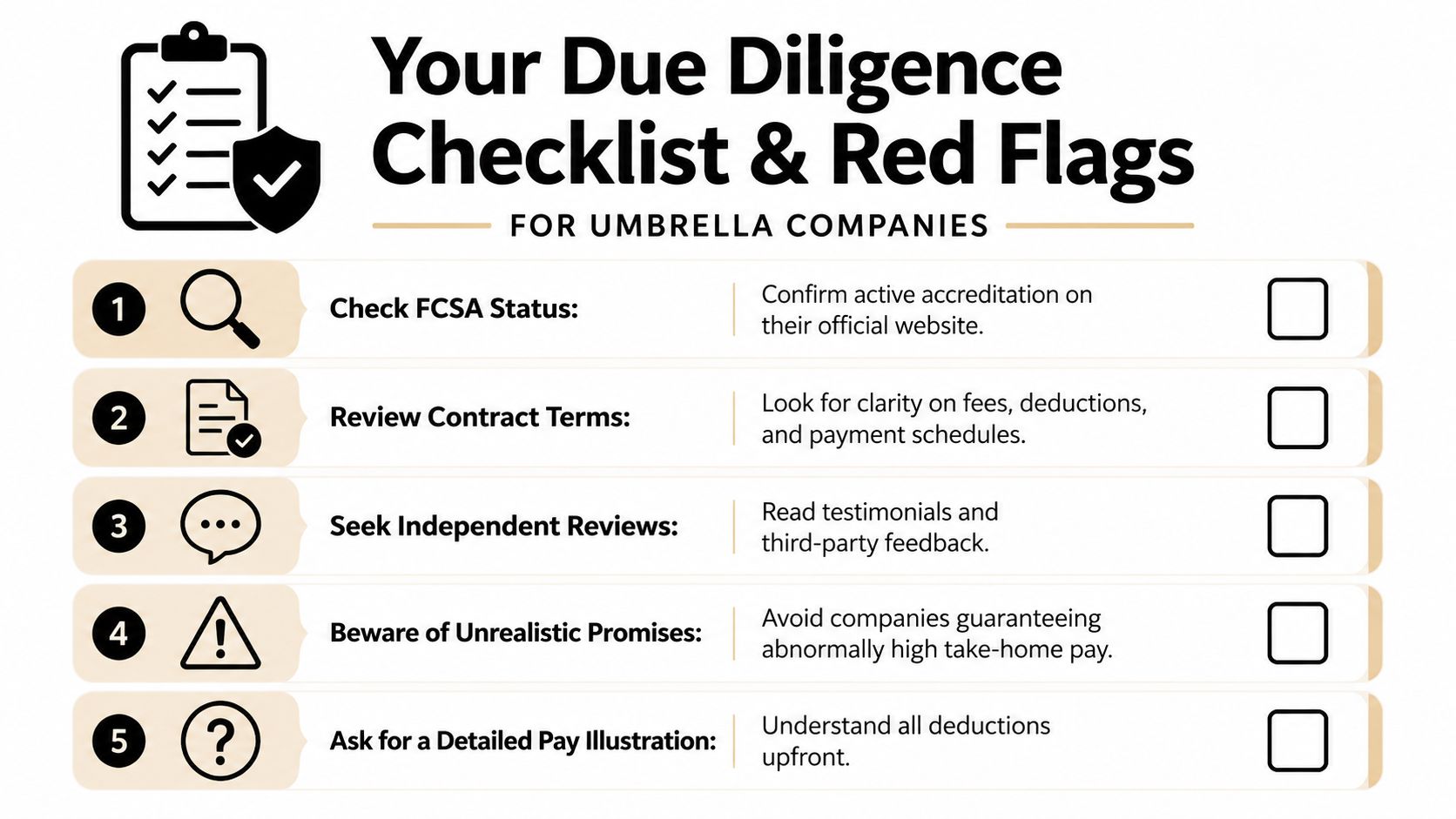
FCSA accreditation is a strong first check, but it shouldn't be your only one. A careful contractor looks at the whole picture, including contract terms, payslips, service clarity, and whether the provider's explanations make sense.
As noted in this explanation of the FCSA audit-backed framework, the point of accreditation is to reduce risk by filtering for providers with documented governance and audited financials, rather than relying on self-asserted policies. Your job is to confirm that this audited standard is benefiting you in practice.
The checklist
Verify the accreditation claim. Use the official directory, and make sure the accredited entity matches the company that will employ you.
Read the contract before you sign. You're looking for plain-English explanations of fees, deductions, holiday pay treatment, and payment timing.
Ask for a pay illustration. A proper illustration should help you understand the route from assignment rate to taxable pay and then to net pay.
Check independent feedback. Reviews won't tell you everything, but they can reveal patterns around communication, payroll reliability, and issue handling.
Compare more than margin. A slightly cheaper provider isn't better if its processes are unclear. If you're evaluating options, a directory such as good umbrella company comparisons can help you review providers side by side.
Red flags that deserve caution
Some warning signs appear before you ever sign up.
- Unusually high take-home pay claims. If the figures sound far better than other providers and the explanation is vague, pause.
- References to loans, advances, or unusual payment structures. If the model is hard to understand, that's a problem in itself.
- No clear payslip example. A provider should be able to explain deductions in a straightforward way.
- Pressure to sign quickly. Good compliance doesn't need secrecy or haste.
- Blurry answers about holiday pay or employment rights. If the support team can't explain basics, that tells you something.
A compliant umbrella company should be able to explain your pay without hiding behind jargon.
One extra check many contractors miss
Your own record-keeping matters too. Even when the umbrella handles payroll, you should keep contracts, assignment schedules, payslips, and payment records organised. If you want help improving that side of things, this guide on QuickBooks for contractors is a useful practical resource.
That isn't a substitute for umbrella compliance. It makes it easier for you to spot inconsistencies early.
FCSA Compared to Professional Passport
Many contractors assume they must choose between FCSA and Professional Passport as if one automatically makes the other irrelevant. That's usually the wrong way to look at it.
In practice, both are recognised names in the contractor compliance space, and both are used by agencies and contractors as indicators that a provider has been assessed against formal standards. If you see either accreditation, that's generally a positive sign.
What they have in common
Both accreditations are used to signal that an umbrella company has gone beyond self-certification. For contractors, the practical effect is similar. You're looking for evidence that the provider has structured controls around payroll, employment processes, and compliance governance.
That's why many agencies treat either accreditation as a sign that the provider takes oversight seriously.
Where your decision should really focus
If two providers are both accredited, your decision often comes down to more practical questions:
| Factor | What to check |
|---|---|
| Payslip clarity | Can they explain deductions in plain language? |
| Contract terms | Are holiday pay, fees, and payment timing clear? |
| Support quality | Do they answer compliance questions directly? |
| Fit for your situation | Do they understand your sector and assignment type? |
A point many first-time contractors miss
Accreditation doesn't tell you everything about contractor experience. According to this discussion of underserved contractor support gaps, standards like FCSA focus on core financial and legal compliance, but they don't yet include specific requirements around support for underserved contractor groups, such as first-time contractors or people entering from emerging gig-economy sectors.
That matters because a provider can be compliant and still not be the right fit for your circumstances.
If you're new to contracting, changing sectors, or dealing with an unusual work pattern, ask extra questions about onboarding, support style, and how they explain pay. Accreditation reduces risk. It doesn't replace judgement.
Frequently Asked Questions About FCSA Accreditation
Contractors usually have a few practical questions once they move past the headline claim. Here are the ones that matter most.
Can an umbrella company be compliant without being FCSA accredited
Yes, it can.
Accreditation is a strong signal, not the only possible sign of compliance. A non-accredited provider may still operate properly. The difference is that you have less independent evidence to work with, so your own due diligence becomes even more important.
Does fcsa accredited status guarantee a certain take-home pay
No.
Accreditation is about compliance processes, not promising a particular net pay figure. Your take-home pay depends on your contract rate, tax treatment, payroll deductions, and your individual circumstances. If a provider talks more about unusually high take-home pay than about process clarity, be cautious.
Does accreditation mean every payslip will automatically make sense
Not always.
Even with a compliant provider, umbrella payroll can still be confusing if you're new to the model or moving into an inside IR35 assignment. You should still ask for a sample payslip or pay illustration and ask the provider to explain each line clearly.
What happens if an accredited member becomes non-compliant
The important point is that accreditation is not meant to be a one-off label that lasts forever without scrutiny.
FCSA membership is built around ongoing assessment rather than a single historic check. For a contractor, that means you should still verify current status and not assume an old logo or old article is enough evidence.
Is FCSA better than Professional Passport
Not in a simple winner-loser sense.
Both are treated as strong compliance indicators. If you are choosing between two accredited providers, compare the practical details that affect your day-to-day experience, such as contract wording, customer support, pay clarity, and how comfortably they answer compliance questions.
Should I rely on my recruiter's recommendation alone
No.
A recruiter's input can be helpful, but it shouldn't replace your own checks. Agencies have their own risk considerations, and your priorities may be different. Always verify accreditation yourself and review the provider's terms directly.
What should I ask before signing up
A short list works well:
- Who will employ me legally
- How is holiday pay handled
- Can I see a pay illustration
- What deductions will appear on my payslip
- Is the accredited entity the same one that will pay me
FCSA at a Glance
| Attribute | Description |
|---|---|
| What it is | An audit-backed accreditation framework for umbrella companies and related contractor service providers |
| What it signals | Independent scrutiny of compliance controls rather than self-asserted claims |
| Why contractors care | It helps reduce risk around payroll handling, tax operation, and employment processes |
| What it doesn't do | It doesn't guarantee a specific take-home pay or remove the need for due diligence |
| Best use | As a first filter when comparing umbrella companies |
The safest approach is simple. Use accreditation as your first screen, then test the details yourself.
If you're comparing providers and want a practical starting point, Umbrella Company helps contractors review umbrella options based on their working arrangements, including inside IR35 needs, so you can make a more informed choice.


