


You've probably seen this happen. A recruiter sends over a contract, says you'll need to use an umbrella, and gives you a shortlist of names you've never heard of. At that point, most contractors ask the same questions.
Is this company compliant, will my pay be handled properly, and could I get dragged into a tax problem later?
That's where the phrase fcsa accredited umbrella company matters. In the UK umbrella market, accreditation is one of the clearest signals that a provider has chosen to meet a recognised compliance standard. It doesn't remove the need for due diligence, but it does give you a stronger starting point.
This matters even more if you're working inside IR35, switching from a limited company, or trying to understand why umbrella pay looks lower than a day rate on paper. A good provider should explain the process clearly, show you what's being deducted, and treat you like an employee with proper statutory rights.
Choosing Your First Umbrella Company
If this is your first contract through an umbrella, the choice can feel oddly high stakes. That's because it is. The umbrella company sits between your assignment and your pay, so the provider you choose affects your tax position, employment rights, payslip clarity, and confidence that the arrangement is legitimate.
A lot of contractors start by comparing margins alone. That's understandable, but it's too narrow. The better first question is whether the company operates to a recognised compliance standard. Once you know that, you can compare service quality, support, and how clearly they explain deductions.
A practical way to begin is to build a short checklist:
- Check recognised accreditation: Start with providers that hold a respected compliance credential.
- Review how they explain pay: If the payslip process sounds vague, that's a warning sign.
- Look at contractor support: You want fast answers when timesheets, holiday pay, or agency queries come up.
- Compare options carefully: A side-by-side review helps when the providers sound similar, which is why many contractors start with a best umbrella company in the UK comparison.
Your umbrella isn't just a payroll processor. It becomes your employer, and that changes what you should expect from it.
Most confusion comes from one assumption. Contractors often think an umbrella only forwards money after taking a small fee. In reality, a compliant provider has to process pay through PAYE, account for employment costs correctly, and provide statutory employment protections. That's why choosing carefully at the start saves hassle later.
What FCSA Accreditation Really Means for Contractors
FCSA accreditation is best understood as a recognised compliance mark for firms operating in the UK contractor services market. The FCSA is recognised as the most prominent and respected industry body for umbrella companies in the UK, and its accreditation has become an industry benchmark, with the brand particularly well regarded among recruitment professionals and government bodies, according to this overview of FCSA-accredited umbrella companies.

That sounds abstract, so let's make it practical. If you're choosing a fcsa accredited umbrella company, you're choosing a provider that has gone through an external process to show that its systems and conduct meet established standards. For a contractor, that matters because the umbrella handles the parts of contracting that can cause the biggest problems if done badly, including payroll, tax deductions, and employment administration.
What it means in day-to-day terms
For most contractors, FCSA accreditation gives confidence in a few specific areas:
- Transparency: The company should be able to explain how your pay is calculated in plain English.
- Compliance focus: The provider is expected to operate in line with UK tax and employment requirements.
- Professional credibility: Recruiters often view accredited firms as lower risk.
- Contractor protection: You're less likely to end up with a provider using questionable arrangements.
That doesn't mean every accredited provider will feel identical to work with. Service levels can still vary. Response times can vary. Online portals can vary. But the accreditation helps narrow the field to providers that have met a recognised standard.
Why contractors care about it
The key point is simple. You're outsourcing a sensitive part of your working life to another company. If that company gets things wrong, it's not just an admin issue. It can affect your pay, your records, and your peace of mind.
For many contractors, especially those new to umbrella working, accreditation acts like a quality filter before they look at anything else. It's one reason many people compare accreditation alongside the wider benefits of using an umbrella company, rather than treating it as a separate issue.
Practical rule: If a provider talks more about “maximising take-home” than about compliance, payslips, and employment rights, slow down and ask harder questions.
The FCSA Accreditation Process Unpacked
One of the biggest misunderstandings in this market is thinking accreditation is a badge a company earns once and keeps forever. It isn't. The process is ongoing, and that's part of what gives it weight.
According to this explanation of umbrella company accreditations, FCSA accreditation involves rigorous annual compliance audits by independent experts. Those audits assess financial stability, operating procedures, tax regulation compliance, and adherence to the FCSA code. Members must pass these reassessments annually to keep their status.
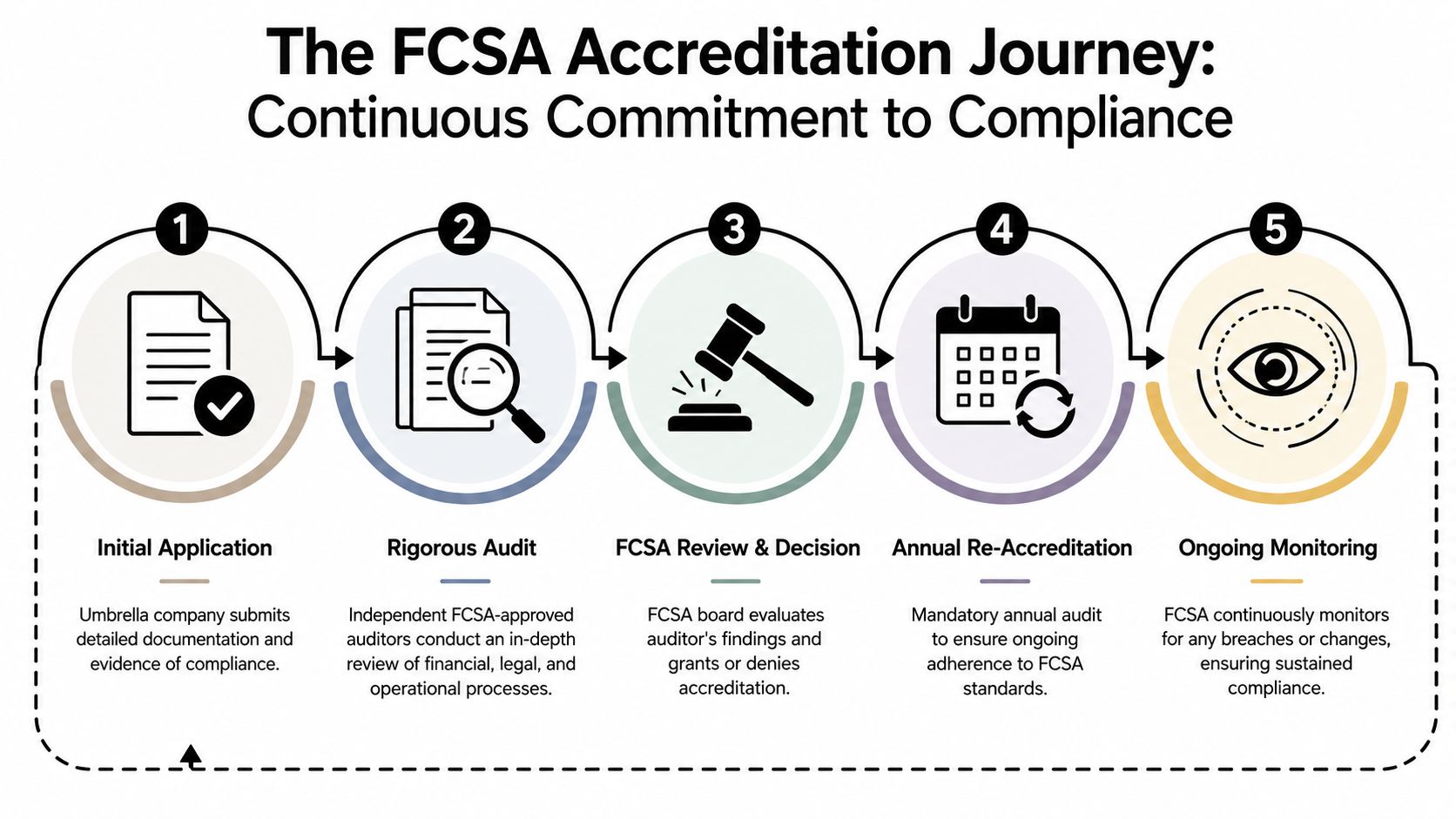
What the audit is really checking
Those audit areas matter because they map directly to contractor risk.
Financial stability matters because you need to know the business is operating on a sound footing. An umbrella company handles payroll and tax administration. Contractors don't want to discover too late that the provider's finances were weak or poorly controlled.
Operating procedures matter because payroll should not depend on improvisation. The company should have repeatable, documented processes for onboarding, invoicing, payroll, deductions, and employee records.
Tax compliance matters because the most serious damage can happen in this area. PAYE, National Insurance, and related deductions need to be handled correctly. If a provider uses questionable arrangements, the problem can become much bigger than a simple payroll dispute.
Adherence to the code of conduct matters because compliance isn't only about calculations. It's also about how the company behaves, what it tells contractors, and whether its practices are fair and transparent.
Why annual reassessment matters
Annual reassessment is a strong feature of the model because it creates a continuing compliance cycle. It tells contractors that status should be maintained, not just claimed.
That's especially useful in a market where providers can change ownership, alter processes, or shift their commercial approach over time. A provider that was strong before still has to meet the standard again.
Consider the following perspective:
| Audit area | What you want to see as a contractor | Why it matters |
|---|---|---|
| Financial stability | A business that appears properly run | Payroll reliability matters |
| Operating procedures | Clear, consistent admin processes | Fewer surprises and disputes |
| Tax compliance | Correct PAYE handling | Lower risk of non-compliant arrangements |
| Code of conduct | Transparent behaviour | Better contractor treatment |
If you're comparing providers, accreditation should sit alongside practical checks such as responsiveness, clarity, and support. A structured umbrella companies comparison is useful because it helps separate headline claims from the details that affect your weekly experience.
Ongoing accreditation matters more than a logo on a homepage. What protects you is the process behind the badge.
Why You Should Prioritise an FCSA Accredited Provider
If you're inside IR35, the umbrella company isn't a side issue. It's central to how your engagement works. That's why choosing an accredited provider should be a priority, not a nice extra.

According to this guide on why FCSA accreditations matter, for contractors within IR35, FCSA accreditation provides evidence that the umbrella company maintains compliant contractual structures, statutory employment rights, and transparent fee disclosures, helping protect workers from non-compliant arrangements and potential HMRC penalties.
Protection from avoidable risk
That sentence contains the reason experienced contractors pay attention. The risk isn't theoretical. If an umbrella uses poor practices, hides how deductions work, or puts you into an arrangement you don't fully understand, you may be the one left dealing with the consequences.
A compliant provider should support the fundamentals properly:
- Your contract position should be clear
- Your statutory employment rights should be recognised
- Your deductions should be explained transparently
- Your pay should be processed through a compliant structure
That's what makes accreditation more than a marketing feature. It gives you evidence that the company is operating within a recognised framework relevant to contractor payroll and employment.
Why this matters even more inside IR35
Inside IR35 work usually means you're focused on assignment delivery, not trying to manage payroll mechanics yourself. But that convenience only works if the umbrella handles the employment side correctly.
Many contractors moving from a limited company model struggle with this change. They expect to think like a supplier, but the umbrella arrangement means they also need to think like an employee. That includes holiday pay, pension administration, payslips, and statutory rights.
If you need a clearer picture of that relationship, this guide to IR35 and umbrella companies is a helpful starting point.
A short explainer can help make that shift easier:
The practical upside
The main benefit is confidence. You can spend less time second-guessing your payroll setup and more time focusing on the contract itself.
A good umbrella should make your employment position clearer, not harder to understand.
That doesn't mean you should stop asking questions. It means you start from a safer place.
How to Verify an Umbrella Company is FCSA Accredited
This is the part many contractors skip, and it's the easiest step in the whole process. Never rely only on a provider's website, brochure, or verbal claim. If a company says it's accredited, verify that independently.
The reason is straightforward. Logos are easy to display. Genuine current status needs to be checked at the source.
A simple verification routine
Use this checklist before you sign any contract or complete onboarding paperwork.
| Step | Action | Why It Matters |
|---|---|---|
| 1 | Go to the official FCSA website | You need to verify against the organisation itself |
| 2 | Find the member directory or accredited members list | This is where current listed members appear |
| 3 | Search for the umbrella company by its trading name | Names can be similar, so search carefully |
| 4 | Confirm the company appears as an accredited member | If it is not listed, treat the claim with caution |
| 5 | Match the company details with the provider you are speaking to | This helps avoid confusion between similar brands |
| 6 | Ask the provider to explain its payslip and employment model anyway | Accreditation is the first filter, not the last check |
What to do if the company isn't listed
If the company doesn't appear in the FCSA directory, stop there and ask why. There may be a simple explanation, such as a trading style issue, but you should not assume that. The provider should be able to give a clear, direct answer.
If the answer is vague, defensive, or focused on sidestepping the question, walk away.
A few checks contractors often forget
Contractors sometimes verify accreditation and then stop asking questions. That's too passive. You still want to check:
- How they explain deductions: Clear language matters.
- Who you contact with payroll issues: A generic inbox isn't always enough.
- What your employment contract says: Read it fully before signing.
- Whether they rush you: Pressure is often a bad sign.
Check the accreditation yourself, then test the company's transparency in conversation. Both matter.
This two-step approach, directory check first, practical questions second, gives you a much stronger basis for deciding whether the provider is worth trusting.
Choosing the Right FCSA Umbrella and Spotting Red Flags
After you have confirmed that a provider is accredited, the next task involves choosing the specific one that fits your needs. Contractors often discover that while accreditation helps narrow the shortlist, it does not make the final decision for them.
The biggest practical issue is pay clarity. Contractors deserve to understand why their net pay looks the way it does, especially inside IR35.

According to this article on FCSA accreditation and umbrella pay, compliant FCSA umbrellas deduct employer NI at 13.8%, apprenticeship levy at 0.5%, holiday pay at 12.07%, and pension contributions, plus a margin. It says this typically results in take-home pay of 55-70% of contract value for inside IR35 roles, rather than the 75-85% sometimes advertised by non-compliant schemes.
What to compare between accredited providers
That data helps frame the right comparison. If two accredited umbrellas are both operating compliantly, the choice usually comes down to service and clarity, not fantasy take-home promises.
Look at points such as:
- Margin structure: Is it flat and easy to understand?
- Payslip quality: Can you follow the deductions without needing a translator?
- Support model: Do you get real help when something goes wrong?
- Onboarding experience: Are documents clear and sensible?
- Employment extras: Holiday pay handling, pension administration, and insurance information should be easy to find.
Red flags that should stop you
A provider can still sound polished and be a poor choice. Watch for warning signs like these:
- Claims of unusually high take-home pay: If the figures sound far better than compliant umbrella pay usually looks, ask exactly how that result is achieved.
- Vague language about deductions: If they can't explain the numbers, that's a problem.
- Complex payment arrangements: If pay is described in ways that feel convoluted or hard to pin down, step back.
- Pressure selling: Reputable firms don't need to force a quick decision.
- Poor contact visibility: If you struggle to find a UK office presence or clear support channels, be cautious.
A useful decision test
Ask the provider to explain your payslip as if you were brand new to umbrella working. The right company will do it calmly, clearly, and without sounding irritated.
If an umbrella can't explain your pay before you join, it won't explain it better after you've signed up.
That one conversation often tells you more than a polished homepage ever will.
Switching to an Accredited Umbrella With Our Help
If you're already with an umbrella and something doesn't feel right, you don't have to ignore it. Contractors switch providers for all sorts of sensible reasons, including poor communication, unclear payslips, or concerns about compliance. The important thing is to move carefully and verify the new provider before making the change.
A smooth switch usually means checking your current notice arrangements, confirming how final pay and holiday pay will be handled, and making sure your new umbrella's onboarding documents are ready before your next payment cycle. It's also worth telling your agency early, so there's time to update the payroll route without avoidable delays.
The strongest reason to switch is simple. You want an arrangement you understand and can trust. A properly accredited provider gives you a firmer base for that.
If you want help comparing options, we make that easier at Umbrella Company. Our service helps contractors review trusted umbrella providers based on their role, pay rate, and working setup. Instead of trying to decode the market on your own, you can compare suitable options and make a more confident decision.
If you're ready to compare compliant options, Umbrella Company can help you review trusted umbrella providers and choose a setup that fits your contract, your pay expectations, and your need for peace of mind.


