


You're comparing umbrella companies, scanning features, and then you see a badge that says FCSA Accredited. If you're new to contracting, that label can feel important without being very clear. Is it just marketing, or does it protect you?
It matters because the umbrella company you choose handles your pay, tax deductions, employment paperwork, and statutory rights. If they get those basics wrong, the problem doesn't stay with them. It can affect your income, your HMRC position, and your confidence in taking on future contracts.
We work with contractors every day who want a simple answer to a complicated question. This guide explains fcsa accreditation in plain English, what it means in practice, why it matters for financial safety, and how to use it as a smart filter when choosing an umbrella.
What Is FCSA Accreditation and Why Should You Care?
When contractors first encounter fcsa accreditation, they usually assume it's some kind of trade body membership. That's only part of the picture. What matters more is that it acts as a recognised compliance benchmark in the umbrella market.
For a new contractor, that benchmark is useful because the market can be hard to read. Many providers sound similar on the surface. Most promise smooth onboarding, fast payments, and support with payroll. The difference often sits behind the scenes, in how they handle tax, contracts, rights, and compliance checks.
FCSA accreditation gives you a stronger starting point. It helps you separate providers that have been independently assessed from those that state the right things.
A good way to think about it is this. If you don't have the time or technical knowledge to audit an umbrella company yourself, accreditation gives you a practical first screen. It doesn't remove the need for common sense, but it gives you a safer shortlist.
Practical rule: If you're unsure where to begin, start with an FCSA accredited umbrella company list rather than a general search result.
That matters even more in a market where compliance has become a live commercial issue, not just a background admin topic. Contractors want to know their pay is being processed properly. Agencies want confidence in the supply chain. End clients want fewer surprises.
For you, the personal reason to care is simple. Your umbrella company sits between your contract work and your take-home pay. If that business is sloppy, opaque, or non-compliant, you carry the stress. If it's properly assessed, you start from a stronger and safer position.
What FCSA Accreditation Really Means for Umbrella Companies
FCSA accreditation is recognised as the industry's compliance gold standard. Accredited members undergo rigorous independent audits by leading accountancy and legal professionals to confirm adherence to FCSA's Codes of Compliance, which must be passed annually to retain their status, as explained by Xpertise Recruitment's guide to FCSA accredited umbrella companies.
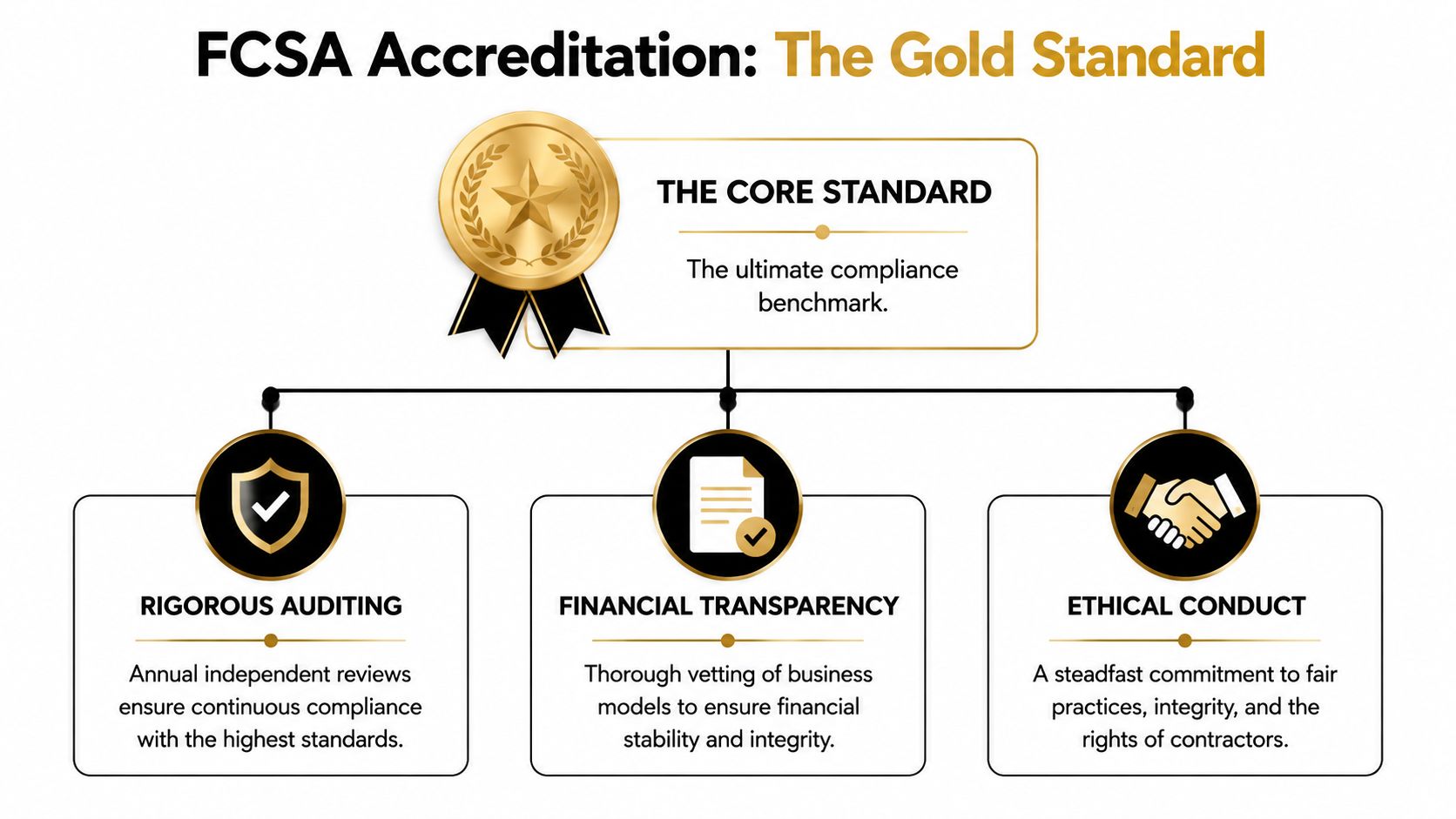
That sentence carries a lot of weight, so it helps to unpack it. The key point is that this isn't just a company paying to join a directory. An accredited provider has to be tested and verified against formal standards, and that testing is repeated.
It's about independent checking
A contractor will often ask, “Can't an umbrella just say it's compliant?” They can say it, yes. That's why independent assessment matters.
With fcsa accreditation, the value comes from outside scrutiny. The provider has to show that its processes and paperwork line up with the required standards. That includes the way it operates as an employer, not just the way it presents itself on a sales page.
It covers the parts that affect you directly
In practical terms, the assessment looks at the areas contractors usually worry about most:
- PAYE and National Insurance handling, so tax deductions are managed properly
- Holiday pay and statutory entitlements, so your employment rights aren't treated casually
- Worker contracts and documentation, so terms are clearer and easier to understand
- Business processes and financial discipline, so the company is operating in a more stable way
Those aren't abstract compliance topics. They shape what appears on your payslip, what happens when you ask a question, and whether you can trust the umbrella to act like a proper employer.
It's a quality marker, not a shortcut to blind trust
Accreditation matters, but it doesn't mean you should switch off your own judgement. You should still read your contract, check your payslips, and ask how holiday pay is handled.
A credible umbrella should be able to explain its process clearly, in plain English, without hiding behind jargon.
The most useful way to view fcsa accreditation is as a high-value filter. It narrows the field to providers that have passed a recognised independent standard. From there, you can compare service, support, margin transparency, and fit for your type of contract.
How FCSA Accreditation Protects Your Pay and Your Career
The reason contractors care about compliance isn't academic. It's personal. You want to be paid correctly, you want your employment rights respected, and you don't want a nasty surprise later because an umbrella cut corners.

The protections that matter most
Here's where fcsa accreditation becomes practical rather than theoretical.
Safer payroll handling. An accredited umbrella is being assessed against recognised compliance standards around PAYE, National Insurance, and related employment obligations. For you, that means a lower chance of confusing or questionable pay arrangements.
Better protection against risky schemes. New contractors sometimes get tempted by umbrella providers that talk more about unusually high take-home pay than proper payroll. A compliance-focused provider is far less likely to build its offer around gimmicks that could cause problems later.
Clearer access to statutory rights. If you're employed by an umbrella, rights such as holiday pay and sick pay aren't optional extras. They should be handled properly. Accreditation gives you more confidence that these rights are being treated as core responsibilities.
A stronger employer relationship. Good umbrella companies don't just process invoices. They issue contracts, run payroll, answer questions, and support you as an employee. That matters when you need documents quickly or want clarity about deductions.
Financial stability is part of contractor safety
One of the most overlooked risks in this sector is basic business resilience. An umbrella can sound polished and still be unstable behind the scenes.
According to JMK Group's explanation of FCSA compliance, FCSA Accreditation mandates stringent financial stability benchmarks, requiring a minimum of 2 years of operation, 1 year's audited accounts, and net assets exceeding 2.5% of gross profit. This directly mitigates insolvency risks that could otherwise jeopardise contractor payments.
That matters because financial safety isn't just about tax. It's also about whether the employer paying you is built on solid ground.
What to ask yourself: If this umbrella had a rough month operationally, would I still feel comfortable trusting it with my wages and statutory payments?
Career protection is wider than one payslip
Your umbrella choice can also affect how confidently agencies and clients engage with you. A contractor linked to a provider with a questionable model may face more friction, more checks, or pressure to move elsewhere.
If you want to review contractor paperwork before you sign, tools like TheLawGPT legal document assistant can help you understand the wording in an independent contractor agreement before you commit.
When you're comparing providers, it helps to narrow the list to firms that already meet a recognised standard. A dedicated umbrella company comparison page makes that process easier, especially when you want to compare compliance signals alongside service and contractor support.
Why FCSA Is Your Best Ally in Navigating IR35
IR35 can feel confusing because it sits at the point where tax status, contract structure, and payroll all meet. If you're working on an assignment that sits inside IR35, your umbrella company becomes central to how your income is processed.

For many contractors, the practical question isn't “What is the legal theory behind IR35?” It's “Who is handling my pay correctly when the role is inside IR35?” That's where accredited umbrellas become useful. They offer a compliant route for workers who need employment and PAYE processing rather than a limited company structure for that assignment.
Why this matters more after the 2026 rule changes
The compliance stakes rose sharply with the regulatory changes that took effect on 6 April 2026. As set out in FCSA's article on why accreditation matters more than ever in 2026, joint and several liability came into force on that date, making recruitment agencies directly liable for unpaid PAYE where their umbrella company partners fail to comply. The same source explains that the Fair Work Agency launched on the same date, and major Statutory Sick Pay changes also took effect.
For contractors, that has a knock-on effect. Agencies now have a stronger reason to care about which umbrella companies sit in their supply chain. If an agency takes compliance seriously, it will look more closely at the umbrella providers it is willing to work with.
When agencies need documented due diligence, accredited umbrellas are easier to justify than providers that rely on vague reassurances.
Inside IR35 needs clean payroll, not clever promises
A common point of confusion is whether an umbrella can somehow “beat” inside IR35. It can't, and you should be cautious if anyone suggests otherwise.
If a role is inside IR35, the safe route is proper employment and payroll treatment. That means tax and National Insurance are handled through PAYE in a way that aligns with the assignment structure. A compliant umbrella supports that process. It doesn't try to dress it up as something more exciting.
If you want a clearer grounding in how this works day to day, this guide to umbrella companies and IR35 is a useful next read.
A short explainer can also help if you prefer video over policy documents.
A Step-by-Step Guide to Verifying FCSA Accreditation
Checking fcsa accreditation is simple once you know what to look for. The common mistake is trusting the badge on a website without doing a second check.
That second check matters because a logo is easy to display. Proper verification is what gives the logo meaning.
The quickest way to check properly
Use this process each time you review an umbrella company:
Check the official FCSA member register
Start with the official FCSA website and confirm whether the umbrella appears on the live register of accredited members.Match the company name carefully
Make sure the trading name on the provider's website matches the name listed on the register. Similar brand names can create confusion.Review the umbrella's own site after that
Once you've confirmed the listing independently, look at the provider's website for its explanation of payroll, holiday pay, contracts, and support.Ask direct questions
Ask how holiday pay is handled, what appears on your payslip, and what margin is deducted. A reputable provider should answer clearly.Watch for unrealistic sales language
If the sales pitch focuses on unusually high take-home pay or complicated payment structures, pause and investigate further.
Cost versus risk
Some contractors worry that accredited umbrellas cost more. That concern is understandable, but it needs context.
FCSA-accredited umbrellas may charge slightly higher weekly fees, averaging £18 to £25, but that premium funds the rigorous compliance that reduces HMRC audit risks. FCSA data from 2024 showed compliance checks dropped by 22% for accredited firms, according to the FCSA website.
That doesn't mean you should ignore price. It means you should compare price alongside what you're buying, which is not just payroll processing, but confidence in the way your employment is being handled.
Paying a little more for a provider that takes compliance seriously can be far cheaper than dealing with payroll disputes, missing entitlements, or HMRC issues later.
Accredited provider versus red flags
| Feature | FCSA Accredited Provider | Non-Compliant Red Flag |
|---|---|---|
| Accreditation status | Can be verified on the official register | Claims compliance but is hard to verify |
| Payslip approach | Explains deductions clearly | Uses vague language or overcomplicated breakdowns |
| Sales message | Focuses on compliance, employment, and support | Focuses heavily on unusually high take-home pay |
| Questions about holiday pay | Gives a direct answer | Avoids specifics or changes the subject |
| General transparency | Clear about process and documentation | Relies on jargon or pressure selling |
If you want a wider checklist for choosing safely, this guide on what makes a good umbrella company is a helpful companion read.
Finding Your Perfect Umbrella with FCSA Filters
Knowing what fcsa accreditation means is useful. Applying that knowledge quickly is even better.

When you compare umbrella companies on a portal, the smartest move is to use accreditation as an early filter rather than a late-stage detail. That saves time and reduces the chance of getting distracted by providers that look attractive on headline messaging but don't meet the standard you want.
Use accreditation as your first screen
A practical comparison process looks like this:
- Start with compliance. Filter for FCSA-accredited providers first.
- Then compare service fit. Look at support for your role, your pay rate, and whether you need help inside IR35.
- Read the detail. Review margin transparency, payroll support, and contractor communication.
- Shortlist only the providers you'd trust with your wages.
This approach works because it puts safety before marketing. You're not trying to become a compliance specialist overnight. You're using a reliable benchmark to narrow the field, then making a decision based on service and suitability.
Why this makes the choice easier
Most contractors don't want to spend hours checking every provider from scratch. Using an FCSA filter turns a broad search into a focused one.
That's especially helpful if you're moving quickly between assignments or joining your first umbrella arrangement. The less time you spend sorting through doubtful options, the easier it is to concentrate on contract terms, onboarding, and getting paid smoothly.
Your Next Steps Towards Secure Contracting
The simplest way to think about fcsa accreditation is this. It's a practical sign that an umbrella company has been independently assessed against recognised compliance standards, and that matters because your pay, tax handling, and employment rights all sit with that employer.
For contractors, the value is clear. Accreditation helps you filter out risk, gives you more confidence in how payroll is being run, and supports a safer route when you're working inside IR35. It also makes due diligence easier at a time when supply chain compliance has become more important for agencies and clients.
You don't need to know every technical detail of the umbrella market to make a sensible decision. You just need a good process:
- Use accreditation as an early filter
- Verify claims independently
- Ask clear questions about payroll and rights
- Choose transparency over flashy promises
That approach protects more than one payslip. It supports your reputation, your financial stability, and your ability to move between contracts without unnecessary stress.
If you're ready to compare providers with compliance in mind, Umbrella Company helps you shortlist umbrella companies that fit your role, rate, and IR35 needs, so you can make a safer decision with less guesswork.


