


So, you're a contractor, and you've just agreed on a daily or hourly rate with a recruitment agency. Great stuff. But then you get your first payslip from your umbrella company, and the numbers do not quite match what you had in your head. What is going on?
The answer, most of the time, lies in what are known as employment on-costs.
In simple terms, these are the legally required costs of employing someone in the UK. When you work through a compliant umbrella company, you become their employee. That means we are responsible for all the standard employer obligations, just like any other business in the country.
It is crucial to understand this one point: these costs are covered by the total project rate your agency agrees with the end client. They are not deducted from your personal gross pay.
Understanding Your Contractor Pay Breakdown
Getting your head around how your pay is structured is the first step to feeling in control as a contractor. Think of employment on-costs as the necessary, non-negotiable expenses that come with being an employee of an umbrella company. When you join us, you gain full employee status, and we take care of all these statutory payments for you.
Here is a simple analogy. Let us say you hire a builder to do some work on your house. The final bill they give you is not just for their time and the materials. It also covers their insurance, their van's running costs, and other overheads. The "assignment rate" from your recruitment agency is a bit like that. It is the total figure the agency bills the client, which is designed to cover your gross pay and all the associated employment costs.

Why This Matters for Contractors
Getting this right is essential because it directly shapes your take-home pay. These costs are not random fees made up by your umbrella company; they are a standard part of UK employment law. Any compliant, trustworthy umbrella organisation will be completely upfront about them.
The biggest chunk of this is usually the Employer's National Insurance Contributions (NICs). If you want to dive deeper into this specific deduction, you can learn more about how employer National Insurance contributions work in our separate guide.
At-a-Glance Breakdown of Employment On-Costs
To make this clearer, let us look at the main on-costs that are deducted from the assignment rate before your own gross pay is calculated.
| On-Cost Component | What It Covers | Who It Is Paid To |
|---|---|---|
| Employer's National Insurance | The employer's contribution towards state benefits like the NHS and pensions. | HMRC |
| Pension Auto-Enrolment | The employer's minimum contribution to your workplace pension scheme. | Your Pension Provider |
| Holiday Pay Accrual | Funds set aside to cover your statutory paid holiday entitlement. | You (when you take leave) |
| Apprenticeship Levy | A levy paid by large employers to fund new apprenticeships. | HMRC |
| Statutory Payments (e.g., SSP/SMP) | A provision for potential Sick Pay, Maternity Pay, etc. | You (if/when you need it) |
| Employer's Liability Insurance | Compulsory insurance to cover you if you are injured or fall ill at work. | The Insurance Provider |
| General Admin/Margin | The umbrella company's fee for processing your payroll and managing compliance. | The Umbrella Company |
This table gives you a quick overview, but we will break down each of these components in more detail throughout this guide.
By the time you have finished reading, you will be able to:
- Pinpoint every component that makes up the employment on-costs.
- Explain exactly why they are deducted from the assignment rate.
- Confidently check your payslip and understand the calculations.
This knowledge is your best tool. It allows you to accurately compare quotes from different umbrella companies and gives you the peace of mind that you are working with a transparent, compliant partner like UmbrellaCompany.com. We are firm believers that total transparency is the foundation of a successful contracting career.
A Detailed Breakdown of Each Deduction
To really get to grips with your payslip, we need to look at each of the employment on-costs one by one. These are not just random fees plucked out of thin air; they are legal responsibilities for any UK employer, and that includes us here at UmbrellaCompany.com. Let us break down each deduction so you can see exactly where the money goes and why.

Employer National Insurance Contributions
First up, the big one: Employer's National Insurance Contributions (NICs). This is a mandatory tax every single UK employer has to pay directly to HMRC. It is what helps fund crucial state services like the NHS, state pensions, and a whole raft of other social security benefits.
Because we are your employer, we are legally required to pay this on your earnings. For the 2024/25 tax year, the rate is set at 13.8% on all your earnings above the Secondary Threshold, which currently sits at £9,100 per year (or £175 per week). It is calculated on your gross taxable pay before any of your personal tax deductions are taken. If you want a deeper dive into the mechanics, have a look at our detailed guide on how PAYE works.
The Apprenticeship Levy
The Apprenticeship Levy is another UK tax, this time aimed at large employers to help fund national apprenticeship programmes. It only kicks in for businesses with an annual pay bill of over £3 million.
As a major employer of contractors, our payroll easily crosses that threshold, so we have to pay it. The levy is calculated at 0.5% of our total annual pay bill. Just like Employer’s NI, this cost is factored into the assignment rate and paid straight to HMRC.
Employer Pension Contributions
UK law is very clear on pensions. All employers must automatically enrol their eligible staff into a workplace pension scheme. You have probably heard of it, it is called auto-enrolment, and it is a government initiative designed to get more of us saving for retirement.
So, when you join us, we will get you set up with our compliant workplace pension. As your employer, we are legally obliged to contribute a minimum amount. Right now, the minimum employer contribution is 3% of your qualifying earnings. This money goes directly into your personal pension pot, helping it grow for the future.
Managing Your Holiday Pay
Being an employee of UmbrellaCompany.com means you get paid holidays, just like any permanent member of staff. The legal minimum you are entitled to is 5.6 weeks (which works out to 28 days) per year, and this is adjusted pro-rata if you are not working full-time.
Your holiday pay builds up as you work and is set aside from the assignment rate we receive from your agency. It is calculated at 12.07% of your gross taxable pay. Wondering where that odd number comes from? It is simply the statutory 5.6 weeks of holiday divided by the remaining 46.4 working weeks in a year. We hold these funds for you until you decide to take a break, and then we pay them out. It is a system designed to make sure you get paid even when you are not on a project.
How Your Umbrella Company Manages These Costs
When you work with us, you effectively become our employee. This is a really important point, because it means we take on the full legal responsibility for handling all the employment on-costs tied to your contract. We have designed the whole process to be straightforward, keeping everything fully compliant with HMRC rules.
You will often hear the term ‘assignment rate’, this is the total amount your agency agrees with the end client for the work you do. It is a single figure that bundles together three key things: your own gross pay, all those employment on-costs (like Employer’s NI), and our small administration margin. Think of it as the total project cost, not your personal salary.
This is how all compliant umbrella companies have to work. By packaging everything into one rate, the client gets a simple, fixed cost, and we deal with the tricky payroll side of things. It guarantees all the right payments are made on time, every time, so you can focus on your work. For a more detailed look at how this works behind the scenes, you can read our complete guide on how an umbrella company works.
The Journey from Assignment Rate to Your Bank Account
To show you exactly what happens, let us trace the money from the moment we are paid by your agency to the second your net pay hits your bank. The flow is methodical and ensures every last penny is accounted for correctly.
This breakdown demystifies your payslip and shows our commitment to being completely open about how your pay is calculated.
Here is the step-by-step process:
- Funds Received: We get the full assignment rate from the agency or client.
- Deducting Our Margin: The very first thing we do is take our agreed weekly or monthly margin for running your payroll.
- Calculating Employment On-Costs: Next, we deduct the employment on-costs. This includes Employer’s National Insurance, the Apprenticeship Levy, and our employer pension contributions.
- Determining Your Gross Pay: What is left after these deductions is your gross pay. This is the key figure that your personal taxes, like Employee’s NI and PAYE, are calculated from.
- Final Deductions: From your gross pay, we then deduct your employee taxes and any personal pension contributions you have chosen to make.
- Net Pay Transferred: The final amount is your net pay, the money we transfer directly into your bank account.
At UmbrellaCompany.com, we believe total clarity is non-negotiable. Our process ensures every pound from the assignment rate is properly accounted for, giving you a clear, compliant, and reliable payroll service every time. You will always get a detailed payslip that breaks all of this down for you.
Putting It All Together: How Your Take-Home Pay is Calculated
The theory behind employment on-costs is one thing, but seeing the numbers in action is what really makes it click. To give you a clearer picture, let us walk through a couple of detailed examples. We will show you exactly how the deductions transform that initial assignment rate into the final amount that hits your bank account.
This simple flowchart shows the three-step journey your money takes, from the assignment rate agreed with the agency, through the deduction of costs, and finally to your net pay.
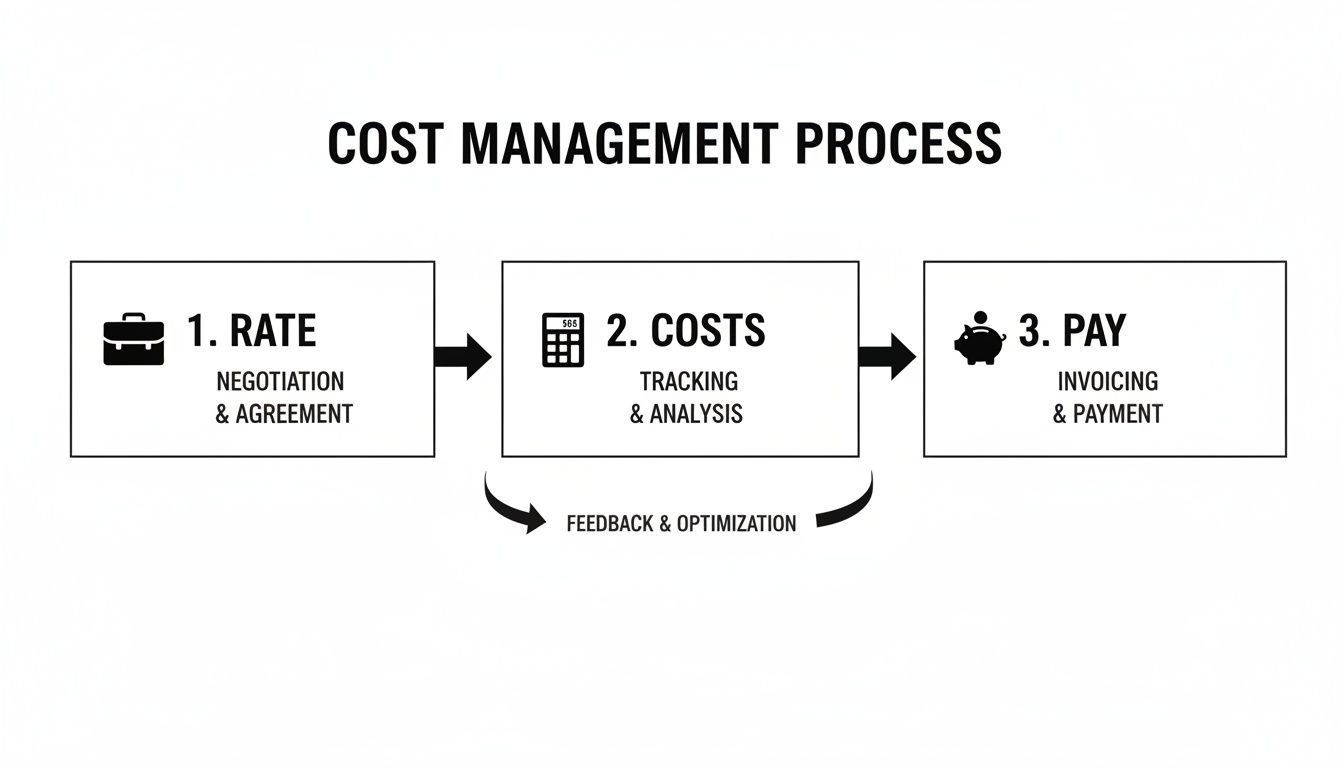
As you can see, the process always starts with the total project rate. From there, all the necessary employment on-costs are deducted before your personal tax calculations even begin.
Example Calculation Based on a £500 Daily Rate
Let us break it down with a common scenario: a contractor on a five-day week, earning a daily rate of £500. This gives a total weekly assignment income of £2,500. It is crucial to remember that this is the amount the umbrella invoices the agency, it is not your personal gross salary.
For this example, we will use the 2024/25 tax and National Insurance rates and a competitive weekly margin of £25.
Here is a step-by-step look at how the funds are processed:
| Item | Calculation | Amount (£) |
|---|---|---|
| Total Assignment Income | 5 days x £500 | 2,500.00 |
| Umbrella Company Margin | Fixed weekly fee | -25.00 |
| Employment On-Costs | ||
| Employer's NI | 13.8% on earnings over £175 | -314.19 |
| Apprenticeship Levy | 0.5% on earnings | -10.83 |
| Employer Pension | 3% of qualifying earnings | -59.54 |
| Your Gross Pay (for tax) | Remaining balance | 2,090.44 |
| Personal Deductions | ||
| PAYE Tax | Based on standard tax code | -495.00 |
| Employee's NI | 8% on earnings between £242-£967 | -118.83 |
| Employee Pension | 5% of qualifying earnings | -99.24 |
| Your Net Take-Home Pay | Final amount to your bank | 1,377.37 |
So, after all the statutory deductions and our small margin are handled, your take-home pay for the week would be £1,377.37. It is a transparent process where every penny is accounted for.
For a more personalised estimate, you can plug your own numbers into our payroll calculator to see your potential take-home pay.
Remember, the 'assignment rate' is designed to cover all these costs. A common mistake is to think of it as a personal salary, which leads to confusion when looking at the final net pay. Always view it as the total project cost.
Stepping Up to a £600 Daily Rate
Now let us see what happens with a higher daily rate of £600, which gives us a weekly assignment income of £3,000. The process remains exactly the same, the principles of deducting employment on-costs before calculating your gross pay do not change. This consistency is the hallmark of a compliant and trustworthy payroll provider.
Of course, with higher earnings, the figures will be different.
Here is how the numbers stack up in this scenario:
| Item | Calculation | Amount (£) |
|---|---|---|
| Total Assignment Income | 5 days x £600 | 3,000.00 |
| Umbrella Company Margin | Fixed weekly fee | -25.00 |
| Employment On-Costs | ||
| Employer's NI | 13.8% on earnings over £175 | -379.83 |
| Apprenticeship Levy | 0.5% on earnings | -13.48 |
| Employer Pension | 3% of qualifying earnings | -73.69 |
| Your Gross Pay (for tax) | Remaining balance | 2,507.99 |
| Personal Deductions | ||
| PAYE Tax | Based on standard tax code | -690.62 |
| Employee's NI | 8% + 2% on earnings | -123.08 |
| Employee Pension | 5% of qualifying earnings | -122.82 |
| Your Net Take-Home Pay | Final amount to your bank | 1,571.47 |
In this case, the higher earnings push some of the Employee's NI into the 2% band and significantly increase the PAYE tax deduction.
These examples clearly show how the mandatory employment costs are handled before we even get to your personal gross pay, giving you a completely transparent view of how your earnings are managed from start to finish.
Why UK Labour Costs Keep Changing
It is easy to look at the employment costs on your payslip and think they are just arbitrary deductions. In reality, they are all part of a much bigger picture, a regulated, nationwide system that is constantly shaped by the wider economy. These are not optional charges from us; they are standard, legal requirements for employing anyone in the UK.
Things like government policy and inflation have a direct impact on UK labour costs. When the Chancellor adjusts National Insurance thresholds in the Budget, or when statutory pay rates go up, those changes have a ripple effect on every single payslip in the country. It is this ever-shifting financial landscape that really highlights the value of working with a compliant, accredited partner who stays on top of it all.
The Bigger Economic Picture
If you look at the official data, you will see a clear and consistent pattern: labour costs are on the rise. This is not just about wages; it covers everything from social security contributions to pension costs.
According to the Office for National Statistics (ONS), labour costs have followed a steady upward path for years. This trend has a very real impact on your assignment rate. As statutory costs like Employer’s National Insurance (currently 13.8% on most earnings) climb, the total cost of employment naturally goes up for every business across the UK. To maintain the same take-home pay, the rate offered for the role has to increase to cover these rising costs.
At UmbrellaCompany.com, we see it as our duty to navigate this complexity for you. We monitor regulatory changes closely to ensure every calculation is accurate and your payroll remains fully compliant, giving you peace of mind.
This is why partnering with an accredited organisation like ours is so important. We make sure your affairs are always handled correctly, transparently, and in line with the latest HMRC guidance. That proactive management protects you and ensures there are no nasty surprises when you get your payslip.
Actionable Tips for Managing Your Contractor Pay
Getting to grips with how your pay is structured is the key to a successful contracting career. Once you understand the moving parts, you can make smarter decisions that protect your income and ensure you are only working with trustworthy, compliant umbrella companies.
It all starts with being proactive. When you are discussing a new role, do not be shy about negotiating an uplifted assignment rate with your agency. This is not just about your day rate; it needs to be high enough to comfortably cover all the employment on-costs we have talked about, plus your own take-home pay. A good, transparent agency will get this completely.
Vet Your Umbrella Company Thoroughly
Before you sign anything, always ask for the Key Information Document (KID). It is a legal requirement for a reason, it gives you a clear, upfront breakdown of every single deduction, from the umbrella's margin to all the other costs. It is your best defence against nasty surprises down the line.
When you are comparing a few different providers, make sure you are looking at like-for-like pay illustrations. A reputable umbrella company will give you a realistic projection based on the full assignment rate, not just an attractive headline figure. This is the only way to accurately forecast what will actually land in your bank account.
A huge green flag is an accreditation from a recognised professional body like the FCSA (The Freelancer & Contractor Services Association) or Professional Passport. This is your seal of approval, telling you they operate to the highest compliance standards.
Avoid Non-Compliant Schemes
Finally, and this is a big one: be extremely wary of any company promising unusually high take-home pay. If an offer looks too good to be true, it almost certainly is. These outfits often use dodgy tax avoidance schemes or disguised remuneration tactics that could leave you facing a massive bill from HMRC in the future.
Stick to these simple rules, and you can manage your finances with confidence, stay compliant, and build a rewarding, sustainable career as a contractor.
Got Questions About Employment Costs? We Have Got Answers
Let us wrap up by tackling some of the most common questions we hear from contractors about employment on-costs. Hopefully, these quick, clear answers will clear up any confusion you might still have.
Why Are These Costs Deducted from My Rate?
This is probably the biggest source of head-scratching for new contractors, and it is a fair question. When you work through an umbrella company, you are not just getting paid by us, you are legally our employee.
The assignment rate you agree with your agency is not just your salary; it is a total project cost. Think of it as a single pot of money that needs to cover your gross pay, our margin, and all the legal employer costs like National Insurance. We deduct these from the total assignment rate to meet our duties as your employer, not from your personal take-home pay.
I Never Saw These Costs as a Permanent Employee, Why Now?
You did not see them, but they were definitely there! When you were a permanent employee, your employer handled all these costs behind the scenes. The salary you agreed to was the figure you received after your employer had already budgeted for their own National Insurance contributions and other overheads.
A contractor's assignment rate works differently. It is an all-inclusive figure that has to cover both your earnings and all the associated employment costs from the get-go.
Is There Any Way to Reduce My Employment On-Costs?
In short, no. Not if you are working with a compliant provider. Legitimate employment costs are set by law and simply cannot be reduced.
Be very, very wary of any company or scheme that promises to lower these deductions. They are almost always non-compliant tax avoidance arrangements that could land you in serious trouble with HMRC. The best and safest approach is to negotiate an assignment rate that is high enough to comfortably cover all the mandatory costs while still leaving you with the take-home pay you want.


