


Seeing an unexpected code on your payslip can be a shock, but it’s usually a temporary issue that is simple to fix. An emergency tax code is HMRC’s default setting when they are not sure what you should be paying. It’s a placeholder to ensure some tax is paid until they have your correct details.
This guide explains what an emergency tax code is, why you might have one, and the steps to get it corrected so you are not overpaying tax.
Understanding the Emergency Tax Code
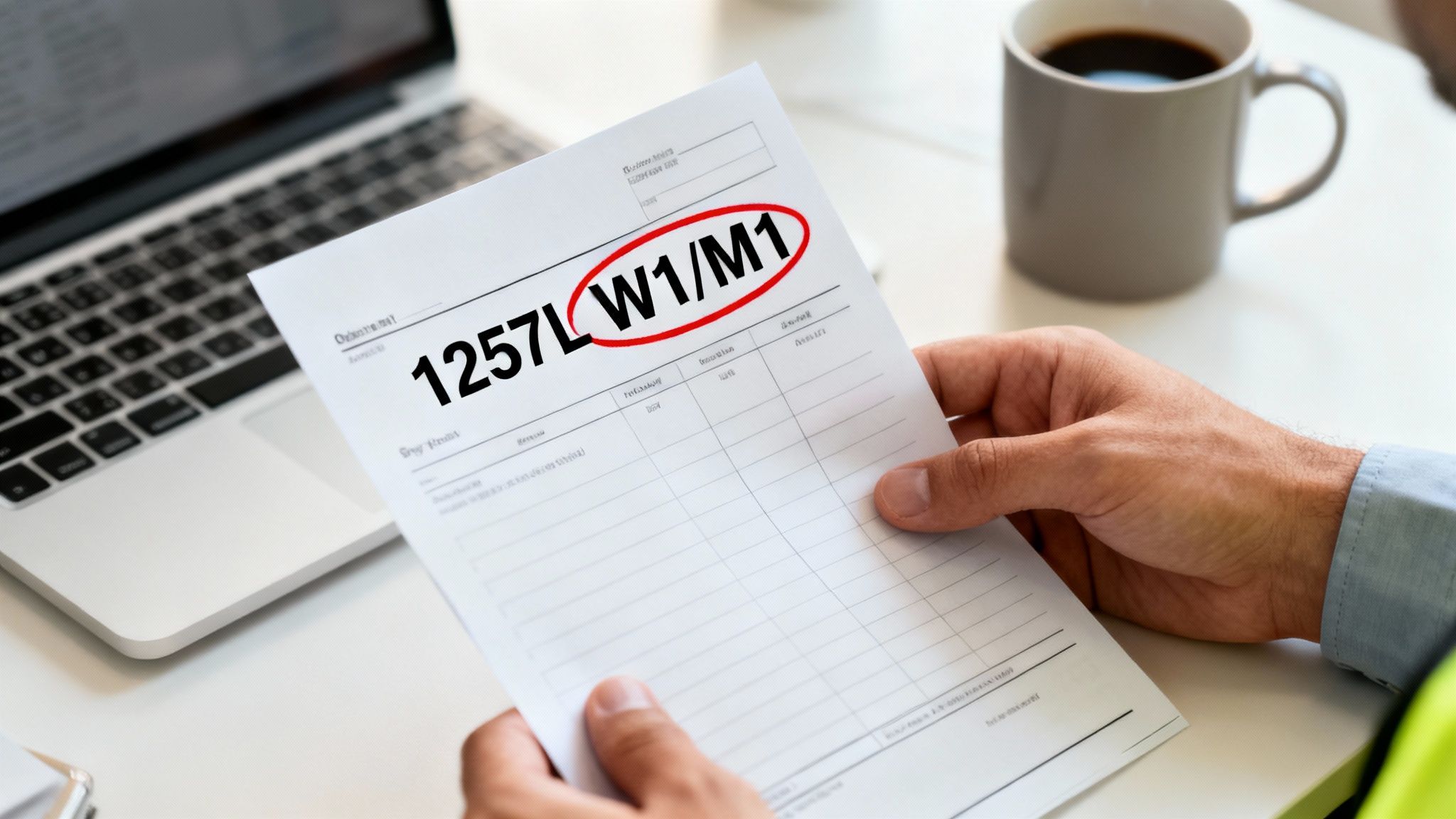
Spotting an unfamiliar tax code is unsettling, especially for contractors whose income can change from one contract to the next. Rest assured, an emergency tax code is not a penalty. It is a standard procedure HMRC uses to collect tax when they do not have enough information to give you the right, cumulative code.
This temporary measure ensures you are contributing to the tax system while your financial details are sorted. It often appears when you start a new contract, particularly through an umbrella company, or if you have not given your new employer a recent P45. The system is designed to get you paying tax right away, but it often does so at a flat, non-cumulative rate.
Why This Code Affects Your Pay
The biggest impact of an emergency tax code is on your take-home pay. Because it taxes you based only on what you earn in that specific week or month (a W1/M1 basis), it ignores how much you have earned or the tax you have paid earlier in the tax year.
This almost always results in you overpaying tax. For contractors, this can mean a significant, though temporary, dip in your net pay until you get things corrected.
The purpose of the emergency tax system is to stop people from falling behind on their tax payments when their job situation changes. While it often means you overpay at first, it is a safeguard built into the PAYE framework.
Here at UmbrellaCompany.com, we know that managing your finances is your top priority. Getting your tax code corrected is a straightforward process, and we are here to help you every step of the way. Understanding how the Pay As You Earn (PAYE) system works is the first step to taking control.
Why You Might Be on an Emergency Tax Code
Understanding why you have an emergency tax code is the quickest way to get it sorted. For contractors, it usually comes down to HMRC not having the latest picture of your work life. An emergency code is a temporary measure, triggered when the tax authority lacks the correct information to tax you accurately.
Once you know the cause, you can provide the missing information and get back on the right code. Here are the most common reasons.
Starting a New Contract Without a P45
This is the most frequent cause. Your P45 is the certificate you receive from your last employer (or umbrella company) when you leave. It provides a snapshot of what you have earned and how much tax you have paid so far in the tax year.
If you start a new contract without giving your new umbrella or client your P45, they have no official record of your tax situation.
As a result, they must put you on an emergency tax code. This default setting ensures some tax is paid from your first invoice, preventing a large tax bill later. As soon as you provide the P45, they can update your record and inform HMRC.
Changing How You Work
Moving between different working arrangements is a classic trigger. Your tax affairs look completely different as a sole trader compared to being paid through PAYE as an umbrella employee.
Common scenarios we see include:
- Moving from self-employed to an umbrella company: When you stop filing a Self Assessment tax return and become an employee of an umbrella, HMRC's systems need time to catch up.
- Starting your first job: If you are new to the world of work, HMRC has no tax history for you. They will place you on an emergency code until you are properly registered in the PAYE system.
You can think of an emergency tax code as HMRC's way of saying, "We see you've started a new job, but we need more information before we can apply your personal tax allowance correctly."
Juggling Multiple Contracts at Once
Working on more than one contract at the same time can also lead to an emergency code. Your tax-free Personal Allowance is usually only applied to your main job.
If you take on a second contract, HMRC will often instruct that second client or umbrella company to use a BR (Basic Rate) code.
This code taxes every penny you earn from that second job at the basic rate, with no tax-free allowance. This is done to prevent you from accidentally using your personal allowance twice and underpaying tax over the year. It may feel harsh, but it is designed to keep you compliant.
How to Read the Different Emergency Tax Codes
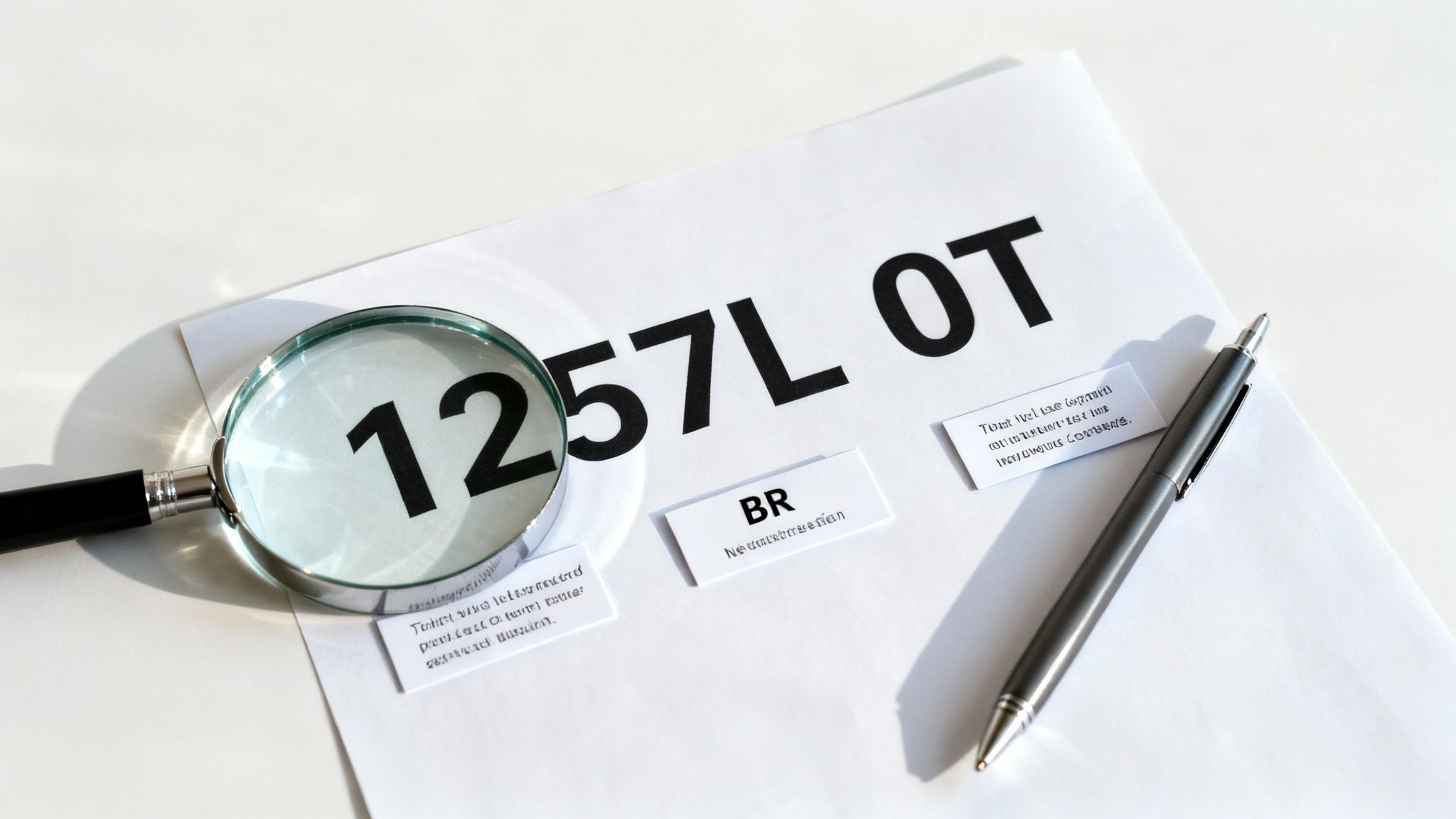
Trying to decode the letters and numbers on your payslip can feel like cracking a secret message from HMRC. The good news is, it is far simpler than it looks. Understanding what your emergency tax code means is the first step to getting it fixed and ensuring you are not overpaying.
Think of an emergency tax code as a temporary measure. It is what HMRC tells your employer or umbrella company to use when they do not have all the details about your income for the current tax year. It is designed to ensure some tax is collected, but it often leads to you paying too much.
The Most Common Code: 1257L W1 or M1
By far, the most frequent emergency tax code you will see is 1257L W1 (if you are paid weekly) or 1257L M1 (if you are paid monthly). Let's break down what each part means.
- 1257: This number relates to your tax-free earnings. Multiply it by 10 to get your Personal Allowance, which is £12,570 for the current tax year. This is the amount you can earn before you start paying income tax.
- L: This letter confirms you are entitled to the standard tax-free Personal Allowance.
- W1/M1: This is the crucial part. It stands for 'Week 1' or 'Month 1' and tells your payroll to tax you on a non-cumulative basis.
This non-cumulative instruction is the main issue. It forces your employer to treat every payslip as if it is the first one of the tax year, ignoring any tax you have already paid. It calculates your tax based only on what you earned in that single pay period, which almost always results in an overpayment.
Other Emergency Codes to Know
While 1257L W1/M1 is the one most contractors see, a few other codes can act as a temporary fix. Spotting these on your payslip is a clear sign you need to take action.
An emergency tax code is HMRC's way of keeping the tax system moving when they have incomplete information. It is a temporary fix, not a permanent status. Correcting it puts you back in control of your money.
To help you get a clearer picture, we have broken down the most common emergency tax codes you might see and what they mean for your finances.
Common UK Emergency Tax Codes and Their Meanings
| Tax Code | What It Means | Impact on Your Pay |
|---|---|---|
| 1257L W1/M1 | Standard Personal Allowance (£12,570) applied, but on a non-cumulative basis. | You will likely overpay tax because previous earnings and tax paid in the year are ignored. |
| BR | Stands for Basic Rate. All your income is taxed at 20%, with no tax-free allowance. | Often used for a second job to avoid using your Personal Allowance twice. A significant portion of your pay is taken in tax. |
| 0T | You have no Personal Allowance. All your income is taxed at the relevant rates (basic, higher, additional). | All your earnings are taxable. This can happen if your allowance is used up elsewhere or HMRC has no details for you. |
Each of these codes can have a different impact on your take-home pay, so it is vital to understand which one applies to you and why.
Our handy UK payroll calculator is a great way to see the real-world impact and get a clearer picture of your take-home pay. It lets you run the numbers and see the financial difference an emergency code makes.
The Real-World Impact on Your Contractor Take-Home Pay
It is one thing to discuss emergency tax codes in theory, but it is the cash difference in your bank account that really matters. Let's look at what this temporary code actually does to your earnings as a contractor.
The reduction in your take-home pay can be surprisingly large. When you are on a non-cumulative code like 1257L M1, HMRC calculates your tax based on that single pay period alone, ignoring what you have earned or paid in tax so far that year. This usually means you overpay.
To make this clear, we have put together two practical examples showing the difference between being on an emergency tax code versus the correct one. These scenarios highlight why it is important to get this sorted quickly.
Example One: Starting a New Contract on 1257L M1
Imagine a contractor, Sarah, who has just started a new project through an umbrella company. Her gross monthly pay is £5,000. The problem is she did not have her P45 from her last role ready in time, so her umbrella company puts her on the emergency tax code: 1257L M1.
On 1257L M1 (The Emergency Code): The tax calculation is based only on that single £5,000 payment. HMRC gives her one-twelfth of her annual tax-free Personal Allowance for that month (£1,047.50). Everything she earns above that amount is taxed, leading to a much higher tax bill for her first payslip.
On 1257L (The Correct Code): With the right code, HMRC would look at the bigger picture. The system would apply her tax-free allowance cumulatively, smoothing out the tax deductions over the year and resulting in a more accurate, and usually lower, tax payment.
The difference in her net pay for that month could easily be hundreds of pounds. That is money that is rightfully hers, but it is with HMRC until her code is corrected. Understanding what impacts your net pay is key; you can learn more in our guide on take-home pay for contractors.
Example Two: Juggling a Second Contract on a BR Code
Here is another common contractor scenario. David has a main contract where his correct 1257L code is being used. He then takes on a smaller, second contract, bringing in an extra £1,500 a month.
To avoid the risk of him underpaying tax, HMRC will almost always apply a BR (Basic Rate) code to this second income stream.
A BR code is a straightforward tool. It tells your payroll provider to tax every single pound you earn at the basic rate, currently 20%. Crucially, you get no tax-free Personal Allowance against this income.
This means David's entire £1,500 from his second job gets taxed at a flat 20%, a £300 tax deduction. This takes a significant chunk out of his earnings from that project.
An emergency tax code is not just an administrative detail to ignore. It has a direct and often significant impact on the money you receive, making it a top priority to fix.
Your Step-by-Step Plan to Correct Your Tax Code
Seeing an emergency tax code on your payslip can be frustrating, but the good news is it is a temporary problem with a clear solution. Acting quickly will get your code corrected, ensuring you pay the right amount of tax and reclaim any you have overpaid. This is your action plan.
The first and most important step is providing the right documents to your new employer or umbrella company. Your tax history for the current year is the key piece of information HMRC needs to put you on the correct code.
This simple flowchart shows how directly an emergency code hits your wallet.
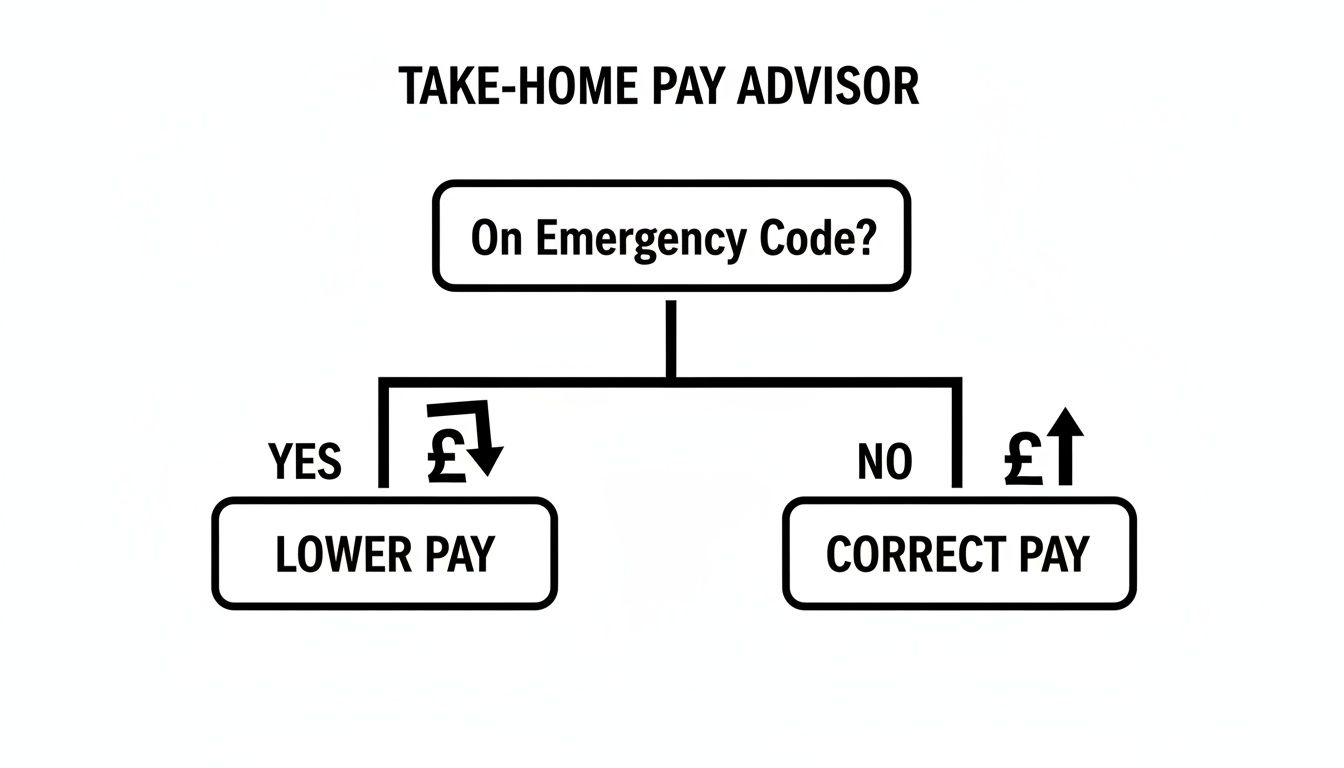
It couldn't be clearer: an emergency code means lower pay, while the correct code ensures you take home what you have rightly earned.
Providing the Right Information
Your immediate priority is to give your payroll provider the details they need. There are two main documents for this, depending on your recent work history.
Provide Your P45: If you have a P45 from a job you left in the current tax year, give this to your new umbrella company straight away. It contains all the crucial details about your earnings and tax paid so far, which allows for a seamless transition.
Complete a Starter Checklist: If you do not have a recent P45 (perhaps this is your first job, you were self-employed, or there is a gap in your employment), you will need to fill out a 'Starter Checklist'. This form, previously known as a P46, asks simple questions to help determine the right tax code for you.
At UmbrellaCompany.com, we guide our contractors through this initial paperwork to ensure HMRC gets the right information from day one. Taking this one simple action is often all it takes to prevent an emergency tax code from being applied.
Contacting HMRC Directly
What if you have provided the correct documents but still find yourself on an emergency code? The next step is to contact HMRC yourself. You can check and update your details directly, which is often the quickest way to resolve the issue.
The most efficient way to do this is through your HMRC online personal tax account. This portal lets you see the information HMRC holds on you, check your current tax code, and report any changes in your circumstances. If you prefer, you can also telephone HMRC.
Before you get in touch, have your National Insurance number and your umbrella company's PAYE reference number ready. This will help the advisor find your record quickly and make the necessary adjustments.
Once HMRC processes your details, they will issue a new tax code notice (a P6) directly to your employer or umbrella company. This updated code will then be applied to your next payslip.
Emergency codes are temporary by design and are a necessary part of the PAYE system for situations like starting a new job without a P45. HMRC typically updates a person's tax code within a few weeks of receiving the correct income details. You can read the full government guidance on rates and thresholds for employers.
Taking Control of Your Contractor Tax Situation
Being placed on an emergency tax code can feel like a setback, but for most UK contractors, it is a temporary issue you can resolve quickly. The key is to stay on top of your finances from the beginning.
When you understand what these codes are, why HMRC might have put you on one, and how to get it fixed, you stay in control. It is just a case of being vigilant, always check your payslips carefully, especially after starting a new contract.
Remember the simple steps: provide your P45 or a completed Starter Checklist to your umbrella company as soon as possible. If things still do not look right, a quick check-in with HMRC usually resolves the issue. Taking these small actions means you pay the right amount of tax from day one and keep your take-home pay exactly where it should be. For a deeper dive, check out our guide on the most tax-efficient contractor setup in the UK.
This knowledge is your best tool for managing your tax affairs effectively and avoiding the financial impact of an incorrect code. Ultimately, you are in control.
Here at UmbrellaCompany.com, we are committed to giving our contractors the support and straightforward guidance they need. We will help you navigate the paperwork with confidence so you can focus on your contract work, free from unnecessary financial stress.
Got Questions About Emergency Tax? We've Got Answers
We have walked through the what, why, and how of emergency tax codes. But it can still feel confusing when it is your money on the line. To wrap things up, here are some quick answers to the questions we hear most often from contractors.
How Long Will I Be on This Code?
This is a key question. The good news is, it's temporary. You will typically stay on an emergency tax code until HMRC resolves the situation on their end.
This usually happens a few weeks after your umbrella company or agency has submitted your P45 or Starter Checklist details. Once HMRC processes the information and your correct code is issued, it will appear on your next payslip.
Will I Automatically Get My Overpaid Tax Back?
Yes, in most cases, you will. The PAYE system is designed to correct itself over the tax year. Think of it as a running total.
Once your correct tax code is applied, the system will look back at what you have paid so far, identify the overpayment, and automatically refund it in your next payslip. You can look forward to a welcome boost in that month's pay.
The only exception is if the tax year ends (on 5th April) before your code is fixed. If that happens, you will likely need to claim the refund directly from HMRC yourself.
Is It Possible to Underpay Tax on an Emergency Code?
It is less common, but it can happen. This scenario can occur if you have several different income streams at once. An emergency code does not account for your total earnings, so it could potentially place you in a tax bracket that is too low.
This is why it is so important to ensure HMRC has the full picture of your income. A little administration now can save you from an unexpected tax bill down the road.
An emergency tax code is a temporary fix, not a permanent state. Being proactive is the best way to ensure you're taxed correctly and keep your finances on track from day one of any new contract.
My Umbrella Company Still Hasn't Fixed It – What Now?
This is a common frustration, but it is important to remember that your umbrella company can only use the tax code HMRC instructs them to use. They do not have the power to change it themselves.
If your code still seems incorrect, your first step should be to log into your Personal Tax Account on the GOV.UK website. Check that HMRC has all your correct details. If everything looks right on their end, you should contact your umbrella company to make sure they have received the updated coding notice.
At UmbrellaCompany.com, our goal is to cut through the confusion. We help you compare and choose compliant, trusted umbrella companies so you know your payroll and tax are in safe hands. Find the right partner for your contracting career and get started today.


