


It’s one of the biggest questions people have about retirement: "do I pay tax on my pension?"
The short answer is yes, most pension income is taxable. It’s best to think of it as a salary you receive when you stop working. But here's the good news—a large part of it can be taken completely tax-free. Understanding how this works is vital for making your retirement savings stretch as far as possible.
This guide explains how pension tax works for UK contractors, what allowances you can use, and how to plan your withdrawals to keep more of your money.
Yes, You Pay Tax on Most Pension Income

When you start digging into pension tax, it can feel a bit complicated, but it all comes down to a couple of key rules. If you get your head around these, you’ll be in a much better position to plan your finances.
Here at UmbrellaCompany.com, we believe in giving you clear, no-nonsense information. For any contractor, the two most important concepts to master are your Personal Allowance and the 25% tax-free lump sum.
Understanding Your Key Allowances
First up is the Personal Allowance. This is the amount of money you’re allowed to earn each year before you start paying Income Tax. For the 2024/25 tax year, the Personal Allowance is £12,570. Any income you have over this amount, whether from your pension, a part-time job, or savings, will be taxed.
Next, and this is a big one for private and workplace pensions, you can usually take up to 25% of your entire pension pot as a tax-free lump sum. This is often called a Pension Commencement Lump Sum (PCLS). It’s a fantastic way to access a significant slice of your savings without HMRC taking a cut.
Key Takeaway: Your total pension income for the year is added to any other income you have. Once that total amount goes over your £12,570 Personal Allowance, you start paying tax. The 25% tax-free lump sum is a separate, upfront benefit from your private pensions.
How Different Pensions Are Taxed
Not all pensions receive the same tax treatment. The State Pension, for instance, is taxable, but the money is paid to you without any tax being deducted first (known as being paid 'gross'). HMRC collects the tax by reducing the Personal Allowance you have available for your other income.
Workplace and personal pensions are also taxable, but they benefit from that brilliant 25% tax-free rule, which doesn't apply to the State Pension.
To make it easier to see how it all fits together, here’s a quick overview of how the main UK pension types are handled.
A Quick Look at How UK Pensions Are Taxed
This table summarises how different types of pension income are generally treated for tax purposes in the UK.
| Pension Type | Is the Income Taxable? | Key Points for Contractors |
|---|---|---|
| State Pension | Yes | It's taxable but paid gross. This reduces the Personal Allowance you can use against other income. |
| Workplace Pension | Yes (the remaining 75%) | You can take 25% tax-free. Often tied to auto-enrolment and salary sacrifice options via an umbrella company. |
| Personal Pension (SIPP) | Yes (the remaining 75%) | You can take 25% tax-free. These offer contractors more control and flexibility over their investments and withdrawals. |
Ultimately, the UK pension system is designed to give you a boost while you save (through tax relief) and then tax the income when you eventually draw it. We will dive into how that initial tax relief works to supercharge your savings in the next section.
How Pension Tax Relief Boosts Your Savings
Before we discuss how your pension is taxed when you start drawing it, let's look at one of the biggest perks of saving into one: tax relief.
Think of it as an instant top-up from the government on your investment. For every pound you put into your pension, HMRC effectively adds money on top. This helps your retirement fund grow that much faster right from the start.
This government contribution is essentially a refund of the Income Tax you paid on your earnings. For contractors, this is a massive upfront tax benefit. While HMRC's own statistics can be dense, expert analysis shows just how much better off you are compared to other savings methods. As you can read in this detailed pensions breakdown, it's a core strategy for building wealth efficiently.
How Tax Relief Works for You
The amount of tax relief you get is tied directly to your rate of Income Tax. This makes pension saving a particularly powerful tool for higher earners.
Here’s how it breaks down:
- Basic Rate Taxpayers: If you pay tax at 20%, you get relief at the same rate. To get £100 into your pension pot, it only costs you £80. The government adds the other £20.
- Higher Rate Taxpayers: If you’re a 40% taxpayer, that same £100 contribution costs you just £60. You receive the same automatic £20 top-up and can also claim an extra £20 back through your tax return.
- Additional Rate Taxpayers: For those paying tax at 45%, the cost of a £100 contribution drops to just £55, as you can claim back a further £25.
This is precisely why we consider pensions one of the most effective tax-saving vehicles available. It’s not just about planning for later; it’s about making your money work significantly harder for you today.
Relief at Source vs Net Pay Arrangements
How you actually get this tax relief depends on your pension scheme.
Most personal pensions, including SIPPs, use the ‘relief at source’ method. Your pension provider claims the 20% basic rate relief from HMRC automatically and adds it to your pot. If you're a higher or additional rate taxpayer, you need to claim the extra relief yourself, usually via a Self Assessment tax return.
On the other hand, many workplace pensions, including those used by umbrella companies, operate on a ‘net pay’ basis. With this setup, your employer deducts your pension contributions from your salary before tax is calculated. You get your full tax relief immediately, whatever your tax band, and there is no need to chase HMRC for anything. This is a very efficient system, especially for contractors working through an umbrella company that offers salary sacrifice.
What is the Annual Allowance?
The Annual Allowance is the ceiling on how much you can pay into your pensions in a single tax year and still get tax relief. For the 2024/25 tax year, this is £60,000 or 100% of your earnings, whichever is lower. If you go over this limit, you could face a tax charge on the excess contributions.
How Your Pension Withdrawals Are Actually Taxed
We’ve seen how pension contributions get a nice boost from tax relief on the way in. But what happens when you finally want to access that money? This is where your decisions really start to shape your final tax bill.
The first, and most exciting, rule to understand is that you can typically take 25% of your private pension pot completely tax-free. This is your Pension Commencement Lump Sum (PCLS). For the remaining 75%, how it's taxed depends on how you choose to access it.
The Tax-Free Lump Sum: Your First Port of Call
Once you’re old enough to dip into your pension (usually from age 55, rising to 57 in 2028), you have the option to take a quarter of your savings as a tax-free lump sum. It's a huge perk and a cornerstone of UK pension planning.
Let's say you've built up a pension pot worth £200,000. You could take £50,000 as a tax-free payment right away. The leftover £150,000 stays invested and becomes your taxable fund, which you can then start drawing from using one of the methods we will look at next. Crucially, that upfront tax-free cash is yours to do with as you please, and it doesn't count towards your Personal Allowance or affect your tax band for the year.
This flowchart gives you a great visual of how your money grows, from your initial contribution to the government top-up, all building the pot you'll eventually live on.
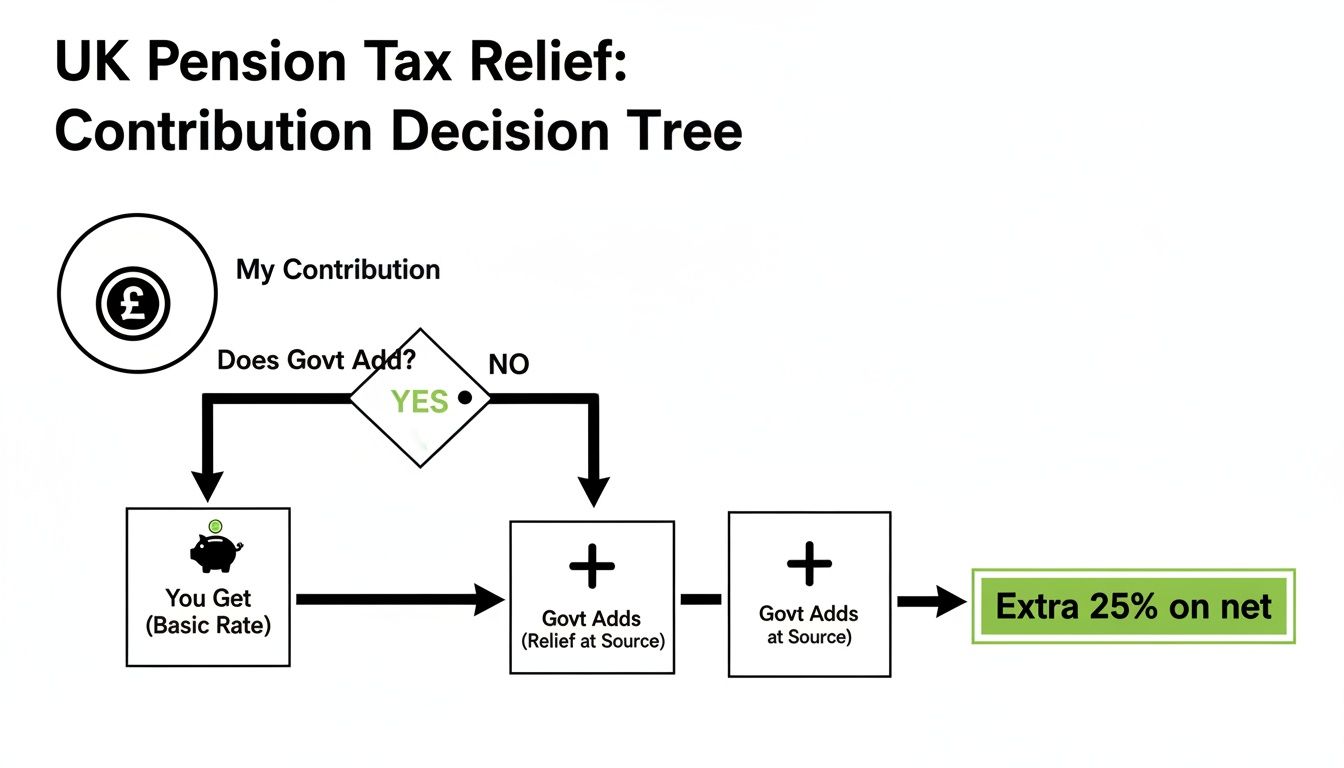
It traces your money's journey, showing how tax relief helps build the fund you’ll draw from in retirement.
Option 1: Buying an Annuity
After you've pocketed your tax-free cash, one classic option for the remaining 75% is to buy an annuity. Think of an annuity as an insurance product that pays you a guaranteed, regular income for the rest of your life. No more stock market worries.
This income is treated just like a salary. It's taxed through the PAYE (Pay As You Earn) system, so your annuity provider will deduct any Income Tax before the money hits your bank account. This makes it a wonderfully simple and predictable option, as you don’t have to get bogged down in tax calculations yourself. For a closer look at the mechanics, you can learn more about how PAYE works in our detailed guide.
Worked Example: The Annuity Route
Let's go back to our contractor with a £200,000 pension. After taking a £50,000 tax-free lump sum, they use the remaining £150,000 to buy an annuity. If that annuity pays them £9,000 a year, this amount is simply added to their other taxable income (like the State Pension) to work out their total tax bill.
Option 2: Using Flexi-Access Drawdown
The second main path is flexi-access drawdown. This is the more modern, flexible route, where you leave your remaining pension pot invested and simply withdraw taxable income from it as and when you need it. You are in the driver's seat.
This flexibility is incredibly powerful for smart tax planning. You could decide to take out just enough to stay within your Personal Allowance (£12,570 for 2024/25) and pay zero tax. Or you could carefully manage larger withdrawals to make sure you don't accidentally tip yourself into a higher tax band.
With flexi-access drawdown, you have a few ways to take your money:
- Take a regular income: You can set up steady monthly or annual payments.
- Take ad-hoc lump sums: Dip in and pull out cash whenever you need it for a big purchase.
- A mix of both: Combine regular payments with occasional lump sums to suit your life.
Every withdrawal is taxable income, and your pension provider will deduct tax under PAYE. But because you control the timing and the amount, you can strategically manage your income from one year to the next and keep your overall tax bill to a minimum.
Worked Example: The Drawdown Route
Our contractor, with £150,000 left in their drawdown pot, might choose to withdraw just £12,000 in one year. Assuming they have no other income, this falls neatly inside their Personal Allowance, meaning they’d pay £0 in Income Tax on that withdrawal. The next year, they might decide to take out £20,000 to fund a big holiday, only paying tax on the amount above their allowance.
Maximising Pension Contributions Through an Umbrella Company
As a contractor, working through an umbrella company gives you access to a powerful and often missed financial strategy. Your pension isn't just a savings pot for the distant future; it's a tool you can use right now to significantly cut your tax and National Insurance bills. Understanding this can make a huge difference to your take-home pay or help you build your retirement fund much faster.
The secret lies in a mechanism called salary sacrifice. By using this arrangement, you make pension contributions from your gross assignment income, before any taxes are calculated. This simple shift delivers a double benefit: it lowers your taxable earnings and also slashes the amount you pay in National Insurance contributions. It's a genuine win for your finances.
The Power of Salary Sacrifice Explained
So, what exactly is salary sacrifice? It’s a formal agreement you make with your employer (the umbrella company) to reduce your salary in return for a non-cash benefit. In this case, that benefit is a larger employer pension contribution on your behalf.
Instead of receiving your full contract rate as salary and then making a personal contribution from your net, post-tax pay, the money goes straight from your gross earnings into your pension. Because both Income Tax and National Insurance are calculated on your new, lower salary, you save on both.
This is what sets it apart from standard personal pension contributions, which only give you tax relief. With salary sacrifice, you also save on National Insurance, making it the single most tax-efficient way for a contractor to save into a pension. For anyone wanting to understand the basic structure of umbrella employment, you can read our detailed guide on how an umbrella company works.
A Calculation Example
Let's walk through a practical example to show the real-world impact.
Imagine a contractor, Sarah, with an assignment rate of £500 per day. Without any salary sacrifice, her income is subject to both employer’s and employee’s National Insurance, plus Income Tax.
Now, let's say Sarah decides to sacrifice £200 per week into her pension.
- Gross Income: Her gross income for tax and NI purposes is immediately reduced by that £200.
- National Insurance Savings: She avoids paying employee's NI on that £200. At the current rate of 8% on earnings between the primary threshold and upper earnings limit, that’s an instant saving of £16 per week.
- Tax Savings: As a higher-rate taxpayer, she also saves 40% Income Tax on the £200, which works out to £80 per week.
- Total Savings: All told, a £200 pension contribution only costs her £104 out of her net pay (£200 – £80 tax – £16 NI). The other £96 is pure tax and NI savings.
This shows how her pension pot grows by £200, while her take-home pay is only reduced by £104. Over a year, that’s an extra £4,992 in tax and NI savings working for you, either turbo-charging your retirement fund or boosting your disposable income today.
Auto-Enrolment and Making Extra Contributions
When you're an employee of an umbrella company, you're automatically covered by auto-enrolment rules. This means your umbrella company must enrol you into a workplace pension scheme and make minimum contributions for you, provided you meet the age and earnings criteria.
While auto-enrolment provides a baseline, the real power lies in going beyond these minimums. The legal minimums are often just a small fraction of what a contractor could be saving tax-efficiently.
Most compliant umbrella companies make it simple to increase your contributions via salary sacrifice. At UmbrellaCompany.com, we ensure the providers we recommend offer flexible pension schemes that let you easily adjust how much you contribute. This gives you full control to optimise your savings based on your contract rate and financial goals, helping you make the most of your money both now and in the future.
How Market Changes Affect Your Retirement Income
When it's time to turn your pension pot into a reliable income for life, market conditions have a huge say in the outcome. If you're looking at buying an annuity, which gives you a guaranteed income, timing is everything.
The amount of income you get is tied directly to factors outside your control, like interest rates and how the market is performing.
This means a contractor retiring today could get a vastly different annual income from the same size pension pot as someone who retired just a few years ago. Understanding this volatility is crucial for making a smart decision about your financial future.
What Are Annuity Rates?
Annuity rates are the all-important number that dictates how much income your pension pot can buy you. When you buy an annuity, the provider takes your lump sum and, in return, calculates a regular income they promise to pay you for the rest of your life.
This calculation hinges on a few things: your age, your health, and, critically, the annuity rates at that exact moment. These rates are heavily influenced by the yields on long-term government bonds (known as gilts) and the interest rates set by the Bank of England. When interest rates go up, annuity rates tend to climb too, meaning your pension pot can suddenly buy you a much higher guaranteed income.
We’ve seen a powerful real-world example of this recently. After years of being stuck at historic lows, annuity rates have surged. This volatility perfectly shows how market timing can dramatically alter a contractor's retirement income. In fact, as recent annuity rate analysis shows, a pensioner buying a typical annuity today could get 76% more annual income (£2,672 more per year on a £100k pot) than someone who bought one back in December 2021.
The Impact of Market Timing: A Clear Comparison
To see just how big a difference this makes, let's compare two contractors. Both have a £100,000 pension pot left to buy an annuity after taking their tax-free cash.
- Contractor A (Retired in late 2021): When annuity rates were at rock bottom, their £100,000 pot might have secured them a guaranteed annual income of around £3,500.
- Contractor B (Retired more recently): With annuity rates flying high, their identical £100,000 pot could now lock in a guaranteed income of roughly £6,200 a year.
That’s a staggering difference of £2,700 every single year for the rest of their lives, all from the same initial savings. It shows perfectly how external economic forces, not just your saving habits, can shape your financial security in retirement.
Because the decision to buy an annuity is irreversible, you absolutely have to be aware of these market dynamics. Locking in a rate when it's low could mean missing out on tens of thousands of pounds over your retirement.
This is exactly why getting independent financial advice before you commit is so important. An adviser can help you work out if now is the right time to buy, or if other options like drawdown might be a better fit for you right now.
How to Report Your Pension Income to HMRC

Understanding the administration side of pension tax can save you a fair bit of hassle. For many people, the tax on their pension income is handled for them. But as a contractor, your income streams are often more varied, so it’s vital to know when you need to step in and manage things yourself.
Most pension income, whether it’s a regular annuity or a drawdown payment, is taxed through the PAYE (Pay As You Earn) system. In simple terms, your pension provider deducts the tax before the money hits your bank account, just as an employer would. They use a tax code from HMRC to figure out how much to take.
This works perfectly well if your financial life is straightforward. But for contractors, it rarely is.
When You Need to File a Self Assessment Tax Return
If you're a contractor, you’re probably already familiar with filing a Self Assessment tax return each year. It’s crucial to know when your pension activity means you have to file one. You will almost certainly need to if you:
- Earn more than £100,000 in a tax year, including your pension income.
- Take large, one-off lump sums from your pension using flexi-access drawdown.
- Have multiple sources of income, like your pension, rental income, and freelance work.
- Need to claim back higher-rate tax relief on personal pension contributions.
- Are self-employed or a director of your own limited company.
For instance, say you pull £30,000 from your drawdown fund on top of receiving your State Pension and some freelance earnings. HMRC will need the full picture to make sure you’ve paid the right amount of tax, and a Self Assessment is the official way to provide it.
Understanding and Reclaiming Emergency Tax
One of the most common shocks for people taking their first flexible pension payment is getting hit with emergency tax. This often happens because your pension provider doesn’t have a correct tax code for you, so they apply a temporary one.
This temporary code usually assumes you’ll be making the same large withdrawal every single month of the year. This can artificially push you into a higher tax bracket, leading to a huge overpayment of tax. Taking a £10,000 lump sum, for example, might be taxed as if your annual income were £120,000.
The good news is this is a temporary problem. You are entitled to get any overpaid tax back from HMRC, and it's usually quite straightforward. Do not panic when you see that first payslip.
How you reclaim the money depends on what you did:
- If you emptied your pot: You can use form P50Z (if you have no other income) or P53Z (if you have other income) to claim your refund.
- If you only took a partial withdrawal: Use form P55 to get your money back within the tax year.
If you do nothing, HMRC should sort out your tax code and send you a refund at the end of the tax year, but that can take a while. For contractors who rely on steady cash flow, it pays to be proactive. You can learn more by checking out our guide on the emergency tax code. Staying on top of it helps you keep control of your money and avoid any needless stress.
Common Questions About Pension Tax for Contractors
The world of pension tax can feel like a maze, especially when you're a contractor. We hear many of the same questions from people trying to understand it, so we’ve pulled together the most common ones to give you some clear, straightforward answers.
Think of this as your quick-start guide to planning your retirement with more confidence.
Can I Take My Entire Pension Pot as a Tax-Free Lump Sum?
This is one of the biggest myths out there, and the short answer is no. You cannot just take your entire defined contribution pension pot tax-free.
What you can do is take up to 25% of your pot as a tax-free lump sum. This is officially known as the Pension Commencement Lump Sum (PCLS). Any money you touch from the remaining 75% is classed as taxable income. This means it is subject to Income Tax at your personal rate, whether you take it as a regular annuity, through flexible drawdown payments, or as one-off lump sums.
Is My State Pension Taxed?
Yes, the UK State Pension is taxable income. But it is paid to you in full without any tax taken off first, which can catch people out.
Instead of deducting tax directly, HMRC accounts for it by reducing your Personal Allowance. This means you have less tax-free allowance available for your other income, like your private pension withdrawals or any contract work. The result is that you end up paying more tax on that other income to cover what's owed on your State Pension.
What Happens If My Pension Pushes Me Into a Higher Tax Band?
Your taxable pension income is added on top of all your other taxable income for the year. That includes your earnings from contracts, any rental income, or even interest from savings.
If this combined total pushes you over a tax threshold, any income that tips into the higher (40%) or additional (45%) rate bands will be taxed at that higher rate. This is exactly why smart planning is so crucial if you're using flexi-access drawdown. By carefully managing when and how much you withdraw, you can keep your annual income in check and avoid, or at least minimise, a bigger tax bill.
For contractors with income that can go up and down, managing pension withdrawals is a powerful financial lever. A little thoughtful planning can help you keep more of your hard-earned money each year. As you plan your finances, you might find it useful to learn more about how to reduce PAYE tax as a contractor in our detailed guide.
Does a Pension Through an Umbrella Company Save Me National Insurance?
Yes, it certainly can, and it's a major advantage for contractors. If your umbrella company offers a 'salary sacrifice' pension scheme, you can make serious savings on your National Insurance Contributions (NICs).
With this setup, your pension contribution is taken from your gross contract earnings before any tax or National Insurance is worked out. This effectively lowers your taxable income. As a result, you save on both Income Tax and NICs, making it an incredibly efficient way to top up your retirement savings.
We hope this guide has clarified how tax on your pension works. The key takeaways are that while most pension income is taxable, you can take 25% tax-free, and smart planning with drawdown or salary sacrifice can significantly reduce your overall tax bill.
At UmbrellaCompany.com, we specialise in helping contractors find compliant and efficient umbrella solutions. Use our free comparison tool to find a provider that offers flexible, tax-efficient pension options perfectly suited to your needs. Compare top UK umbrella companies now.


