


No UK law requires a limited company to appoint an accountant, but every director must prepare statutory accounts, file them with Companies House, submit a Company Tax Return to HMRC, and meet deadlines, typically 9 months after the year end for Companies House accounts and 12 months for the tax return. The question isn't “do I need an accountant for a limited company?” but whether you can reliably carry those duties yourself.
That distinction matters to contractors and freelancers. A limited company gives you responsibility, not just a separate bank account and a different way to receive contract income. You remain accountable for the figures, records, tax filings and confirmations submitted in the company's name, even if you use software or ask someone else to press the final submit button.
An accountant is optional in law. For many contractor-shaped companies, professional help is still the sensible choice because Corporation Tax, payroll, dividends, expenses and IR35 decisions interact. This guide gives you a direct way to decide whether DIY accounting is realistic, or whether paying for support is cheaper than carrying the compliance risk alone.
The Short Answer on Whether You Need an Accountant
You don't legally need an accountant for a UK limited company. Government guidance confirms that directors can appoint an accountant or tax adviser to file on their behalf, but the law doesn't make that appointment compulsory. The director remains responsible for the company's filings and records, whether the work is completed personally or delegated through an agent. GOV.UK guidance on filing company accounts and tax returns explains that an accountant is optional rather than mandatory.
That legal answer is only the starting point. Your company must still prepare annual accounts, file them at Companies House, submit a Company Tax Return to HMRC, keep accounting records for 6 years, and meet the relevant deadlines. Your first accounts must be filed within 21 months of incorporation, which creates an important early milestone for a new director. Government guidance for limited companies sets out those obligations.
Ask the practical question
Use this test:
- Can you keep complete records? You'll need evidence for money received and spent, assets, liabilities, stock, invoices and bank statements.
- Can you prepare the right accounts? Limited companies generally need traditional accounting and statutory accounts, not the simpler cash basis available to some unincorporated businesses.
- Can you file accurately and on time? A filing calendar isn't enough if you don't understand the figures behind each return.
- Can you handle changes? A new contract, dividend payment, payroll arrangement or IR35 determination can alter the work required.
A steady contractor with simple transactions and confidence using accounting software may manage parts of the process alone. A contractor taking dividends, running payroll, claiming expenses or moving between inside and outside IR35 work faces more judgement calls.
Our advice is straightforward: DIY is viable only when you understand the responsibility, not merely when you can afford software. If you want specialist support with contractor accounts, see accounting support for contractors.
What the Law Actually Requires of Every Director
A director inherits the compliance work when the company is formed. You must keep accounting records that explain the company's transactions and financial position, then use those records to prepare statutory accounts. The records must cover money received and spent, assets, liabilities, stock and supporting documents such as invoices and bank statements. Companies House and government guidance confirm that records generally need to be retained for 6 years. The official filing guidance describes the records and retention duty.
The accounts themselves normally include a balance sheet, profit and loss account and notes. An auditor's report may also be required depending on the company's size. The government's business guidance classifies limited company accounting as more complicated than sole trader bookkeeping and confirms that a limited company must use traditional accounting rather than the simpler cash basis used by some unincorporated businesses. Business.gov.uk's accounting guidance explains the difference.
The deadlines sit with you
| Filing duty | Deadline | What happens if you miss it |
|---|---|---|
| Annual accounts | Usually 9 months after the financial year end for a private company | Companies House late filing penalties apply automatically |
| First annual accounts | Within 21 months of incorporation | The company can miss its first statutory filing milestone |
| Corporation Tax payment | 9 months and 1 day after the accounting period ends | Tax may become overdue, with potential interest and penalties |
| Company Tax Return | 12 months after the accounting period ends | HMRC can apply late filing consequences |
| Confirmation statement | At least once during each annual confirmation period | The company record may become inaccurate or non-compliant |
Companies House calculates the accounts deadline from the company's accounting reference date. A private company normally has 9 months from that date to file, although first accounts can receive a longer period where the accounting period covers more than 12 months. Companies House explains accounting reference dates and filing windows.
Your records need to tell the same story
Keep invoices, receipts, bank statements, payroll information, dividend paperwork and explanations for business expenses together. If you're VAT registered, your VAT records must also support the returns you submit. A confirmation statement isn't a tax return, but you still need to make sure the company information it confirms is accurate.
Practical rule: If you couldn't explain a transaction to HMRC using your records, it isn't ready to include in your accounts.
Late accounts penalties for private companies start at £150 and rise to £1,500, and the penalty doubles where the company files late in two successive years. The government's annual requirements guidance sets out those penalties. The legal responsibility remains with the directors, not the accountant you might later hire.
For a clearer explanation of the role itself, see our guide to being a limited company director.
What an Accountant Does for a Contractor Limited Company
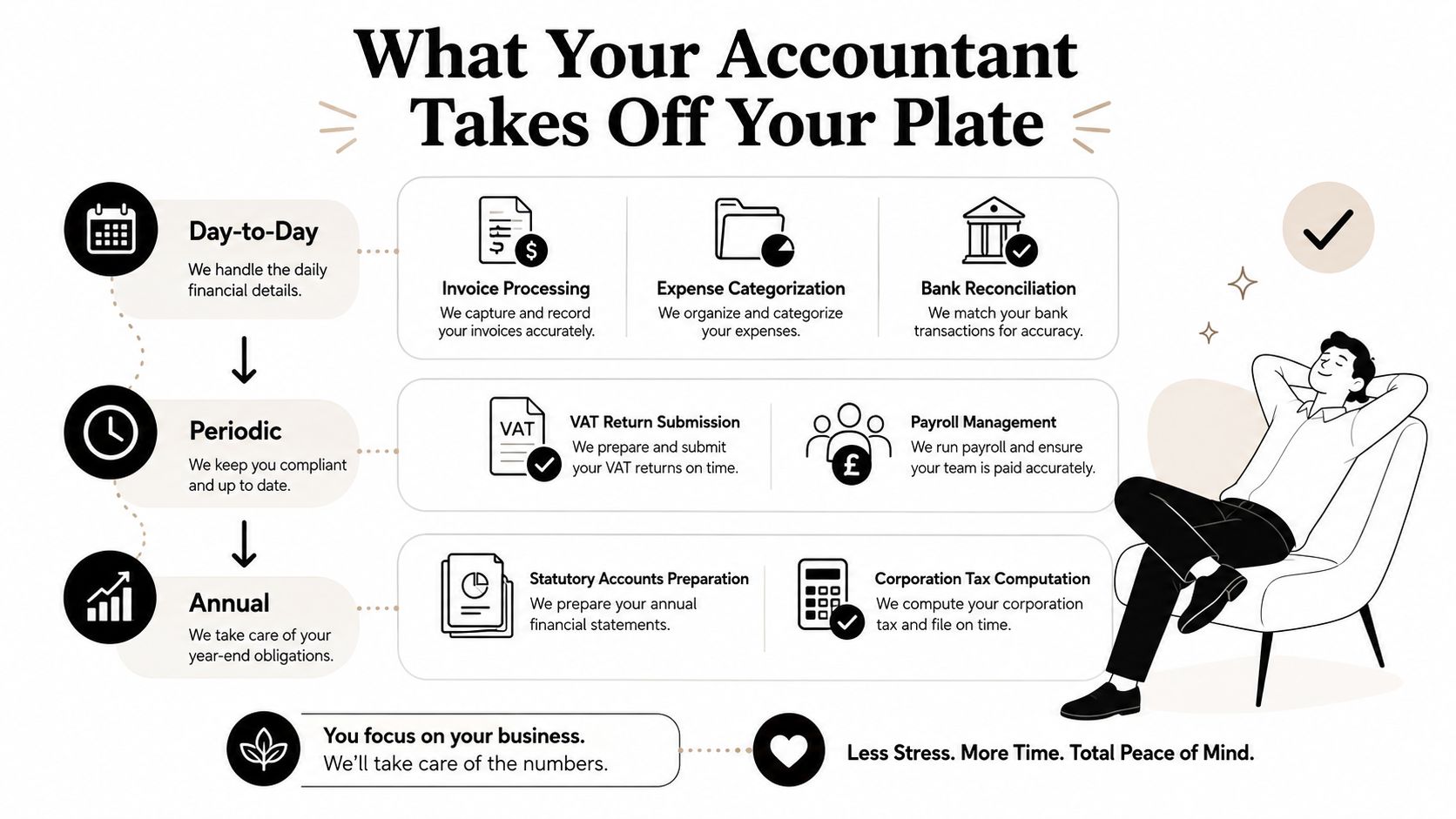
An accountant's value isn't limited to producing a set of year-end figures. For a contractor, the useful work happens throughout the year, when invoices arrive, expenses are incurred, salary is paid, dividends are considered and contracts change.
Responsibilities commonly handed over
- Bookkeeping: The accountant can organise invoices, categorise expenses and reconcile the company bank account.
- Statutory accounts: They turn the bookkeeping file into accounts in the required format, including the balance sheet, profit and loss account and notes.
- Corporation Tax: They calculate the company's taxable profit and submit the CT600 to HMRC.
- Payroll: If you pay yourself a salary, they can run PAYE, prepare payslips and manage the required payroll reporting.
- Dividends: They can check whether a dividend is supported by available distributable profits and prepare the relevant paperwork, such as dividend vouchers and minutes.
- Companies House filings: They can submit annual accounts and help maintain accurate company information.
- Tax administration: With the appropriate authority, an accountant can act as your agent for HMRC online services and deal with tax queries directly.
Advice is the part software can't replace
Accounting software can record a transaction, but it won't necessarily decide whether a contract's working practices create an IR35 concern. An accountant can review a changed engagement, discuss the practical effect of an inside or outside determination and identify when the company's arrangements need attention.
They can also recommend suitable bookkeeping software, help organise digital records and review year-end tax planning. That named contact matters when HMRC asks a question or a filing doesn't go as expected. You won't need to reconstruct the company's history from scattered emails and bank entries.
Don't confuse bookkeeping with the full accounting role. Our comparison of an accountant and a bookkeeper explains why the distinction affects the support you receive.
DIY vs Accountant Real Costs and Trade Offs
DIY accounting looks cheaper because the cash cost is visible and the time cost is easy to ignore. A contractor-focused accountant commonly charges around £1,200 to £2,400 a year for accounts, CT600 filing and payroll, while packages including VAT, bookkeeping and dividend administration can move to £2,500 or more. These figures are editorial price bands, not a legal fee schedule, so ask exactly what each quote includes.
The DIY route may involve software such as Xero or QuickBooks, often costing around £25 to £70 per month, plus any applicable HMRC or Companies House charges and the value of your own time. Those software prices are plan-dependent and can change, so check current pricing before committing.
Put the trade-off on paper
| Cost Item | DIY Route | With Contractor Accountant |
|---|---|---|
| Bookkeeping software | Around £25 to £70 per month, depending on the product and plan | May be included, or charged separately |
| Annual accounts | Your own time and technical knowledge | Usually included in the core package |
| CT600 and Corporation Tax calculation | Completed by you | Usually included |
| Payroll | You set up and manage PAYE, or buy a separate service | Often included in contractor packages |
| Dividends | You calculate, document and review them | Accountant can prepare or check the paperwork |
| VAT and bookkeeping | Additional work and possible software costs | Usually part of a higher service tier |
| Mistake risk | Carried directly by the director | Reduced through review and professional handling |
The hidden DIY price is your time. If bookkeeping, reconciliations, accounts preparation and tax filing consume evenings that could be used for paid work or finding the next contract, the headline saving may be misleading. Mistakes can also create extra tax where expenses are disallowed, delay a repayment or force you to correct a CT600.
Late accounts penalties begin at £150 for a private company and can rise to £1,500, according to Companies House and government annual requirements guidance. The penalty is only one possible cost. The greater problem is making a wrong decision about profits, dividends or expenses and discovering it after the money has left the company.
For a wider view of how outsourced finance support can work, you can review outsourced accounting services for SMEs. For contractor-specific pricing questions, see our guide to the cost of an accountant for a limited company.
The break-even point often sits around the £40,000 to £60,000 profit mark, once you value your time and account for greater compliance complexity. That isn't a universal rule. A lower-profit company with difficult contracts may need help, while a simple company with a confident director may manage more internally.
Why Going Alone Is Getting Harder in 2026 and Beyond
Software records transactions efficiently. It does not decide how a limited company should prepare statutory accounts, whether a dividend is lawful, how an expense should be treated, or whether a new contract changes your IR35 position. Those decisions remain the director's responsibility, and they are where contractor-shaped companies often need judgement rather than another bookkeeping feature.
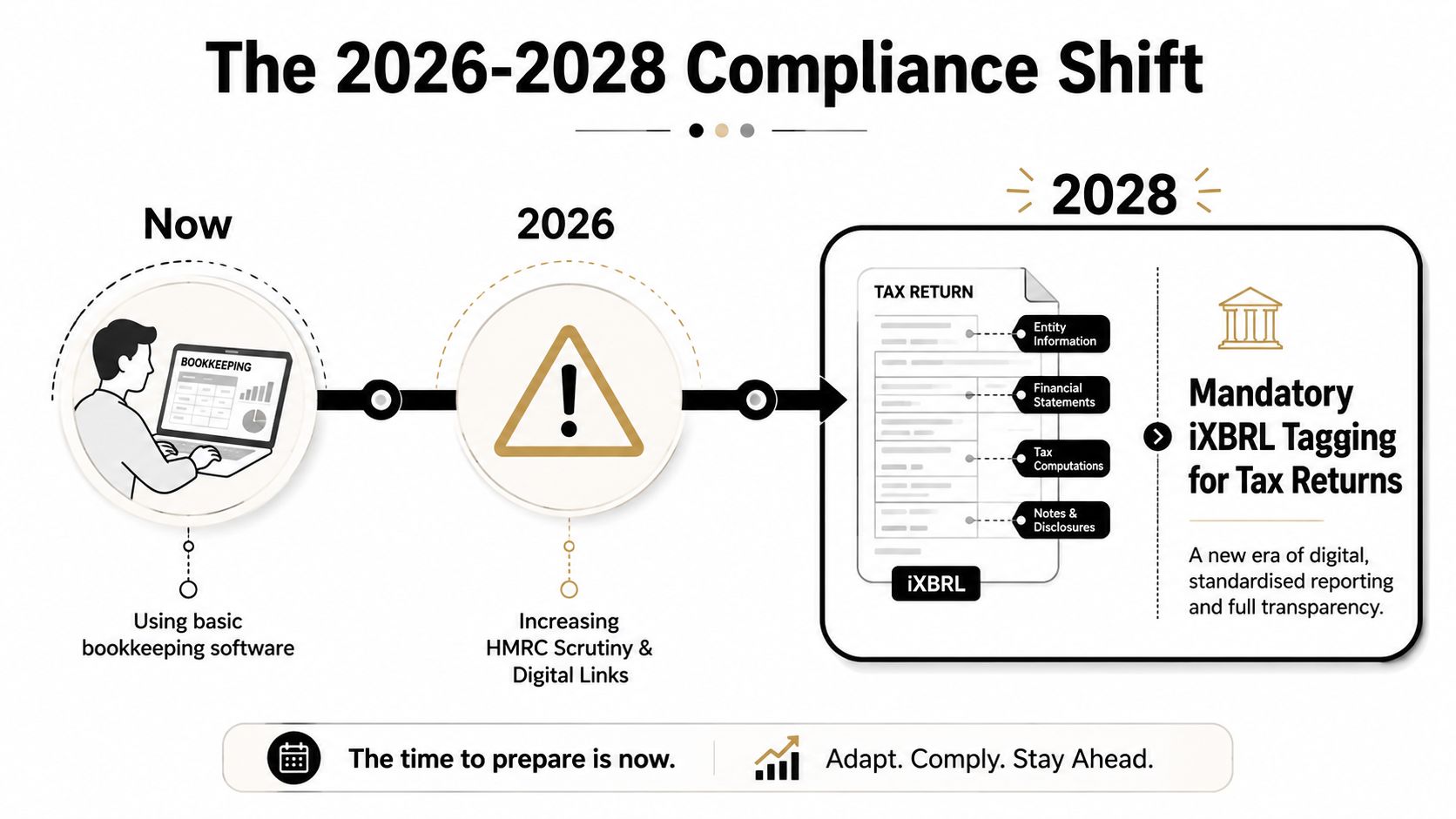
The technical requirements are also changing. Company law changes announced in 2026 state that, from 1 April 2028, accounts filings are planned to use commercial software in iXBRL format, ending Companies House web and paper routes for accounts filings. A timeline graphic showing the shift from basic bookkeeping to mandatory iXBRL digital tax reporting by 2028.
The software assumption needs challenging
iXBRL is structured digital reporting. Information must be tagged so software and other systems can read the accounts consistently. A director who currently uploads basic information manually may need a commercial platform, plus enough understanding to confirm that the tagged accounts match the company's records. ICAEW's guide to iXBRL explains the reporting format.
Companies House processing problems add another risk. ICAEW reported that service issues in June 2026 could still lead to late-filing penalties, with appeals available only in specific cases. ICAEW's report on Companies House filing delays shows why submitting at the deadline is poor risk management. Build in review time, or have an accountant handle the filing.
Proposed changes requiring small companies and micro-entities to file fuller profit and loss information have been paused, according to recent guidance. That pause does not remove the need to monitor the rules. A DIY director must keep track of filing changes instead of assuming today's process will remain unchanged.
The following video provides useful context for contractors assessing the wider compliance requirements.
How to Decide for Your Own Contracting Setup
The right answer depends on the shape of your company, not on whether another freelancer manages their own books. Start with three filters.
First, measure contract complexity
A single client, stable working arrangement and straightforward invoices create a simpler bookkeeping pattern. Multiple clients, changing assignments, subcontractors, reimbursed costs or contracts with different IR35 determinations require more judgement.
Second, assess how money leaves the company
A contractor receiving most income through a PAYE-style arrangement may have fewer dividend decisions. A company paying a salary, distributing dividends, claiming expenses and retaining funds for Corporation Tax needs tighter administration. The more routes money takes, the more opportunities there are for an incorrect record or unsupported payment.
Third, price your attention
Ask how long compliance takes you each month and what you could do with that time. Then ask whether you understand the accounts, Corporation Tax calculation, CT600 and dividend paperwork well enough to review the finished work.
A steady inside-IR35 contractor with a basic PAYE-style setup may reasonably use software and handle routine bookkeeping. A mixed-status contractor moving between assignments should usually involve an accountant. A high-rate outside-IR35 contractor with substantial expenses and dividends should treat specialist advice as part of the operating cost.
Your answer to “do I need an accountant for a limited company?” should therefore reflect contract complexity, tax decisions, available time and risk tolerance. Choosing DIY because it is legally permitted is not the same as choosing it because you are equipped to do it properly.
Three Real Contractor Scenarios Side by Side
These examples are decision illustrations, not claims about named businesses or measured outcomes. They show how the same legal structure can create very different accounting demands.
The first contractor works inside IR35 on a fixed 12-month contract. Most income is handled through PAYE, dividend extraction is limited and the company has relatively simple transactions. DIY bookkeeping may be workable if the director keeps records consistently, but Corporation Tax timing and the annual accounts still need attention.
The second contractor moves between inside and outside IR35 assignments during the year. Different contract arrangements can produce different payroll, invoicing and expense questions. An accountant becomes more useful here, because the director needs a consistent view of the company rather than isolated answers for each invoice.
The third contractor is a high-rate outside-IR35 specialist. They take larger dividends, claim more business expenses and are considering the £50,000 state pension cap mentioned in the planned scenario. Here, tax planning decisions can matter more than the bookkeeping mechanics, and a specialist accountant can test whether the proposed withdrawals and expenses are properly supported.
| Scenario | DIY Outcome | Accountant Outcome |
|---|---|---|
| Steady inside-IR35 contractor on a fixed 12-month contract | Routine records may be manageable, but deadline control and Corporation Tax timing remain the director's responsibility | Payroll and year-end filings are organised, with less administrative effort |
| Contractor moving between inside and outside IR35 work | Greater risk of inconsistent treatment across contracts, expenses and payments | The accountant can review changes and keep the company's records aligned |
| High-rate outside-IR35 specialist taking larger dividends | More time spent checking distributable profits, expenses and tax consequences | Advice focuses on lawful extraction, records and tax planning rather than basic data entry |
The practical outcome isn't just “more take-home” or “less tax”. An accountant can't remove tax that the company legitimately owes, and no adviser can make unsupported expenses acceptable. The benefit is a clearer process, earlier decisions and less chance that the director discovers a problem after filing.
For the first scenario, DIY may be sensible. For the second, professional input is the safer default. For the third, refusing to obtain advice to save the fee is usually a false economy.
Your Decision Checklist and What to Do Next
Run through this checklist before deciding:
- Contract type: Are you working under one stable arrangement, or several contracts with different terms?
- IR35 status: Do you understand how each determination affects the way the company receives and pays out money?
- Turnover and profit: Can you forecast the company's position without confusing turnover, profit, cash and distributable reserves?
- Transactions: Will you reconcile invoices, expenses and bank entries consistently?
- Dividends: Are you confident that each dividend is supported by the company's accounts and documented correctly?
- Corporation Tax: Could you prepare and review the CT600 rather than submit figures generated by software?
- Deadlines: Can you meet the Companies House, HMRC, payroll and confirmation statement dates without relying on last-minute reminders?
- Future readiness: Are you prepared to use commercial software and check iXBRL accounts filing requirements before 1 April 2028? Business.gov.uk outlines the planned iXBRL change.
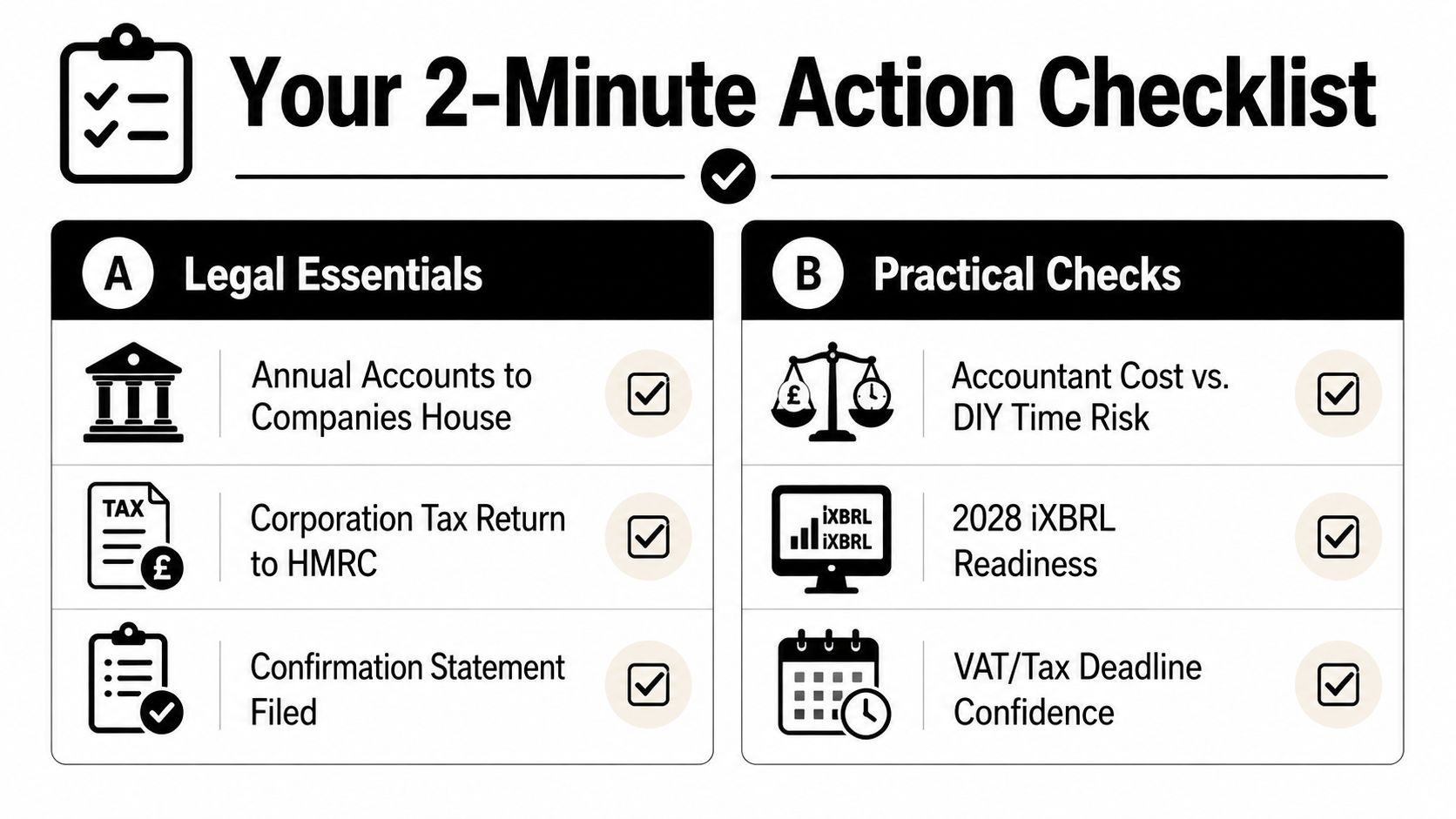
If four or more answers point towards complexity, price an accountant before committing to DIY. Compare the annual fee with your own time, the cost of suitable software, the likelihood of contract changes and the consequences of an inaccurate or late filing.
A dormant company doesn't escape the decision. GOV.UK confirms that dormant companies still need to file annual accounts and a confirmation statement with Companies House. The dormant company filing guidance explains why inactivity doesn't remove those duties.
You don't have to appoint an accountant because you formed a limited company. You do need a reliable process for every filing, every record and every payment. If you can't explain that process clearly, professional support is the sensible next step.
Umbrella Company helps contractors and freelancers compare umbrella options and provides limited company accountancy support, including services such as a registered address and Self Assessment assistance. Visit Umbrella Company to compare your options and decide whether specialist support fits your contracting setup.


