


The biggest difference between taking a salary and paying yourself dividends comes down to one thing: tax efficiency.
For UK contractors working outside IR35, the go-to strategy is almost always a low salary combined with dividends. Why? It dramatically reduces, and sometimes completely wipes out, your National Insurance Contributions (NICs). In sharp contrast, a straight salary gets hit with both employee and employer NICs, which means less money in your pocket at the end of the day.
Structuring Your Pay as a UK Contractor

Welcome to the definitive guide on the salary versus dividends debate, a conversation every UK contractor with a limited company needs to have. We are here to cut through the jargon and clearly explain the two main ways you can pay yourself, breaking down exactly how they are taxed and managed.
Getting your head around these differences is absolutely crucial for maximising your take-home pay. While one route might look simpler on paper, the other can unlock some serious financial benefits, especially if your contracts fall outside of IR35. Our goal is to give you the clarity you need to make the best decision for your business and your finances.
In this guide, we will walk you through:
- What salary and dividends actually mean for a company director.
- A detailed look at the tax and National Insurance implications for each.
- How your IR35 status ultimately decides your payment options.
- Real-world scenarios to help you figure out the right structure for you.
To kick things off, let's start with a quick side-by-side look at the key differences.
Quick Comparison: Salary vs Dividends
This table gives you a snapshot of the core distinctions between drawing a salary and issuing dividends from your limited company.
| Feature | Salary | Dividends |
|---|---|---|
| Source of Funds | Paid before Corporation Tax is calculated. | Paid from profits after Corporation Tax. |
| Nature of Payment | A reward for your work as an employee/director. | A distribution of company profits to shareholders. |
| Tax Treatment | Subject to Income Tax and National Insurance. | Subject to Dividend Tax but not NI. |
| Business Impact | An allowable business expense, reducing profit. | Not treated as a business expense. |
| Typical Strategy | Often kept low to minimise PAYE liabilities. | Used to extract the majority of company profits. |
This table is just the starting point. The real value comes from understanding how these factors play out in your specific financial situation.
By the time you have finished this guide, you will have a much clearer picture of what each choice means for your take-home pay, your tax bill, and your company's financial health. For a deeper dive, you can learn more about how to structure your contractor income in our detailed article.
Understanding Your Payment Options
To really get to grips with the salary versus dividends question, you first need to understand what each one actually is from a limited company director's point of view. While both methods get money into your bank account, HMRC sees them as fundamentally different beasts, and that has massive implications for your tax planning.
Think of them as two separate routes for taking cash out of your business. Each has its own rulebook and tax consequences. Nailing these basics is the first real step to building a payment structure that is as tax-efficient as possible.
What Is a Salary?
A salary is what it sounds like: a fixed, regular payment you get from your company for the work you do as its director or employee. It is handled through the Pay As You Earn (PAYE) system, exactly like in a conventional job.
This means your salary gets hit with both Income Tax and National Insurance Contributions (NICs). But what is really key here is that your company also has to pay employer’s NICs on top of your salary, which is an extra cost to the business. The upside? Your gross salary and the employer’s NICs are both allowable business expenses, which lowers the company's profit and, in turn, its Corporation Tax bill.
Most contractors intentionally keep their salary low, usually right around the National Insurance threshold. This nifty strategy means you qualify for state benefits like the State Pension without actually paying much, or any, National Insurance.
What Are Dividends?
Dividends, on the other hand, are totally different. They are not a payment for your time and effort; they are a share of the company's profits paid out to its shareholders. For the typical contractor, you are wearing both hats: you are the sole director and the sole shareholder.
Here is where the distinction really matters:
- Dividends are paid from post-tax profits. This means your company has to work out its profit and pay Corporation Tax on it first.
- Whatever profit is left over can then be paid out as a dividend.
- Crucially, dividends are not subject to National Insurance Contributions.
That last point is the big one. The lack of NICs is the main reason the low-salary, high-dividend model is the go-to strategy for UK contractors working outside IR35. It simply means more of your hard-earned money ends up in your pocket compared to taking the same amount purely as salary.
A Detailed Comparison of Tax and National Insurance
When you are weighing up dividends versus salary, the biggest factor by far is how HMRC treats them. The differences in tax and National Insurance Contributions (NICs) are not just small details, they have a massive impact on your take-home pay. Getting your head around these rules is the first step to structuring your income efficiently.
A salary gets hit by two things: Pay As You Earn (PAYE) Income Tax and National Insurance. Dividends, however, are only subject to Dividend Tax. Crucially, they are completely free of NICs. This single fact is why the low-salary, high-dividend model is the go-to strategy for contractors working outside IR35.
The Tax Treatment of a Salary
When you pay yourself a salary from your limited company, it runs through the PAYE system. This means your company deducts Income Tax and National Insurance before the money even hits your bank account, exactly like a permanent employee.
The tax you pay is based on progressive bands. For the 2024/25 tax year, the rates for the UK (excluding Scotland) are:
- Personal Allowance: 0% on earnings up to £12,570.
- Basic Rate: 20% on earnings from £12,571 to £50,270.
- Higher Rate: 40% on earnings from £50,271 to £125,140.
- Additional Rate: 45% on earnings over £125,140.
But that is not all. National Insurance is also due. Class 1 NICs are applied in two ways:
- Employee’s NICs: A percentage is taken directly from your gross salary.
- Employer’s NICs: Your company has to pay an additional percentage on top of your salary.
This "double hit" from NICs eats into the net pay from a salary, making it a pretty inefficient way to take large sums out of your company. It is why most contractors opt for a small salary, often just enough to qualify for the State Pension, and take the rest of their income in a more tax-friendly way. If you want to dig deeper into this, our guide on how to pay less National Insurance as a contractor has some useful strategies.
The Tax Advantage of Dividends
Dividends have a completely different tax profile. Because they are paid from post-tax company profits, HMRC treats them more gently on the personal tax front. The game-changing benefit is the total absence of National Insurance for both you and your company.
Dividend income has its own set of rates and allowances:
- Dividend Allowance: You can earn a certain amount in dividends each year, tax-free. For 2024/25, this is £500.
- Basic Rate: 8.75% on dividends that fall within your basic rate Income Tax band.
- Higher Rate: 33.75% on dividends in your higher rate band.
- Additional Rate: 39.35% on dividends in your additional rate band.
As you can see, these rates are much lower than their Income Tax equivalents. The combination of lower tax rates and zero NICs creates a huge tax saving, which is the whole point of using dividends to pay yourself.
Key Takeaway: The absence of National Insurance on dividends is the single most important factor in the dividends versus salary debate. It allows contractors to retain a significantly larger portion of their company’s profits compared to taking the same amount as salary.
How Government Policy Has Shifted the Balance
This tax efficiency gap between salary and dividends has not always been the same. Over the years, government policy has tweaked the rules, which just goes to show why contractors need to keep up to date.
For instance, between 2010 and 2016, dividends were an incredible deal. Basic rate taxpayers paid just 7.5%, and higher rate taxpayers paid 32.5%. This was a world away from the income tax rates of 20% and 40% on salary. Unsurprisingly, when the government announced reforms in 2015, there was a huge rush of dividend payments as directors pulled profits out before the higher rates kicked in. You can see the historical rates yourself on the government's website.
This context is important. It shows that while the salary-dividend split is the most efficient structure for outside IR35 contractors right now, tax rules can and do change. For those working inside IR35 through an umbrella company, this comparison is just as relevant, as their income is treated entirely as salary, meaning they cannot access these dividend tax advantages at all.
Calculating Your Take-Home Pay in Practice
It is one thing to talk about the theory behind the dividends versus salary debate, but it is the numbers that really tell the story. To show you just how big a difference your payment structure can make, let’s run through a practical, side-by-side comparison. This will bring home exactly how a tax-efficient model impacts what you actually keep.
We will look at the most common strategy for contractors operating outside IR35 through their own limited company. This involves taking a small salary, usually pegged to the National Insurance threshold, and then drawing the rest of the company’s profits as dividends. We will compare this directly against the far less efficient method of taking the entire amount as a straight salary.
The Scenario: A £90,000 Contract
Let's imagine a contractor, Alex. His limited company has just billed £90,000 for a project. To keep the numbers clean and focused on the pay structure, we will assume there are minimal business expenses. Now, Alex has to decide how to pay himself.
Here are the two options on the table:
- Salary-Only Model: Alex pays himself the full £90,000 as a gross salary.
- Low Salary/High Dividend Model: Alex pays himself a small salary of £12,570 (matching the 2024/25 Personal Allowance) and takes the rest as dividends.
This chart breaks down the fundamental tax differences that drive the outcome of our calculations.
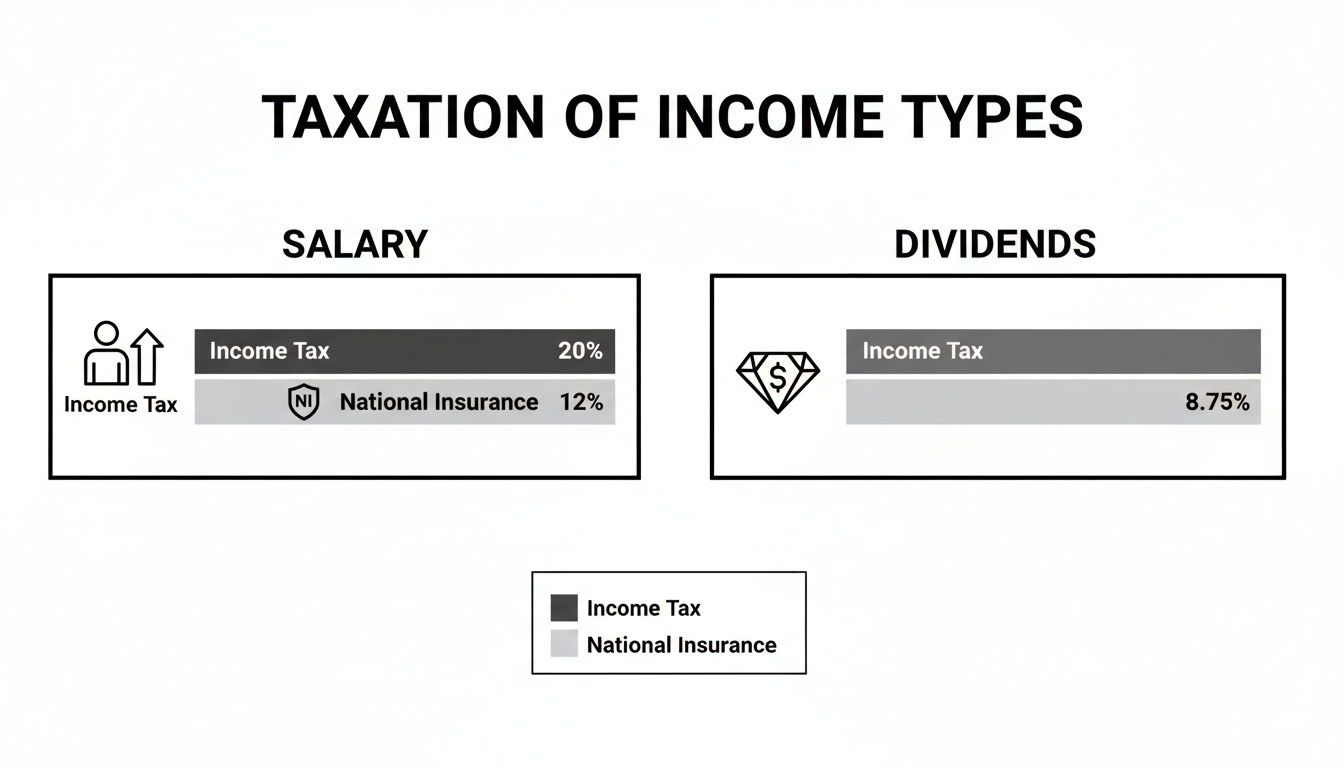
The crucial point is that salaries get hit by both Income Tax and National Insurance. Dividends, on the other hand, are only subject to Dividend Tax, which opens up some serious potential for savings.
The Calculations Unpacked
Let’s get into the nitty-gritty of both models. The table below lays out a simplified comparison, showing how each approach affects Corporation Tax, personal taxes, and, most importantly, Alex's final take-home pay.
Take-Home Pay Comparison for a £90,000 Contract
| Metric | Salary-Only Model | Low Salary/High Dividend Model |
|---|---|---|
| Gross Company Revenue | £90,000 | £90,000 |
| Director's Salary | £90,000 | £12,570 |
| Employer's NICs (@ 13.8%) | £10,030 | £0 (below threshold) |
| Company Profit (before CT) | (£10,030)* | £77,430 |
| Corporation Tax (@ 19%) | £0 | £14,712 |
| Profit Available for Dividend | £0 | £62,718 |
| Employee's NICs (@ 8%) | £3,018 | £0 |
| Income Tax (on Salary) | £23,332 | £0 |
| Dividend Tax | N/A | £4,388 |
| Total Tax Paid | £36,380 | £19,100 |
| Net Take-Home Pay | £53,620 | £70,800 |
*In the salary-only model, the high salary and employer's NICs create a business loss, so no Corporation Tax is due.
The results are stark. By opting for the low salary and high dividend model, Alex’s net take-home pay is £70,800. This is a staggering £17,180 more than the £53,620 he would receive if he took the entire amount as salary.
This huge difference is almost entirely down to avoiding National Insurance Contributions. In the salary-only model, a combined £13,048 is lost to employee's and employer's NICs. In the mixed model, this liability disappears completely because the salary is set below the payment threshold.
Why This Matters for You
These figures really highlight why structuring your pay correctly is so critical. The savings are not just marginal; they represent a massive boost to your personal income.
Of course, every contractor's situation is unique, with different revenues and expenses, but the principle holds true. Minimising your National Insurance liability through a smart salary-dividend mix is the most effective way to maximise your earnings when working outside IR35.
These are simplified calculations, naturally. For a more tailored estimate based on your specific contract rate and business costs, we recommend plugging your own numbers into our dedicated limited company take-home calculator. It is the best way to see the potential benefits for yourself.
Navigating the Impact of IR35

The off-payroll working rules, better known as IR35, are arguably the biggest factor in the dividends versus salary debate for contractors. If a contract is deemed ‘inside IR35’, the tax-efficient structure of taking dividends is simply not an option. The legislation completely changes how you are allowed to be paid for that specific project.
Essentially, an ‘inside IR35’ determination means you are treated as an employee of your client for tax purposes. Because of this, all the income you generate from that contract has to be processed as if it were a salary. It is subject to the full weight of PAYE Income Tax and both employee’s and employer’s National Insurance Contributions.
The Financial Penalty of an Inside IR35 Status
This forced switch from a flexible dividend model to a standard salary has a massive financial impact. All the tax efficiencies that make running a limited company so appealing are wiped out for any work that falls inside IR35. There is no longer a choice to draw profits through lower-tax dividends.
The difference in your take-home pay can be eye-watering, often leading to a reduction of 20-25% compared to an identical contract that is outside IR35. This really drives home why getting a correct and fair IR35 status determination is so critical for every assignment you take on.
An inside IR35 determination effectively aligns your tax position with that of a traditional employee for that contract. It eliminates the financial advantages of operating as a separate business entity, reinforcing the need for careful contract review and status assessment.
The Role of an Umbrella Company
This is exactly where umbrella companies have become a crucial part of the contracting world. When a contract is determined to be inside IR35, the most common and compliant route to getting paid is to work through an umbrella company. We become your employer for the duration of that specific contract.
It is a straightforward process:
- We sign a contract directly with your recruitment agency or the end client.
- You then become our employee, complete with a proper contract of employment.
- We invoice the client for the work you have done and collect the payment.
- From there, we process your payment as a salary, making all the necessary deductions for tax and NICs before paying you.
This system guarantees full compliance with HMRC’s off-payroll working rules. It also lifts the administrative weight off your shoulders, as we manage all the calculations, deductions, and reporting to HMRC. For a complete breakdown, you can learn more about how IR35 works for contractors in our guide.
Understanding the Historical Context
The classic model of a low salary topped up with dividends has long been a powerful way for company directors to lower their tax bills. Research from the Institute for Fiscal Studies, looking at HMRC data between 2000 and 2016, showed just how much dividends boosted the incomes of the UK’s top earners. This blend was the gold standard for contractors working outside IR35.
For contractors now finding themselves working inside IR35 via an umbrella, this history starkly highlights the financial hit the legislation has caused. With your income fully taxed as salary, you could be taking home thousands of pounds less each year compared to the old dividend route. It is a reality that makes it more important than ever to compare umbrella company providers carefully to ensure your net pay is compliantly maximised.
How to Choose the Right Structure for You
Deciding how to pay yourself is one of the most important calls you will make as a contractor. When it comes to salary versus dividends, there is no single right answer; it hinges entirely on your circumstances, your contracts, your financial goals, and frankly, how much admin you are prepared to deal with.
Getting this right directly impacts your take-home pay, your tax bill, and even your ability to get a mortgage. Let's walk through how to assess your situation and pick the most sensible and compliant path forward.
Your IR35 Status Is the Deciding Factor
Before anything else, you need to know where you stand with IR35. The off-payroll working rules are the first and final word on how you can structure your income.
If your contract is Outside IR35: You have the freedom to operate your limited company as a genuine business. This opens the door to the highly tax-efficient low salary, high dividend model. By taking a small salary up to the National Insurance threshold and drawing the rest as dividends, you can legally minimise your NI bill and maximise what you take home.
If your contract is Inside IR35: The rules tighten up considerably. You are treated as an employee for tax purposes, which means taking dividends is off the table. All your income from that specific contract must be processed as a salary, subject to full PAYE tax and National Insurance. For inside-IR35 work, a compliant umbrella company is the standard, no-fuss solution.
Pinning down your IR35 status for each contract is not just good practice, it is a legal necessity that dictates everything that follows.
How Much Admin Can You Stomach?
Running a limited company and managing a salary-dividend split is not without its own to-do list. You are responsible for bookkeeping, filing annual accounts, submitting confirmation statements, and declaring dividends correctly. An accountant can handle the heavy lifting, but the buck always stops with you as the director.
It really comes down to personal preference:
Want full control and maximum tax efficiency? If you are comfortable with the administrative side (or happy to pay an accountant for it) and your work is outside IR35, a limited company offers the highest potential take-home pay.
Prefer simplicity and zero paperwork? If you just want a straightforward, 'plug-and-play' setup, an umbrella company is a great choice. This is the go-to for inside-IR35 contracts, but it is also perfect for any contractor who simply wants to avoid the hassle of running a company. We handle all the tax and NI calculations, and you just get a simple payslip.
What Are Your Financial Goals?
Your long-term plans also have a say in this. While dividends are great for boosting your immediate income, a consistent salary can be more helpful in other areas of your life.
For big financial steps like getting a mortgage, lenders often favour the predictability of a regular salary. While specialist contractor mortgage brokers understand dividend income, a steady stream of PAYE payslips from an umbrella company can sometimes make the application process much smoother.
Think about what is on the horizon:
- Applying for a mortgage or a loan? A consistent salary, shown through payslips from your own limited company or an umbrella, provides the clear proof of income that lenders love to see.
- Planning for retirement? Salary payments qualify for pension contributions, and your company can contribute to your pension as a tax-deductible expense. You can still contribute from dividend income, but the mechanisms are different. A steady salary makes pension planning more predictable.
Making the Final Call
Choosing your payment structure is a balancing act between tax efficiency, compliance, admin, and your personal goals. For contractors whose work is clearly outside IR35, the financial upside of the low salary, high dividend model is hard to ignore and remains the most popular way to maximise income.
However, for anyone with contracts inside IR35, or contractors who simply value peace of mind above all else, a compliant umbrella company is the most logical and secure route. It removes the administrative burden and ensures you are always paying the right tax, freeing you up to focus on what you do best.
Frequently Asked Questions
Choosing between a salary and dividends is a big decision for any contractor. It directly impacts your tax bill and how much admin you will have to deal with. It is only natural to have a few questions.
Here, we will run through some of the most common queries we get from UK contractors, giving you clear, straightforward answers. The goal is to help you feel confident you are making the right call for your limited company.
What Is the Optimal Salary for a Contractor?
For most limited company directors working outside IR35, the sweet spot for a salary is usually around the National Insurance Secondary Threshold. A really popular strategy for the 2024/25 tax year is to take a salary right up to the Personal Allowance of £12,570.
This setup is incredibly tax-efficient, and here is why:
- No Income Tax: Your salary is completely covered by your tax-free Personal Allowance.
- No National Insurance: It falls below the point where employee’s and employer’s NICs kick in.
- Qualifying Year: Crucially, it is still high enough to count as a qualifying year towards your State Pension.
This structure lets you build up your state pension entitlement without actually paying any significant tax or NI on your salary. You can then take the rest of your income as dividends.
How Do I Legally Declare Dividends?
Paying yourself dividends is not as simple as just moving cash from your business account to your personal one. To satisfy HMRC, it needs to be a formal, documented process.
To issue a dividend correctly, you must:
- Hold a directors' meeting to declare the dividend. You have to create minutes for this, even if you are the only director.
- Check you have enough profit. The company must have sufficient post-tax profits to cover the full dividend amount.
- Create a dividend voucher for every shareholder getting a payment. This little document needs to show the date, company name, shareholder's name, and the amount paid.
It is illegal to pay a dividend if your company does not have enough retained profit to cover it. These are called 'ultra vires' or illegal dividends, and they can cause serious trouble with HMRC.
Can I Pay into a Pension from Dividends?
Yes, you can absolutely contribute to a personal pension from the income you have received as dividends. But, there is a much more tax-efficient way to do it.
The best approach is to make employer contributions directly from your limited company into your pension.
When your company does this, the payment is treated as an allowable business expense. This reduces your company's profit, which in turn lowers its Corporation Tax bill. It is a far more efficient method than making personal contributions from your dividend income, which has already been taxed.
Figuring out the best payment structure can feel complicated, but you do not have to go it alone. At UmbrellaCompany.com, we help contractors compare trusted, compliant umbrella solutions to find the perfect fit. Find and compare your ideal umbrella company today.


