


You've reached the end of a contract year, checked the company bank account and found a healthy balance. The immediate question is familiar to many contractor directors: should you take the money as salary, dividends, or a mixture of both? The answer depends on more than the cash available. You need to consider distributable profits, corporation tax, dividend tax, salary, National Insurance, personal allowances and, where relevant, IR35.
This guide explains how dividends work in a UK limited company, how to declare and document them, and how the 2026/27 dividend tax changes affect a contractor's take-home pay. You'll also find a practical salary-and-dividend framework and a worked example showing how the figures fit together.
Why Contractor Directors Pay Themselves in Dividends
A contractor director closes the company's year-end accounts and sees £80,000 left in the business. That balance looks like personal income, but it isn't. A limited company is a separate legal person, so money in its bank account belongs to the company until it's formally transferred as salary, reimbursed expenses, a director's loan repayment or a dividend.
Dividends are attractive because they're distributions to shareholders from profits left after corporation tax. They aren't a substitute for company cash management, though. The company must have enough distributable profit, and the dividend must be declared properly.
Salary and dividends also follow different tax routes. Salary is employment income processed through PAYE, while dividends are paid because the director owns shares. A contractor may therefore use salary for regular remuneration and dividends for some of the remaining post-tax profit.
Practical rule: A bank balance tells you how much cash the company holds. The accounts tell you whether the company can lawfully distribute it.
The phrase dividends limited company often appears in searches because the arrangement can look simple from the outside. In reality, the director needs to connect three separate questions:
- Can the company pay? Check retained realised profits and accumulated losses.
- How should the director be paid? Compare salary, dividends and other legitimate payments.
- What personal tax follows? Consider total income, the dividend allowance and the relevant tax band.
Readers who want a broader explanation of how dividends compare with other ways of earning a return may find The Money Maniac's guide to dividends and interest useful alongside professional tax advice.
The rest of this guide covers declaration rules, the 2026/27 tax rates, salary planning, records, IR35 considerations and a worked contractor example. That gives you a framework for deciding whether your current extraction method still suits your company.
The Legal Foundation for Paying a Dividend
Think of retained profit as a cake. The company may only slice the cake that exists, and it can only place slices on plates represented by shares. A dividend is the portion formally handed to a shareholder, not money taken from the business bank account.
The Companies Act 2006 provides the central rule. A company may only make a distribution out of profits available for that purpose, with distributable profits determined from the company's accounts using applicable accounting principles. The practical test is accumulated realised profits less accumulated realised losses. HMRC guidance on distributions and distributable reserves reinforces that operating cash flow alone isn't enough.
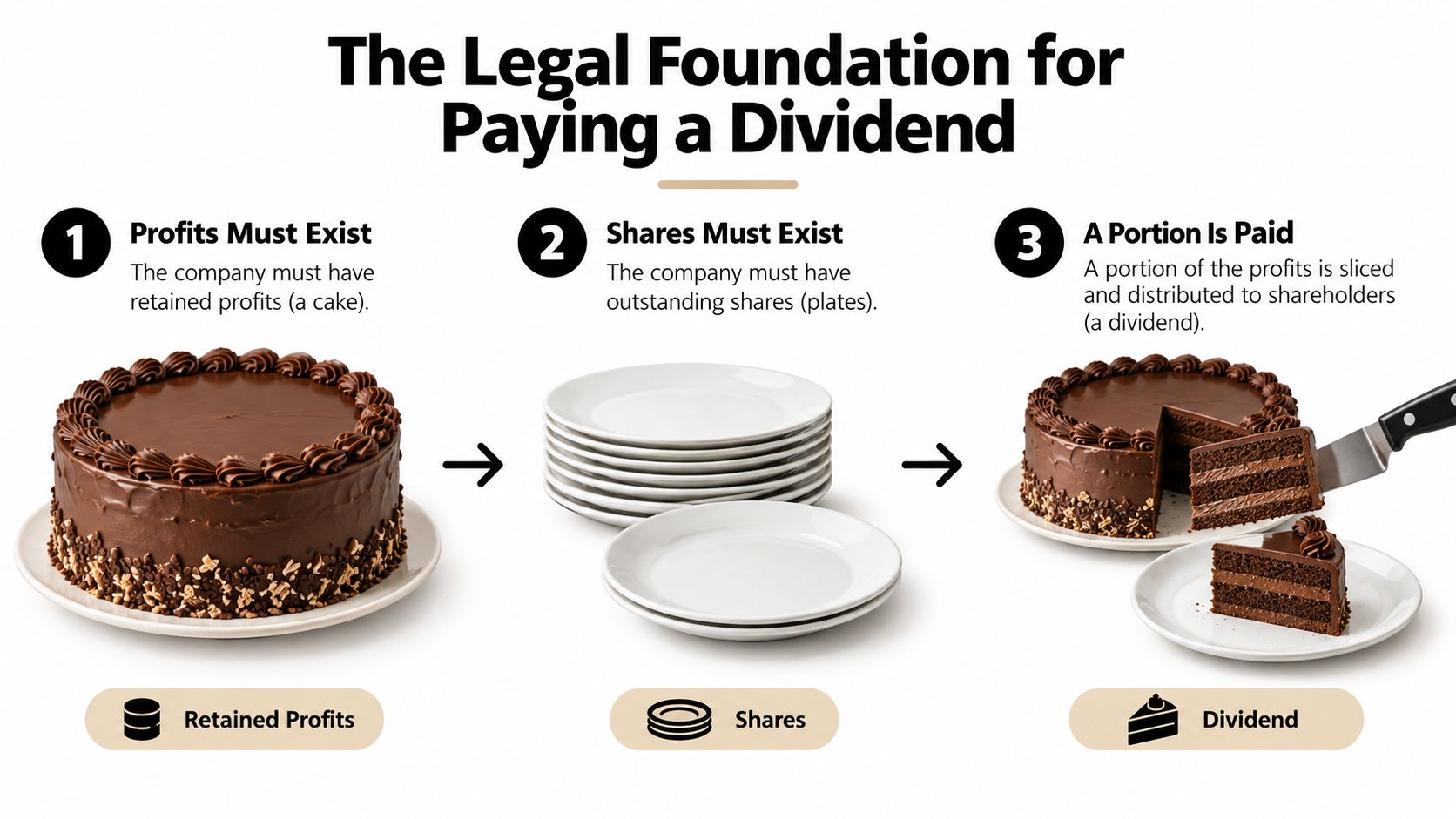
The checks before you slice the cake
Before declaring a dividend, work through the accounts rather than relying on the bank statement:
- Prepare suitable accounts. These might be interim management accounts or year-end accounts, depending on the type of dividend.
- Confirm genuine accumulated realised profits. Deduct accumulated realised losses before deciding what can be distributed.
- Check the share structure. The payment must respect the rights attached to the relevant share class and the shareholder's entitlement.
- Read the company documents. The articles of association and any shareholder agreement may contain restrictions or procedures.
- Keep the payment within the available amount. A dividend that exceeds distributable reserves is unlawful to the extent of the excess.
The board should be able to show how the accounts support the decision. That evidence matters if the payment is later questioned by HMRC, a liquidator or another shareholder.
A lawful dividend also needs a proper corporate decision. The board records the declaration, and the company prepares dividend vouchers for shareholders. Directors should avoid treating transfers from the company account as informal drawings.
An unlawful dividend can become a personal problem. The director may have to repay it, and the intended dividend treatment may no longer apply.
For a practical walkthrough of the paperwork and process, see our guide on how to pay yourself dividends.
How a Dividend Is Declared and Paid
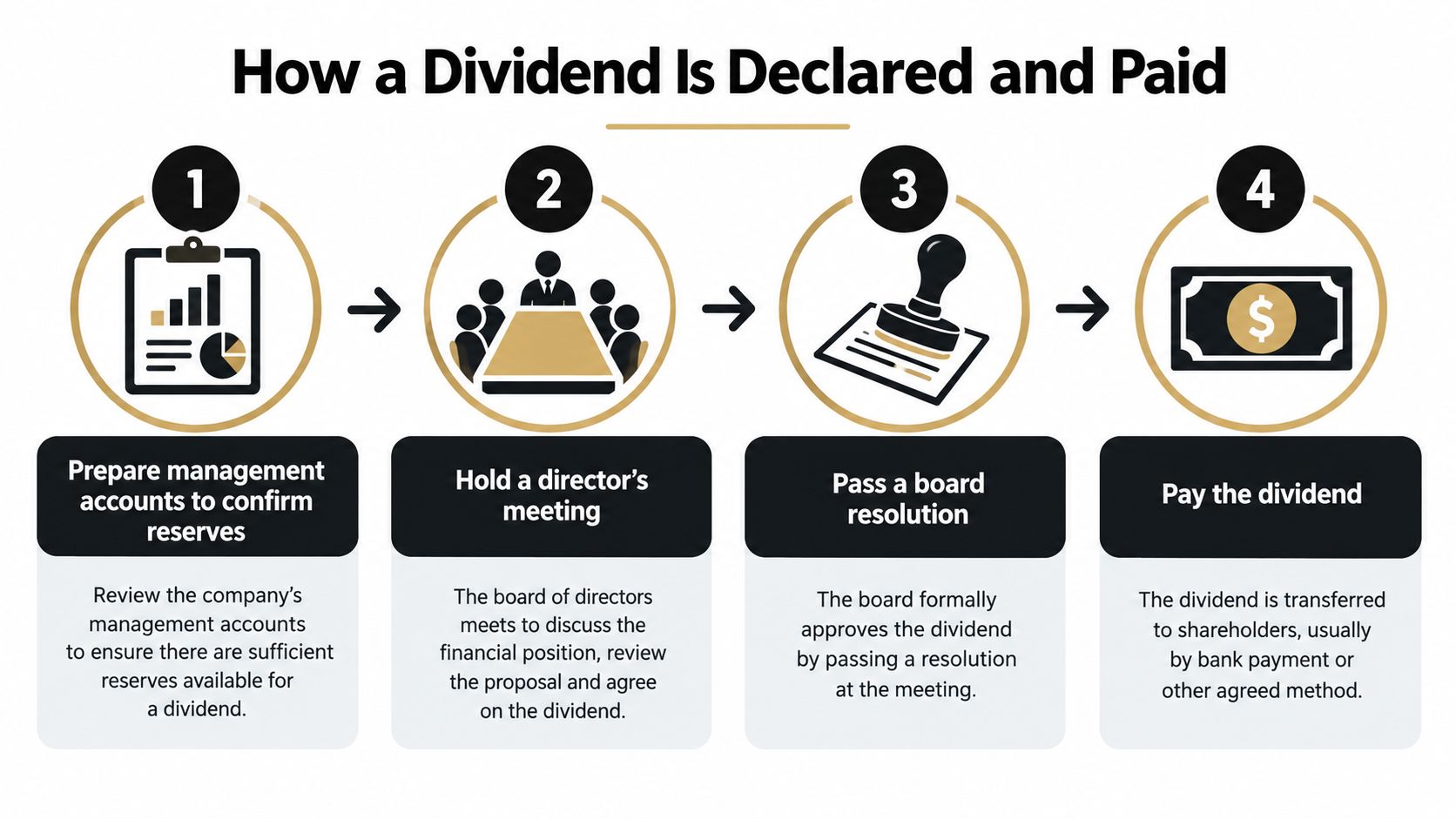
A director normally completes the dividend process in a set order. The paperwork isn't decorative. It creates the audit trail showing why the company could pay, who received the dividend and when the decision was made.
Start with the accounts
Prepare management accounts or year-end accounts that show the company's distributable reserves. The figures should account for relevant costs, tax provisions, prior realised losses and dividends already declared. A current bank balance can support the payment operationally, but it doesn't establish the legal entitlement.
An interim dividend is declared during the financial year, usually using recent management information. A final dividend is declared after the year-end, using the company's statutory accounts, whether audited or unaudited where the company's circumstances permit.
Record the board decision
Hold a short board meeting, even if you're the only director. The minutes should record:
- the date of the meeting;
- the accounts considered;
- the amount available for distribution;
- the dividend amount;
- the relevant share class and payment entitlement;
- the record date and payment date;
- the director's decision to declare the dividend.
The minute should make clear that the board considered the company's distributable profits. If several shareholders hold the same class of shares, the calculation should show how the per-share amount produces the total payment.
Issue vouchers and make the payment
Prepare a dividend voucher for each shareholder. It should show the company name, date, share class, amount per share and total dividend. Give the shareholder a copy and retain the company record with the board minutes and supporting accounts.
The company can then pay from its business bank account. If a shareholder leaves the money in the company, record the amount properly rather than assuming no payment occurred. The accounting entry should reflect the declared liability and the shareholder's position.
Directors often declare dividends monthly or quarterly to create predictable personal cash flow. That can work, but each declaration still needs enough supporting profit. The date of declaration also matters for the shareholder's tax reporting, so keep the timing consistent with the company records and accounting period.
Dividend Tax Rates and the Allowance for 2026/27
From 6 April 2026, the dividend ordinary rate rises from 8.75% to 10.75%, while the upper rate rises from 33.75% to 35.75%. The additional rate remains 39.35%, and the dividend allowance remains £500, according to HMRC's 2026/27 dividend rate changes.
The allowance applies to the first slice of dividend income. It isn't an extra payment from the company, and it doesn't remove the need to report dividend income where Self Assessment applies. Dividends still sit on top of other taxable income when you work out which band applies.
The personal allowance is £12,570, and the main income-tax bands run around £12,571 to £50,270, £50,271 to £125,140, and above £125,140 for the purposes of the 2026/27 dividend interaction described in the supplied HMRC guidance. The personal allowance is tapered away once adjusted net income reaches £100,000, which can make additional dividend income more expensive because it can reduce the tax-free income available elsewhere.
| Tax Band | Dividend Rate | Income Range | Effective Rate on £1k Dividend |
|---|---|---|---|
| Dividend allowance | 0% | First £500 of dividend income | £0 tax on the allowance slice |
| Basic rate | 10.75% | Around £12,571 to £50,270 | £107.50 before considering any unused allowance |
| Higher rate | 35.75% | Around £50,271 to £125,140 | £357.50 before considering any unused allowance |
| Additional rate | 39.35% | Above £125,140 | £393.50 before considering any unused allowance |
The effective result depends on your salary and other income. A director with salary using the personal allowance may still have dividends taxed at the ordinary dividend rate. A director whose salary already fills the basic-rate band can see the next dividend taxed at the higher rate.
That's why the headline dividend rate isn't the whole answer. Our explanation of the UK dividend allowance helps put the £500 allowance into the wider calculation.
Salary and Dividend Mix for Contractor Directors
The right mix starts with the company's profit and ends with the director's personal tax position. A common framework has three layers:
- Salary and company relief. Salary is normally a company expense, so it reduces the profit on which corporation tax is calculated, subject to the wider PAYE and National Insurance position.
- Benefits and pension record. Salary can support qualifying state benefits and creates pensionable employment earnings, while dividends don't perform that role.
- Residual extraction. Once the company has accounted for costs, salary and corporation tax, the remaining distributable profit may be paid as dividends.
The company's corporation tax rate can be 25% on the relevant profits in the supplied contractor scenario. A dividend doesn't provide a second corporation tax deduction, because it's paid from post-tax profit. Salary can reduce company profit, but it creates PAYE and potentially employee and employer National Insurance costs.
How the 2026/27 tipping point moves
Consider a director whose salary and other income leave room within the basic-rate band. A dividend that would previously have faced 8.75% now faces 10.75%, so each £1,000 of dividend in that band produces £20 more personal dividend tax after the rate change, before considering the allowance. The comparison changes again once total income crosses the higher-rate boundary, where the rate moves from 33.75% to 35.75%.
For a basic-rate director, an unchanged salary-and-dividend plan can push the final dividends into higher-rate territory. That creates a double effect, the ordinary rate rises and the director may have less basic-rate capacity left. A higher-rate director already has more dividends taxed at 35.75%, so the proportional change may feel smaller, although the cash cost remains real.
The useful question isn't “Are dividends taxed at a lower rate?” It's “Which slice of my next dividend will be taxed at which rate after my salary and other income are included?”
Use a forecast rather than a fixed rule. Compare salary near the personal allowance, the salary level needed for your benefits and pension objectives, and dividends that keep total income within the basic-rate band where practical. Our dividend versus salary guide provides a further comparison, while this guide to contractor employment law can help with the separate employment-status issues that affect contractors.
Compliance, Records and IR35 Considerations
Declaring the dividend is only one part of the job. The director must preserve the evidence, report the income correctly and keep the company's statutory records aligned with what happened.
Records after payment
Keep the board minutes, supporting accounts and dividend vouchers together. The supplied compliance requirements call for dividend vouchers to be retained for at least six years, so use a consistent digital or paper filing system. The company's corporation tax return should reflect the company's accounts and dividend activity, while the director includes personal dividend income on Self Assessment where required.
Check the confirmation statement whenever shareholdings or share classes change. The shareholder record should agree with the dividend calculation. A mismatch can make an otherwise straightforward payment difficult to explain.
The most common practical trap is declaring a dividend from accounts that haven't been finalised or reviewed. If later adjustments reduce distributable profits, the original payment may exceed what the company could lawfully distribute.
Keep IR35 separate from extraction
A dividend from a personal service company doesn't determine employment status. IR35 looks at the relationship and working practices in the engagement, not at how the company later distributes its profits.
If an engagement falls inside the off-payroll rules, the deemed payment calculation can affect the amount available for extraction. Paying a dividend doesn't turn an inside-IR35 engagement into an outside-IR35 engagement, and it doesn't remove PAYE obligations that apply to the deemed payment.
Record-keeping habit: Save the accounts, resolution, voucher and payment evidence in one transaction folder before moving on to the next payroll cycle.
A practical annual diary should include the company accounts deadline, corporation tax filing and payment dates, Self Assessment registration and filing dates where relevant, and the personal tax payment date. Keep those dates separate from the dividend declaration date, because each serves a different compliance purpose.
A Worked Example for a Typical Contractor Director
Alex is a sole director and shareholder working through a limited company. Alex bills £450 a day for 220 days, giving the company gross revenue of £99,000. The company also has £22,430 of operating costs. After paying a £12,570 salary, that leaves £64,000 profit before corporation tax.
The calculation works like a set of connected accounts. Revenue pays for salary and operating costs first. Corporation tax then reduces the remaining profit, leaving the amount the company can distribute as dividends.
| Step | Amount (£) | What it represents |
|---|---|---|
| Daily rate | 450 | Contract rate |
| Working days | 220 | Contracted working days |
| Gross revenue | 99,000 | Company turnover before costs |
| Salary | 12,570 | Director remuneration |
| Operating costs | 22,430 | Company costs other than salary |
| Profit after salary and costs | 64,000 | Profit before corporation tax |
| Corporation tax at 25% | 16,000 | Tax on the £64,000 profit |
| Distributable reserves | 48,000 | £64,000 less £16,000 corporation tax |
| Dividend | 28,500 | Single shareholder distribution |
Alex can therefore declare a dividend of £28,500, provided the accounts support at least that amount of distributable reserves. Paying the full £48,000 is not required. Leaving £19,500 in the company gives it a reserve for future costs or a later distribution.
Alex checks the accounts, prepares a board minute, records the shareholder entitlement, issues a dividend voucher and pays the dividend from the company bank account. The paperwork is the evidence trail for the payment. The accounts are the proof that the company had enough profit to make it lawfully.
For personal tax, Alex uses the £500 dividend allowance first. The remaining £28,000 is taxed at the 2026/27 ordinary dividend rate of 10.75%, assuming Alex's other income leaves the dividend within that band. The resulting dividend tax is £3,010. Alex's salary and any other income must still be included when deciding which rate applies, because the dividend sits on top of those amounts.
Alex reports the dividend through Self Assessment, using the relevant dividend pages, including SA102 where employment income reporting applies, and sets aside funds for the personal liability. The company's corporation tax bill and Alex's dividend tax bill are separate responsibilities.
Contractors can compare different salary, reserve and dividend assumptions with our UK dividends calculator. An accountant should review the final figures where the company has complex share classes, losses or IR35 exposure.
Bringing It All Together
A lawful dividend follows a clear chain. The company needs genuine distributable profits, the board must declare the payment, the company must issue and retain vouchers, and the shareholder must report and pay any personal tax due through Self Assessment.
For 2026/27, three decisions deserve particular attention:
- Keep salary under review. A salary near the personal allowance may support company tax relief, but PAYE, National Insurance, benefits and pension objectives still matter.
- Size dividends against total income. Dividends can use up the remaining basic-rate band and move into the higher-rate dividend band sooner than expected.
- Recalculate every year. The ordinary dividend rate rises to 10.75%, the upper rate to 35.75%, and the allowance remains £500, so an old extraction pattern may no longer produce the same result. See HMRC's dividend tax guidance when checking the current position.
Review your PAYE scheme, reconcile the shareholder register with your dividend vouchers, and model more than one withdrawal pattern before declaring the next payment. If your contract falls inside IR35, compare the limited company route with compliant umbrella employment rather than assuming dividends remain available in the same way.
Umbrella Company helps contractors and freelancers compare umbrella providers, including options relevant to inside-IR35 work, pay rates and sector requirements. Visit Umbrella Company to compare your options and choose a route that fits your contract and payroll needs.


