


If you're looking at your company bank balance and wondering what you can safely take out, you're in the right place. Most contractors don't struggle with the idea of dividends itself. The confusion starts when salary, company profit, tax bands, IR35, and personal tax all collide.
A good dividends calculator uk tool helps, but the calculator is only as useful as the figures you put into it. If you start with the wrong profit number, or choose a salary level without understanding the knock-on effect, the result won't mean much.
That matters even more in 2026. A contractor outside IR35 still has room to plan how income is drawn from a limited company. A contractor inside IR35 doesn't have that flexibility, because income is usually processed through PAYE instead. The strategic choice comes first. The calculator comes second.
Your Guide to Contractor Dividends in 2026
Most limited company contractors reach the same decision point. The work is done, invoices have been paid, and the next question is simple on the surface, how much should you take as salary, how much as dividends, and what will land in your bank account?
The answer starts with understanding the order of events. Your company earns money. The company pays its own costs. The company then works out profit. Only after that can you look at what may be available for dividends. Personal tax comes after the company side has been dealt with properly.
For contractors, this isn't just a bookkeeping detail. Small choices can change the final outcome. A higher salary may reduce company profit. A larger dividend may push more of your personal income into a higher tax band. The best answer depends on the mix of company profit, salary, and any other income you already receive.
A useful way to think about it is this:
- Company decisions come first, because dividends can only come from available post-tax profits.
- Personal tax decisions come next, because dividends sit alongside your other income.
- IR35 status changes everything, because an umbrella arrangement usually removes the dividend option entirely.
Practical rule: Before you use any calculator, decide which question you're actually asking. Are you testing how much profit is available to distribute, or how much personal tax you'll pay on a dividend you've already planned?
Contractors often jump straight to the tax rates. That's understandable, but it skips the most important planning step. The figure you can draw from your company isn't the same as turnover, and it isn't always the same as cash in the bank either.
The Journey From Company Profit to Your Pocket
The cleanest dividend plan starts with one principle. Dividends are paid from company profit, not from turnover and not from guesswork.
If your company invoices clients and receives payment, that money isn't automatically yours to draw as a dividend. Some of it belongs to the business. Some of it will be used to cover running costs. Some of it will later be due to HMRC. What remains after those stages is what matters.
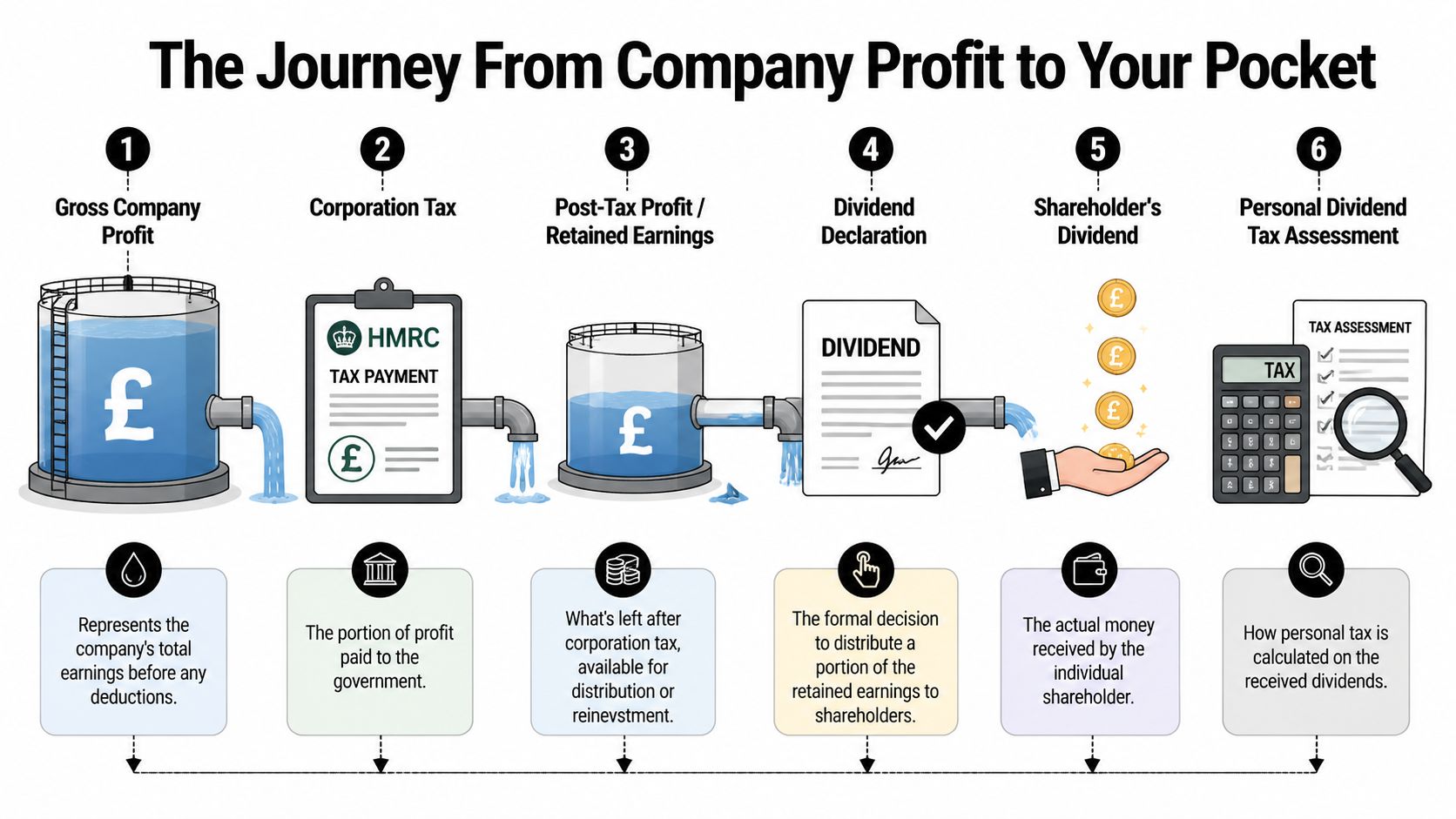
Revenue isn't dividend income
Start with gross income coming into the company. That may feel like your earnings, but legally and practically it's company money.
From there, the business pays its own costs. Common contractor costs might include software, insurance, accountancy fees, training, equipment, and other legitimate business expenses. Once those costs are deducted, you're left with company profit before tax.
That number is much more important than your annual invoicing total.
Corporation Tax sits between profit and dividends
A lot of confusion comes from treating pre-tax company profit as if it's available for distribution. It isn't.
The company has to meet its Corporation Tax obligations before you can sensibly decide how much profit is available to extract. What remains after that is often described as retained profit, retained earnings, or distributable reserves, depending on the context.
In plain English, it's the profit left in the company after tax that can potentially be paid out to shareholders or kept in the business.
If you skip this step and pay yourself from money that should have been reserved for tax, the problem usually appears later, when the tax bill arrives and the cash has already gone.
Dividends need a formal decision
A dividend isn't just a transfer from the business account to your personal account. It should reflect a real decision by the company to distribute part of its available profit to shareholders.
That matters because the calculator only deals with tax math. It doesn't confirm whether a dividend is legally payable. Good planning always starts with the company accounts being up to date enough to support the payment.
A sensible checklist looks like this:
- Check current profit, not just bank balance.
- Allow for tax, so you don't distribute money that should stay in the company.
- Confirm retained reserves, because dividends must come from available post-tax profit.
- Record the payment properly, so your personal tax return matches the company paperwork.
Why contractors get caught out here
Contractors often work with uneven cash flow. One month looks strong, the next includes VAT payments, software renewals, accountancy costs, or a quieter billing period. That can create a false sense of security if you only look at cash on hand.
A dividends calculator uk tool becomes much more useful once you've separated these stages:
| Stage | What it means |
|---|---|
| Gross revenue | What the company billed and received |
| Business expenses | Running costs paid by the company |
| Profit before tax | Earnings after expenses |
| Post-tax profit | What may be available for dividends |
| Dividend declared | The amount formally paid to shareholders |
| Personal tax | What you may owe on the dividend received |
This is the core contractor mindset. First, protect the company. Then decide what to extract. Then calculate the personal tax.
UK Dividend Allowances and Tax Rates for 2026/2027
For personal tax planning, the key point is straightforward. Dividend income sits on top of your other income. Your salary uses up allowances and tax bands first, then your dividends are assessed on what's left.
For the 2026/27 tax year, the dividend allowance remains £500, and the dividend tax rates are 8.75% for basic rate taxpayers, 33.75% for higher rate taxpayers, and 35% for additional rate taxpayers, according to the IT Contracting dividend tax calculator guidance. The same source notes that this continues the reduction from £5,000 in 2016/17 to £500.
The allowance and what it really means
The £500 dividend allowance doesn't mean dividends sit outside the tax system altogether. It means the first £500 of dividend income is taxed at a nil rate, while still forming part of your overall income position.
That point trips people up. Contractors sometimes assume the allowance is completely separate from the tax bands. It isn't. Your salary and dividends still combine when working out where your income lands overall.
The 2026/27 rates at a glance
Here is the rate structure for England, Wales, and Northern Ireland for 2026/27:
| Tax Band | Total Income (Salary + Dividends) | Dividend Tax Rate |
|---|---|---|
| Basic rate | Within the basic rate band | 8.75% |
| Higher rate | Within the higher rate band | 33.75% |
| Additional rate | Within the additional rate band | 35% |
The practical effect is simple. A modest director's salary can leave more room for dividends to fall into the lower dividend tax band. A larger salary uses up more of that band before dividends are added.
Why salary choice matters before you use a calculator
Strategy holds greater importance than software. If you enter a salary figure without thinking about what it does to your tax bands, you miss a key planning opportunity.
Many contractors deliberately test a lower salary and higher dividend mix because salary and dividends are taxed differently. If you want a more detailed walkthrough of that planning process, this guide on how to structure dividends for tax saving in the UK is a useful next step.
A calculator shows the result. Your salary decision creates the result.
The rates matter, but they only tell part of the story. The more important question is how much of your dividend falls into each band after salary and any other income have already taken their slice.
Use Our Interactive UK Dividends Calculator
Reading the rules helps. Running your own figures helps more.
A good interactive dividends calculator uk tool removes the manual work from a calculation that can become fiddly very quickly. Once you factor in company profit, salary, dividend allowance, and the way dividends stack on top of other income, it becomes easy to miss a step on a spreadsheet.
What the calculator is good for
The best use of a calculator isn't just checking one answer. It's testing choices.
You can change your planned salary, compare different dividend amounts, or see how another income source affects the final tax position. That matters for contractors because pay planning isn't static. A strong contract year can produce a very different answer from a quieter year or a year with gaps between assignments.
Useful inputs usually include:
- Your planned salary, because this affects your personal tax bands before dividends are added.
- Expected dividend level, so you can estimate personal tax on the amount you want to draw.
- Other personal income, if applicable, because your dividend tax doesn't exist in isolation.
- Company profit available, so your plan stays grounded in what the business can distribute.
Why modelling scenarios is worth the time
Contractors already use calculators for all sorts of planning, not only tax. For example, if you're forecasting the commercial side of your business, a tool such as this customer acquisition cost calculator can help you think more clearly about what it costs to win work in the first place. The same principle applies here. Better inputs lead to better decisions.
For take-home planning, a dedicated limited company take home calculator can help you test different combinations quickly, rather than relying on a single rough estimate.
The value is speed, but also confidence. When you can compare two or three realistic options side by side, you stop guessing and start planning.
Worked Examples of Salary and Dividend Scenarios
Contractors usually understand the theory once they see it applied to a real situation. The challenge is that no two years look exactly the same. Profit moves. Contracts pause. Other income appears. One decision on salary changes the tax treatment of everything that follows.

A common contractor approach is to test a salary at £12,570 and then consider dividends for the rest. Which? notes expert analysis from Gorilla Accounting indicating that an optimal salary-dividend mix, such as salary at the £12,570 personal allowance threshold, can increase net take-home pay by 15% to 20% on an income of £100,000 compared with taking the full amount as salary, as referenced in Which?'s dividend tax calculator discussion.
A starting contractor with steady profits
Take a contractor whose company has had a solid first full year. They've covered operating costs, kept records tidy, and now want a dependable way to pay themselves without creating a surprise tax bill later.
They decide to keep salary modest and use dividends for the remainder of what the business can distribute. The attraction is easy to understand. Salary usually creates payroll obligations. Dividends don't work like salary, so the personal tax profile can look very different.
The practical thinking often goes like this:
- Keep salary efficient, rather than automatically paying everything through payroll.
- Review available profit first, because the company must be able to support the dividend legally.
- Use the calculator to test limits, especially where dividends may begin to move into a higher band.
- Reserve cash for HMRC, rather than treating the projected take-home figure as free spending money.
For a contractor at this stage, the biggest benefit isn't squeezing every last pound out of the plan. It's learning the discipline of separating company money from personal money.
An established contractor with larger drawings
Now consider a contractor with a stronger year and more profit available for extraction. At this point, the easy assumptions stop working.
At lower income levels, a salary-plus-dividends approach often feels straightforward. Once profits rise, more of the dividend can start to land in less favourable bands. The decision isn't just "take the rest as dividends". It becomes "how much should I draw now, and how much should stay in the company?"
That second question matters because contractors often overlook timing. A dividend doesn't have to be treated as an all-or-nothing annual event. Some directors prefer to review profit through the year and decide whether a larger distribution still makes sense once they can see the full tax picture more clearly.
Higher profits create more choices, not just a bigger personal tax bill. Sometimes the smarter move is controlled extraction, not maximum extraction.
A contractor in this bracket may also start thinking beyond immediate take-home pay. If there's likely to be a quiet period, a future tax bill, or planned investment in the company, keeping part of the post-tax profit inside the business may be the more resilient choice.
To see the calculation process being discussed in a practical format, this explainer is useful:
A high-earning contractor with more moving parts
At the upper end, dividend planning stops being a quick mental calculation. The interaction between total income, tax bands, and overall extraction strategy becomes more sensitive.
A high-earning contractor usually has to think about more than one objective at once:
| Priority | Why it matters |
|---|---|
| Immediate take-home pay | You still need a reliable personal income |
| Tax efficiency | The mix of salary and dividends affects the overall result |
| Company resilience | Leaving funds in the company can support future commitments |
| Timing | The point at which dividends are declared can affect personal planning |
Calculators earn their keep. Not because they replace judgement, but because they let you test different assumptions without reworking every layer manually.
What these examples really show
The lesson across all three scenarios is consistent. The dividend plan that works best is usually the one built backwards from real company profit and real personal needs.
Contractors often ask for a perfect formula. There usually isn't one. There is, however, a sound process:
- Work out what the company can realistically afford to distribute
- Choose a salary level deliberately
- Estimate personal dividend tax before making the payment
- Check whether keeping some profit in the company makes more sense
That's why a calculator is most useful when you treat it as a planning tool rather than a confirmation tool. It isn't there to justify a decision you've already made. It's there to help you make a better one.
Your Step-by-Step Dividend Tax Calculation
Some contractors prefer to understand the engine before trusting the result. That's sensible. If you know the order of the steps, the calculator output becomes easier to sense-check.
The six-step method
Start with company profit available for distribution
Use the post-tax profit figure that is available for dividends. Don't use turnover and don't use the company bank balance as a shortcut.Add up your personal income
Combine your planned salary and planned dividends. If you have other income, that also affects where your dividends land for tax purposes.Use your allowances in the right order
Salary is usually considered before dividends when you're looking at how income fits into the wider tax picture. The dividend allowance is then applied to dividend income.Place the dividend into the correct tax bands
Placing dividends into tax bands often leads to mistakes. Dividends don't float in isolation. They sit on top of the income you've already received.Apply the dividend tax rates to the portions in each band
Once you've identified how much dividend income falls into each band, you can apply the relevant dividend rates.Add the tax together and compare with your planned drawings
The result gives you an estimate of the personal tax due on those dividends. From there, you can decide whether the plan still feels right.
A simple way to sense-check the output
If the tax result looks surprisingly low or surprisingly high, the issue is usually one of these:
- The salary figure was unrealistic, so too much basic rate band was left available.
- The dividend amount assumed more profit than the company can distribute.
- Other income was missed, which can distort the banding.
- The allowance was misunderstood, especially if the first £500 was treated as if it sat outside the total income picture.
Keep one habit throughout the year. Update your expected profit before you update your dividend plan.
A crucial point for Scottish contractors
Dividend tax uses UK-wide bands, which catches out many contractors in Scotland. ContractorCalculator notes that this is important because Scottish income tax bands differ, but dividend tax still follows the UK-wide dividend band framework. Its example explains that a higher-rate taxpayer taking £100,000 in dividends would have the first £500 tax-free, the next portion up to the £50,270 threshold taxed at the basic dividend rate, and the remainder taxed at the higher dividend rate, regardless of Scottish income tax thresholds, as shown in the ContractorCalculator dividend tax calculator.
That doesn't mean Scottish taxpayers can ignore their wider tax position. It means you need to be especially careful when reading calculator outputs and comparing salary with dividends.
Use the process, not just the answer
The best contractors don't just ask, "What tax will I pay?" They ask better questions:
- Is the dividend supported by profit?
- Does my salary choice still make sense?
- Am I pushing too much into a higher band unnecessarily?
- Would I rather leave some profit in the company for flexibility?
If you want a practical guide focused on the mechanics of director payments, this article on how to pay myself dividends is a helpful companion.
Once you understand the sequence, a dividends calculator stops feeling like a black box. It becomes a quick way to test a decision you've thought through properly.
Limited Company Dividends vs Umbrella PAYE The IR35 Impact
For some contractors, the dividend question is a real planning decision. For others, IR35 decides it for them.
If your contract sits outside IR35, you may operate through your own limited company and consider the salary-plus-dividends model. If your contract sits inside IR35, income is normally taxed through PAYE, often using an umbrella company, which means dividends from that contract income aren't part of the picture.
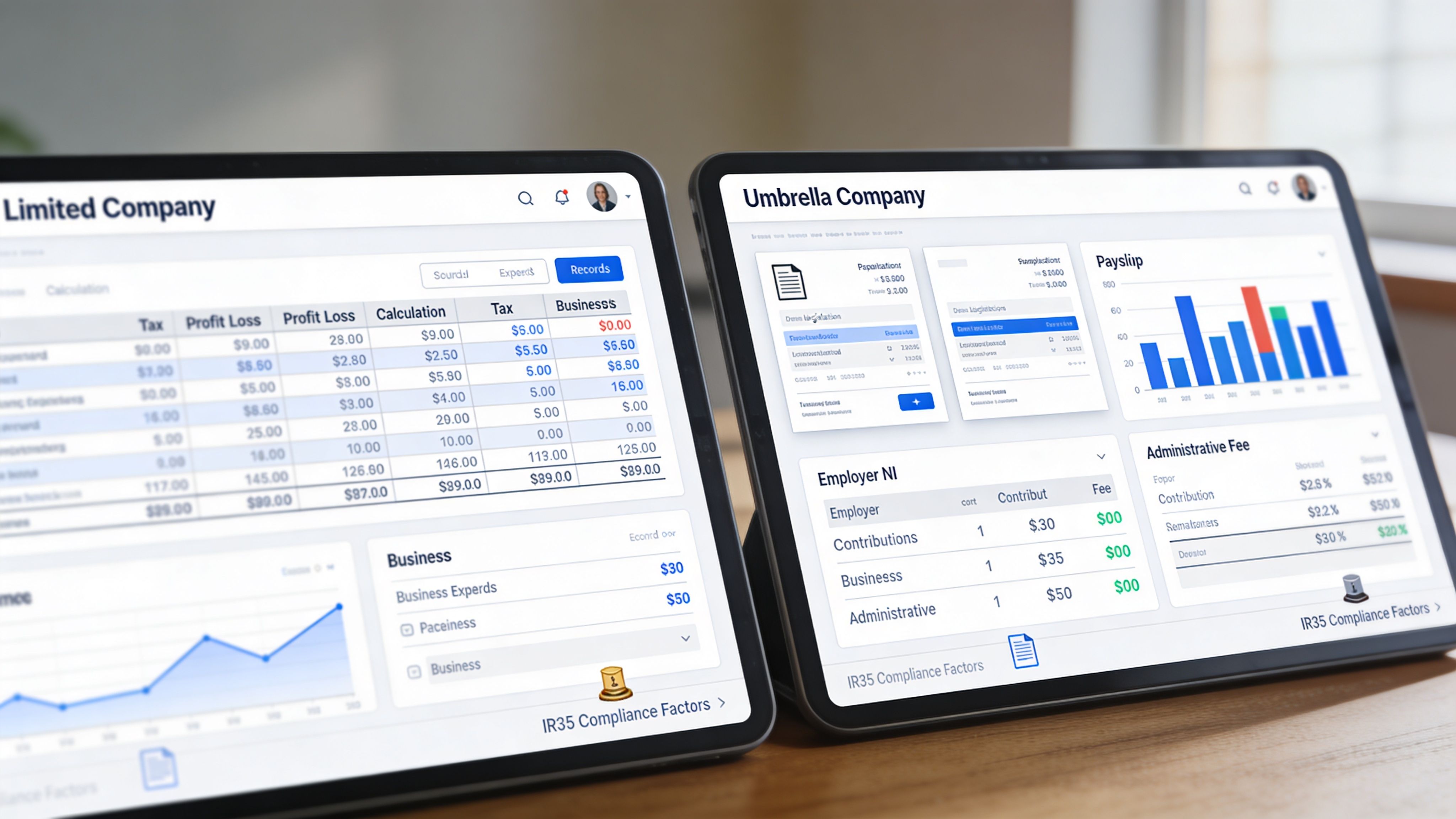
Outside IR35 with a limited company
This route gives you planning flexibility. You can review company profit, decide on salary, assess what profit is available after company obligations, and then consider dividends.
The advantage isn't that dividends are always "better". It's that they are taxed under a different framework from salary, and they don't operate through the same payroll mechanism. That gives directors room to structure extraction more deliberately.
Typical features of this route include:
- Control over timing, because dividends are declared by the company when supported by profit.
- Choice over mix, since salary and dividends can be balanced.
- Need for discipline, because tax still needs to be set aside and paperwork still needs to be correct.
Inside IR35 through an umbrella
Inside IR35, the position is much more direct. The income is treated as employment income for tax purposes. That means PAYE becomes central and dividends are no longer the tool for extracting that contract income.
For many contractors, that feels less flexible, but it can also be simpler administratively. The umbrella handles payroll, deductions, and payslips. What you lose is the ability to use the same dividend planning strategy that may be available outside IR35.
The biggest mistake here is comparing an outside-IR35 dividend plan with an inside-IR35 payslip as if they were built under the same rules. They aren't.
The practical comparison
A side-by-side view makes the distinction easier to hold in mind:
| Topic | Outside IR35 limited company | Inside IR35 umbrella |
|---|---|---|
| Main payment method | Salary plus possible dividends | PAYE salary |
| Dividend option | Yes, if supported by post-tax profit | No, not for that contract income |
| Planning flexibility | Higher | Lower |
| Payroll simplicity | Lower | Higher |
| IR35 sensitivity | Central to the model | Already reflected in PAYE treatment |
If you're unsure which framework applies to your contract, this guide to IR35 for contractors is worth reading before you spend too long modelling dividend scenarios that may not be available to you.
Making Smart Decisions About Your Contractor Pay
The most useful thing a dividends calculator uk tool can do is help you make decisions before money leaves the company. That's where the value is.
Keep the process simple. Start with real post-tax company profit. Choose salary on purpose, not by habit. Check how dividends interact with your wider personal income. If the answer looks tight, reduce the dividend rather than hoping the tax bill will somehow work itself out later.
A few habits make contractor pay planning much easier:
- Separate company and personal thinking, because business cash isn't automatically distributable profit.
- Model more than one option, especially if profits are uneven.
- Respect IR35 status, because it determines whether dividends are even relevant.
- Use outside references wisely, including broader guides on contractor payment methods such as how to pay contractors when you're comparing different working arrangements and responsibilities.
Good planning doesn't need to be complicated. It needs to be timely, realistic, and based on the right starting figures.
If you're comparing your options around limited company contracting, PAYE, or inside IR35 working, Umbrella Company can help you review the options and find a setup that fits how you work.


