


If you’re running a limited company in the UK, one of the biggest decisions you will make is how to pay yourself: through a salary, or by taking dividends. It is not just a technicality; it is a fundamental choice that shapes your entire financial picture.
A salary is a straightforward payment subject to Income Tax and National Insurance. Dividends, on the other hand, are your share of the company's profits as a shareholder and, crucially, are not subject to National Insurance Contributions. This single difference is why the low-salary, high-dividend model has long been the go-to strategy for contractors operating outside IR35.
In this guide, we will break down how each payment method works, examine the critical role IR35 plays, and help you determine the best path for your contracting career.
Understanding Your Pay: Dividend vs Salary
Getting the dividend vs salary balance right has a direct impact on your take-home pay, your tax bill, and even your ability to get a mortgage. It is less about just minimising tax and more about creating a pay structure that works for your contract status, your business goals, and how much admin you're willing to handle.
Here at UmbrellaCompany.com, we want to cut through the jargon and give you the clarity needed to make the right call. This guide breaks down how each payment method works, looks at the critical role IR35 plays, and helps you figure out the best path for your contracting career.

Core Differences at a Glance
So, what is the real-world difference? A salary is treated as a standard business expense, which means it reduces your company's Corporation Tax bill. The catch is that both you and your company have to pay National Insurance Contributions (NICs) on it.
Dividends are different. They are paid out of post-tax profits, so your company has to pay Corporation Tax on its profits before you can distribute them.
The huge upside? There are no NICs to pay on dividend income, which can lead to some pretty significant savings.
This table gives you a quick side-by-side summary to help you grasp the key distinctions.
Quick Comparison: Salary vs Dividends
| Attribute | Salary | Dividends |
|---|---|---|
| Tax Treatment | Subject to Income Tax and National Insurance Contributions (NICs). | Subject to Dividend Tax but exempt from NICs. |
| Source of Funds | Paid from company revenue before Corporation Tax is calculated. | Paid from company profits after Corporation Tax has been paid. |
| Business Expense | Yes, it is a tax-deductible business expense for the company. | No, it is a distribution of profits, not an expense. |
| Eligibility | You must be a registered employee or director of the company. | You must be a shareholder in the company. |
| Payment Regularity | Typically paid regularly (e.g., monthly) through a PAYE system. | Can be paid at any time, provided the company has sufficient profits. |
The key takeaway is all in the trade-off.
A salary lowers your Corporation Tax but gets hit with National Insurance. Dividends are paid from profits that have already been taxed but are completely free from NI. Getting your head around this is the first step to truly optimising your income.
As we will see, your contract’s IR35 status can often force your hand and make this decision for you. But for those firmly outside IR35, a smart, carefully balanced mix of both salary and dividends is almost always the most tax-efficient route.
How Salary and Dividends Are Taxed
To get to the heart of the salary vs dividend debate, you need to see things from HMRC's perspective. The tax authority treats these two income streams completely differently, and it is these differences that open up smart tax planning opportunities for limited company directors.
Getting this right has a direct, and often significant, impact on your take-home pay. Let's break down exactly how salaries and dividends are handled and what it means for your wallet.

The Tax Treatment of Salaries
A salary is straightforward employment income, taxed at source through the Pay As You Earn (PAYE) system. It is the standard for employees across the UK and involves two main deductions: Income Tax and National Insurance Contributions (NICs).
Income Tax is tiered. For the 2024/25 tax year in England, Wales, and Northern Ireland, the bands are:
- Personal Allowance: Up to £12,570 is completely tax-free.
- Basic Rate: 20% on income from £12,571 to £50,270.
- Higher Rate: 40% on income from £50,271 to £125,140.
- Additional Rate: 45% on income over £125,140.
But the real sting comes from National Insurance. This is the crucial point of difference. With a salary, both you and your company have to pay it.
- Employee's NICs: You pay this from your gross salary.
- Employer's NICs: Your limited company pays this on top of your gross salary.
Because a salary is hit by both Income Tax and two separate lots of National Insurance, it is the most heavily taxed way to draw money from your company.
The Tax Treatment of Dividends
Dividends are handled in a completely different way, which is why they form the cornerstone of a tax-efficient strategy for contractors. The single biggest advantage is that dividends are not subject to National Insurance Contributions. This alone can lead to huge savings.
But there is an important step that comes first: Corporation Tax. Dividends are a share of company profits, and those profits can only be distributed after the company has paid Corporation Tax on them.
The core trade-off is this: salaries are a business expense that reduces your Corporation Tax bill but attracts NI. Dividends are paid from post-tax profits but are completely free of NI.
Once Corporation Tax is settled, you can pay yourself dividends. You get a tax-free Dividend Allowance each year. Once you have used that up, any further dividends are taxed at special rates:
- Basic Rate: 8.75%
- Higher Rate: 33.75%
- Additional Rate: 39.35%
As you can see, these rates are much lower than the equivalent Income Tax bands for salaries, making them a very attractive option.
Why This Matters for Your Take-Home Pay
The rules around dividend vs salary taxation have shifted over the years, forcing contractors to adapt. A major change was the introduction of the dividend allowance in 2016, which started at a generous £5,000 but has since been slashed to just £500 from April 2024. This change, coupled with hikes in dividend tax rates, has made the calculation far more nuanced.
For years, a low-salary, high-dividend strategy has been the go-to for limited company directors working outside IR35. You can dig into the specifics in our guide on the most tax-efficient way to pay yourself in the UK.
By taking a small salary (often just enough to trigger National Insurance credits) and the rest as dividends, you can massively reduce your overall tax bill. This strategy boosts your take-home pay while still ensuring you qualify for state benefits. Crucially, though, this is only an option if your contracts are confirmed as being outside IR35.
How IR35 Changes the Equation
For UK contractors, the whole dividend vs salary debate starts and ends with one thing: the off-payroll working rules, better known as IR35. It is the single biggest factor, more important than tax rates or allowances, because your IR35 status dictates how you can legally pay yourself. It does not just influence the decision; it can take the choice off the table completely.
If you are running your own limited company, the dream of a tax-efficient, low-salary, high-dividend structure hinges entirely on your contract being assessed as ‘outside IR35’. This is HMRC’s way of saying they see you as a genuine business-to-business service provider, which gives you the freedom to manage your company's finances as you see fit.
But if your contract is deemed ‘inside IR35’, that flexibility vanishes overnight. This determination means HMRC views your working relationship as ‘disguised employment’. As a result, every penny you earn from that contract has to be treated as employment income, killing the dividend option for that particular project.
Understanding the Deemed Payment
When a contract falls inside IR35, the rules force a ‘deemed payment’ calculation. It is a process designed to make sure your earnings are hit with the same tax and National Insurance Contributions (NICs) as a regular employee. The fee-payer (usually your client or recruitment agency) is legally required to deduct PAYE Income Tax and both employee's and employer's NICs before the net amount ever lands in your company bank account.
This effectively shunts all your income down the salary route. The tax advantages of dividends are completely wiped out because the money is taxed as if it were a salary before you even get a chance to touch it.
The real sting of an inside IR35 determination is the loss of control. The choice between salary and dividends is made for you, with the rules forcing your income through a payroll system, complete with all the usual employment deductions.
As you can imagine, this has a massive impact on your take-home pay, often slashing it compared to what you would earn on an outside IR35 contract.
Why Umbrella Companies Become the Go-To Option
Staring down the barrel of an inside IR35 determination, many contractors quickly realise that running their limited company for that contract is a complex and financially pointless exercise. This is precisely why so many turn to an umbrella company.
An umbrella company simply acts as your employer for the contract's duration. They handle the client's payment, process it through their payroll, and pay you a salary after taking care of all the necessary tax and NICs. It is a straightforward, compliant fix that takes all the PAYE admin off your shoulders.
Here is why it is often the most sensible path:
- Compliance Certainty: It guarantees every tax obligation for your inside IR35 contract is handled correctly, removing any risk of a future headache with HMRC.
- Administrative Simplicity: You get to sidestep the nightmare of running deemed payment calculations through your own limited company payroll.
- Continuity of Employment: Working this way provides a solid employment record, which can be a real help when applying for a mortgage or loan.
Recent government policy has only made a salary feel more predictable than dividends, especially for those inside IR35. The dividend allowance, for example, has been hammered, dropping from £5,000 in 2016 to just £500 in 2024. Meanwhile, historical data from the Office for Budget Responsibility shows huge spikes in dividend payments just before tax hikes are introduced, which highlights just how volatile they can be. You can discover more insights from the OBR on income tax trends and see how these policy shifts force changes in pay strategies.
The Clear Distinction Outside IR35
On the flip side, an ‘outside IR35’ status protects your autonomy as a business owner. It is the official green light confirming you are in business for yourself, allowing you to use your limited company to its full potential. You keep the freedom to structure your pay with the tried-and-tested low-salary, high-dividend model that maximises your tax efficiency and take-home pay.
Ultimately, IR35 draws a very clear line in the sand. Your contract's status is the first question you have to answer, long before you start weighing up the pros and cons of dividends and salary. To get a better handle on these crucial rules, you can check out our comprehensive guide on IR35 for contractors.
Crunching the Numbers: Your Take-Home Pay in Different Scenarios
Theory is one thing, but what really matters is how the choice between dividends and salary hits your bank account. To bring this all to life, let's walk through three realistic scenarios for a UK contractor. This will show you exactly how your IR35 status and payment structure can dramatically change your net pay.
These worked examples cut through the abstract rules, giving you real-world numbers to help you plan your finances. We will use the same income figure across the board to keep the comparison crystal clear.
This is where your IR35 status really dictates your options.
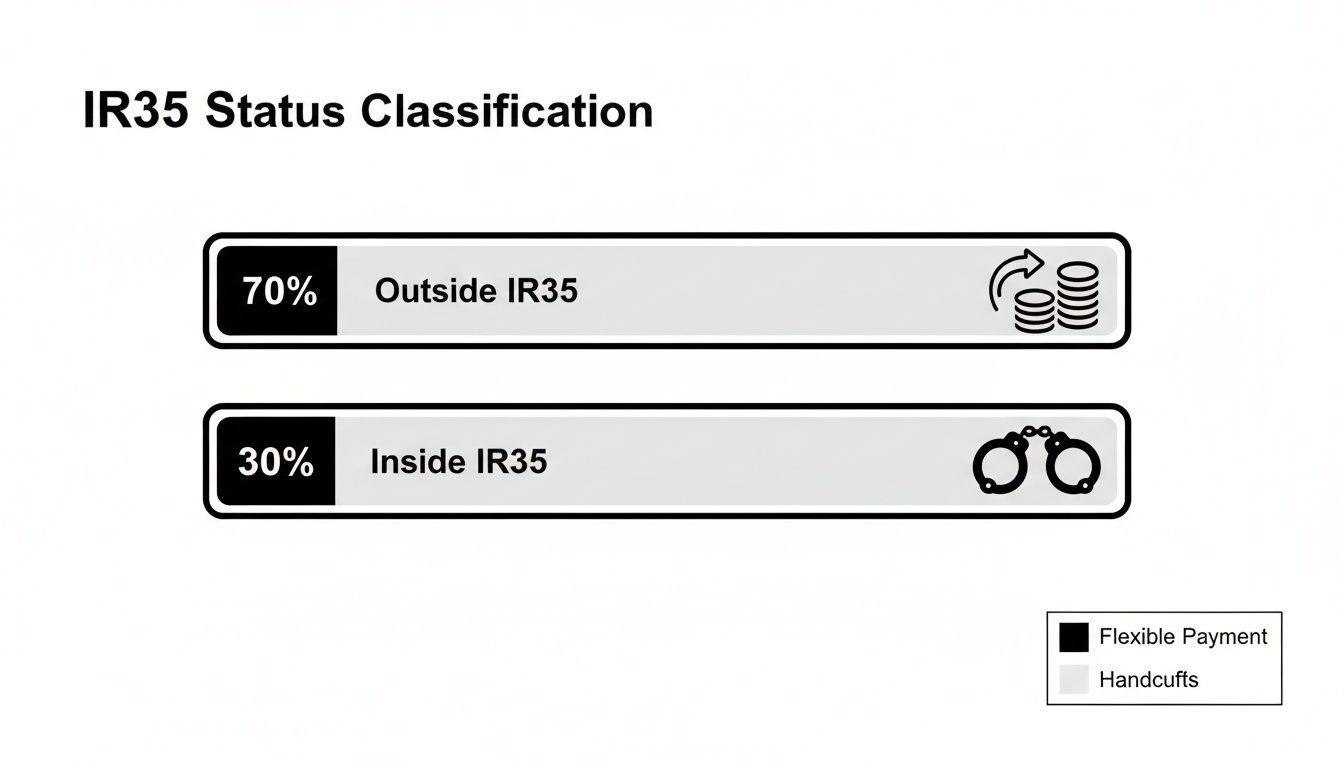
The takeaway here is simple: an 'outside IR35' determination opens the door to flexible, tax-efficient payment structures. 'Inside IR35', however, funnels you down the path of standard payroll.
Scenario 1: Outside IR35 Director
For a director whose contract is firmly outside IR35, the name of the game is tax efficiency. This is where the classic low-salary, high-dividend model comes into its own, maximising your take-home pay.
Here is the standard approach:
- Set a minimal salary: The director pays themselves a small salary, typically up to the National Insurance (NI) primary threshold. This is just enough to qualify for state benefits like the State Pension without actually paying any NI.
- Pay Corporation Tax: The company pays Corporation Tax on its remaining profits.
- Distribute dividends: The post-tax profits are then paid out to the shareholder as dividends.
This strategy cleverly sidesteps the hefty National Insurance contributions that eat into a traditional salary. By making the most of lower dividend tax rates, the contractor gets to keep a much larger slice of their earnings.
Scenario 2: Inside IR35 Director
Now, let's take that same limited company director, but this time their contract is deemed inside IR35. The rulebook gets thrown out completely. That tax-efficient low-salary, high-dividend strategy is now off the table for this particular contract.
Instead, the fee-payer (your client or agency) has to treat the payment as if it were employment income. This is called the deemed payment.
- Deductions at source: Before the money even hits your company's bank account, the fee-payer deducts Income Tax and both employee's and employer's National Insurance.
- No dividend option: The net amount that arrives is already post-tax employment income. There is no profit left in the company from this contract to distribute as a dividend.
The hit to take-home pay is significant. Your earnings are subjected to the full force of PAYE, including those punishing employer's NICs.
The stark reality of an inside IR35 contract is the loss of financial autonomy. The rules enforce a salary-based structure, which, while compliant, is far less tax-efficient than the dividend route available to those outside IR35.
Scenario 3: Inside IR35 Umbrella Employee
Facing an inside IR35 contract, many contractors decide that running their limited company for that project is just not worth the hassle. The most practical and compliant solution is often to work through an FCSA or Professional Passport accredited umbrella company.
The umbrella company effectively becomes your employer for that contract, which simplifies everything.
Here is a breakdown of how the money flows:
- Client pays the umbrella: The client pays the umbrella the agreed day rate for your services. This is known as the assignment rate.
- Deductions are made: From this assignment rate, the umbrella company deducts its margin, employer's NICs, the Apprenticeship Levy, and employer pension contributions.
- Salary is paid: The remaining amount becomes your gross salary. Standard employee tax and NI are deducted, and the final net amount is paid into your personal bank account.
While this means less take-home pay than an outside IR35 setup, it provides complete compliance and administrative peace of mind. Historically, high-earning contractors have always used a mix of salary and dividends to keep their income tax-efficient. In fact, research shows that business owner-managers in the top 1% often retain about a third of their profits within their company each year, playing to the different tax treatments.
Want to run the numbers for your own situation? Use our limited company take-home calculator to model these scenarios with your own figures and see which structure works best for you.
Practical Considerations Beyond Tax
While tax efficiency usually steals the spotlight in the dividend vs salary debate, it is a big mistake to let it be the only factor. Your choice has real-world consequences for your administrative workload, financial stability, and long-term planning. A decision that looks fantastic on paper might not actually fit your life.
It is all about taking a balanced view. You have to consider the practical, day-to-day realities of each approach before you commit. This way, you can be confident you are choosing a payment structure that supports both your business and your personal life.
Administrative Responsibilities
Opting for a salary and dividend mix through your own limited company gives you fantastic financial control, but that freedom comes with a string of administrative duties. You are legally on the hook for running payroll, even if it's just for yourself.
This is more than just a simple bank transfer. To keep HMRC happy, you must:
- Run a compliant PAYE payroll for your salary, making sure you submit reports on time.
- Hold formal board meetings to declare dividends, even if you are the only director in the room.
- Create and issue dividend vouchers and maintain accurate board minutes as a legal paper trail.
- Manage company accounts, filing annual returns and confirmation statements without fail.
Let this paperwork slip, and you could be facing penalties. For many contractors who just want to focus on their work, the sheer simplicity of an umbrella company (which handles all of this for you) is a massive draw.
Choosing the limited company route means you're not just a contractor; you're a company director. This requires a commitment to administrative diligence that shouldn't be underestimated.
Proving Your Income for Loans and Mortgages
One of the most practical benefits of a consistent salary is how straightforward it makes proving your income. When you apply for a mortgage, loan, or credit card, lenders want to see a stable and predictable earnings history.
A regular monthly payslip provides just that. It is a format every lender understands instantly. While it is absolutely possible to secure a mortgage using dividend income, it often involves more hoops to jump through. Lenders will typically want to see several years of company accounts and personal tax returns before they feel comfortable.
Long-Term Financial Planning
Your payment structure also has a huge impact on your future financial health, especially when it comes to pensions and state benefits.
A salary is the foundation for both. Paying yourself a salary that meets at least the Lower Earnings Limit for National Insurance ensures you are making qualifying contributions. This is vital for building up your entitlement to the State Pension and other benefits down the line. You can find more details in our guide on how to pay yourself dividends correctly.
On top of that, a salary unlocks one of the most powerful tax-planning tools available: employer pension contributions. Your limited company can make payments directly into your pension pot, and these contributions are treated as an allowable business expense. This reduces your company's Corporation Tax bill while building your retirement savings in a highly efficient way, an option that simply isn’t available with dividends.
So, Which Path is Right for Your Contracting Career?
Deciding between a dividend/salary mix and an umbrella company really boils down to a handful of core factors. There is no single right answer here; the best strategy is entirely dependent on your IR35 status, how much admin you are willing to take on, and what you want to achieve financially.
Let's pull it all together. The first, and most critical, filter in your decision-making process has to be your contract's IR35 determination.
For Contracts Inside IR35
If your contract lands you inside IR35, the choice is pretty much made for you. HMRC rules mean your income has to be treated as employment earnings, which makes a compliant umbrella company the most straightforward and headache-free option. It is a simple way to get paid correctly while also getting statutory employment rights, and it lifts the burden of managing PAYE deductions from your shoulders.
Going with an accredited umbrella company gives you genuine peace of mind. It guarantees you're fully compliant with the off-payroll working rules, shielding you from any future tax headaches related to that particular contract.
For Contracts Outside IR35
When you are working outside IR35, you are in the driving seat. A tax-efficient blend of a low salary topped up with high dividends is usually the most profitable way to go, but it comes with strings attached. You have to be prepared to handle the administrative duties of a company director, which means running payroll, keeping board minutes, and issuing dividend vouchers.
Making Your Final Call
At the end of the day, you need to weigh up your priorities. If your work falls inside IR35, or if you simply value simplicity and guaranteed compliance above everything else, then an umbrella company is the clear winner. But if you are operating outside IR35 and feel comfortable with the responsibilities that come with being a director, the limited company dividend route offers the biggest financial rewards.
Should you decide an umbrella company is the right fit, the next step is finding a provider you can trust. Here at UmbrellaCompany.com, we have made that bit easy. Our comparison tool helps you find a fully accredited and cost-effective partner for your next contract in just a few clicks.
Burning Questions Answered
When you are weighing up salary versus dividends, a few common questions always seem to pop up, especially with IR35 looming in the background. Let's clear up some of the most frequent queries we hear from UK contractors to help you map out your financial plan.
Can I Still Take Dividends if My Contract Is Inside IR35?
This is a big one. The short answer is yes, you can… but not from the money you earn on that inside-IR35 contract. The off-payroll working rules are crystal clear on this: every penny from an inside-IR35 gig must be treated as salary, which means it is subject to the full whack of PAYE tax and National Insurance.
That does not mean your limited company is suddenly barred from issuing dividends, though. If you have got other projects on the go that are genuinely outside IR35, or your company has other streams of income, the profits from that work can absolutely still be paid out as dividends.
What is the Most Tax-Efficient Salary to Pay Myself?
For company directors fortunate enough to be working outside IR35, the go-to strategy is almost always a small salary topped up with dividends. The trick is to set your salary high enough to qualify for state benefits but low enough to sidestep any significant National Insurance Contributions (NICs).
By pitching your salary at or just above the NI Primary Threshold, you ensure you are building up qualifying years for your State Pension without actually having to hand much (or any) of it over in tax or NI. This smart move leaves the bulk of your company’s profit ready to be withdrawn far more efficiently as dividends.
Is an Umbrella Company My Only Choice for Inside IR35 Contracts?
While it is not technically the only option, using an accredited umbrella company has become the most popular, practical, and compliant route for inside-IR35 work by a country mile. It is just a much simpler setup; the umbrella company acts as your employer, taking care of all the tax and NI headaches for you.
This path also gives you a continuous employment record and access to statutory rights, which can be a real help for things like getting a mortgage. The main alternative is something called agency PAYE, where the recruitment agency just adds you to their own payroll. It is less common and does not provide that same continuity if you find yourself hopping between different agencies for contracts.
If you have decided an umbrella company is the right move for your next contract, the next job is to find a good one. At UmbrellaCompany.com, our free comparison tool makes it simple to find a compliant, accredited provider that fits your needs. Find your ideal umbrella company in minutes.


