


For the 2024/25 tax year, the rates you will pay on dividend income are 8.75% for basic-rate taxpayers, 33.75% for higher-rate, and 39.35% for additional-rate taxpayers. These rates apply to any dividend income you earn above the new, lower £500 Dividend Allowance.
This guide will break down what you need to know about the dividend tax rates for 2024/25, helping you understand your obligations and plan your finances with confidence.
Understanding the 2024/25 Dividend Tax Rates

Getting to grips with your tax obligations as a contractor can feel complex, but understanding how dividends are taxed is a critical piece of the puzzle. At UmbrellaCompany.com, we aim to make this clear and straightforward so you can plan your finances effectively.
The tax you pay on your dividends is not a standalone figure; it is directly tied to your overall income tax band for the year. The system is set up to treat your dividend income as the very last slice of your total earnings.
How Your Income Is Stacked for Tax Purposes
It helps to think of your total annual income like a stack of building blocks. HMRC taxes each block in a specific order, one on top of the other.
- The Foundation: Your salary, any self-employed profits, and pension income form the base. Your tax-free Personal Allowance (£12,570 for 2024/25) is used up first here.
- The Middle Layer: Next, any income you have made from savings interest is added to the stack.
- The Top Layer: Finally, your dividend income is placed right on top.
This stacking method is vital to understand. It means your salary and other earnings can easily use up your Personal Allowance and fill your basic rate tax band, potentially pushing your dividend income into a higher tax bracket than you might expect.
The rate of tax you pay on dividends is determined by which income tax band they fall into after all your other income has been accounted for.
The Current Dividend Tax Rates and Bands
For the tax year running from 6 April 2024 to 5 April 2025, the first £500 of dividends you receive is completely tax-free. This is your Dividend Allowance. Anything above that gets taxed.
Here are the rates you will pay on dividends that fall into each tax band:
UK Dividend Tax Rates and Bands 2024/25
| Tax Band | Total Income Threshold | Dividend Tax Rate 2024/25 |
|---|---|---|
| Personal Allowance | Up to £12,570 | 0% |
| Dividend Allowance | First £500 of dividends | 0% |
| Basic Rate | Up to £50,270 | 8.75% |
| Higher Rate | £50,271 to £125,140 | 33.75% |
| Additional Rate | Over £125,140 | 39.35% |
As the table shows, after your Personal Allowance and Dividend Allowance are used, the tax you pay on dividends depends entirely on your total income.
These rates are higher than they were a few years ago. Before 6 April 2022, the rates were 7.5%, 32.5%, and 38.1%. At the same time, the government has cut the tax-free Dividend Allowance from a generous £5,000 in 2017 down to its current £500 level. This has significantly changed the tax landscape for limited company directors. You can find a detailed history of these changes on Ross Martin's tax guidance website.
The Real Impact of the Reduced Dividend Allowance

The cut in the Dividend Allowance to just £500 for the 2024/25 tax year is not a minor tweak. For limited company directors and anyone receiving dividend income, it is a significant change that directly hits your take-home pay. Understanding the real-world consequences is key to smart financial planning.
It is better to think of it as a ‘0% tax zone’ for the first £500 of your dividends, rather than a typical tax-free allowance. Crucially, while you do not pay tax on this amount, it still uses up a slice of your income tax band.
This is a detail that trips many people up. Say your salary has already taken you right up to the edge of the higher-rate tax threshold. That first £500 of dividends, while tax-free itself, will fill the last remaining bit of your basic-rate band. The result is that any further dividends are instantly taxed at the higher rate of 33.75%.
The Journey From Generous Allowance to Nominal Zone
The sharp decline of the Dividend Allowance tells a clear story of the growing tax burden on contractors. This rapid reduction has completely changed the calculations for extracting profits tax-efficiently.
Just look at the timeline:
- 2017/18: The allowance was a very useful £5,000.
- 2018/19 – 2022/23: It was cut to £2,000.
- 2023/24: It was halved again to £1,000.
- 2024/25: It now sits at a token £500.
This consistent reduction has a clear aim: to increase the tax take from those who draw profits as dividends. The government's own figures predict this latest cut will generate an extra £450 million in tax revenue for 2024/25 alone.
In just six years, the Dividend Allowance has been cut by a staggering 90%. This systematic erosion means that even small amounts of dividend income, which were once entirely tax-free, are now being drawn into the tax net.
What This Means for Your Take-Home Pay
The practical upshot is simple: more of your company’s profit will now be subject to dividend tax. For limited company directors, the classic strategy of a low salary topped up with dividends is far less attractive than it once was. The lower the Dividend Allowance, the sooner you start paying tax on your hard-earned profits.
This makes careful planning more critical than ever. You need to look closely at how your salary level, combined with the new dividend tax rates 2024/25, impacts your overall tax bill. Every pound of dividends over that £500 threshold is now taxed, which directly reduces your take-home cash. It may be time to rethink your payment strategy. For a deeper dive, check out our guide on how to structure dividends for tax saving in the UK.
Ultimately, the shrinking allowance is a reality check. The days of sheltering a meaningful chunk of dividend income are over. This reinforces the need for contractors to accurately compare payroll options, whether through a limited company or a compliant umbrella company, to ensure their setup is as efficient as possible.
How Dividend and Income Tax Work Together
This is where all the pieces of the tax puzzle start to fit together. For any contractor looking to manage their finances, understanding this interplay is essential, especially with the dividend tax rates for 2024/25 in mind. You must understand how HMRC treats your different streams of income.
Think of your annual income like different types of passengers queuing for a bus, with the bus being the tax system. Your salary gets on first, then any savings interest, and only then do your dividends get a turn. This ‘stacking order’ is not just technical jargon; it is the core principle that decides which tax band your dividends fall into and how much tax you will pay.
The Stacking Order Explained
HMRC calculates your tax bill following a strict sequence. Each type of income is added on top of the last, filling up your tax bands one by one.
Here is the breakdown:
- Non-Savings Income First: This is your salary from employment, self-employment profits, and any pension income. Your tax-free Personal Allowance of £12,570 is used up here first.
- Savings Income Next: Any interest you have earned from bank accounts or other savings gets stacked on top of your salary.
- Dividend Income Last: Finally, your dividend income is added to the very top of this pile. This means its tax rate is determined by whatever tax band is left after all your other income has been counted.
The implications of this are huge. If your salary and other income are high enough to use up your entire basic rate band, any dividends you receive (over the £500 allowance) will automatically be taxed at the higher rate of 33.75%.
Worked Example: A Contractor with Salary and Dividends
Let's walk through a real-world scenario. This will help you see how to calculate your own tax bill and witness the direct impact of the stacking rule.
Imagine a contractor, Alex, who runs their own limited company. To be as tax-efficient as possible, Alex pays themself a small salary and takes the rest as dividends.
Alex's Income for 2024/25:
- Salary: £12,570 (set to match the Personal Allowance)
- Dividends: £45,000
Here is how we calculate Alex’s tax, step-by-step.
Worked Example Calculation Breakdown
The table below breaks down Alex's tax liability, showing how each component of income is treated.
| Income Component | Amount | Tax Calculation | Tax Due |
|---|---|---|---|
| Salary | £12,570 | Fully covered by the Personal Allowance (£12,570). | £0 |
| Dividend Allowance | £500 | The first £500 of dividends are tax-free. | £0 |
| Basic Rate Dividends | £37,700 | Taxed at the basic rate of 8.75%. | £3,298.75 |
| Higher Rate Dividends | £6,800 | The remaining dividends, pushed into the higher rate band, are taxed at 33.75%. | £2,295.00 |
| Total Tax Bill | £5,593.75 |
Let's unpack those numbers.
Step 1: Calculate Tax on Salary
Alex’s salary is £12,570. This is perfectly covered by their £12,570 Personal Allowance, so there is £0 Income Tax and National Insurance to pay on it.
Step 2: Apply the Dividend Allowance
Alex has a total dividend income of £45,000. The first £500 of this is covered by the Dividend Allowance, which is taxed at 0%.
Step 3: Calculate Tax on the Remaining Dividends
We are now left with £44,500 of dividend income to deal with (£45,000 – £500). We need to see which tax bands this income falls into.
The basic rate tax band for 2024/25 is £37,700. Since Alex’s salary only used up the Personal Allowance, this entire band is still available.
- The first £37,700 of the remaining dividends is taxed at the basic rate of 8.75%, resulting in a tax bill of £3,298.75.
Now, Alex has £6,800 of dividend income left over (£44,500 – £37,700). This amount spills over into the higher rate tax band.
- This remaining £6,800 is taxed at the higher rate of 33.75%, which comes to £2,295.00.
Step 4: Calculate Alex's Total Tax Bill
To get the final figure, we add up the tax from each part:
- Tax on salary: £0
- Tax on first £500 of dividends: £0
- Tax on basic rate dividends: £3,298.75
- Tax on higher rate dividends: £2,295.00
- Total Tax Bill: £5,593.75
This example clearly shows how even with a modest salary, significant dividend income can quickly push you into a higher tax bracket, making strategic planning essential. For a detailed comparison, you can explore our guide on the salary versus dividends debate.
This interaction between allowances and tax bands is a unique feature of the UK system. With the 2024/25 dividend tax rates holding at 8.75% (basic), 33.75% (higher), and 39.35% (additional), running these numbers for your own situation is vital. You can also read the official government guidance on how dividends are taxed for more detail.
Strategic Tax Planning for Limited Company Contractors
As a director of your own limited company, extracting profits tax-efficiently is one of your biggest challenges. This is where the 'salary versus dividends' debate comes in. Recent changes to Corporation Tax and the dividend tax rates 2024/25 have shifted the goalposts.
If you are a contractor working outside IR35, figuring out the best mix of salary and dividends has become more crucial than ever. It is all about finding the sweet spot to minimise your total tax bill, which includes your company's Corporation Tax, your personal National Insurance Contributions (NICs), and the tax on your dividends.
Rethinking the Salary and Dividend Mix
The traditional wisdom for company directors was simple: pay yourself a small salary, just enough to qualify for state pension benefits, and then take the rest as dividends. This worked because the salary is a tax-deductible expense for your company, lowering its Corporation Tax bill.
However, things have become more complicated. The main rate of Corporation Tax has risen to 25% for companies with profits over £250,000 (with some relief for those between £50,000 and £250,000). This change alone forces a rethink of old strategies.
On top of that, you need to remember how HMRC views your income. Your salary comes first, then any other income, and finally, your dividends are placed on top.
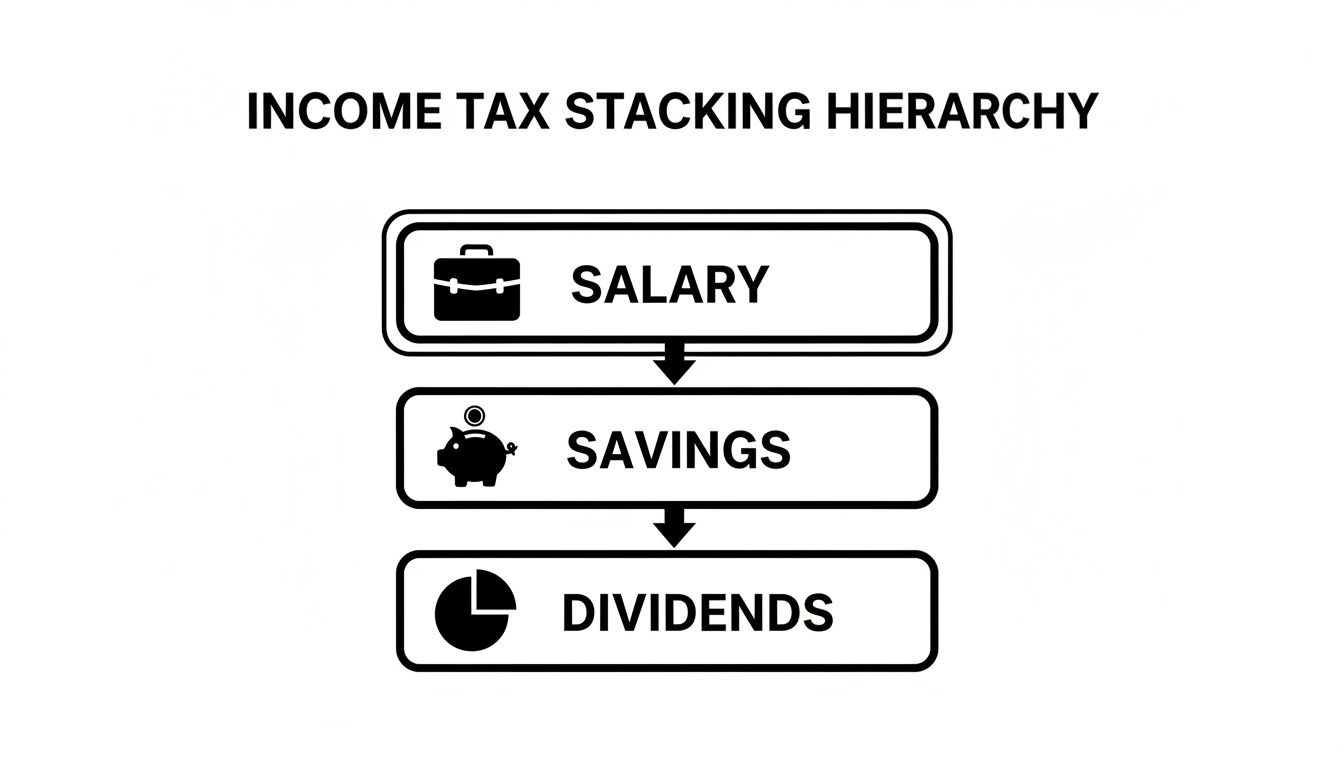
As the diagram shows, once your salary has used up your tax-free personal allowance, your dividends are the first to get pushed into the higher tax bands.
Finding Your Optimal Profit Extraction Strategy
With the Dividend Allowance cut to just £500 and dividend tax rates rising, being proactive is your best defence. You need to model a few different scenarios to see which one leaves you with the most money in your pocket.
Here is what you need to juggle:
- Your Company's Profits: If your profits are under the £50,000 threshold, your company pays Corporation Tax at 19%. This changes the calculations compared to a business paying the main 25% rate.
- Your Personal Income Needs: How much cash you need to draw from the business directly impacts how much you will take in dividends, which in turn affects your personal tax bill.
- National Insurance Thresholds: Paying a salary of at least £6,396 a year secures a qualifying year for your State Pension without costing you any NICs. It is a small but important detail.
- Other Income: Do you have a rental property or a side hustle? Any other income you have will use up your tax-free allowances and tax bands, affecting which band your dividends fall into.
Remember, dividends can only be paid from post-tax profits. Your company must first pay Corporation Tax on its profits before you can declare a dividend. This is a crucial difference from salary, which is paid before Corporation Tax is calculated.
A Practical Approach to Modelling Your Income
So, what does this look like in practice? Let's walk through a common approach for the 2024/25 tax year, assuming your company's profits are comfortably below £50,000.
- Set a Salary: A popular strategy is to pay yourself a salary of £12,570. This uses up your entire Personal Allowance, so you will not pay any Income Tax on it. While some NICs will be due, it also secures a qualifying State Pension year.
- Declare Dividends: Any other money you need is then taken as dividends. The first £500 of this is completely tax-free.
- Calculate the Tax: Every pound of dividends you take above that £500 allowance will be taxed at the relevant dividend tax rates 2024/25: 8.75%, 33.75%, or 39.35%, depending on what is left of your basic or higher rate tax bands.
This is just one way to do it. An alternative might be to take a smaller salary of £9,100 to avoid employer's NICs entirely. Every choice has a knock-on effect. To explore this in more detail, our guide on how to pay yourself dividends runs through several other examples.
Ultimately, there is no single 'right' answer, as it is entirely personal. At UmbrellaCompany.com, we provide the tools and information to compare your options. By modelling different scenarios, you can land on a strategy that fits your financial situation and helps you keep more of what you earn.
Why Dividend Tax Does Not Apply to Umbrella Employees

We have spent a lot of time on the dividend tax rates 2024/25, but it is vital to clear up a common point of confusion for contractors. If you work through an umbrella company, the rules around dividend tax simply do not apply to you.
The reason is refreshingly straightforward. When you join an umbrella company, you become its legal employee. You are not a director or shareholder of your own limited company, so you cannot receive dividend payments from your contracting work.
Instead, every penny you earn is processed as salary through the Pay As You Earn (PAYE) system. The umbrella company handles all your tax and National Insurance deductions on your behalf, just as any traditional employer would.
The Simplicity of the PAYE Model
The main draw of the umbrella company model is its simplicity. As an employee, you receive a salary, and your payslip clearly shows all deductions for tax and National Insurance before the money lands in your bank account.
This structure completely sidesteps the complexities of running a limited company. Umbrella employees do not need to worry about:
- Corporation Tax: Since you do not operate a separate company, there is no Corporation Tax to calculate or pay.
- Declaring Dividends: Your income is salary, not dividends, so no board meetings or dividend vouchers are needed.
- Self-Assessment: For most umbrella employees, there is no need to file a Self-Assessment tax return for their employment income because all tax is correctly deducted at source.
This setup is especially useful for contractors whose assignments are determined to be inside IR35. In these situations, the tax treatment is already similar to that of an employee, and an umbrella company offers a compliant and hassle-free way to get paid.
By operating as an employee of an umbrella company, you trade the administrative headaches of running a company for the simplicity of a standard payroll process. Your income is salary, making dividend tax entirely irrelevant to your finances.
A Clear Distinction in How You Are Paid
It is crucial to grasp the fundamental difference in how your pay is structured. A limited company director extracts profit by paying Corporation Tax, taking a small salary, and then distributing the remaining post-tax profits as dividends. Each step has its own tax implications.
An umbrella company employee, on the other hand, receives a single, consolidated payslip. The process looks like this:
- The umbrella company invoices your end client for the work you have done.
- From this income, the umbrella deducts its margin and all necessary employment costs, including Employer's National Insurance.
- The remaining amount becomes your gross pay.
- Finally, PAYE Income Tax and your personal National Insurance contributions are deducted from your gross pay, leaving you with your net take-home pay.
This clear, transparent process ensures you are fully compliant with HMRC's rules. If you're exploring different ways to manage your finances, our guide on using an umbrella company for freelancers offers more detail on this straightforward approach. For many contractors, this simplicity is a huge advantage, freeing them up to focus on their work rather than complex tax admin.
What Now? How to Plan Your Contracting Finances
Understanding the dividend tax rates for 2024/25 is the first, crucial step. You should now have a clearer picture of how the lower £500 Dividend Allowance and the way income stacks up will affect your bottom line.
We have summarised the key differences between working through your own limited company and using an umbrella. For company directors, smart tax planning is a must to juggle Corporation Tax and the personal tax on your dividends. For umbrella employees, it is simpler: everything is handled via PAYE, so dividend tax is not a factor.
Turning Knowledge Into Action
Applying this knowledge to your own situation is what really counts. Your next move is to take this information and build a solid plan that works for you.
Here is a practical, two-step approach:
- Compare your options: Every contractor's setup is unique. A great starting point is to use a comparison tool to explore accredited umbrella companies. Seeing real-world pay illustrations can make it clear which structure fits your contract rate and IR35 status best.
- Talk to an expert: If your affairs are complex, especially if you run a limited company, a good accountant is invaluable. They can model different salary and dividend mixes to pinpoint your most tax-efficient strategy.
The goal here is to create a financial setup that is not just compliant, but one you feel confident and clear about. Taking these simple steps will put you back in control.
Here at UmbrellaCompany.com, we want to give you the information you need to make smart choices. Whether you choose the simplicity of an umbrella company or the flexibility of running your own limited company, having a well-thought-out strategy is your biggest asset.
Your Dividend Tax Questions Answered
Working out the tax on your dividends can feel complicated. It is no surprise that we get many specific questions from contractors trying to get to grips with the dividend tax rates for 2024/25. To help clear things up, we have answered some of the most common queries.
How Do I Actually Pay My Dividend Tax Bill?
If you have tax to pay on your dividends, you must do it by filing a Self-Assessment tax return.
You are legally required to file a return if your dividend income exceeds £10,000. However, you will almost certainly need to file one anyway if you earn anything over the £500 tax-free Dividend Allowance. On the return, you declare all your income for the year (your salary, dividends, and anything else). HMRC then calculates your final bill, which you must pay by the 31st January deadline the following year.
Does the Dividend Allowance Eat Into My Personal Allowance?
No, they are completely separate. Think of your £12,570 Personal Allowance and your £500 Dividend Allowance as two different tax-free pots.
The key thing to remember is the order in which they are used. Your Personal Allowance is always applied first, typically against non-dividend income like your salary. The Dividend Allowance is a special 0% rate reserved just for the first £500 of your dividends.
What Happens if My Dividends Push Me Into a Higher Tax Band?
This is a classic scenario for limited company directors and shows why the 'stacking order' of your income matters. Your dividends are always considered the final slice of your income, taxed at the very top.
Let's say your salary uses up most of your basic-rate band. Even a modest dividend payment can easily tip your total income over the higher-rate threshold of £50,271. When that happens:
- The slice of your dividend income that still fits within the basic-rate band is taxed at 8.75%.
- The part that spills over into the higher-rate band gets hit with a 33.75% tax rate.
This can make a huge difference to your final tax bill. It is why careful planning around how and when you take dividends from your company is so important.
The crucial takeaway is this: your dividend tax rate is not set by the size of the dividend alone. It is determined by your total income for the year and which tax band your dividends fall into after everything else has been counted. Understanding this is vital for anyone planning their finances under the dividend tax rates 2024/25.
At UmbrellaCompany.com, our goal is to give you the clarity and tools to make the right calls for your contracting career. Whether you're weighing up running a limited company or prefer the simplicity of an umbrella, we are here to help. Take a look at our free comparison portal to find a payroll solution that is the perfect fit for you.


