


When you are a contractor, the biggest difference between PAYE and an umbrella company boils down to a single question: who is your employer?
If you are on agency PAYE, you are an employee of the recruitment agency for that specific contract. Simple as that. But with an umbrella company, you become an employee of the umbrella organisation itself. This gives you a single, continuous source of employment, no matter how many different clients you work for.
This guide explains the key differences to help you make an informed decision that suits your contracting career.
Understanding Your Core Employment Options
This one distinction changes everything. It directly shapes your employment rights, how your pay is calculated, and your long-term flexibility as a contractor. Understanding this is the first step to making a smart choice that fits your professional and financial goals.
The decision is not just about paperwork; it has real-world consequences, from getting a mortgage to handling your tax obligations. It is crucial to understand what is an umbrella company and why it acts as your continuous employer. That continuous employment record can be incredibly valuable, even as you move between projects for different end clients.
Agency PAYE Explained
With agency PAYE, the relationship is very straightforward. The recruitment agency that finds you the role becomes your legal employer for as long as that assignment lasts. They take care of all your tax and National Insurance Contributions (NICs) directly from your agreed rate.
Key points to remember:
- Direct Employment: The agency employs you, not the end client.
- Fixed-Term: Your employment stops when the contract ends.
- Simplicity: The agency handles all payroll deductions, so there is minimal administration for you.
This model works well for contractors on single, long-term contracts where keeping things simple is the top priority.
The Umbrella Company Model
An umbrella company acts as a central employer for many contractors working on various assignments. You sign one contract of employment with the umbrella, and they then contract with the recruitment agency or end client for your services.
At UmbrellaCompany.com, we find this structure gives contractors the best of both worlds: the flexibility of independent work combined with the stability and rights of traditional employment. It neatly bridges the gap between being a freelancer and a permanent employee.
To help you see the differences side-by-side, we have put together a quick comparison.
PAYE vs Umbrella at a Glance
For a quick summary of how these two options stack up, this table breaks down the main characteristics.
| Feature | Agency PAYE | Umbrella Company |
|---|---|---|
| Your Employer | The recruitment agency | The umbrella company |
| Employment Continuity | Broken between contracts | Continuous employment record |
| Statutory Benefits | Entitled, but tied to each contract | Consistently managed and accrued |
| Administrative Burden | Very low for the contractor | Low, managed by the umbrella |
| Ideal For | Single, longer-term assignments | Multiple, short-term contracts |
As you can see, the right choice really depends on your working patterns. Agency PAYE is all about simplicity for a single project, whereas an umbrella company provides a stable employment foundation for career contractors juggling multiple roles.
How Your Pay Is Processed and Managed
Understanding how money gets from your client to your bank account is central to choosing between agency PAYE and an umbrella company. The main difference between PAYE and umbrella is about who handles the deductions and how many steps are involved before you receive your payment. Both routes are perfectly legitimate, but they work in very different ways.
With agency PAYE, the process is as straightforward as it gets. Your recruitment agency bills the client, calculates and deducts your Income Tax and National Insurance Contributions (NICs), and pays you the net salary. It is a simple two-way street between you and the agency.
The umbrella model, on the other hand, brings in an intermediary that acts as your employer. This adds a couple of layers to the payment journey but, in return, offers you the continuity and statutory benefits of employment.
The Umbrella Company Payment Chain
When you work through an umbrella, the money trail is a bit more detailed. It is important to understand these steps to see exactly how your take-home pay is worked out.
Here is the typical flow of funds:
- You Submit Timesheets: You send your approved timesheets to your umbrella company.
- Umbrella Invoices the Client: The umbrella then invoices the agency or end client for your hours. This invoice is for the full assignment rate, which is designed to cover all employment costs.
- Funds are Received: The umbrella gets the payment from the client or agency.
- Deductions are Made: From this amount, the umbrella first deducts its own margin, plus all the employer's costs: Employer’s NICs, the Apprenticeship Levy, and employer pension contributions.
- Your Gross Pay is Calculated: What is left after these deductions becomes your gross pay. This figure is the equivalent of what a permanent employee would see on their payslip.
- Final Net Pay: From your gross pay, the usual employee deductions are made, such as Income Tax, your employee NICs, and any student loan repayments. The final amount is your net salary.
To really get to grips with this, our guide explains in detail how do umbrella companies work, breaking down each part of the payment cycle.
Compliance and Due Diligence
While both models are legitimate, the umbrella sector has come under scrutiny. Because the structure involves multiple parties, it can sadly be exploited by non-compliant providers.
It is vital to choose a reputable, accredited partner like those we list on UmbrellaCompany.com. Reputable providers will be transparent about deductions and will be accredited by bodies like the FCSA or Professional Passport, confirming they adhere to HMRC's rules.
The core difference in payment processing is that agency PAYE is a direct deduction from your rate, whereas an umbrella company first covers all statutory employment costs from the assignment rate before calculating your individual gross pay.
At the end of the day, agency PAYE offers maximum simplicity. The umbrella route, however, provides the security of continuous employment but comes with a more complex payment structure. Understanding this flow gives you full visibility over where your money is going.
A Practical Look at Take-Home Pay and Deductions

Your net pay is often the bottom line when choosing a contract. But comparing the rates between agency PAYE and an umbrella company is not as simple as it looks. The core difference between PAYE and umbrella arrangements is how employment costs are handled, which makes a huge difference to your final take-home figure.
An umbrella company’s rate is often called the 'assignment rate' or 'uplifted rate', and it is an all-inclusive number. It has to be higher because it is designed to cover all statutory employment costs, such as Employer’s National Insurance Contributions (NICs), the Apprenticeship Levy, and your holiday pay, plus the umbrella company’s margin.
An agency PAYE rate, on the other hand, looks lower because the agency absorbs these employment costs behind the scenes. They are not deducted from the rate you are quoted, which is why a direct, face-value comparison can be so misleading.
Understanding the Deductions
When you work through an umbrella company, that assignment rate is processed first to cover all the necessary employment costs. It is only after these deductions are made that your personal gross pay is calculated. From that gross pay, your own taxes, like Income Tax and employee NICs, are then deducted.
This process might seem convoluted at first, but it ensures everything stays compliant and legal, while giving you the benefits of continuous employment. We can help you figure out exactly which payroll solution gives the highest take-home pay by showing you how these sums work.
It is crucial to remember that a higher umbrella rate does not automatically mean more money in your pocket. You must account for all the employment costs that will be deducted from it to find the true equivalent PAYE rate.
A Real-World Pay Comparison
Let’s put this into practice with a simple example. Imagine you are offered two roles: one at £400 per day via agency PAYE and another at £500 per day through an umbrella company. That umbrella rate looks far more tempting, does it not?
However, the £500 umbrella rate must first cover costs like Employer's NICs (around 13.8%), the Apprenticeship Levy (0.5%), and the umbrella's margin (for example, £25 per week). After those deductions, the amount left over becomes your gross pay for tax purposes, which could end up being very close to the £400 PAYE rate.
The difference in take-home pay can be significant. For instance, a contractor on a £500 per day umbrella rate would find the equivalent PAYE rate is nearer to £437 per day because of these structural differences. And while umbrella companies offer great flexibility, their weekly service fees of £20–£30 add up over a year, something you do not have with agency PAYE.
Ultimately, understanding this fundamental difference allows you to make a proper financial comparison and pick the option that works best for you.
Comparing Your Employment Rights and Benefits

The choice between agency PAYE and an umbrella company has a huge knock-on effect on your employment rights and the benefits you can access. This decision shapes your statutory protections and even your long-term financial stability, so it is something you need to get right.
When you join an umbrella company, you create a continuous record of employment. This is an incredibly valuable asset, especially if you move between contracts frequently. Lenders for mortgages or loans prefer to see a consistent employment history, and that is exactly what an umbrella provides.
The Value of Continuous Employment
With an umbrella, you are employed by a single entity, not the end client you are working for on any given day. This single, unbroken employment relationship unlocks a full suite of statutory benefits, managed consistently no matter how many different assignments you take on.
This means you get crucial protections like:
- Statutory Sick Pay (SSP): A financial safety net if you are too ill to work.
- Holiday Pay: You are guaranteed paid time off, which you can take during or between contracts.
- Maternity, Paternity, or Adoption Leave and Pay: Real support for when life’s biggest moments happen.
- Workplace Pension: You will be automatically enrolled into a pension scheme, helping you save for the future without any extra hassle.
It is also worth understanding the specifics of things like the UK Statutory Sick Pay requirements. A good, compliant umbrella company will handle all of these entitlements for you, which gives you both peace of mind and frees you from a lot of administration.
The continuity an umbrella company offers is more than just a line on a CV. It is a stable employment foundation that provides access to statutory rights and strengthens your financial standing, making it easier to secure credit and plan for the future.
Rights Under Agency PAYE
Agency PAYE workers are absolutely entitled to the same statutory rights. The crucial difference, however, is that your employment is tied to each individual assignment. When a contract ends, so does your employment with that agency.
This stop-start employment history can cause issues. For career contractors who move from one role to the next, that lack of continuity can complicate mortgage applications or other financial checks where a stable employment record is a top priority.
Every time you start a new contract, the clock on accruing certain benefits can effectively restart. You are protected while you are on the job, of course, but the gaps between roles mean you are not building that all-important seamless history with one employer. It is a subtle but significant distinction when deciding which model best suits your career.
Choosing the Right Path for Your Contracting Career
Deciding between agency PAYE and an umbrella company is a strategic choice that needs to align with your career goals. There is no single ‘best’ option here. The right path is simply the one that makes the most sense for your contract length, your work style, and the level of stability you need.
For some contractors, the simplicity of agency PAYE makes it the clear winner. If you are settling into a single, long-term public sector contract, for example, being on the agency's payroll is often the most straightforward route. You have one role, one employer for the duration, and very little paperwork.
But for a career contractor juggling a string of short-term projects across different clients, the continuity an umbrella company offers becomes incredibly valuable. This model gives you a consistent employment record, which is a massive advantage when you are applying for a mortgage or a loan.
A Framework for Your Decision
To make the right call, you need to look at your own priorities. The key difference between PAYE and umbrella comes into focus when you weigh up things like how much administration you can tolerate against the need for continuous employment.
Ask yourself these crucial questions:
- How long are your typical contracts? Shorter, varied assignments often favour the umbrella model.
- Is your contract inside IR35? Both routes are fully compliant for inside IR35 roles, so you will need to base your decision on other factors.
- Do you need a continuous employment history? For big financial commitments, that unbroken record from an umbrella company is a powerful asset.
- How much administration do you want to handle? Both are low-admin options, but the umbrella company will manage your statutory benefits across all your different roles.
This decision tree helps break down the main points based on what kind of contractor you are.
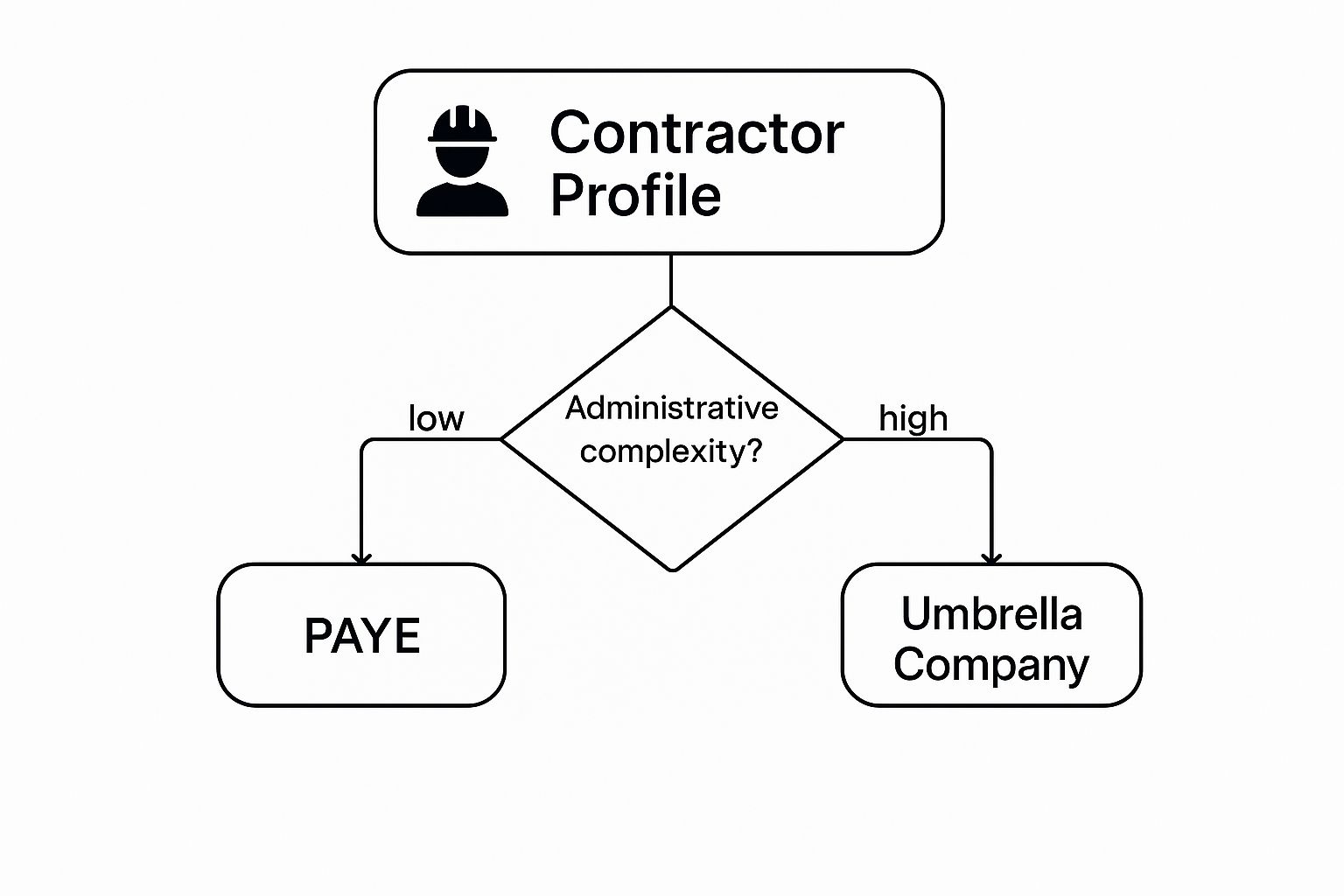
As the infographic shows, if you prize simplicity above all else, agency PAYE might be your best bet. On the other hand, if you are more focused on consolidating your benefits and tax affairs, an umbrella company starts to look like the stronger choice.
Decision Guide: PAYE or Umbrella?
To help you place your own circumstances into context, this table breaks down some common scenarios. Think of it as a quick reference guide to point you in the right direction.
| Contractor Scenario | Recommended Option | Key Reason |
|---|---|---|
| First-time contractor on a 12-month public sector role | Agency PAYE | Simplicity is key. No need for the continuity benefits of an umbrella yet. |
| Career contractor juggling multiple 3-month projects | Umbrella Company | Provides a single, continuous employment record, ideal for mortgages and loans. |
| Needs to prove income for a mortgage application soon | Umbrella Company | An unbroken employment history from one employer strengthens your application. |
| Works inside IR35 and prioritises minimal paperwork | Agency PAYE | It is the most direct and least complex payroll option for a single contract. |
| Values having one source for holiday and sick pay | Umbrella Company | All statutory benefits are managed by one employer, regardless of the client. |
Ultimately, this is not a one-size-fits-all decision. It comes down to what works for you right now, and what will support your career in the long run.
Your working style is the most important factor. A contractor who values simplicity above all else will have different needs to one who prioritises the long-term benefits of a continuous employment record.
Here are a few common situations to guide your thinking:
You might choose Agency PAYE if:
- You are new to contracting and have just secured your first long-term role.
- You mainly work on public sector contracts where a simple setup is often preferred.
- You do not see yourself changing roles frequently in the near future.
You might choose an Umbrella Company if:
- You are a career contractor who moves between different clients and projects every few months.
- You are planning to apply for a mortgage or loan and need that stable employment history.
- You like the idea of having all your statutory benefits, like holiday and sick pay, handled by one consistent employer.
By carefully thinking through these points, you can make a balanced decision that not only fits your current contract but also supports your long-term ambitions. Here at UmbrellaCompany.com, we are on hand to help you weigh these options and find a compliant, trustworthy partner for your contracting journey.
How to Select a Compliant and Trustworthy Partner
Whether you go down the agency PAYE route or use an umbrella company, partnering with a compliant and trustworthy organisation is non-negotiable. Your financial security and professional reputation are on the line.
While you need to be careful with both, the umbrella market has sadly become a target for non-compliant schemes. They make promises they cannot legally keep, which can leave contractors in a difficult situation.
It is vital to know the difference between a legitimate partner and a risky tax avoidance scheme. Be extremely wary of any provider promising unrealistic take-home pay, such as 80-90% retention. This is a massive red flag. These schemes often work by disguising your income as non-taxable ‘loans’ or using complex payslips to hide their true nature.
Vetting Your Umbrella Company
To protect yourself, you need to look for clear signs of compliance and transparency. The single most reliable way to know if an umbrella company is legitimate is to check for third-party accreditations.
Stick to providers who are accredited by reputable, independent bodies like:
- The FCSA (Freelancer & Contractor Services Association)
- Professional Passport
These organisations carry out rigorous, regular audits to make sure an umbrella company is adhering strictly to HMRC’s rules and industry best practices. Choosing an accredited partner gives you solid peace of mind that your taxes are being handled correctly and you are working with a proper employer.
Choosing a compliant umbrella is about safeguarding your finances from future HMRC investigations and potential penalties. A trustworthy partner will always be transparent about deductions and will never promise unrealistic financial returns.
When you are picking a partner, always put compliance first, no matter how tempting a misleading offer might seem. For more on this, our guide on finding a truly tax-efficient umbrella company in the UK offers some more essential advice.
Ultimately, a compliant partner ensures your contracting career is built on a secure and sustainable foundation.
Contractor FAQs
When you are weighing up how to get paid, a few common questions always arise about the real-world differences between agency PAYE and using an umbrella company. We have tackled the most frequent queries to give you clear, straightforward answers.
Can I Switch from an Umbrella to PAYE Mid-Contract?
Often, yes, but it is not always a given. It really depends on the terms you have with your recruitment agency and the end client. If your agency has its own PAYE payroll setup, you can usually ask to move over. This means you would end your employment with the umbrella company and sign a new contract directly with the agency.
Before you make any moves, however, double-check your umbrella contract for any notice periods or specific clauses. The best first step is always to have a chat with your agency to make sure it will be a smooth transition that does not disrupt your assignment.
Is an Umbrella Company More Expensive?
This is a common misconception. You will see an umbrella company deducts its margin, but this is not a cost that comes out of what would have been your PAYE rate. The assignment rate offered for an umbrella contract is uplifted to cover all employment costs, which includes the umbrella's margin, Employer's National Insurance, and the Apprenticeship Levy.
When you see a higher daily or hourly rate for an umbrella role, it is an inclusive figure designed to cover these statutory costs. Once they are deducted, what is left is your gross pay. From there, it is taxed just like any other salary. It is not an extra "fee" you are paying on top.
How Does IR35 Affect My Choice?
IR35 is a huge factor, but here is the key point: when a contract is determined to be ‘inside IR35’, both agency PAYE and an umbrella company are perfectly compliant ways to get paid. The rules simply demand that you are taxed as an employee, and both of these models do that correctly.
So, the difference between PAYE and umbrella for an inside IR35 role is not about tax compliance. The decision really boils down to other factors. Do you need a continuous record of employment for a mortgage application? Or do you just prefer the simplicity of being on the agency's books for a one-off project? That is what should guide your choice.
At UmbrellaCompany.com, we give you the tools and insights you need to compare trusted, accredited umbrella companies. We are here to help you make a compliant and confident choice for your contracting career.
Compare Compliant Umbrella Companies Now


