


A lot of contractors first meet this issue when a recruiter or umbrella provider says they can deliver unusually high take-home pay. The wording often sounds reassuring. It may mention efficiency, advances, loans, bonuses, or a special pay model. What you need to know is simple: the difference between evasion and avoidance of tax can decide whether your arrangement is lawful, challenged, or outright illegal.
For UK contractors, this isn't just a technical distinction for accountants. It affects your payslip, your Self Assessment, your IR35 position, and your personal risk if HMRC later asks questions. Some tax planning is built into the rules. Some arrangements push those rules to the edge. Some cross the line completely.
We see readers get confused because the language overlaps. A scheme may be sold as tax planning when it is really aggressive avoidance. A worker may think the umbrella company is handling everything, then discover their pay was structured in a way HMRC challenges. The safest approach is to understand the line for yourself.
Understanding Why This Distinction Matters
If you're contracting in the UK, especially inside IR35, tax is already less flexible than many people expect. Once someone offers a workaround that seems to reduce PAYE in a way your payslip doesn't fully explain, the question stops being academic. It becomes about whether you're being drawn into a problem.
At the broadest level, tax evasion is illegal. It involves hiding income, lying, or leaving out information. Tax avoidance uses legal methods to reduce tax, but that doesn't mean every avoidance arrangement is safe or accepted. HMRC can still challenge structures it sees as abusive or artificial.
That distinction matters because HMRC treats the two very differently. HMRC's latest estimates put the UK tax gap at £39.8 billion for tax year 2022 to 2023, equal to 4.8% of total theoretical tax liabilities, and its methodology separates deliberate evasion from legal avoidance because the response is different, as explained in this analysis of UK tax-gap estimates.
Why contractors should pay attention
Contractors, freelancers, and umbrella workers often sit in the middle of several moving parts:
- A recruitment agency that wants a quick placement
- An umbrella company that processes pay
- An end client with IR35 rules to follow
- A worker who may assume the payroll is compliant because somebody else set it up
That last point causes real trouble. If your pay model includes unexplained deductions, separate non-taxed payments, or vague wording on your payslip, you can't safely assume it's all fine because an intermediary arranged it.
Practical rule: If you can't clearly explain how your pay is taxed, you shouldn't accept the arrangement until someone can.
Why people mix the terms up
Part of the confusion is emotional. People hear "avoidance" and think "illegal". Others hear "tax planning" and think "safe". In reality, the line depends on how the arrangement works, how transparent it is, and whether the reporting to HMRC is accurate.
For contractors, that means the question isn't just "Is avoidance legal?" It's whether your pay structure uses straightforward PAYE and lawful reliefs, or whether it depends on artificial steps that could be challenged later.
Defining Tax Evasion and Tax Avoidance
Before looking at umbrella payroll and IR35, it helps to define both terms in plain English.
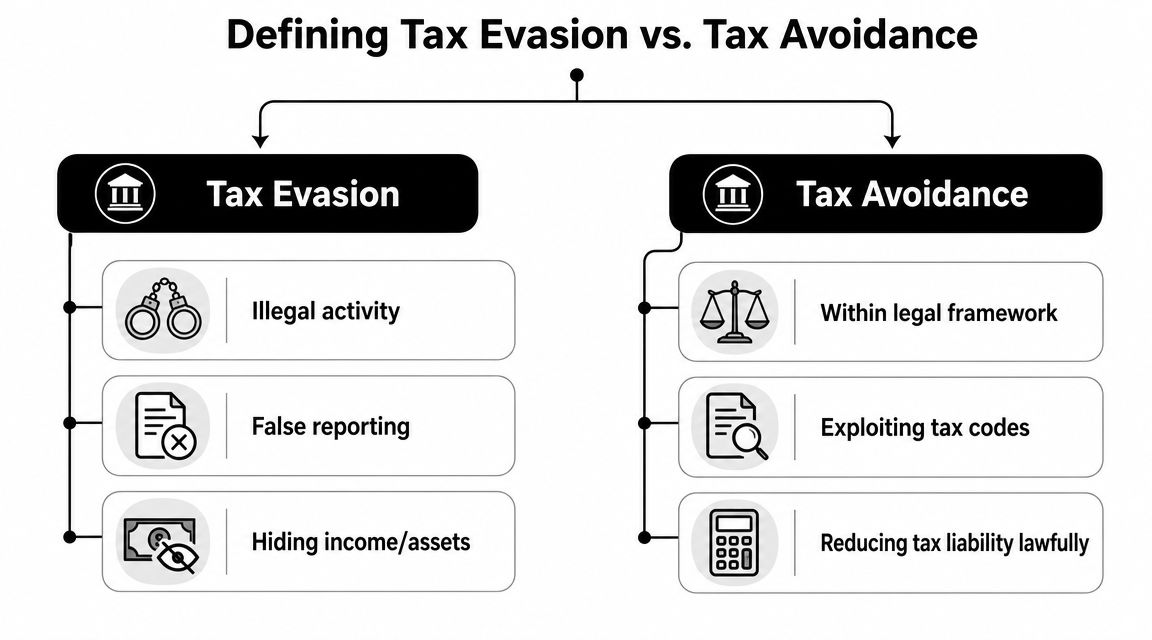
Tax evasion
Tax evasion means deliberately reducing tax by hiding the truth from HMRC. The key features are concealment and dishonesty.
Examples include:
- Hiding income, such as leaving cash payments off a tax return
- Falsifying records, such as inventing invoices or receipts
- Misreporting facts, such as claiming deductions you know you aren't entitled to
Evasion is not a clever use of the rules. It is fraud in a tax context. That's why HMRC can pursue it through penalties and prosecution.
Tax avoidance
Tax avoidance means arranging your affairs within the law to reduce tax. In its simplest form, that can include using reliefs and deductions Parliament intended people to use. It becomes more controversial when arrangements rely on technical loopholes or artificial structures that may follow the letter of the law more than its spirit.
In the UK, the distinction isn't left entirely to guesswork. A key milestone was the Finance Act 2004, which introduced the Disclosure of Tax Avoidance Schemes regime, often called DOTAS. That regime requires promoters of certain schemes to disclose them to HMRC, showing that avoidance is tackled through rules, disclosure, and anti-avoidance legislation rather than the criminal route usually associated with evasion, as outlined in this explanation of tax evasion and UK enforcement history.
Why the definitions matter in practice
For a contractor, this means two things can be true at once:
- Some tax planning is entirely legitimate
- Some "tax-saving" schemes are sold as legal but carry serious risk
That's why broad promises about reducing tax aren't enough. You need to know the mechanism. If you'd like a practical overview of lawful contractor tax planning, our guide on how to pay less tax as a contractor covers the everyday options in straightforward terms.
Avoidance is usually about structure. Evasion is usually about concealment.
That one sentence clears up most of the confusion. If somebody is asking you to keep something off the books, describe income inaccurately, or ignore odd payslip entries, you're no longer in ordinary tax planning territory.
The Key Legal Tests Intent Legality and Methods
The clearest way to understand the difference between evasion and avoidance of tax is to compare them side by side. For UK contractors, the practical boundary is often an intent-and-disclosure test. Lawful arrangements are transparent. Evasion depends on hiding or misrepresenting something.
Tax Evasion vs. Tax Avoidance The Core Differences
| Criterion | Tax Evasion | Tax Avoidance |
|---|---|---|
| Intent | To reduce tax by concealment, dishonesty, or misstatement | To reduce tax by arranging affairs within legal rules |
| Legality | Illegal | Legal in principle, but some schemes may be challenged or countered by anti-avoidance rules |
| Disclosure | Income, assets, or facts are hidden or misreported | Arrangement is generally transparent, even if complex |
| Typical methods | False invoices, hidden income, fabricated expenses | Use of reliefs, deductions, salary sacrifice, pension planning, structured arrangements |
| Contractor risk | Civil penalties, possible criminal consequences | HMRC challenge, disputed tax, interest, and further scrutiny if the arrangement is aggressive |
The legal boundary is well captured in this guide to the intent-and-disclosure test, which explains that lawful avoidance relies on transparent arrangements, while evasion involves deliberate concealment or misrepresentation.
Intent matters
Intent is often where readers get stuck. They ask, "What if I didn't mean to do anything wrong?" That matters, but it doesn't remove your responsibility to check what you're being paid and how it's reported.
A contractor who claims a genuine, properly recorded expense isn't evading tax. A contractor who fabricates an expense, alters a receipt, or knowingly submits false information has crossed the line.
Legality is not the same as safety
A lot of confusion comes from this point. Something may be presented as legal because it isn't obviously criminal. That still doesn't make it a sensible or durable arrangement.
Anti-avoidance rules exist because Parliament and HMRC know some schemes are designed to exploit gaps in the rules. In the contractor market, that matters most when a payment structure tries to separate what is really employment income into different labels.
Methods tell you a lot
If you're unsure how to assess a pay model, start with the method being used. Ask simple questions.
- Is everything shown clearly on the payslip?
- Is the income being taxed through PAYE in the normal way?
- Are deductions explained and easy to verify?
- Are any payments described as loans, credits, grants, or advances?
If you're already working through off-payroll rules, our guide on inside or outside IR35 helps clarify why tax treatment changes once a role falls inside those rules.
The more a payment structure depends on unusual labels and poor visibility, the less comfortable you should be with it.
How This Affects Contractors and Umbrella Companies
For umbrella workers, the legal definitions only become useful when you apply them to a payslip. That's where most of the risk sits.
A compliant umbrella company should employ you, run payroll through PAYE, deduct the right taxes, and show those deductions clearly. Problems start when the arrangement looks like employment on paper but the pay doesn't look like ordinary taxed salary in practice.
Where risk appears in the umbrella market
One of the biggest danger areas is disguised remuneration. That term covers arrangements where earnings are routed to you in a form that is meant to avoid normal tax treatment. The language varies, but the warning signs are often similar.
HMRC has repeatedly warned umbrella workers to check payslips for unusual deductions or payments described as loans, which are red flags for non-compliant avoidance schemes. This contractor-focused issue is discussed in this guide to avoidance, evasion, and umbrella risk.
Common red flags include:
- A low taxable salary, followed by another payment that isn't taxed in the same way
- References to loans or advances, especially if repayment is unclear or unrealistic
- Unexplained deductions, where you can't tell what has been taken and why
- Complex offshore wording, with no simple explanation of who is paying you and under which rules
- Promises centred on take-home pay, instead of compliance, payslip transparency, and employment rights
Why inside IR35 makes the issue sharper
If you're inside IR35, the starting point is that the role is taxed broadly like employment income. That doesn't mean every detail of payroll is identical in all cases, but it does mean unusual alternatives should make you pause.
If somebody claims they can keep you inside IR35 while still paying a large share of your income outside normal PAYE, you should ask exactly how and why. In many cases, that's where contractors get pushed towards arrangements HMRC later challenges.
Our overview of IR35 for contractors explains why tax status and payroll method need to match the actual working arrangement.
Your practical responsibility
Contractors sometimes assume the umbrella provider carries the entire compliance burden. In reality, you still need to review what you're being paid.
Check for:
- A clear payslip that matches your understanding of gross pay and deductions
- Accurate reporting of salary and statutory deductions
- Plain-English explanations when anything on the payslip is unfamiliar
- No pressure to move quickly without time to review the arrangement
If an umbrella company explains its model clearly, that's a good sign. If it avoids direct answers and keeps returning to take-home pay, that's not.
A lawful umbrella arrangement isn't tax evasion. It isn't automatically suspect either. The risk appears when a provider uses the umbrella structure to disguise income, create artificial deductions, or blur what should be straightforward PAYE employment income.
Real World Examples Distinguishing The Lines
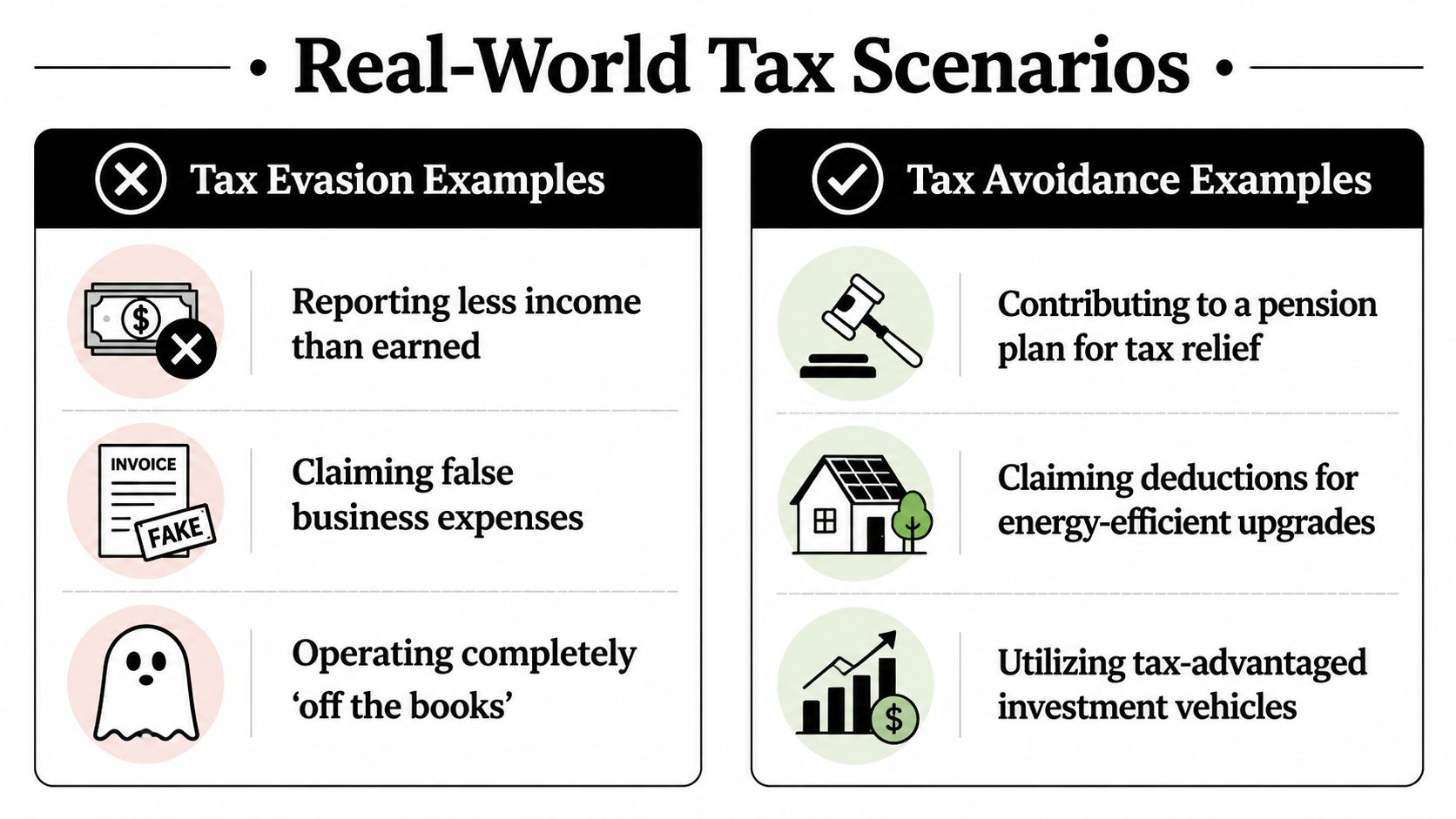
Definitions are useful, but examples are what make the line clear. The three scenarios below show how the same goal, paying less tax, can fall into very different categories depending on the method.
Acceptable tax planning
A contractor joins a compliant umbrella company and chooses to make pension contributions through a recognised arrangement. Their payslip shows taxable pay, deductions, and pension treatment clearly. Records are complete, and HMRC reporting is accurate.
This is the kind of planning often understood when they talk about reducing tax lawfully. The arrangement is transparent and uses a recognised part of the tax system.
Aggressive avoidance
A contractor is told they will receive a small salary and the rest of their earnings through a payment described as a loan, advance, or another label that isn't taxed in the normal way. The scheme is marketed as legal and efficient. The paperwork is dense, and the explanation focuses on take-home pay rather than PAYE treatment.
Many people get caught out in these scenarios. The worker may not think they are doing anything dishonest. Even so, the arrangement can still create major tax risk if the structure is artificial and HMRC sees it as disguised remuneration.
Outright evasion
A freelancer receives income from a client and chooses not to declare part of it to HMRC. In another example, a person creates false expense claims to reduce the tax shown on their return.
That is tax evasion. The line is crossed because the person is concealing the truth or presenting false information.
A simple way to classify an arrangement
If you're unsure which category a situation falls into, ask these questions:
- Is the income fully reported?
- Does the paperwork accurately describe the payment?
- Could you explain the arrangement to HMRC without leaving anything out?
- Does the tax result depend on a label that doesn't match commercial reality?
A lawful arrangement can be explained plainly. Risky schemes usually need a sales script.
Penalties and Risks What Happens When You Get It Wrong
The consequences depend on which side of the line you're on, but neither route is something contractors should treat lightly.
If HMRC sees evasion
Tax evasion can lead to severe outcomes because it involves deliberate concealment or misrepresentation. That can include civil penalties and criminal prosecution. For anyone trying to understand how serious prosecution can become in a tax setting, this plain-language article from Australia Wide Tax Solutions on prosecution offers useful context on what happens when a tax authority moves beyond routine enquiries.
The point for UK contractors is straightforward. If you knowingly hide income or submit false information, you're in a very different position from someone caught in a disputed planning arrangement.
If HMRC challenges avoidance
Aggressive avoidance carries a different kind of danger. You may not face a criminal allegation, but you can still end up with disputed tax, interest, penalties, stress, and a long argument over what your pay really was.
This is one reason deadlines and record-keeping matter so much. If HMRC reviews your position and you need to respond, you don't want missing paperwork or late filings making things worse. Our guide to UK Self Assessment deadlines is worth keeping handy if you still complete a return alongside umbrella work or other income.
The real cost is often delayed
Many contractors focus on today's take-home pay and ignore tomorrow's risk. That's exactly how poor arrangements gain traction. If the structure later unravels, the worker may be the one trying to explain payslips, contracts, and unexplained payments long after the recruiter has moved on.
Short-term tax savings can turn into long-term personal liability if the arrangement wasn't sound to begin with.
How to Stay Compliant and Choose the Right Path
A contractor signs up with a new umbrella, sees a higher take-home figure than expected, and assumes that means the provider is efficient. A month later, the payslip shows salary, a separate payment with an unfamiliar label, and no clear explanation of how PAYE was worked out. That is the moment to slow down and ask questions.
For contractors, staying compliant usually comes down to one practical habit. You should be able to explain, in plain English, how you are being paid and why the tax treatment makes sense. If the arrangement only works when nobody looks too closely, the risk is already too high.
A contractor checklist
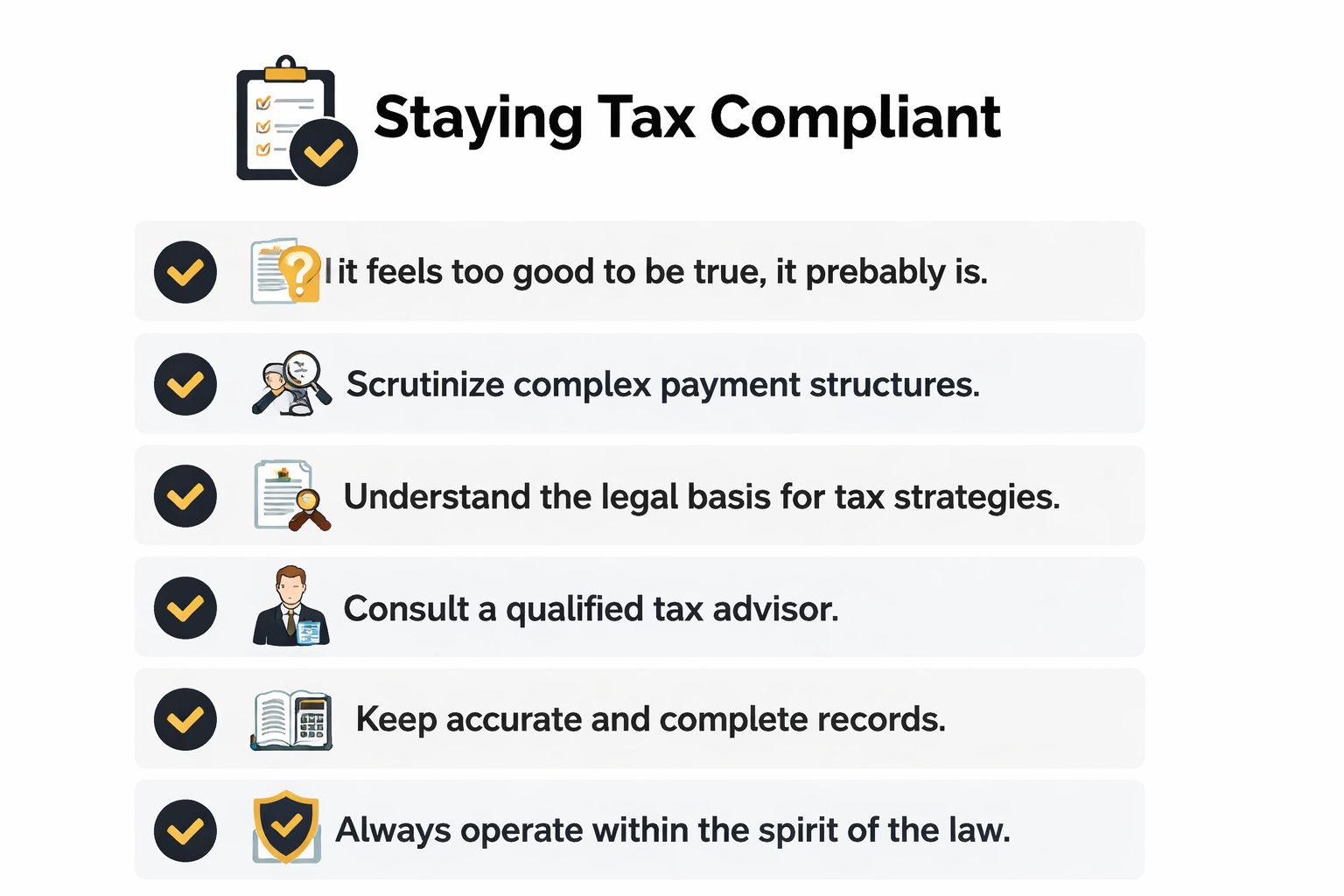
Use this checklist before you join an umbrella company or accept a payment model that promises unusually high net pay:
- Check who oversees compliance. Look for recognised bodies such as FCSA or Professional Passport, then confirm what that means in day-to-day payroll, not just on the website.
- Read the payslip like a receipt. A correct payslip should show salary, tax, National Insurance, pension deductions where relevant, and any other amounts in a way you can follow.
- Treat unusual labels as warning signs. Loans, advances, credits, grants, bonuses paid outside normal payroll, or similar terms need a clear written explanation.
- Ask a direct PAYE question. For example: "Is all of my taxable income being processed through PAYE?" If the answer is vague or overly complicated, reconsider the arrangement.
- Check the IR35 position separately. IR35 decides how your engagement should be taxed. It does not justify odd umbrella payroll structures or payments routed in a different form.
- Keep every document. Save contracts, key information documents, payslips, timesheets, onboarding emails, and any written explanation of your pay model.
- Get advice before signing, not after a problem appears. If you also need planning around investments or disposals outside your contracting income, this guide with actionable advice for capital gains tax may help you frame the right questions for a qualified adviser.
Choosing a provider carefully
A compliant umbrella company makes the flow of money easy to follow. Your gross pay goes through payroll, deductions are shown clearly, and your net pay matches the explanation. That is how normal PAYE should feel.
By contrast, disguised remuneration often works like a detour built into the payslip. Part of your earnings may be described as something other than taxable pay, even though it came from your work. Contractors in the UK umbrella market should be especially cautious if a provider focuses on unusually high take-home percentages, offshore elements, or payment structures that are hard to explain to an accountant.
Umbrella Company offers a way to review umbrella options based on your role and IR35 needs, which can help you narrow the field before carrying out your own due diligence.
The safest path is usually the least mysterious one. If the provider can show, clearly and in writing, how your pay is taxed under PAYE, how holiday pay is handled, what margin is charged, and how your contract fits with IR35, you are in a much stronger position.
Clear paperwork matters. Clear payroll matters more.


