


Heard the term "umbrella company" but not sure what it means for you as a contractor? Think of us as your personal HR and payroll department, packaged into one simple service.
An umbrella company acts as the employer for contractors working on temporary assignments. We handle all the complex administration, freeing you up to focus on what you do best: your work. This guide explains exactly what an umbrella company is and how we can support your contracting career.
What Exactly Is an Umbrella Company?
The primary role of an umbrella company is to make your contracting life simpler and more secure. When you join us, you become our employee. This means we are responsible for managing your payments and ensuring your tax and National Insurance Contributions are correctly processed with HMRC through the PAYE system.
This setup is beneficial because it provides you with a continuous record of employment and access to statutory employment rights, such as holiday pay and sick pay, even when you move between different projects and clients. It removes the administrative burden that often comes with being self-employed.
Growth in the UK Market
This method of working has become incredibly popular in the UK. The figures speak for themselves: the number of contractors using an umbrella company increased from approximately 100,000 in 2007/08 to 625,000 by 2020. This growth shows that the model provides an essential service in today's flexible labour market.
This diagram illustrates how it all fits together, with the umbrella company at the centre of the relationship between you, your agency, and the end client.
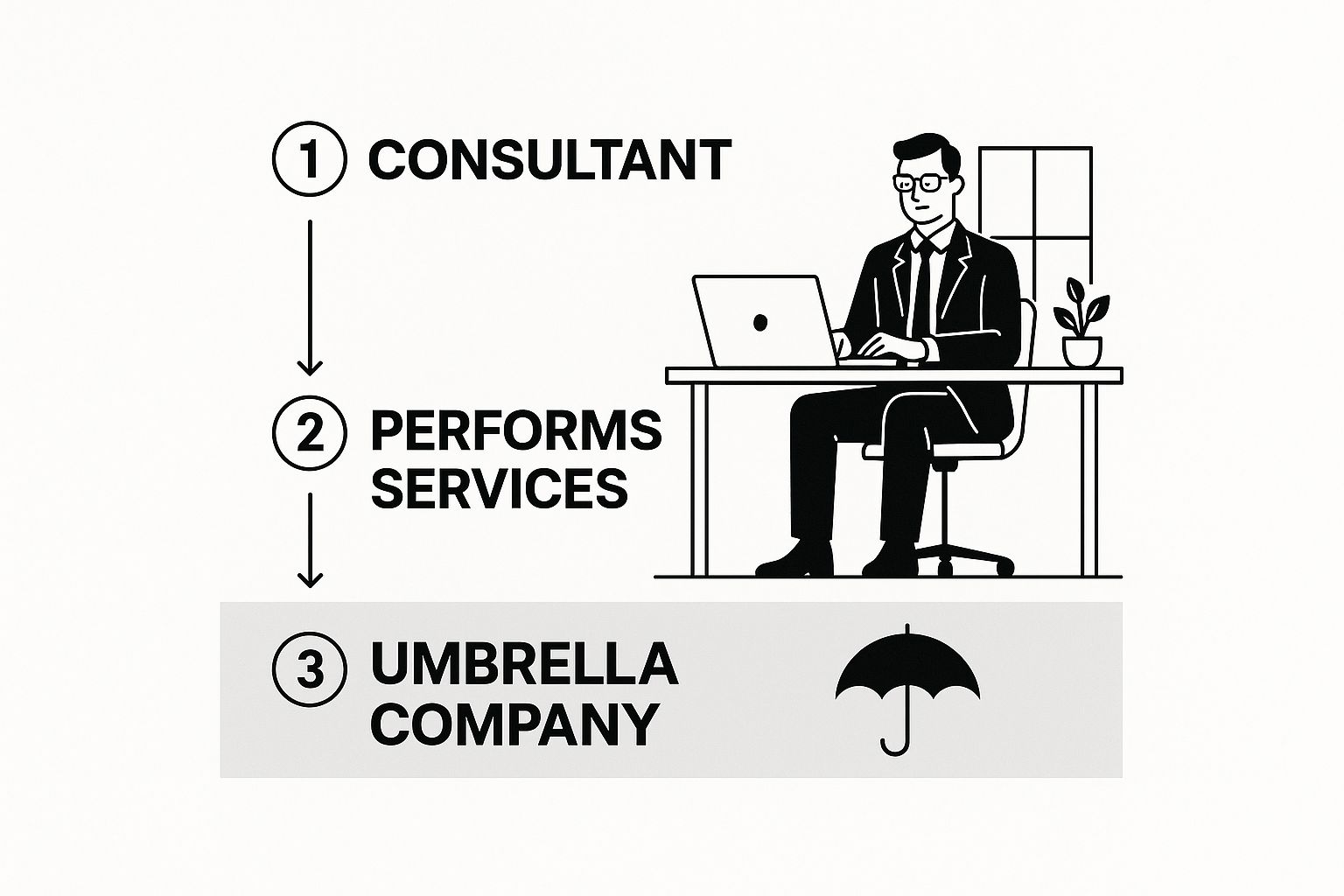
As you can see, the umbrella company becomes the central employer. This simplifies the contractual chain and means we take on all payroll responsibilities for you.
To give you a clearer picture, here’s a summary of what an umbrella company does and what that means for you.
An Umbrella Company at a Glance
| Core Function | What It Means for You |
|---|---|
| Acts as Your Employer | You gain a single, continuous employment record. |
| Manages Invoicing | No more chasing clients for payment. |
| Processes Payroll (PAYE) | Your tax and NI are calculated and paid correctly. |
| Handles Admin | You receive statutory rights like holiday and sick pay. |
| Ensures Compliance | Peace of mind that you are operating within UK law. |
Ultimately, this structure bridges the gap between the freedom of contracting and the stability of traditional employment. By taking the paperwork off your plate, we let you get on with delivering excellent work for your clients.
For a more detailed look at the mechanics, read our guide on how an umbrella company works.
How Does It Work? A Contractor’s Guide to the Umbrella Process
If you are new to contracting, you might wonder how your money gets from the client to your bank account. The system is straightforward and designed to make your life easier. Let's walk through it together.

When you join an umbrella company, you officially become our employee. This is a crucial step. It means you get a single, continuous record of employment and access to all the statutory rights that come with it, like sick pay and holiday pay, even if you are working on different projects.
Your Payment Journey, Step-by-Step
Once you are on board, the payment cycle runs like a well-oiled machine. We handle the administration and calculations, leaving you free to focus on your work.
Here is a simple breakdown of how the process unfolds:
- You Submit Your Timesheet: At the end of your working week or month, you send us your approved timesheet.
- We Invoice on Your Behalf: Using your timesheet, we create and send an invoice to your recruitment agency or end client. This invoice is for the assignment rate, which is the full amount the client has agreed to pay for your services.
- The Client Pays Us: The agency or client pays the invoice directly into our account. This single payment covers your earnings, all employment costs, and our small margin for running the service.
The assignment rate is the total amount for your contract. It covers not only your wage but also the costs of employing you, such as Employer’s National Insurance, the Apprenticeship Levy, and our administrative fee.
From Client Payment to Your Pocket
Once the funds arrive, our payroll experts process your pay. We manage all the deductions required by HMRC, including your PAYE tax and employee National Insurance contributions, plus any pension payments you have chosen to make.
From the same funds, we also deduct the employer’s costs and our margin, which we agree with you upfront.
The final figure is your net take-home pay, which we transfer directly into your bank account. With every payment, you will receive a detailed payslip breaking everything down, so you can see exactly where every penny has gone with complete clarity.
Curious about what you could earn? Use our reliable umbrella company calculator for a quick estimate. It is a great way to understand your potential take-home pay and plan your finances.
What Are the Real-World Perks?
Why do so many UK contractors choose to work this way? A good, compliant umbrella company offers a unique blend of contractor freedom and employee stability that is hard to beat.

The biggest advantage is gaining access to statutory employment rights. By becoming our employee, you receive legal protections that a sole trader does not have. This provides a vital safety net for your contracting career.
A Blend of Security and Simplicity
No one enjoys dealing with tax paperwork. Working with us removes that burden. We handle all your PAYE tax and National Insurance contributions, so you do not have to worry about a self-assessment tax return. That peace of mind is invaluable.
Another significant benefit is having a continuous record of employment. This unbroken history is very helpful when you are applying for a mortgage or a loan, as lenders value the stability it shows.
As our employee, you can count on these core benefits:
- Statutory Sick Pay: A financial cushion if you are too ill to work.
- Holiday Pay: You will earn paid time off, so you can take breaks without your income stopping.
- Workplace Pension Scheme: We automatically enrol you into a pension, helping you save for retirement.
- Essential Business Insurance: We provide critical cover, such as Professional Indemnity and Public Liability insurance, at no extra cost to you.
Think of us as your outsourced HR services. We manage the complex administration, freeing you up to concentrate on delivering great work for your clients.
To learn more, check our guide on the best umbrella companies for high take-home pay and see how different providers compare.
Navigating the Risks and Red Flags
While a compliant umbrella company offers many benefits, the market has its risks. The biggest danger is engaging with a non-compliant scheme disguised as a legitimate provider. These schemes can leave you with large, unexpected tax bills and serious legal problems.
When you work with us, our margin is a simple, transparent fee deducted from your assignment rate. Some schemes, however, hide costs or use illegal models to promise incredibly high take-home pay.
Spotting a Non-Compliant Scheme
The most obvious red flag is a promise of unusually high pay retention, often 80% or more. If it sounds too good to be true, it almost certainly is. These schemes typically rely on non-compliant payment structures to create this illusion.
A common tactic is to pay you a portion of your income as a tax-free 'loan' or other payment. This is a classic example of disguised remuneration.
HMRC is clear on this: these schemes do not work. Any money you receive this way is taxable income. Ultimately, you, the contractor, will be liable for all unpaid tax, plus interest and penalties.
This is a widespread problem. It is estimated that over a third of contractors using umbrella companies work through non-compliant providers, costing the UK government around £500 million a year in lost tax revenue.
Key Warning Signs to Watch For
Knowing what to look for is your best defence. Be cautious if a provider you are considering:
- Advertises an unrealistically high take-home pay figure.
- Lacks accreditation from a recognised UK body like the FCSA or Professional Passport.
- Sends your payments from multiple sources or uses offshore accounts.
- Fails to provide a clear payslip detailing all deductions.
Making an informed choice is the only way to protect yourself. To learn more about legitimate payment structures, read our guide to finding a tax-efficient umbrella company in the UK.
IR35 and Where Umbrella Companies Fit In
It is difficult to discuss UK contracting without mentioning IR35. These off-payroll working rules were introduced by HMRC to determine if a contractor is genuinely self-employed or a ‘disguised employee’ for tax purposes.
If your contract is deemed ‘inside IR35’, it means your working arrangement is similar to traditional employment. As a result, your earnings must be taxed at source through PAYE, with National Insurance contributions deducted like a permanent employee. This is where an umbrella company is essential.
The Go-To Solution for Inside IR35 Contracts
For the business you contract for, an inside IR35 assignment carries a significant compliance burden. They are responsible for ensuring the correct tax is paid, which poses a risk.
To manage this, they will almost always require you to work through a compliant umbrella company. This transfers the responsibility for tax and payroll from them to us. It is a clean and simple way for them to mitigate their risk.
An umbrella company acts as a compliant payroll solution for inside IR35 contracts. It guarantees that all taxes are correctly calculated and paid to HMRC, giving everyone in the supply chain peace of mind.
This setup is also a great benefit for you. You can accept inside IR35 projects without the stress of navigating complex tax rules or worrying about a future HMRC enquiry. The umbrella company manages all deductions, ensuring you are paid correctly and on time.
How to Choose a Compliant Umbrella Partner
Choosing the right umbrella company is one of the most important decisions you will make as a contractor. A good choice provides security and peace of mind. A poor choice could lead to serious financial trouble with HMRC.
So, how do you distinguish between good and bad providers? Start by checking for recognised accreditation. Reputable industry bodies hold their members to high standards, so this should be your first check.
Look for Key Quality Marks
A key sign of a trustworthy umbrella company is its professional affiliations. Before signing up, you must confirm they hold current accreditation from one of the UK’s main compliance bodies.
Look for membership with:
- The FCSA (Freelancer & Contractor Services Association): This is widely regarded as the UK's leading membership body for compliant providers.
- Professional Passport: Another highly respected, independent assessor that audits providers against strict compliance standards.
Seeing one of these logos demonstrates the company’s commitment to operating correctly.
Choosing an accredited partner is your best defence against disguised remuneration schemes. It shows the provider has undergone rigorous, independent checks to verify their processes are fully compliant with HMRC regulations.
Scrutinise the Details Before Signing
Never rush into a contract. First, ask for a detailed pay illustration. This document should clearly break down every deduction, including the umbrella’s margin, Employer’s National Insurance, and the Apprenticeship Levy. Your first payslip should match this illustration perfectly.
This is about protecting yourself from a growing problem. The government is aware of the risks posed by non-compliant providers. In the 2022/23 tax year, an estimated 275,000 workers were involved in such schemes. As a result, new regulations are being introduced to protect contractors. You can read more about the government's action on umbrella companies to stay informed.
To help you spot the difference, here is a simple comparison.
Compliant vs Non-Compliant Umbrella Schemes
| Feature | Compliant Umbrella (Safe) | Non-Compliant Scheme (Warning Sign) |
|---|---|---|
| Take-Home Pay | Realistic take-home pay, typically 60-70% of your contract rate. | Promises unusually high take-home pay, often 80-90% or more. |
| Payment Method | All payments are made through standard UK PAYE. | Payments may involve loans, grants, or offshore transfers. |
| Deductions | All statutory deductions (Tax, NI, Levy) are clearly shown on your payslip. | Vague or missing deductions. Payslips are often confusing or incomplete. |
| Accreditation | Proudly displays FCSA or Professional Passport accreditation. | No accreditation, or claims membership of an unknown body. |
| Transparency | Open about their margin and provides a clear pay illustration upfront. | Reluctant to provide a clear breakdown of fees and deductions. |
| Contract | Provides a standard Contract of Employment with statutory rights. | May use unusual contracts or no contract at all. |
Ultimately, a compliant partner will be completely transparent and happy to answer all your questions. Read the contract of employment carefully, ensuring it outlines your rights to holiday pay and sick pay. Your financial safety depends on performing these checks.
Got Questions About Umbrella Companies? We Have Got Answers.
It is normal to have questions about how this all works. We understand. Let's clarify some of the most common queries we hear from new contractors.
So, Am I an Employee of the Umbrella Company?
Yes, you are. When you sign up with a compliant umbrella company, you sign a contract of employment and become their legal employee.
The umbrella company becomes your employer for payroll purposes, even though you are working on-site for a different business. This is what gives you access to employment rights like holiday pay, sick pay, and a workplace pension.
What Is the Situation with Claiming Business Expenses?
This is a key question, as the rules have changed. Since HMRC introduced the Supervision, Direction, or Control (SDC) rules, claiming tax relief on most travel and subsistence expenses is no longer possible for most umbrella contractors.
While some specific business costs might still be claimable, be very wary of any provider that promises you can claim a wide range of expenses. Sticking with a fully compliant umbrella company that follows HMRC's rules is the only way to protect yourself.
Is an Umbrella Company the Same as a Recruitment Agency?
Not at all, they perform two different roles. A recruitment agency finds you contract work with their clients.
An umbrella company steps in once you have secured that role. We become your official employer, handling all the payroll and administration for the work you do. You will have a contract with the agency for the work and a separate employment contract with your umbrella company.
Ready to find a compliant, trustworthy partner for your contracting career? UmbrellaCompany.com makes it easy to compare accredited providers and get started. Find your perfect umbrella company today.


