


Starting a new contract often feels straightforward until the paperwork lands. If the role sits inside IR35, you’ll usually be paid through an umbrella company, and that means your pension suddenly becomes part of your payslip, your employment status, and your long-term planning all at once.
That catches plenty of contractors off guard. You might know what your day rate is, but still feel unsure about where pension contributions go, who pays them, what scheme you’ve been placed into, and whether it’s a good deal.
A defined contribution pension plan is the pension type most contractors now deal with. It’s common, portable, and usually easier to move around than older pension arrangements. It also puts more responsibility on you, because the outcome depends on what goes in and how the investments perform over time.
If you’re new to contracting, our guide on how to become a contractor helps with the bigger picture. For now, let’s focus on the pension side, in plain English, and make it manageable.
An Introduction to Pensions for UK Contractors
When you contract through an umbrella company, the umbrella becomes your employer for payroll purposes. That’s why pension enrolment can appear quickly, sometimes before you’ve had the chance to compare providers or understand the scheme.
For many contractors, this is their first close look at a workplace pension. Permanent employees often leave pension admin in the background for years. Contractors don’t have that luxury. Contracts change, umbrella providers change, and small pension pots can build up faster than people expect.
Why contractors need a clear pension view
A pension is money set aside for later life, with tax advantages and employer involvement in many workplace arrangements. In your case, the important point is this: the pension doesn’t disappear just because your contract ends. It stays yours.
That matters because a contractor’s career rarely follows one tidy path. You might move between agencies, clients, umbrellas, or periods of direct engagement. Your pension needs to keep up with that movement without becoming a mess.
Practical rule: If you can read your contract and your payslip, you can learn to read your pension too. It’s just another part of your earnings flow.
Where the confusion usually starts
Most pension confusion for contractors comes from three places:
- Auto-enrolment: You may be placed into a scheme automatically, rather than actively choosing one at the start.
- Payslip wording: Pension deductions can sit alongside tax, National Insurance, umbrella margin, and other employment costs, which makes them harder to spot.
- IR35 context: Once you’re inside IR35 and paid through an umbrella, pension contributions are handled within that employment structure, not as a separate side arrangement.
The good news is that the basics are logical once you know what each piece does. Your pension has a clear purpose. Your umbrella has a defined role. Your provider holds the pot. The investments inside that pot try to grow over time.
What Is a Defined Contribution Pension Plan
A defined contribution pension plan is best thought of as your own retirement pot. Money goes in during your working life, the provider invests it, and what you eventually have depends on contributions plus investment performance.
That’s why it’s called “defined contribution”. What’s fixed is the amount going in, not the income you’ll later receive.
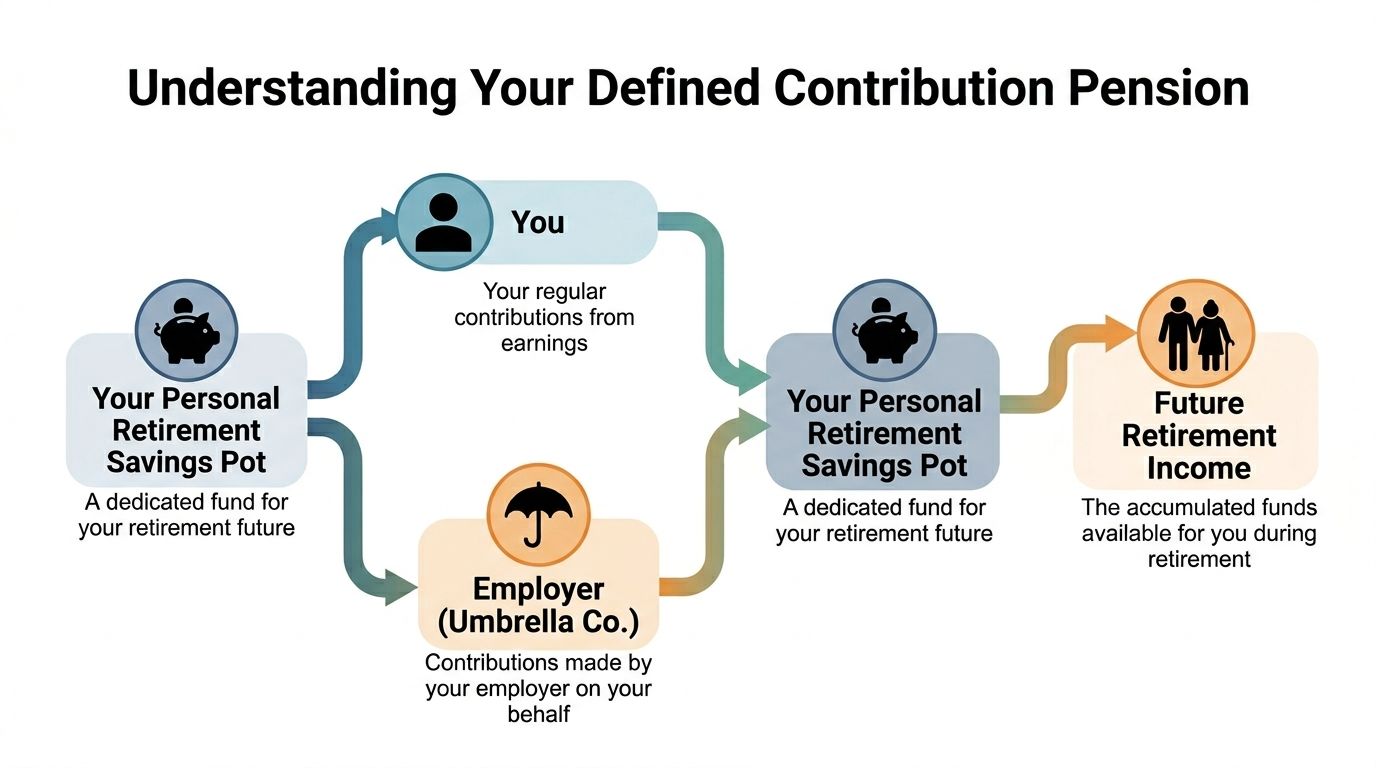
The savings pot idea
Consider it a plant pot.
You and your employer add soil and water over time. The pension provider then places that pot where it can grow, using investment funds rather than a windowsill. Some periods bring strong growth. Some don’t. The final size depends on how much went in and how well it grew.
That’s very different from an older style pension that promised a set income. With a defined contribution arrangement, there is no fixed retirement payout built in from the start.
What goes into the pot
In a workplace setting, contributions normally come from two places:
- Your contributions, taken through payroll
- Employer contributions, paid by the employer, which for many contractors is the umbrella company acting as employer
Once paid in, that money is invested. Many schemes place new joiners into a default fund. Others may offer choices such as lifestyle funds or broader multi-asset options.
Why this pension type matters so much now
Defined contribution pensions now dominate workplace pension saving in the UK. Active membership in DC schemes rose from 5.5 million in 2012 to over 23 million by 2023, following the expansion of auto-enrolment, according to this analysis of defined contribution plan growth.
For contractors, that matters because you’re not dealing with an unusual pension model. You’re dealing with the main one.
What people often misunderstand
A lot of contractors assume the pension provider guarantees the outcome. It doesn’t.
Others assume the value should always rise. It won’t. Investments move up and down, especially over shorter periods. A temporary drop doesn’t automatically mean the pension is bad. It means the money is invested, not sitting still.
Your pension statement shows a moving value because the money is working in markets, not waiting in cash.
A simple contractor example
Suppose you start an inside IR35 contract through an umbrella. You’re auto-enrolled into the umbrella’s pension scheme. Contributions are taken through payroll and paid into your named pension account. You leave the contract months later. The pot remains yours.
You can usually leave it where it is, transfer it later, or combine it with another pension if that suits your wider planning. That ownership is one of the core strengths of the defined contribution pension plan.
Defined Contribution vs Defined Benefit Plans
The easiest way to understand your pension is to compare it with the older pension style many people still call a final salary pension.
A defined benefit pension aims to provide a promised income in retirement, usually based on a formula linked to pay and service. A defined contribution pension builds a pot of money, and that pot funds your later retirement choices.
The key difference is who carries the risk
With a defined benefit plan, the employer carries the investment risk because the pension promise has to be met.
With a defined contribution plan, the investment risk sits with the individual, because the final value depends on contributions and market performance. Under auto-enrolment, the total minimum contribution into a DC plan is 8% of qualifying earnings, with the employer paying at least 3%, as outlined in this guide to defined contribution plan minimum contributions.
Defined Contribution vs Defined Benefit Pensions
| Feature | Defined Contribution (DC) | Defined Benefit (DB) |
|---|---|---|
| What is promised | Contributions paid in | A retirement income based on a formula |
| Who takes investment risk | The individual | The employer |
| Outcome at retirement | Depends on pot size and investment performance | More predictable |
| Portability for contractors | Usually easier to move and keep track of | Often less suited to frequent job moves |
| Common place in modern contracting | Very common | Rare in contractor arrangements |
Why this matters for contractors
Contracting rarely fits the shape of a long, uninterrupted employment history with one employer. That’s one reason DC pensions suit the market better. They move with you more easily.
The trade-off is obvious. You gain flexibility, but you lose certainty.
If you’re a contractor, that means your pension planning can’t stop at “I’m enrolled”. You need to know what fund you’re in, what charges apply, and whether the arrangement still works when you move contracts.
Key Benefits and Risks of Your DC Pension
A defined contribution pension plan works well for many contractors, but only if you understand both sides of the deal. It has strengths that fit modern working life, and risks that shouldn’t be brushed aside.

The benefits that suit contractor life
The biggest practical advantage is portability. Your pension pot belongs to you, not to one contract or one client. UK DC pension plans are highly portable, and pots can transfer between providers, with the wider pensions dashboard initiative intended to support visibility. Annual contributions can be up to £60,000 for 2024/25, with tax relief available up to your marginal rate, as noted in this overview of UK DC pension portability and contribution limits.
For contractors, that helps in several ways:
- Job changes are easier: You don’t lose the pension because you switch assignment.
- Personal ownership matters: The pot sits in your name and remains part of your long-term finances.
- Tax treatment is valuable: Pension saving can be more efficient than taking everything as immediate taxable income.
Another advantage is visibility. Most modern schemes provide online access, so you can check value, fund choice, and contribution history instead of waiting for paper statements.
The risks you need to take seriously
The main risk is investment risk. Your pot can rise or fall because it is invested. A weak period in markets can reduce the value on your statement.
Then there’s longevity risk. In simple terms, that means your money may need to last longer than you expect. A pension pot isn’t just about getting to retirement. It’s about funding years after that.
There is also a contractor-specific risk. If you move often, you can end up with multiple small pension pots across different providers. That creates admin friction and makes oversight harder.
Key takeaway: Flexibility is useful only when you stay organised enough to use it.
Fees and fund choice matter
Charges can look small and still make a difference over time. That’s why you should check:
- Annual management charges: What the provider charges for running the fund.
- Default fund design: Whether the standard option matches your time horizon and risk tolerance.
- Transfer process: Whether moving your pension later is straightforward or awkward.
If you never review the default fund, you may end up in an investment mix that doesn’t reflect your age, goals, or appetite for ups and downs.
A balanced view
A DC pension isn’t bad because it carries risk. It’s more hands-on than many people expect.
For contractors, the pertinent question isn’t whether a defined contribution pension plan is perfect. It’s whether you understand how to manage it well enough to make the flexibility work in your favour.
How DC Pensions Work Through an Umbrella Company
For contractors, theory becomes reality here. Your umbrella company is the employer that processes your pay, and pension contributions usually flow through that payroll setup.
That changes how the pension feels. Instead of being an abstract savings product, it becomes part of your contract economics and your weekly or monthly pay.

The umbrella’s role in plain English
When you work through an umbrella, the agency or end client pays the umbrella. The umbrella then processes your pay under PAYE and handles employer obligations, including pension administration where auto-enrolment applies.
If you’re unsure about that employment chain, this explanation of how an umbrella company works gives the payroll context that sits around your pension.
What matters for pensions is simple. The umbrella is usually the party enrolling you, deducting contributions through payroll, and passing them to the pension provider.
How contributions usually reach the pension
Most contractors see pension contributions through one of these routes:
- Auto-enrolment by default: You’re placed into the umbrella’s workplace pension unless you opt out within the allowed process.
- Standard payroll deduction: Your contribution is taken through pay and sent to the scheme.
- Alternative contribution arrangement: Some umbrellas may offer salary sacrifice or other pension contribution structures, depending on how their payroll model is set up.
The exact payslip wording can vary. That’s why you should ask the umbrella how pension entries appear and when payments reach the provider.
A practical way to read the process
Think in stages:
- Your contract value comes in to the umbrella.
- Employment-related deductions and payroll processing apply under the umbrella model.
- Pension contributions are calculated according to the scheme rules and your status in the arrangement.
- Money is sent to the pension provider and invested in your chosen or default fund.
That’s also why two contractors on similar rates can still see different pension outcomes. The details depend on the umbrella’s setup, the pension scheme, and how actively the contractor manages the arrangement.
Questions worth asking before you sign up
A good pension arrangement through an umbrella should be transparent. Ask direct questions.
- Which pension provider do you use? Ask whether it’s a master trust, a workplace pension provider, or another arrangement.
- What are the charges? You want clear information on provider fees and any admin friction around the pension.
- What fund am I placed into by default? A default isn’t automatically wrong, but you should know what it is.
- Can I transfer out later? If the answer is vague, that’s a warning sign.
- Do you support salary sacrifice? If available, ask how it works in practice and what it means for your payslip.
A contractor should never need detective skills to understand where pension money is going.
Pension leakage is a real contractor problem
Short contracts can create a hidden weakness. You move on, another pension pot starts elsewhere, and the old one fades into the background.
That becomes more serious when people access or cash out smaller pension savings too early. A key risk for contractors is pension leakage when moving between short-term contracts. UK data shows 25% of flexible workers aged 35-54 cash out pensions prematurely, which can reduce final retirement income by up to 40%, according to the Pension Policy Institute.
That doesn’t just mean “don’t touch your pension”. It means build a habit of tracking every pot you already have.
How to reduce leakage in real life
Use a checklist, not memory.
- Keep provider details: Save scheme names, account numbers, and login details in one secure place.
- Check every leaving pack: When a contract ends, confirm whether contributions have fully reached the provider.
- Review small pots regularly: If you have multiple old arrangements, assess whether consolidation might help.
- Don’t make rushed withdrawal decisions: Short-term cash pressure can turn into long-term pension damage.
Later on, pension tracing and consolidation become easier if you’ve kept records from the start.
Why accounting language sometimes appears
Some contractors, especially those moving between finance-heavy sectors, notice pension terminology that sounds technical. If you want a clearer sense of how pensions are treated from an employer accounting perspective, this explainer on accounting for employee pensions under IAS 19 gives useful background without needing a full accounting qualification.
That isn’t essential for everyday pension management. It can, however, help you understand why payroll teams and finance teams describe pension obligations the way they do.
A short video can help
If you prefer seeing the umbrella setup in action before comparing providers, this overview gives useful context.
The contractor mindset that helps most
The best approach is to treat your pension like part of your rate negotiation and your net income planning, not as a side issue.
That means checking the provider, understanding the deduction method, and making sure you can follow the money from assignment income to pension pot. Once you do that, the defined contribution pension plan stops feeling mysterious and starts acting like what it really is, a long-term asset attached to your working life.
Practical Steps to Manage and Grow Your Pension
A pension works better when you interact with it occasionally. You don’t need to become an investment analyst, but you do need a routine.

Start with your online access
Your first job is simple. Get the login details for your pension provider’s portal and make sure you can use it.
Once inside, check:
- Current pot value
- Recent contributions
- Fund choice
- Charges shown by the provider
- Named beneficiaries, if the provider allows you to set them
Many contractors delay this for months. That usually leads to guesswork later.
Build a simple review habit
You don’t need to watch your pension every week. You do need to review it often enough to stay in control.
A practical routine might include:
- After a new contract starts: Confirm enrolment and first contribution.
- When a contract ends: Check the final payment reached the scheme.
- At regular intervals: Review the fund and whether the plan still suits your timeline.
If you want to improve tax efficiency more broadly while looking at pension saving, our guide to the best ways to reduce tax as a contractor in the UK is a useful companion read.
Consider consolidation carefully
Contractors often collect several pension pots over time. Consolidation can make life easier because you have fewer accounts to track.
That said, don’t consolidate blindly. Compare:
- Charges
- Investment options
- Service quality
- Transfer restrictions or guarantees
If one older scheme has features your new one lacks, moving it might not be the best decision.
Good habit: Before consolidating, write down what you’re gaining, what you’re giving up, and who confirmed the transfer details.
Use forecasting tools, but treat them as guides
Most providers offer retirement planners or projection tools. These are helpful for spotting whether your current saving pattern looks light, reasonable, or ambitious.
They are not promises. They’re planning aids.
That’s worth remembering because pensions are long-term and uncertain by nature. A forecast can help you ask better questions, but it can’t remove investment risk.
Keep emergency needs separate from pension decisions
One of the biggest mistakes contractors make is treating pension money as backup cash for short-term pressure. Pensions usually work best when left for their intended purpose.
If you’re reading widely about retirement savings and emergency access rules in other countries, this piece on understanding new 401k penalty-free withdrawal rules for emergencies is useful context, even though it covers a different system. It’s a reminder that access rules vary a lot, and UK contractors should avoid assuming overseas pension rules apply here.
Frequently Asked Questions About Your Pension
Contractors often ask sharper pension questions than permanent staff, because they have to. The arrangement changes more often, and small misunderstandings can cost money.
Is an umbrella pension better than a SIPP
It depends on the scheme, the charges, and how the contributions are handled through payroll.
A ContractorUK survey in 2025 found that 62% of freelancers report poor guidance on their pension options. The same finding highlights that comparing an optimised umbrella DC scheme with a personal SIPP can reveal meaningful differences, with some estimates suggesting a 12% advantage for the right umbrella setup.
That doesn’t mean umbrella pensions always win. It means you should compare the actual setup, not the label.
Can I opt out of the workplace pension
In many cases, yes, there is an opt-out process after enrolment. But opting out means giving up workplace pension participation, so it shouldn’t be treated as a casual admin step.
If cash flow is tight, pause before acting. Short-term relief can damage long-term retirement planning.
What if I change umbrella companies often
That’s common in contracting. The key is record-keeping.
Keep a note of each provider, each scheme, and each policy reference. If you don’t, you may lose track of old pots and create exactly the sort of pension leakage that hurts contractors later.
Do I need to choose my own investments
Not always. Most workplace pensions place you into a default fund if you don’t make an active choice.
That can be fine as a starting point. It shouldn’t be the end of the conversation. Review whether the default fund suits your age, retirement horizon, and comfort with market swings.
What should I ask an umbrella company about its pension
Keep it practical:
- Who is the provider
- What are the charges
- What is the default fund
- How do transfers work
- When are contributions paid over
- Is salary sacrifice available
If the answers are unclear, the pension arrangement probably is too.
Take Control of Your Contractor Pension Today
A defined contribution pension plan isn’t something to ignore until retirement gets close. For contractors, it sits right in the middle of pay, tax, IR35, and long-term security. The contractors who tend to do best are the ones who check the provider, understand the deductions, keep track of old pots, and review their options as contracts change.
If you’re weighing umbrella work against other income structures, our guide on salary versus dividends adds useful context for the wider planning picture.
Choosing the right payroll setup affects more than your payslip. It affects your pension too. Compare compliant options through Umbrella Company if you want a clearer route to an umbrella provider that fits your contracting style.


