


Ever felt caught between the freedom of contracting and the administrative headache that comes with it? That's where an umbrella company steps in. Think of it as a hassle-free hub that handles all the payroll and HR details for independent contractors like you.
It's an organisation that employs you for the duration of your contract, sorting out your tax and National Insurance contributions through PAYE. This simple setup means you build a continuous record of employment and can sidestep the complexities of self-assessment for your contract income.
What Exactly Is an Umbrella Company?
At its core, an umbrella company is the middleman between you (the contractor) and your end client or recruitment agency. Instead of navigating the world of self-employment or running your own limited company, you become an employee of the umbrella company. It's a relationship designed to smooth out the administrative and tax burdens of contracting, especially for jobs that fall 'inside IR35'.
The process is surprisingly straightforward. The recruitment agency pays us for the work you have completed. We then take care of all the necessary deductions, such as our margin, employer’s costs, and your personal taxes, and pay you a salary straight into your bank account. It’s the best of both worlds: you get the flexibility of being a contractor with the rights and security of being an employee.
To give you a clearer picture, here’s a quick summary of how it all works.
At a Glance: How Umbrella Companies Work
| Feature | What It Means for You |
|---|---|
| Employment Status | You become a legal employee of the umbrella company. |
| Payroll Management | All your income is processed through PAYE, just like a regular job. |
| Tax & NI | We calculate and pay your Income Tax and National Insurance for you. |
| Invoicing & Admin | We handle invoices and chase payments from the agency, so you do not have to. |
| Statutory Rights | You are entitled to holiday pay, sick pay, and other employee benefits. |
| Employment Record | You build a continuous history of employment, great for mortgage applications. |
This structure makes life much simpler and gives you peace of mind that everything is being handled correctly.
Key Features of an Umbrella Arrangement
Working this way gives you a unique mix of professional independence and solid security. The main things you will notice are:
- Continuous Employment: Even if you move between different projects and clients, you keep a single, unbroken employment record. This is a massive help when you need to apply for a mortgage or a loan.
- Statutory Rights: As a proper employee, you are covered for statutory benefits like sick pay, holiday pay, and maternity or paternity leave.
- Simplified Tax Compliance: We take care of all your PAYE tax and National Insurance deductions, making sure you’re always fully compliant with HMRC. No more end-of-year tax panics.
- Administrative Support: Forget about chasing invoices or drowning in paperwork. We manage all the payroll admin, leaving you free to focus on what you do best.
This model has become incredibly popular, and for good reason. The government estimated that at least 700,000 temporary workers were paid through umbrella companies during 2022-23. You can explore the full range of advantages in our detailed guide on the benefits of an umbrella company. By stepping into the role of your employer, we deliver a reliable and compliant solution for the modern UK contractor.
How Your Pay Is Processed Step by Step
Have you ever wondered how the money gets from your client into your bank account? It's a question every contractor asks. Feeling confident about your pay starts with understanding this process, and we make sure it is straightforward and transparent from start to finish.
The whole process begins when your end client pays the recruitment agency for the work you have completed. That agency then sends the money over to us. This lump sum is what’s known in the industry as the assignment rate, which is the total pot of money for your contract, designed to cover all the costs of your employment.
This diagram gives you a quick visual of how we fit into the picture, connecting you with your client.
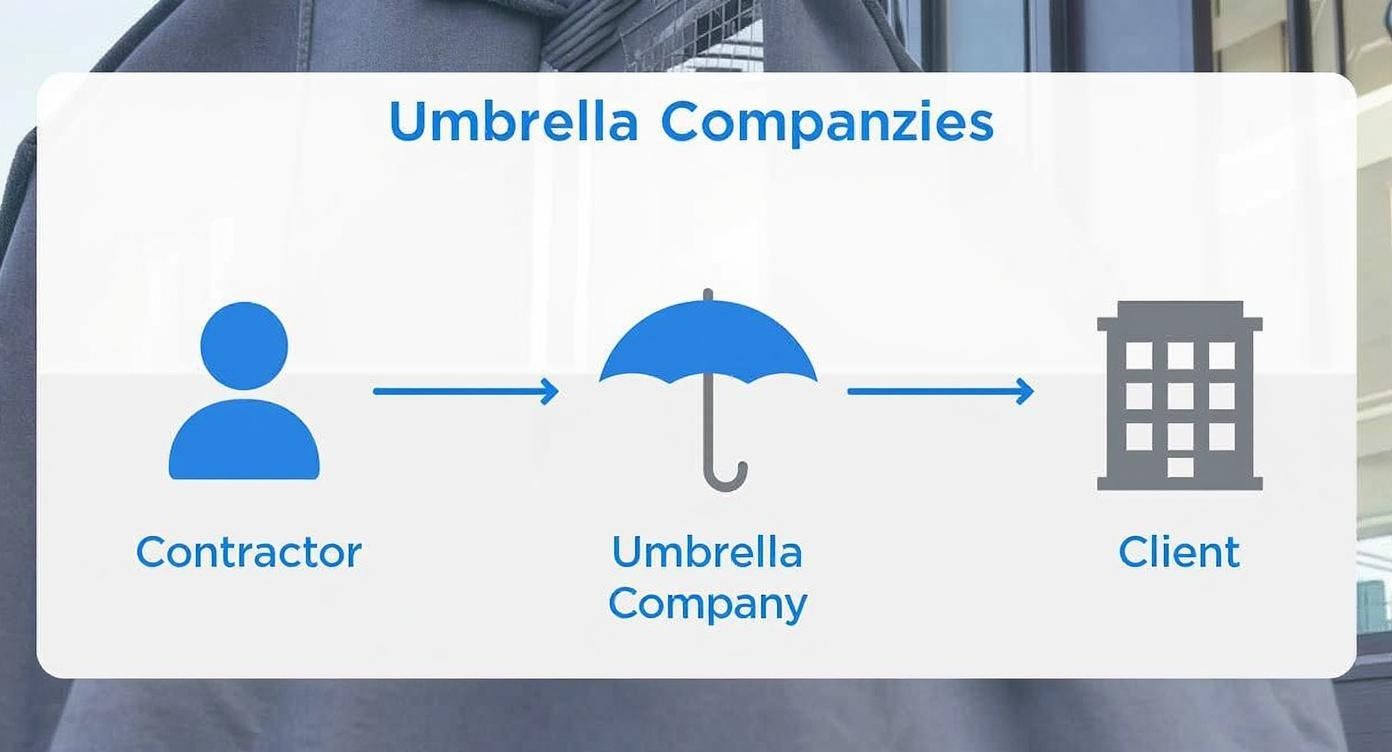
Think of us as the central hub. We manage all the complicated financial admin so you can focus on your actual work.
From Assignment Rate to Your Bank Account
Once we have the assignment rate from the agency, our payroll team gets to work. The first thing we do is handle the legal employment costs. This is not just our fee; it includes statutory deductions like Employer’s National Insurance and the Apprenticeship Levy, which every UK employer is required to pay. Our agreed margin for running the service is also deducted at this stage.
After these costs are covered, what’s left is your gross pay. This is the exact same figure you would see on a payslip if you were a permanent employee. From this gross amount, we make the final deductions for your personal taxes:
- PAYE (Pay As You Earn) Income Tax: This is worked out using your unique tax code from HMRC.
- Employee’s National Insurance Contributions: Your share of contributions towards state benefits like the pension.
The final figure is your net pay, which is the money that lands in your bank account on payday. Simple.
You will always get a detailed payslip that breaks down every single deduction, so you can see exactly where every penny has gone. For a more detailed look, you can find out more about how an umbrella company works on our main guide. It’s all about giving you complete visibility and peace of mind.
The Critical Link Between Umbrella Companies and IR35
For any UK contractor, the term IR35 is a big one. You have probably heard it mentioned, and for good reason, as it has a massive impact on how you are paid and taxed.
At its core, IR35 (also known as the off-payroll working rules) is HMRC’s way of figuring out if a contractor is genuinely self-employed or, for tax purposes, a ‘disguised employee’ of their client. Getting this distinction right is absolutely crucial.
If a contract is deemed ‘inside IR35’, it means the way you work looks a lot like a permanent employee's role. That triggers a specific tax treatment: your income must have Income Tax and National Insurance taken off at source through PAYE, just like a regular staff member. This means you cannot pay yourself through more tax-efficient dividends from your limited company for that particular job.

Why an Umbrella is the Go-To Choice for Inside IR35 Work
So, what do you do when a great contract falls inside IR35? This is exactly where an umbrella company comes in. It is easily the most straightforward, risk-free way to handle an inside IR35 engagement.
By becoming an employee of the umbrella company, you’re automatically paid through PAYE. Simple as that. This setup ticks all the boxes for an inside IR35 determination, leaving no grey areas or complicated tax sums for you to wrestle with.
It also brings total peace of mind to everyone involved: you, your recruitment agency, and the end client. It guarantees that all tax obligations are handled correctly from the very start, completely removing any risk of HMRC opening an investigation into your employment status for that contract.
Using an umbrella company effectively takes the whole IR35 headache off your plate for that contract. It positions you as a compliant, low-risk professional, which is something agencies and clients value.
Navigating IR35 can feel like a maze, which is why we've put together a comprehensive guide to help. You can learn more about how IR35 affects contractors in our detailed article. Ultimately, choosing a good umbrella company is a smart, proactive move to stay on the right side of UK tax law while still enjoying the freedom of contracting.
Understanding Your Payslip: Costs and Deductions Explained
Getting to grips with your payslip is one of the most important things you can do as a contractor. It is the only way to feel truly confident about your earnings and, just as importantly, to spot any red flags from dodgy providers.
The first thing to look for is our umbrella margin. Think of this as our service fee. It is a small, fixed amount we take from the assignment rate to cover the costs of running your payroll, handling all the admin, and making sure you get paid on time, every time. We always show this clearly on your payslip, so you know exactly what you are paying for.

Employment Costs vs. Your Personal Taxes
This is where things can get confusing, but it’s actually quite simple when you break it down. As your employer, we are legally required to pay certain costs to HMRC. These are known as employment costs, and they are covered by the assignment rate we get from your agency; they do not come out of your personal earnings.
These employment costs include two main things:
- Employer’s National Insurance Contributions (NICs): A mandatory payment to HMRC based on your earnings, just like any other UK employer has to pay.
- The Apprenticeship Levy: A government tax on larger employers that helps fund apprenticeship schemes across the country.
Once these legal employment costs are handled, the amount left over becomes your gross pay. This is the figure that your own personal taxes are based on.
From your gross pay, we then deduct the same things you would see on any payslip in a permanent job: income tax (PAYE) and your own employee National Insurance contributions. The final figure is your net pay, which is what lands in your bank account.
To give you a better picture, here’s a simple table breaking down what you will see.
Your Umbrella Company Payslip Explained
This table breaks down the common deductions you will see on your payslip, clarifying where the money goes and who is responsible for paying it.
| Deduction | Explanation | Who Pays It? |
|---|---|---|
| Umbrella Margin | The fixed fee for the umbrella company's payroll and admin services. | You (from the assignment rate) |
| Employer's NI | A statutory tax paid by all UK employers on employee earnings. | The Umbrella (from the assignment rate) |
| Apprenticeship Levy | A UK tax on large employers to fund national apprenticeships. | The Umbrella (from the assignment rate) |
| Employee's NI | Your personal National Insurance contribution, paid by all UK employees. | You (from your gross pay) |
| Income Tax (PAYE) | Your personal income tax, calculated based on your tax code. | You (from your gross pay) |
| Pension Contributions | Your contributions to a workplace pension scheme, if you are enrolled. | You (from your gross pay) |
Understanding these components is key to managing your finances effectively as a contractor.
It's also worth noting that government changes can affect these figures. For example, recent regulatory updates, like the 2025 UK wage increases, have a direct impact. Employer's National Insurance Contributions rose from 13.8% to 15% on 6th April 2025, which increases the costs for employers like us. This is exactly why working with a fully transparent and compliant umbrella company is so crucial. If you'd like to read more, we've covered the impact of wage hikes on UK umbrella companies in another guide.
How to Choose a Compliant Umbrella Company
Picking the right umbrella company isn’t just about getting paid on time; it’s about protecting your finances and professional reputation. With so many providers out there, making an informed choice is the only way to ensure you stay compliant and get the service you deserve.
The single most important thing you can do is choose a provider that is accredited by a professional body. Keep an eye out for names like the FCSA (The Freelancer & Contractor Services Association) or Professional Passport. This accreditation is your seal of approval, proving they have been independently audited and given a clean bill of health against UK tax law.
Spotting Red Flags
Be very cautious of any provider dangling the promise of unusually high take-home pay, especially anything over 80%. More often than not, this is a massive red flag for a disguised remuneration scheme or some other form of tax avoidance, which can land you in serious trouble with HMRC.
Other warning signs to watch out for include:
- Payments being described as non-taxable ‘loans’, ‘advances’, or something similar.
- A total lack of transparency around their margin or any other costs.
- Vagueness or hesitation when you ask for a full pay illustration or a copy of your employment contract.
A reputable umbrella company will be completely upfront about its costs and ensure you have all the necessary insurance cover. The scale of the problem is huge; HMRC found that at least 275,000 workers were paid by non-compliant providers in 2022-23, leading to an estimated £500 million in lost tax revenue. You can discover more about the upcoming umbrella company legislation which aims to clamp down on these practices.
Ultimately, you are looking for a partner who puts your financial security first. Taking a few extra minutes to check for accreditation and demand transparency is a small step that offers massive protection. Our guide to finding the right umbrella company for contractors has more detailed tips to help you choose with confidence.
A Few Final Questions
As you get closer to deciding, it is natural for a few last questions to pop up. Nailing down the practical details is the key to feeling confident you are making the right move. To help you get there, we have put together some straightforward answers to the things we hear most often from contractors.
Think of this as clearing up the day-to-day details. We want to get rid of any lingering uncertainties so you can move forward with a full picture of how it all works.
What Happens to My Holiday Pay?
Good question. As an employee of an umbrella company, you are legally entitled to paid time off. This holiday pay accrues (or builds up) as you work. The standard UK statutory entitlement is 28 days a year, including bank holidays, calculated on a pro-rata basis.
Most compliant umbrella companies will handle this in one of two ways:
- Paid in Advance: Your holiday pay is calculated and added to your regular payslip each week or month. This is sometimes called a ‘rolled-up’ payment and it will always be clearly itemised on your payslip.
- Accrued and Paid Later: We can hold onto your holiday pay for you. When you are ready to take a break, you just let us know, and we pay it out from the pot you have built up.
The important thing to remember is that this is your money. We just make sure the process is transparent and you are in complete control.
Can I Contribute to a Pension?
Absolutely. We will automatically enrol you into our workplace pension scheme, just as any employer would, in line with UK government regulations. This means both you and we (as your employer) make contributions, helping you save for the future.
You can always opt out if you would rather make your own arrangements, but auto-enrolment is designed to make saving for retirement as simple as possible. It is a very tax-efficient way to build a nest egg, and we handle all the admin.
How Easy Is It to Switch Between Contracts?
This is one of the biggest perks of using an umbrella company. Moving between different assignments is incredibly simple. Because you stay on our payroll as a continuous employee, there is no need to set up new PAYE arrangements or go through employment checks every time you land a new assignment.
You just send us the details of your new contract, and we sort out the rest. This creates a continuous record of employment, which can be a massive help for things like mortgage or loan applications. It lets you move smoothly from one role to the next with zero administrative headaches.
Ready to find a compliant, supportive partner for your contracting career? At UmbrellaCompany.com, we make it easy to compare trusted, accredited providers, ensuring you find the perfect fit for your needs. Compare top UK umbrella companies today!


