


Thinking about making the leap from a day rate to a permanent salary? The back-of-the-envelope calculation is simple enough: just multiply your day rate by the number of days you work in a year.
So, a £400 day rate multiplied by 232 working days looks like a gross salary of £92,800 on paper. But as any seasoned contractor knows, that is just the start of the story. This guide explains how to make a realistic comparison so you can decide what is right for you.
A Realistic Starting Point for Your Salary
When you are weighing up a permanent role against your contracting gig, a straight calculation is a good first step, but it rarely paints the full financial picture. That initial number might look tempting, but it glosses over the crucial details that really shape your take-home pay and overall financial health.
We believe in giving you a clear, honest perspective so you can make a properly informed decision. That means looking beyond the headline figures and digging into the real-world differences between the two ways of working.
The Basic Sum and What It Leaves Out
Let’s start with that simple calculation. The UK has around 260 working days in a year. Once you knock off the standard 28 days for statutory holiday and bank holidays, you are left with about 232 billable days.
To give you a rough idea, here is how that translates for a few common day rates.
Quick Day Rate to Gross Annual Income Conversion
This table shows a simplified calculation of annual income based on different day rates, using a standard 232 working days per year (260 total days minus 28 days holiday/bank holidays).
| Day Rate | Gross Annual Figure (232 working days) |
|---|---|
| £350 | £81,200 |
| £500 | £116,000 |
| £650 | £150,800 |
This gives you a useful baseline, but it is fundamentally incomplete. It does not factor in sick days, the inevitable downtime between contracts, or the significant costs you have to cover yourself as a contractor. On the flip side, a permanent salary offer comes bundled with a package of benefits that carry a real monetary value.
A common baseline for UK working days is between 220 and 260 days per year. For instance, a £350 daily rate multiplied by 260 days gives a gross income of £91,000. However, this does not factor in paid holidays, pension contributions, or sick pay that permanent roles provide.
For a more personalised estimate to get you started, you can use our online tool. Check out our guide and use the contractor daily rate calculator for a quick look at your potential annual earnings before we get into the nitty-gritty.
Next, we will break down all those hidden costs and benefits that will truly determine whether a salary offer is the right move for you.
Accounting for Your True Contractor Costs
It is tempting to just multiply your day rate by the number of working days in a year to get your "salary," but that figure is dangerously misleading. To get a real, honest comparison between a contract role and a permanent job, you have to account for all the time you are not earning and the costs you shoulder yourself.
Permanent employees get paid holidays, sick days, and bank holidays as standard. For a contractor, every single one of those days is a day without income. It is a massive financial blind spot if you ignore it.
This infographic shows that first, simple calculation, the one that looks great on paper but does not tell the whole story.
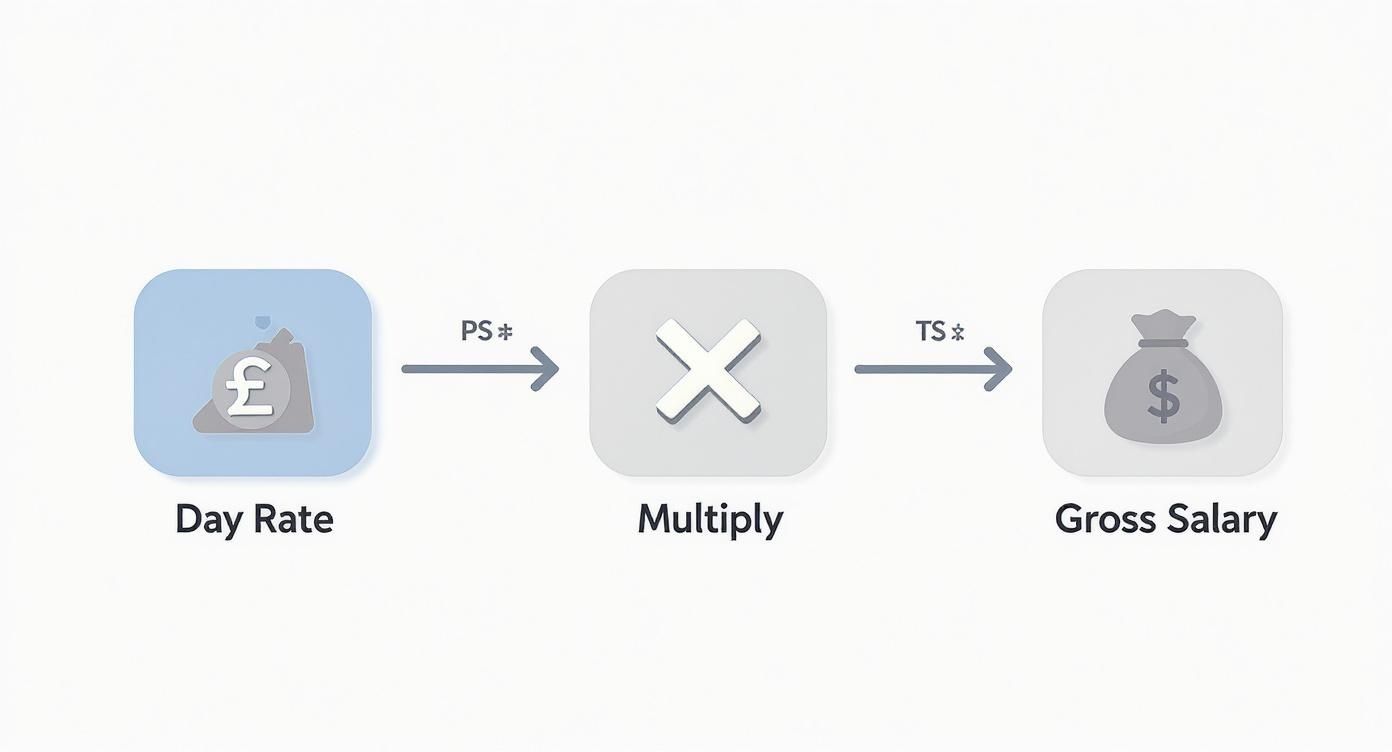
While it gives you a gross annual figure, it completely overlooks the deductions and real-world costs that eat into what you actually take home.
Factoring In Non-Billable Time
First things first, let's get realistic about how many days you actually get paid for. A permanent employee has a safety net of paid time off that you, as a contractor, have to build for yourself. You need to subtract these days from your potential earning days to see what is really going on.
Think about the typical non-billable periods you will face:
- Paid Holidays: A full-time employee in the UK gets a minimum of 28 days of paid leave. That is nearly six weeks you will not be invoicing for.
- Sick Leave: You never plan to be ill, but it happens. The average UK worker takes about 5.7 sick days a year. It is smart to budget for at least a week off, unpaid.
- Bank Holidays: There are usually 8 bank holidays in England and Wales. For an employee, that is a paid day off. For you, it is a day the office is closed and you cannot bill.
Just add those up. You are already looking at around 41 days of unpaid time each year that a permanent employee does not have to worry about. If your day rate is £500, that is a staggering £20,500 hole in your earnings you need to account for when a salary offer comes along.
Tallying Up Your Business Expenses
Beyond the time you are not working, you have a whole host of business costs that an employer would normally cover. These are the nuts and bolts of running your business, the things you have to pay for just to do your job. These need to be subtracted from your gross income.
One of the biggest mistakes contractors make when weighing up a salary is forgetting to deduct their business expenses. These costs can easily run into thousands of pounds a year, which can make a seemingly lower salary offer far more attractive than it first appears.
Here is a quick checklist to help you get a handle on your annual contractor expenses:
- Accountancy Fees: Getting professional help with your tax returns and company accounts is non-negotiable. This usually costs anywhere from £80 to £150+ per month.
- Professional Insurances: Most clients will insist you have Public Liability and Professional Indemnity insurance.
- Pension Contributions: It is all on you. There is no employer matching your contributions; you have to fund your retirement entirely on your own.
- Software and Subscriptions: Think about any specialist tools, industry memberships, or software licences you pay for out of pocket.
- Equipment Costs: That laptop, your work phone, any other hardware, it all comes out of your pocket.
Tracking these costs properly is vital. For a more detailed breakdown, have a look at our in-depth guide on accounting for contractors. Once you have added it all up, you will have a much clearer idea of the true financial gap a permanent salary package needs to fill.
Navigating Tax and National Insurance Differences
When you are trying to compare a day rate to a permanent salary, tax is easily the biggest tripwire. The way HMRC treats your earnings as a contractor versus an employee is fundamentally different, and this has a massive impact on your actual take-home pay.
If you ignore these differences, you risk seriously undervaluing a good salary offer or overestimating what your day rate is truly worth.
For permanent employees, it is all quite straightforward. Your employer handles everything through the Pay As You Earn (PAYE) system, deducting Income Tax and National Insurance before the money even hits your account. Your payslip clearly shows the gross pay, all the deductions, and the net figure you receive. It is predictable and requires zero effort on your part.
Contracting, on the other hand, is a different world. Whether you are running your own limited company or working through an umbrella, the tax arrangements are far more complex, and the responsibility for managing them falls squarely on your shoulders.

Understanding National Insurance Contributions
National Insurance (NI) is where the most significant financial gap appears. The type and amount you pay in each scenario are worlds apart, directly affecting how you should compare a day rate to a salary.
Here is a quick rundown of the main NI classes you will come across:
- Class 1 (Employee): This is what is automatically taken from an employee's salary via PAYE. Simple.
- Class 2 and Class 4 (Self-Employed): If you are a limited company director, you will be paying these contributions on your profits.
- Employer’s National Insurance: This is a hefty cost that employers pay on top of an employee’s salary. As a contractor, this cost is almost always baked into your day rate, whether you realise it or not.
When you accept a permanent role, your new employer takes on the responsibility for their NI contributions, which currently sit at 13.8% on earnings above a certain threshold. This is a huge, and often overlooked, financial benefit. It is a cost you no longer have to factor into your earnings, making a salary offer instantly more valuable than the gross figure suggests.
If you want to dig deeper into this, our detailed guide explains what employer National Insurance contributions are and why they matter so much.
Comparing Financial Responsibilities Side by Side
The different tax structures completely reshape your financial duties and potential perks. A gross salary from an employer and your gross contracting turnover are simply not like-for-like figures because of what is going on behind the scenes.
The switch from contractor to employee means shifting from managing your own complex tax affairs to having them handled for you. This transition includes the significant financial relief of no longer covering the equivalent of Employer's NI from your day rate.
To make this crystal clear, let's put the key responsibilities side-by-side.
Contractor vs Employee Financial Responsibilities
This table breaks down who is responsible for what, highlighting the hidden benefits of a permanent role.
| Financial Aspect | Limited Company Contractor | Permanent Employee |
|---|---|---|
| Tax Management | Responsible for Corporation Tax, VAT, and personal tax returns. | Handled by employer through PAYE. |
| National Insurance | Pays Class 2 and Class 4 contributions. | Pays Class 1 contributions (deducted at source). |
| Employer's NI | Cost is factored into the day rate (an indirect cost). | Paid entirely by the employer on top of the salary. |
| Pension | Solely responsible for setting up and funding. | Employer contributions are mandatory (a significant benefit). |
| Admin Burden | High (invoicing, bookkeeping, tax filing). | Low (minimal personal admin required). |
As you can see, a direct day-rate-to-salary conversion is often misleading. A permanent salary package comes with significant hidden financial advantages and a massive reduction in personal admin, all things your day rate has to cover.
Calculating the Real Value of Employee Benefits
When you are weighing up a permanent role against your day rate, it is easy to get fixated on the headline number. But that is a mistake. The employee benefits package is a massive, often overlooked, part of the equation that can quietly add thousands to the real value of a salaried position.
As a contractor, you are used to footing the bill for things like your pension and private healthcare. When a company offers these perks, it is a direct financial saving for you and a significant cost for them. To get a true picture, you need to understand exactly what a total compensation package includes.

Putting a Price on Common Perks
To make a genuine like-for-like comparison, you have to quantify the value of the benefits on offer. Let's break down some of the most common perks you will see in the UK and work out what they are actually worth.
- Employer Pension Contributions: This is often the biggest financial win. By law, UK employers have to chip in a minimum of 3% of your qualifying earnings. On a £70,000 salary, that is an extra £2,100 a year landing in your pension pot without you doing a thing. Some companies are far more generous, so always check the percentage they offer.
- Private Health Insurance: The cost of a private medical policy can vary, but a decent plan for an individual will typically set you back somewhere between £800 and £1,500 annually. That is a straight saving.
- Life Assurance (Death in Service): This benefit usually pays out a multiple of your salary (often 4x) to your loved ones. A personal life insurance policy with similar cover could easily cost £30-£50 a month, adding another £360-£600 of value each year.
- Company Sick Pay: While you might get Statutory Sick Pay as a contractor, it is a pittance. Many permanent roles offer a far better company scheme, covering your full salary for weeks or even months if you are seriously ill. It is hard to put an exact price on this financial safety net, but its value is immense.
Do Not Forget the Other Valuable Additions
Beyond the big three, many companies throw in other perks that boost your financial wellbeing and improve your work-life balance.
Do not forget that an employer's total cost for an employee often exceeds the base salary by 20-40%. This covers their National Insurance contributions, the pension, and all those benefits. It is why some firms find contractors more attractive financially, even at a higher daily rate, as they get flexibility without the long-term overheads.
When you add it all up, a 3% pension contribution, private medical cover, and life assurance can easily turn a £70,000 salary into a total compensation package worth over £74,000. And that is before you even factor in things like bonuses or training.
Keep an eye out for these other valuable extras:
- Annual Bonus Schemes: Is the bonus discretionary or tied to performance? Ask what the typical payout looks like.
- Training and Development Budgets: Getting access to funded courses and qualifications can save you thousands in professional development you would otherwise pay for yourself.
- Car Allowance: If it is on the table, this is a fixed cash amount added to your salary each month, which is a nice, straightforward boost.
By methodically adding up the real-world value of these benefits, you start to see how a salary offer that initially seems a bit low might actually be far more competitive than you first thought.
How IR35 Status Shapes Your Decision
If you are a UK contractor, you absolutely have to get your head around IR35 when weighing up a permanent role. It is the single biggest factor that dictates how you are taxed and, ultimately, how much money lands in your bank account each month.
Your IR35 status is not just a bit of admin; it completely changes the maths. Trying to compare a day rate to a salary without factoring it in is a recipe for a nasty financial surprise.
The Reality of Working Inside IR35
When your contract is deemed 'inside IR35', it is HMRC’s way of saying they see you as an employee for tax purposes. This means your earnings are subject to PAYE tax and National Insurance, deducted at source before you even see the money. Sound familiar? It is exactly how permanent employees are paid.
This is where an umbrella company usually steps in. We act as your employer for the contract, handling all the tax and NI deductions for you and paying you a net salary. It is straightforward and keeps you compliant, but you lose the tax advantages that come with being a genuine business owner.
For a contractor working inside IR35, the financial gap between contracting and permanent employment narrows significantly. A salary offer with a full benefits package can become a much more attractive and straightforward proposition.
The Financial Autonomy of Being Outside IR35
Operating 'outside IR35' is a different world. It puts you firmly in the driver's seat of your finances. As a genuine business, you can structure your income in a more tax-efficient way, typically through a mix of a small salary and larger dividend payments.
You have the freedom to claim legitimate business expenses and make smart financial decisions that benefit your company. This autonomy often means your potential take-home pay is significantly higher than that of a contractor on the exact same day rate but working inside IR35. For a proper deep-dive, check out our guide on working inside or outside IR35.
Why Your Status Changes the Calculation
So, how does this all affect your day rate to salary calculation? An inside IR35 contractor is already in a position that is financially similar to a permanent employee, just without any of the perks. You are paying tax like an employee, but you are not getting sick pay, holiday pay, or a pension contribution from your client.
When you are looking at a permanent job offer, you need to account for the real-world value of these benefits. Things like employer-provided group life insurance as an employee benefit offer huge peace of mind and financial security. For many inside IR35 contractors, a move to a permanent role can be a compelling upgrade, offering stability and valuable perks without a huge hit to their net income.
A Few Common Questions
When you are sizing up a permanent role, it is only natural to have a few questions about how a salary offer really stacks up against your day rate. Here are some of the most common queries we hear from contractors making this exact comparison.
Is There a Quick Rule of Thumb for a Day Rate to Salary Conversion?
A popular shortcut is to multiply your day rate by 200. For a contractor on £400 a day, this gives a rough-and-ready salary equivalent of £80,000.
This back-of-the-napkin maths builds in a buffer for typical non-billable time, like holidays and gaps between contracts. But honestly, you should treat this calculation as a starting point only. It completely ignores your business costs, the tangible value of employee benefits, and the very different tax treatments.
For a true comparison, you need to work through a detailed calculation like the one in this guide. It is the only way to see the full financial picture.
How Do I Factor in Job Security and Career Progression?
These are the big, non-financial considerations that can carry significant weight. A permanent role generally offers more stability and a clearer path for progression, including access to internal training programmes that the employer pays for.
As a contractor, you gain flexibility but accept the risk of contracts not being renewed, and you have to fund your own professional development. When weighing an offer, you have to ask yourself what that security and career support is personally worth to you. It is a value judgement that should be a key part of your final decision.
While the financial metrics are vital, the value of stability and a defined career ladder should not be underestimated. A permanent role invests in your long-term growth, a benefit that is difficult to quantify but essential to consider.
Are Online Day Rate to Salary Calculators Reliable?
Online calculators are useful for getting a quick, ballpark figure, but you should definitely use them with caution. Most rely on simplified formulas and simply cannot account for your unique business expenses, the specific benefits package on offer, or your personal IR35 status.
Our advice? Use them for an initial estimate to see if an offer is even in the right territory. Afterwards, follow up with your own detailed calculation to get a true, personalised comparison based on your circumstances. It is the only way to know for sure.
What Salary Should I Ask for if My Day Rate Is £500?
A basic calculation of £500 x 232 working days gives a gross figure of £116,000. But this is not the whole story and it is absolutely not the figure you should be targeting.
You must subtract your annual contractor costs. For example, let's say these are £8,000 for insurance, accountancy, and software. You then need to add the value of the employer's benefits package, which could easily be worth £15,000 when you include pension contributions, private healthcare, and a potential bonus.
In this scenario, a genuinely comparable salary would be closer to £123,000 (£116,000 – £8,000 + £15,000). This example clearly shows why a direct conversion is never enough to make a fair and informed decision about your career.
Making the right choice between contracting and a permanent role requires clear, accurate information. At UmbrellaCompany.com, we provide the tools and guidance to help you compare your options with confidence.


