


So, what should you budget for a limited company accountant? In the UK, you can expect to pay anywhere from £60 to over £200 per month. The final figure really depends on what you need from them.
The price hinges on the complexity of your business, how many transactions you make, and the level of support you are after. A solo contractor with a handful of invoices a month will have very different needs to a growing consultancy with employees and VAT obligations.
What's the Real Cost of an Accountant?
It is easy to see an accountant’s bill as just another business expense, but it is more helpful to think about the true cost of accounting. A good accountant is an investment. They do not just file your returns; they keep you compliant, save you tax, and free up your time to focus on what you do best.
The infographic below gives a quick overview of what you can expect to get for your money at different price points.
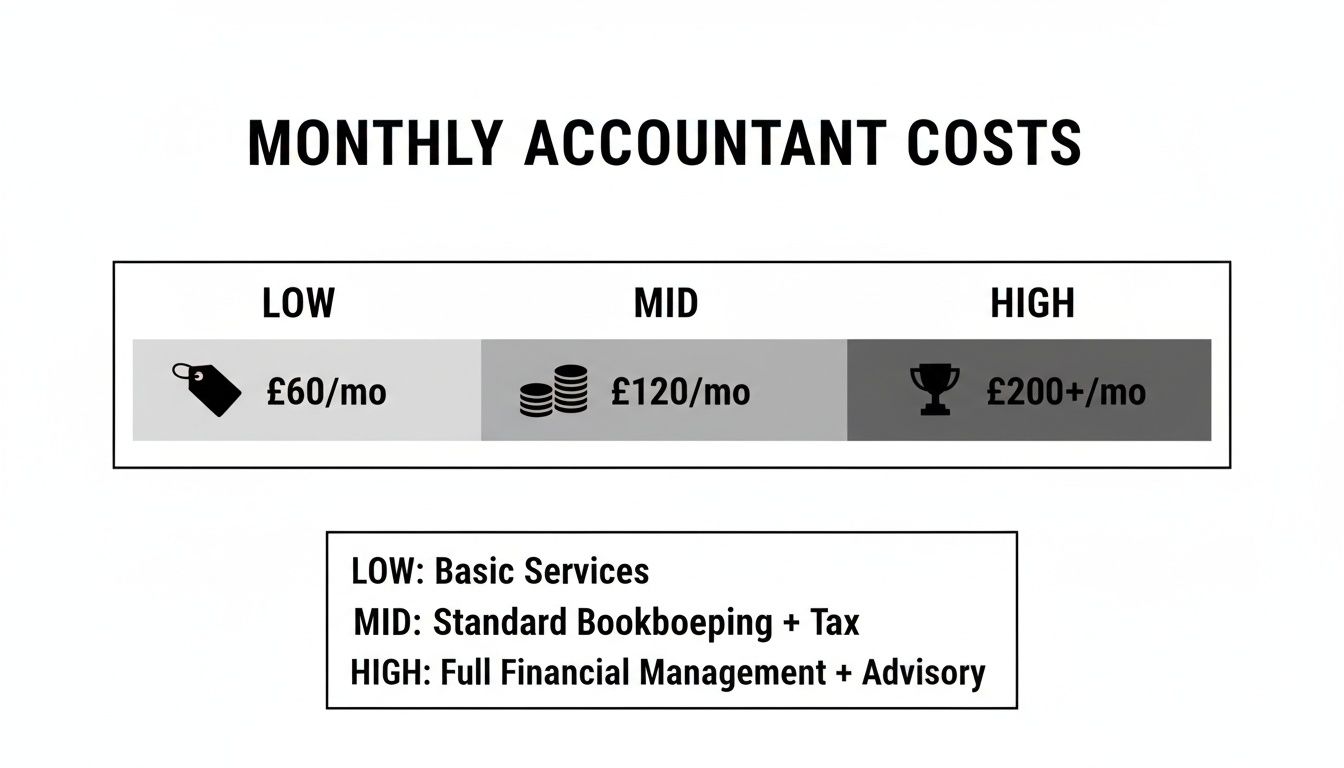
As you can see, the more you pay, the more proactive the service becomes. It shifts from basic compliance to genuine financial strategy and support.
Typical Monthly Accountant Fee Packages for UK Limited Companies
For contractors running a limited company, a fixed-fee monthly package is the most common setup. It makes budgeting predictable and usually covers all the essentials you will need throughout the year.
Here is a table breaking down what you will likely find at different monthly price points.
| Price Band (Monthly) | Typical Included Services | Best For |
|---|---|---|
| £60 – £90 | Annual Accounts, Corporation Tax Return, Director's Self-Assessment, access to accounting software. | Solo contractors with low transaction volumes and simple finances. |
| £90 – £150 | Everything in the basic tier, plus VAT Returns, Payroll for 1-2 directors, and some bookkeeping assistance. | VAT-registered companies or those with a small payroll. |
| £150+ | All of the above, plus management accounts, tax planning advice, and payroll for multiple employees. | Growing businesses that need more hands-on support and strategic advice. |
These packages are designed to bundle the services most contractors need, like payroll and VAT returns, which are crucial for staying on the right side of HMRC.
Of course, these accounting fees are just one part of running your business. They sit alongside your initial setup costs, which you can learn more about in our guide on how much it costs to set up a limited company.
What Core Services Does Your Accountant Handle?
So, what are you actually paying for when you hire an accountant for your limited company? It is easy to see the monthly fee leave your bank account, but less clear what is happening behind the scenes.
Think of it this way: your accountant handles the essential, non-negotiable tasks that keep your business compliant. Getting these wrong means automatic penalties from HMRC and Companies House, so this is your first line of defence.

Most fixed-fee packages for contractors are built around a handful of critical duties. These are the absolute must-dos.
The Core Compliance Tasks
At a minimum, any standard package for a contractor’s limited company should cover four key areas. These form the bedrock of your financial reporting.
- Annual Accounts: Your accountant will prepare and file your company's statutory accounts with Companies House each year. This is a public document showing your company’s financial health.
- Corporation Tax Return (CT600): This is your company's tax return. It is sent to HMRC to calculate the Corporation Tax owed on your profits. Accuracy here is vital.
- Director's Self-Assessment Tax Return: As a director paying yourself a salary and dividends, you need to file a personal tax return. A good package will typically include this for one director.
- Confirmation Statement: A simple but crucial annual filing. It just confirms the details Companies House has on file for your company (like directors and official address) are still correct.
These core duties are just the start. An accountant can offer a whole range of financial services, moving from basic compliance to more strategic advice.
Key Takeaway: An accountant’s main job is to ensure you meet every filing deadline with HMRC and Companies House. This protects you from fines and legal headaches.
Payroll and Day-to-Day Support
Beyond the big annual jobs, your accountant also deals with the regular, month-to-month stuff.
Most packages will include running a basic payroll, even if it is just for you as the sole director. This means calculating the right PAYE tax and National Insurance, generating your payslips, and reporting it all to HMRC every time you pay yourself a salary.
They also provide ongoing support. This is where a good accountant really earns their fee, answering your questions on allowable expenses, dividend timing, or tax planning. This guidance is what helps you make smarter financial decisions all year round.
For a closer look, our complete guide to accounting for contractors goes into much more detail. The cost of an accountant for a limited company is not just about filings; it is about having an expert in your corner.
What Drives Your Accountant's Fees Up or Down?
Ever wondered why one contractor pays their accountant £80 a month while another is paying £300? There is no single price tag for an accountant. The cost is tied directly to the amount of work your business generates.
Put simply, the more complex your company’s finances, the more time and skill your accountant has to put in. A few key things will determine where you land on that pricing scale. Getting your head around these will help you figure out your likely costs and what level of support you actually need.
Your Business Activity
The main driver of your fee is the sheer volume and type of your business transactions. An accountant will look at a few metrics to get a feel for the workload involved.
Here are some of the biggest factors:
- Turnover: While it is not the only thing that matters, a higher turnover usually means more complex finances and greater financial risk. This naturally calls for more careful oversight from your accountant.
- Transaction Volume: This is a huge one. A business processing hundreds of small sales and purchases every month needs a lot more bookkeeping and reconciliation work than one that just sends out a couple of large invoices.
- Number of Employees: If you have staff, your accountant has to run a more complicated payroll. This means calculating PAYE, National Insurance, and pensions, then filing regular reports with HMRC, all of which adds to the monthly job.
- VAT Registration: Being VAT registered brings in a quarterly (or sometimes monthly) admin task: getting your VAT return prepared and submitted. It demands meticulous record-keeping and is a major service add-on.
The Need for Specialist Advice
It is not just about the day-to-day stuff. Needing specialist advice can also bump up your fees. If you operate in a niche sector or need some advanced tax planning, you will need an accountant who knows their stuff in that specific area.
This might be help with claiming Research & Development (R&D) tax credits, handling the complexities of international transactions, or getting detailed advice on investment structures. These services are not usually in a standard package and will add to your overall costs.
Traditional vs Online Accountants
Finally, the type of accountancy firm you go for makes a difference to the price. The choice is usually between a traditional high-street firm and a modern online accountant.
Traditional accountants often have bigger overheads like office rent, so they may charge more, sometimes by the hour. The upside is you get valuable face-to-face meetings and a very personal service.
Online accountancy firms, on the other hand, lean on technology to automate a lot of the routine work. This efficiency lets them offer lower-cost, fixed-fee packages. They are a great fit for contractors and small businesses with straightforward finances who are happy to communicate by email and phone.
Going Beyond the Basics: Optional 'Add-On' Services
Your core accountancy package keeps you compliant with HMRC and Companies House, but that is just the baseline. Most accountants also offer extra services that can save you a huge amount of time and give you a much clearer picture of your company's financial health.
Deciding whether you need these 'add-ons' comes down to your specific situation, your turnover, and how much you value your time.

Think of it this way: the basic service ensures you are playing by the rules. The add-ons are what help you play the game better, turning your accountant from a simple necessity into a genuine strategic partner.
Common Add-Ons and What to Expect
When you are getting quotes, you will probably see these services offered as optional extras. They are designed to solve common problems contractors face as their business grows.
Bookkeeping: Most accountants assume you will do your own day-to-day bookkeeping. If you would rather not, you can pay them to do it. For a small limited company, expect to pay an extra £30 to £100 per month. It is a no-brainer if you are spending weekends sorting receipts instead of billing clients.
VAT Return Preparation: Once you are VAT registered, you have quarterly returns to deal with. An accountant will typically charge between £50 and £150 per quarter to handle this. It ensures everything is filed correctly under Making Tax Digital (MTD) rules and avoids the stress of getting it wrong.
Management Accounts: These are detailed monthly or quarterly reports on your business's financial performance, costing anywhere from £75 to £250 per month. If you need to track profitability, manage cash flow tightly, or apply for a mortgage or business loan, these reports are essential.
Strategic Tax Planning: This is more than just filing your tax return; it is about structuring your affairs to be as tax-efficient as possible. It is a bespoke service, so prices vary, but it often starts from a few hundred pounds for specific advice. Good tax planning can often save you far more than it costs.
When Are These Services Worth the Extra Money?
So, how do you know if you need to bolt on these services? It usually boils down to a simple trade-off between your time and your money.
If you dread doing your bookkeeping or you are losing sleep over your VAT return, paying an expert to handle it is almost always a smart move.
For example, a freelance creative director might find that the hours spent on tedious bookkeeping could be better used on a project that bills for far more than the £50 monthly bookkeeping fee. In this case, the add-on provides a clear return on investment.
As your business grows, the need for management accounts and strategic advice becomes more urgent. These services shift your accountant’s role from a compliance box-ticker to a key advisor who provides the data you need to make better decisions, grow your company, and increase your profitability.
Maximising the Value From Your Accountant
Think of your accountant as an investment, not just another line item on your profit and loss account. To get real value from them, you cannot just see them as a box-ticker for compliance. The best approach is to treat them as a genuine partner in your business.
This means getting away from the once-a-year scramble for your tax return. Proactive communication is what transforms the service you receive. Instead of waiting for them to chase you for records, you should be reaching out with questions and booking regular chats. It is the only way they will really understand your goals and be able to give you timely advice.
Prepare for Productive Meetings
To make every conversation count, never go into a meeting cold. A clear agenda with specific questions makes the discussion focused and respects both your time and theirs.
Before a catch-up call, you should:
- Jot down any big business changes since you last spoke.
- List out specific questions you have about expenses, tax planning, or your future goals.
- Have your latest financial figures ready to pull up if needed.
This simple prep work allows your accountant to offer you specific, tailored advice rather than just general tips. The cost of an accountant for a limited company feels much more reasonable when they are actively helping you make smarter financial decisions.
Embrace Digital Record-Keeping
One of the easiest wins for getting more value is keeping your records organised and digital. Using cloud accounting software like FreeAgent or Xero makes your accountant's life easier, which often has a direct, positive impact on your fees.
Clean, tidy data means they spend less time on basic bookkeeping and can focus more of their brainpower on high-value strategic advice.
By keeping your financial records tidy throughout the year, you not only make year-end less of a headache but also empower your accountant to spot opportunities for tax savings and business improvements in real time.
Try to schedule reviews at least quarterly to go over your performance and financial goals. Use these meetings to explore tax efficiency strategies. You can find more ideas in our guide on how to pay less tax as a limited company. A good accountant will always welcome these conversations; it is how they help you build a more profitable and stable business.
Essential Questions to Ask Before You Hire an Accountant

Choosing an accountant for your limited company is more than just a box-ticking exercise; it is one of the most critical partnerships you will form. Think of it as a long-term professional relationship. Get it right, and a great accountant will save you not just tax, but also a huge amount of time and stress.
To help you find the right fit, we have put together a checklist of questions. Arm yourself with these before you start making calls, and you will get a clear picture of their expertise, fees, and the way they work. It is all about ensuring there are no surprises down the line.
Questions About Their Experience and Specialisms
Not all accountants are created equal. You need someone who lives and breathes the world of UK contracting, because their familiarity with your sector can be the difference between simply filing your accounts and genuinely adding value to your business.
- How many contractor clients do you currently work with?
- What is your experience with IR35 legislation, and how do you help clients manage it?
- Do you have specific experience in my industry (e.g., IT, creative, engineering)?
- Are you an Authorised Corporate Service Provider (ACSP)? This matters for handling identity verification with Companies House.
Clarifying Fees and Services
The cost of an accountant for a limited company should be completely transparent. You must know exactly what you are paying for and what might crop up as an extra charge. Any vagueness here is a big red flag.
A fixed-fee package should cover all your essential compliance needs. Be cautious of hourly rates that can quickly get out of hand, and never sign anything without getting a detailed breakdown of what is included.
- Is your fee a fixed monthly cost, or do you charge by the hour?
- What specific services are included in that monthly fee?
- Are there any extra charges for things like Self-Assessment returns, mortgage references, or general advice calls?
- Will I have a dedicated person to contact with my day-to-day questions?
Asking these questions upfront will help you make a confident, well-informed choice. For more tips, have a look at our guide on finding the best accountant for limited company contractors.
Frequently Asked Questions
To finish up, let’s tackle a few of the most common questions contractors ask us about accountant costs. We want to give you clear, straightforward answers so you can feel confident about your next move.
Can I Do My Limited Company Accounts Myself to Save Money?
Technically, yes, you can. But for most contractors, we would strongly advise against it. The rules for UK company accounting and tax are notoriously complex and seem to change every other week. A simple mistake can easily lead to hefty penalties from HMRC or Companies House.
Think of it this way: the cost of a good accountant is almost always less than a potential fine. More importantly, a savvy accountant should save you more in tax than their fee costs, turning the expense into a smart investment.
Are Accountant Fees a Tax-Deductible Expense?
Yes, absolutely. The fees you pay your accountant for your limited company’s affairs are a legitimate business expense. This means you can deduct the full cost from your company's profit before calculating your Corporation Tax bill.
This deduction effectively lowers the net cost of getting professional help, making it even more of a no-brainer. It is a perfect example of a business cost that pays for itself.
Do I Need an Accountant If My Limited Company Is Dormant?
Even if your company is dormant (meaning it is not trading), you still have legal duties. You are required to submit dormant company accounts to Companies House and file a Confirmation Statement every year. Fail to do so, and you will face penalties.
While the paperwork is simpler than for a trading company, an accountant can make sure it is done right and on time. Many firms offer a reduced 'dormant company' service for a small annual fee, which buys you complete peace of mind.
Finding your way through your financial obligations as a contractor can feel overwhelming, but you do not have to go it alone. Here at UmbrellaCompany.com, we offer the tools and resources you need to compare trusted, compliant providers.
Find the right support for your contracting career on UmbrellaCompany.com


