


You’ve accepted a contract, passed the onboarding checks, and then the client asks for one more thing before you can start. They want proof of public liability insurance. If you’re working through an umbrella company, that request can feel confusing. You’re on PAYE for tax, but you’re still the person delivering the work, entering the site, meeting the client, and creating day-to-day risk.
That confusion is common. Insurance sits in the gap between tax status, contract wording, and practical site rules. It’s also becoming more important. The Association of British Insurers notes a 15% increase in public liability claims within the construction sector between 2019 and 2023, which helps explain why clients, agencies, and umbrella companies are looking more closely at cover.
If you want a broader overview of the insurance products contractors often need, this guide to contractor insurance in the UK is a useful starting point.
Introduction Why Public Liability Insurance Matters
Contractors public liability insurance protects you if your work causes injury to someone who isn’t your employee, or damage to their property. In plain terms, it’s there for those moments when an ordinary working day turns into a claim.
A simple example makes it easier to understand. You’re carrying tools through a client’s premises and a visitor trips over equipment you left temporarily in a walkway. Or you’re working in an office and accidentally damage part of the client’s property while setting up. The injured person or the client may ask you to pay for the loss. Public liability insurance is designed to deal with that kind of third-party claim.
For contractors, this usually matters long before any claim happens. Clients often ask for evidence of cover before they’ll issue a pass, approve a purchase order, or let you begin work. In many cases, the policy is as much about access to work as it is about protection after something goes wrong.
Practical rule: If a client has asked for insurance details, treat that as a commercial requirement, not just admin. It usually means they won’t let the contract proceed without it.
Working through an umbrella can make things feel less straightforward, because employment status for tax doesn’t automatically answer the insurance question. What matters is whether the policy arrangement covers the activities you perform and meets the client’s contract terms.
What Contractors Public Liability Insurance Actually Covers
Public liability insurance is a financial safety net for accidents involving other people. It doesn’t insure every problem a contractor might face, but it does cover a very specific and important set of risks.
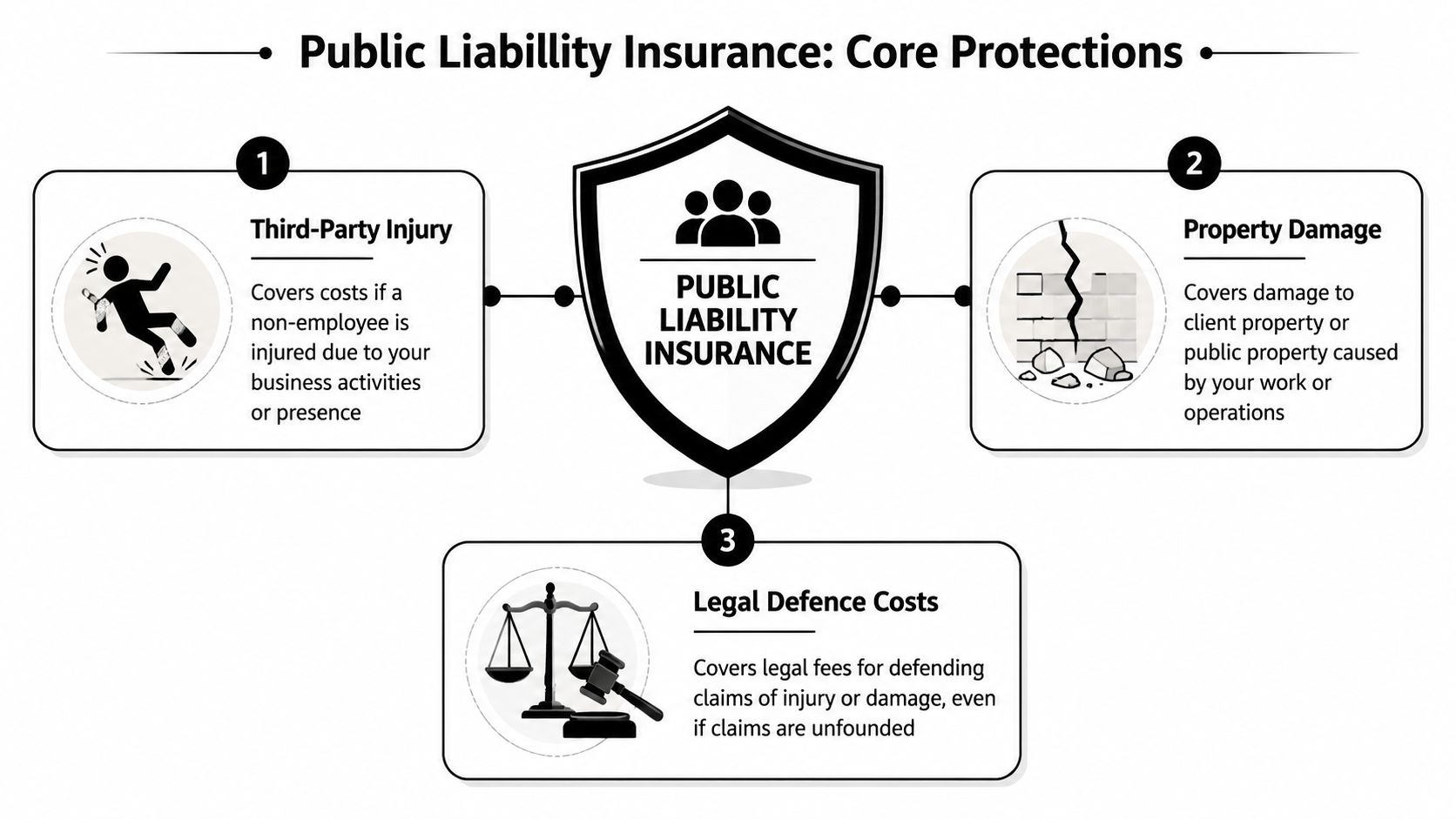
The three main areas it protects
Most contractors think first about injuries, but the cover usually has three practical uses.
Third-party injury
If a client, visitor, passer-by, or member of the public gets hurt because of your business activities, the policy can respond.Third-party property damage
If you accidentally damage a client’s office, equipment, flooring, walls, stock, or another person’s property, this is the part of the policy that may help.Legal defence costs
Even where a claim is disputed, insurers often deal with the legal side. That matters because a weak claim can still be expensive to answer.
According to Allianz UK claims statistics, 68% of public liability claims against contractors stem from slips, trips, and falls during ongoing operations. That’s useful because it shows these claims often arise from ordinary site activity, not dramatic disasters.
What this looks like in real life
A few practical examples help separate theory from reality:
- A painter or decorator leaves equipment in a hallway and a visitor falls.
- A tradesperson drops materials that crack a client’s tiled floor.
- An IT contractor working on-site knocks over equipment while setting up hardware in a client environment.
- A maintenance contractor creates a temporary hazard while carrying out work and someone is injured nearby.
These aren’t unusual scenarios. They’re the kind of incidents that happen when people work around tools, cables, materials, ladders, deliveries, visitors, and busy premises.
Public liability insurance is about harm caused to other people or their property. It is not a general promise that every business problem will be paid for.
What it doesn’t usually cover
This is where many contractors get caught out. Public liability insurance has limits, and understanding those limits matters just as much as knowing what it includes.
Common gaps include:
Poor advice or professional mistakes
If your issue is an error in design, specification, consultancy, or technical advice, that usually points to professional indemnity rather than public liability. If you need help comparing the two, this guide to contractor indemnity insurance helps clarify the difference.Injuries to your own employees
That usually falls under employers’ liability, not public liability.Damage to your own tools or equipment
Public liability is about third-party loss, not your own business property.Faulty workmanship on its own
If the sole complaint is that work must be redone because it wasn’t carried out properly, that may not be covered under a standard public liability policy.
The easiest way to remember it
Ask one question first. Did someone outside your business suffer injury or property damage because of your work activities?
If the answer is yes, public liability is likely the policy you’d look at first. If the issue is advice, tax status, poor workmanship, or damage to your own kit, the answer often lies elsewhere.
Determining If You Need Public Liability Insurance
A lot of contractors ask whether public liability insurance is legally required. In many cases, the more useful question is different. Will anyone let you work without it?
For many contractors, the practical answer is no. Even where the law doesn’t force you to buy a standalone policy yourself, clients, agencies, site managers, and procurement teams often expect proof of cover before work begins.

Why clients insist on it
Clients usually ask for public liability cover for three reasons.
They want risk transferred properly
If your work causes a third-party problem, they don’t want uncertainty over who pays.Their own insurance and compliance teams require it
Larger organisations often have standard onboarding rules.It signals professionalism
A contractor with the right documents in place looks organised and easier to work with.
Health and safety risk is part of that picture. HSE data for 2024/25 shows that construction sites accounted for 28% of all public liability-related incidents. If you work in construction or on active sites, clients already know the exposure is real.
When contractors underestimate the need
Some contractors assume they don’t need cover because they work carefully, use checklists, or only take short assignments. Good working practices matter, but they don’t remove liability. A small accident can still turn into a claim if someone is injured or a client’s property is damaged.
It’s also worth separating public liability insurance from paperwork such as disclaimers or signed waivers. Documents can help set expectations, but they aren’t a substitute for insurance. If you use waivers in your business, these liability waiver templates for businesses can help you think about documentation properly, alongside insurance rather than instead of it.
A sensible test to apply
Ask yourself these questions:
- Do you work on client premises or shared sites?
- Could your tools, equipment, movement, or materials injure someone?
- Could your activities damage a client’s building, fixtures, or equipment?
- Does your contract mention insurance, indemnity, or minimum cover levels?
If you answered yes to any of those, contractors public liability insurance is usually a business necessity.
Insurance isn’t just for high-risk trades. It matters anywhere your work can affect people, premises, or property you don’t own.
Decoding Cover Levels Costs and Common Exclusions
The next question after “Do I need it?” is usually “How much cover do I need?” That’s where many contractors get stuck, because the market talks about limits in millions, while quotes can vary widely depending on what you do.
What cover levels mean in practice
A public liability policy has a cover limit, which is the maximum amount the insurer will pay within the terms of the policy. The right level usually comes from the contract in front of you, not from a generic rule.
Common contract requirements often refer to levels such as:
- £1 million, usually for lower-risk work or smaller private clients
- £2 million, common where clients want a stronger baseline
- £5 million, often requested for larger commercial work and many contractor arrangements
- £10 million, sometimes required for higher-risk or public sector work
If a client asks for a minimum level, that figure becomes your starting point. It doesn’t matter if you think the risk is low. If the contract says you must hold a particular amount, that’s the standard you have to meet.
Typical premium range
Price varies by trade and exposure. According to 2025 data from Simply Business, average annual premiums for contractors range from £250 for low-risk roles to over £2,500 for higher-risk trades like roofing.
That range tells you something important. The insurer isn’t just pricing the policy name. They are pricing the work description, the location, the claims risk, and the chance that a claim could be severe.
| Cover Level | Typical Annual Premium Range (Low-Risk Trade) | Commonly Required For |
|---|---|---|
| £1 million | From the lower end of the market range | Smaller private contracts and lower-risk off-site work |
| £2 million | Varies by insurer and work type | Many standard commercial client requirements |
| £5 million | Higher than lower-limit policies, depending on trade | Larger commercial clients, agencies, and many site-based roles |
| £10 million | Usually at the upper end of available options | Some public sector or higher-risk contract terms |
What makes the premium go up or down
Insurers usually look at a mix of practical factors, including:
Your trade
Roofing, construction, and physically hazardous work generally cost more to insure than low-risk consultancy.Where you work
Site-based work, public-facing premises, and busy client environments tend to increase exposure.Your business description
The wording needs to match what you do. If it’s too narrow, it may create claim problems later.Claims history
Previous incidents can affect pricing or insurability.The limit you choose
More cover often means a higher premium, though the difference isn’t always as dramatic as contractors expect.
Common exclusions contractors need to read carefully
The exclusions section matters more than the marketing summary. That’s where insurers explain what they won’t pay.
Watch particularly for exclusions around:
- Professional advice or design work
- Rectifying your own faulty workmanship
- Asbestos or pollution-related work
- Work types outside your declared business activity
- Use of heat, specialist tools, or hazardous environments, if not specifically accepted
Key check: The policy schedule and business description should match the work you actually carry out, not the work you did last year or the label an agency casually used.
A cheap quote can still be the wrong quote if the exclusions make it unusable for your contract.
How Insurance Works with Umbrella Companies and IR35
Often, contractors get mixed messages. You move from your PSC into an umbrella arrangement because a role is inside IR35, and suddenly you’re employed for payroll purposes. It’s easy to assume the insurance question disappears at that point. It doesn’t.
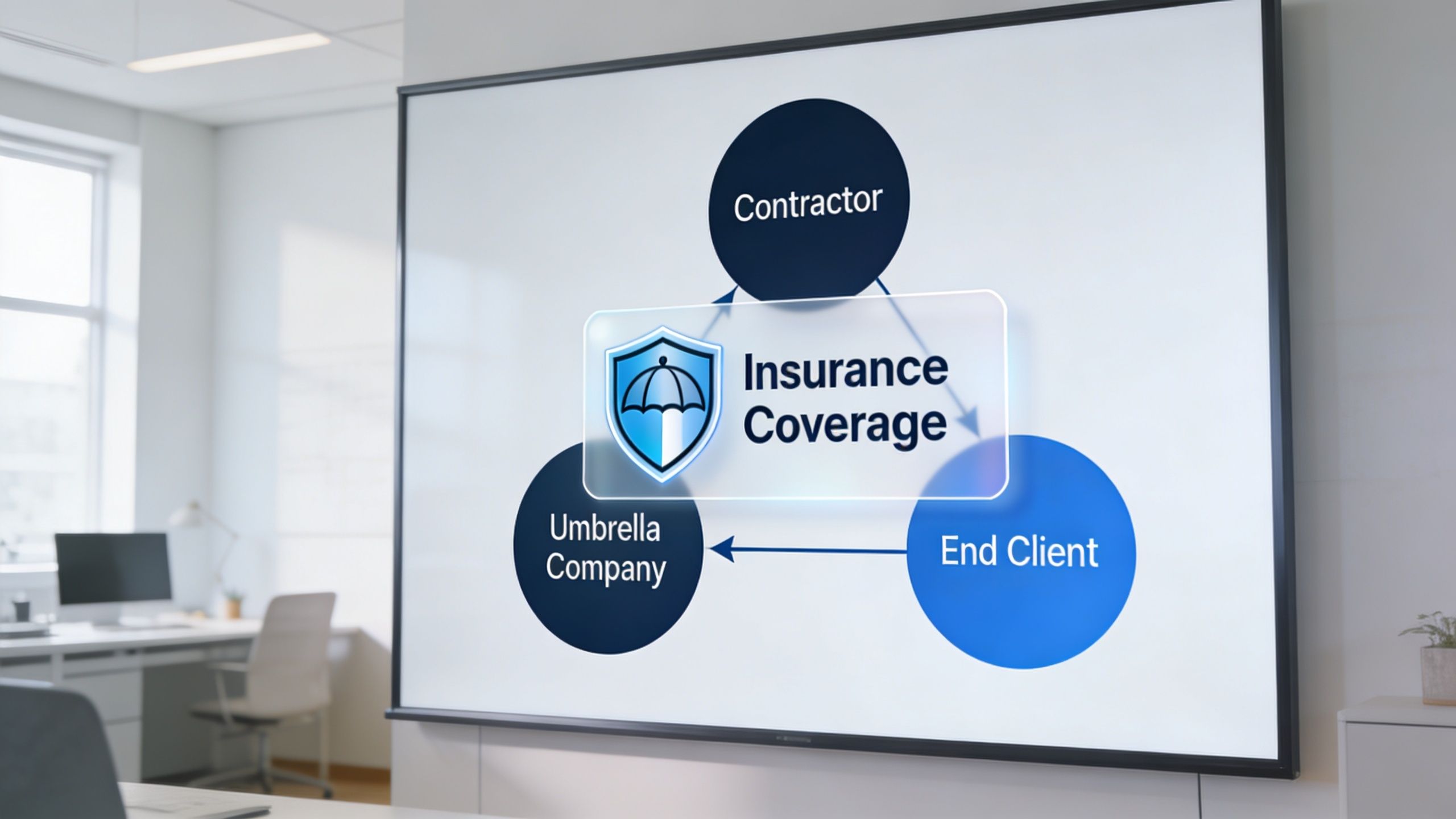
Why IR35 status doesn’t remove the risk
IR35 deals with tax treatment, not day-to-day liability risk. If you are the person attending site, using equipment, interacting with client staff, or carrying out the contracted services, your work can still lead to a third-party claim.
That means contractors working through umbrellas still need to know:
- whether public liability cover exists,
- who holds the policy,
- what activities it covers,
- and whether it satisfies the client contract.
For a clear explanation of the off-payroll rules that drive many of these working arrangements, this guide to umbrella companies and IR35 is useful background reading.
Who may provide the cover
In an umbrella arrangement, insurance is often handled in one of two ways.
Umbrella-provided cover
Some umbrella companies include business insurance within their overall service package. That can be convenient, but convenience isn’t the same as suitability. You still need to check the policy wording, the limit of indemnity, and whether your actual assignment falls within the covered activities.
Your own separate policy
In some cases, especially if the role or contract wording is unusual, contractors may need their own policy or additional cover. This can happen when the umbrella’s standard arrangement doesn’t meet the client’s insurance schedule or endorsement requirements.
A common problem appears when contractors switch working models. Hiscox UK reported a 22% rise in claims disputes involving IR35-affected freelancers moving between a PSC and an umbrella in 2025. That highlights the importance of updating the policy position when your status changes.
If you’ve changed from a limited company to an umbrella, don’t assume the old insurance arrangement still fits. Check the named insured, the business activity, and the contract requirements again.
A short explainer can make that relationship easier to visualise.
The questions to ask before you start an assignment
Whether the umbrella provides cover or not, ask for clear answers to these points:
What type of insurance is included?
Don’t ask only whether you’re “insured”. Ask specifically about public liability, professional indemnity, and employers’ liability.What is the cover limit?
The client may ask for a specific amount.Does the policy cover my assignment type?
“Contractor” is a broad label. A policy needs to fit the work you perform.Can I see evidence of cover?
You may need documents for onboarding or site access.What happens if I change role or sector?
Insurance that fits one contract may not automatically fit the next.
The practical takeaway
An umbrella company can make insurance administration easier, but it doesn’t remove your responsibility to check the details. The safest approach is simple. Treat insurance as part of your contract review, alongside pay, expenses, notice, and IR35 status.
Choosing Your Policy A Contractor's Checklist
When you compare policies, or assess the cover offered by an umbrella company, the aim isn’t to find the cheapest document. It’s to find cover that would be effective if a claim landed tomorrow.
Start with the contract
Before you look at insurers, look at the contract or assignment schedule. That tells you what you must match.
Check for:
Minimum cover level
The client may specify a required amount.Specific policy types
Some contracts ask for public liability and professional indemnity separately.Named party requirements
The client, agency, or another party may need to be noted on insurance documents.Site or sector conditions
Public sector, engineering, construction, and specialist environments often have tighter wording.
Review the policy wording, not just the headline
A certificate is useful, but the schedule and wording detail the coverage.
Use this checklist when reviewing any contractors public liability insurance arrangement:
Business description matches your work
If you install, advise, inspect, supervise, or handle equipment, the wording should reflect that.Excess is affordable
A policy can look attractive until you notice the amount you must pay towards a claim.Territorial limits are suitable
If your work includes travel or projects outside standard UK-based activity, check the policy territory.Exclusions are realistic for your trade
If an exclusion cuts out the very work you do, the policy isn’t useful.Documents are available quickly
Clients often want evidence fast. Delays can hold up your start date.
A policy isn’t good because it exists. It’s good because the business description, cover level, and exclusions all line up with the contract you’re about to perform.
Questions worth asking an insurer, broker, or umbrella provider
You don’t need to ask everything in insurance language. Plain questions work better.
Try these:
- Does this cover the exact services I’ll perform on this assignment?
- If the client asks for proof today, what documents can you provide?
- Are there exclusions for the sector or site type I’ll be working in?
- If I move from one assignment to another, do I need to notify anyone?
- If I’m inside IR35 and employed through an umbrella, how is liability handled in practice?
If you’re also thinking about wider protection around off-payroll working, it’s worth reading about IR35 insurance options, because tax and contract status can affect the wider risk picture even where public liability is the immediate concern.
Signs a policy may be the wrong fit
Walk away or ask more questions if you see any of these warning signs:
- The quote uses a vague or inaccurate trade description.
- No one can explain whether the policy covers your assignment type.
- The provider avoids sharing evidence of cover.
- The client contract asks for one level of cover and the policy provides another.
- The policy seems broad in sales material but narrow in the exclusions.
The best insurance decision is usually a calm one. Read the documents. Match them to the contract. Ask awkward questions early.
Conclusion Your Key Takeaways for Staying Protected
Public liability insurance is one of those topics that seems complicated until you break it into the decisions that matter. What work are you doing, what does the contract require, and who is providing the cover?
If you keep those questions in mind, you’ll avoid most of the mistakes that cause stress later.
The points worth remembering are simple:
- Check the contract first, because the client’s required cover level usually sets the standard.
- Know what public liability covers, namely third-party injury, property damage, and related legal defence.
- Don’t confuse it with professional indemnity or employers’ liability, because each policy handles different risks.
- If you work through an umbrella company, verify the insurance details, rather than assuming PAYE status answers everything.
- Update your insurance position when your working model changes, especially if you move between a PSC and an umbrella.
Handled properly, contractors public liability insurance isn’t just another compliance task. It’s part of running your contract work professionally, protecting your income, and giving clients confidence that you take risk seriously.
If you’re comparing umbrella options and want to find a provider with the right support for your contract setup, Umbrella Company can help you review and compare UK umbrella companies quickly.


