


Your contractor take home pay is what is left in your bank account after every last deduction has been taken from your day rate. Unlike a straightforward salary, a contractor’s net pay is a moving target, influenced by your business structure, IR35 status, and a whole host of taxes.

What Really Determines Your Net Pay as a Contractor?
Getting your head around your take-home pay is the first, most crucial step to managing your finances as a contractor. It is not about the big, impressive day rate you agreed; it is about what you actually pocket. For contractors just starting out, the gap between the gross contract value and the final net pay can be a real eye-opener.
This guide is here to cut through the confusion. We will break down every single element that chips away at your earnings, giving you a crystal-clear picture of where your money is going. The goal is to give you the confidence to make smart decisions, stay compliant, and keep as much of your hard-earned cash as possible.
Key Factors We'll Cover
To get the full picture, we need to dig into a few critical areas that directly shape what you are paid. These are the nuts and bolts that every UK contractor needs to grasp to build a successful career.
Here’s what you will learn:
- Essential Deductions: We will lift the lid on your payslip, explaining common deductions like Income Tax and National Insurance Contributions.
- IR35 Status: You will see how being classed as 'inside' or 'outside' IR35 can drastically change your bottom line.
- Operating Structures: We will compare the financial reality of working through an umbrella company versus running your own limited company. You can learn more about finding the most tax-efficient contractor setup in our detailed guide.
- Practical Calculations: We will walk you through a real-world example, showing you exactly how your take-home pay is calculated from your assignment rate.
By understanding these moving parts, you can go from feeling uncertain to being in complete financial control. Knowing how your pay works lets you plan your finances, compare contracts properly, and choose the best setup for you.
Here at UmbrellaCompany.com, we are firm believers that a well-informed contractor is a successful one. This guide gives you the foundational knowledge to manage your finances with confidence. Let's get started by looking at the specific deductions you will see on your payslip and what they mean for your pay packet.
Breaking Down the Key Deductions on Your Payslip
Getting your first payslip as a contractor can be a bit of a shock if you are used to traditional employment. Suddenly, a whole list of deductions appears, and it is not always obvious what they are all for.
Let's walk through it. We will break down exactly where your money goes, from the gross contract value agreed with your client to the net amount that lands in your bank account.

The biggest chunks taken out will almost always be Income Tax and National Insurance Contributions (NICs). These are the standard, non-negotiable taxes set by HMRC, so getting your head around them is the first big step.
Income Tax and National Insurance Contributions
Income Tax is pretty straightforward. You get a Personal Allowance, an amount you can earn each year completely tax-free. Anything you earn above that gets taxed according to which tax band it falls into. The more you earn, the higher the rate you pay on the portion of your income in the higher bands.
National Insurance Contributions are also mandatory. This money funds state benefits like the State Pension and Jobseeker's Allowance. When you are with an umbrella company, you will actually see two different types of NICs on your pay documents:
- Employee's NICs: This is your personal contribution, and it comes directly out of your gross pay. The exact amount is based on how much you earn.
- Employer's NICs: This is the contribution your employer, the umbrella company, is legally required to pay for employing you. It is a major employment cost, and it gets deducted from the total funds received from your client before your own gross pay is even calculated.
It's a common point of confusion, but Employer's NICs are a cost of employment that must be covered by the total funds from the contract. This is a key reason why your take-home pay is significantly different from your headline day rate.
Understanding the Umbrella Company's Role and Margin
So, why are you paying an umbrella company? Essentially, they act as your employer, handling all the payroll admin and making sure you are fully compliant with tax law. For providing this service, they keep a small fee known as their margin.
This margin is usually a fixed amount, taken either weekly or monthly. It is their income for running the payroll, arranging your insurance, and offering support. It is also one of the few real variables you can compare when choosing between providers. A good, compliant umbrella will always be upfront about their margin, and you will see it clearly itemised on your payslip.
To give you a clearer picture, here is a quick summary of the deductions you will typically see when working through an umbrella company.
Common Deductions from a Contractor's Gross Pay
| Deduction | Who It Applies To | Brief Explanation |
|---|---|---|
| Umbrella Margin | You (the contractor) | A fixed fee paid to the umbrella company for their payroll and administrative services. |
| Employer's NI | The Umbrella (as employer) | A mandatory tax paid by the employer, deducted from the contract value. |
| Apprenticeship Levy | The Umbrella (as employer) | A UK-wide tax on large employers to fund apprenticeship schemes. |
| Employer Pension | The Umbrella (as employer) | The minimum contribution an employer must make to your workplace pension. |
| Employee's NI | You (the contractor) | Your personal contribution towards state benefits, deducted from your gross pay. |
| Income Tax (PAYE) | You (the contractor) | The tax on your earnings above your personal allowance. |
| Employee Pension | You (the contractor) | Your personal contribution to your workplace pension scheme. |
| Student Loan | You (if applicable) | Automatic repayments deducted if you have a student loan and earn over the threshold. |
This table shows how the funds from your client are carved up to cover both your personal taxes and the necessary costs of employment.
Other Common Deductions
Beyond the big ones, a few other deductions might pop up depending on your personal situation.
- Pension Contributions: If you are opted into a workplace pension, you will see your contribution deducted here. It is a great, tax-efficient way to save for the future.
- Student Loan Repayments: Got a student loan? Once you earn over a certain amount, HMRC will automatically start taking repayments directly from your pay.
- Apprenticeship Levy: This is another cost of employment that the umbrella has to cover. It is a UK tax levied on larger employers to help fund apprenticeship training.
Once you understand these moving parts, your payslip starts to make a lot more sense. You can see exactly how your final take-home pay is worked out, check that everything is correct, and plan your finances with confidence. To dig a little deeper into the mechanics, you can learn more about how the whole Pay As You Earn (PAYE) system operates.
How Your IR35 Status Defines Your Earnings
When it comes to your take-home pay as a contractor, one piece of legislation towers above all others in importance: the off-payroll working rules, better known as IR35. Getting to grips with this is non-negotiable for any UK contractor, because a misstep can have some pretty serious financial consequences. Let's break down this often-tricky topic into plain English.
At its heart, IR35 is HMRC's way of figuring out your real employment status for tax purposes. It is designed to spot contractors who, if not for their limited company, would look and act just like a regular employee of their client. Every contract you take on is assessed and given a status: it is either 'inside IR35' or 'outside IR35'.
What Does Inside IR35 Mean for Your Pay?
If your contract is judged to be 'inside IR35', it means HMRC sees your relationship with the client as 'disguised employment'. In the eyes of the taxman, you are essentially treated just like a permanent employee for that project.
This has an immediate and major impact on what you actually pocket. Your income is run through a PAYE system, so Income Tax and National Insurance Contributions (NICs) are nipped out at the source before the money ever hits your account. This is a big reason why many contractors in this boat opt to work through a compliant umbrella company, as they handle all these deductions correctly.
The bottom line? Your take-home pay will be significantly lower than for an outside IR35 contract, even if the day rate is exactly the same. You lose the tax-planning flexibility that comes with running a limited company because you cannot pay yourself with a mix of a small salary and larger dividends. Our guide on what IR35 is dives into the nitty-gritty of the rules.
An inside IR35 status effectively strips away the financial perks of being a limited company director for that specific contract. Every penny you earn from that project will be taxed at standard employee rates.
The Financial Benefits of Working Outside IR35
On the flip side, if your contract is deemed 'outside IR35', you are officially seen as a genuine business providing a service to a client. This is the status most contractors strive for because it unlocks a much more tax-efficient way to manage your earnings.
Working outside IR35 means you can operate through your own limited company and structure how you get paid for maximum tax efficiency. The classic approach is to pay yourself a small, tax-friendly salary and take the rest of the company's profits as dividends.
This structure leads to a much healthier contractor take home pay for a few key reasons:
- Dividends do not attract National Insurance Contributions.
- You have far more control over when and how you draw money from your business.
- You can claim a wider array of legitimate business expenses, which lowers your company's corporation tax bill.
How Day Rates and IR35 Status Combine
Your day rate is obviously the starting point for your earnings, but IR35 is what really dictates how much of that rate you get to keep. UK contractor day rates can vary wildly depending on the sector, location, and your specific skills. For example, a £600-a-day IT contractor working 220 days a year will generate a gross income of £132,000. But after all the deductions and taxes, which are heavily shaped by IR35 status, the net amount they actually bank might be around half that, or a little more.
The difference between the two statuses is stark. A contractor on a £500 day rate working outside IR35 could easily take home more than another contractor on the very same rate whose contract is inside IR35. This is precisely why a proper IR35 assessment for every single engagement is not just a box-ticking exercise; it is a fundamental part of your financial planning. Knowing your status from day one helps you accurately forecast your income and, crucially, avoid any nasty surprise tax bills from HMRC later on.
Comparing Umbrella and Limited Company Pay Structures
Deciding how you will operate as a contractor is one of the biggest financial calls you will make. It is a choice that directly shapes your day-to-day admin, your legal duties, and, of course, your contractor take home pay. The two main routes are joining an umbrella company or setting up your own limited company. Each has its own way of handling your pay, and the right path usually comes down to your IR35 status, your day rate, and how much you want to get involved with your own finances.
The Umbrella Company Model: Simplicity and Security
When you join an umbrella company, you effectively become their employee. It is a straightforward and very popular option, especially for contractors whose work is 'inside IR35' or for those who simply want a low-admin, hands-off approach.
The whole process is pretty clear-cut:
- You send your timesheets to the umbrella.
- They bill your end client or the recruitment agency you are working with.
- When they get paid, they run your payroll, deducting all the necessary taxes and costs before sending the net salary to your bank account.
This setup gives you the security of employment, which means you get statutory rights like holiday pay, sick pay, and a workplace pension. The trade-off for this simplicity? You have less flexibility for tax planning, as every penny of your income is processed through PAYE.
The Limited Company Route: Higher Pay Potential with More Responsibility
Running your business through your own limited company, often called a Personal Service Company (PSC), is the go-to method for contractors working 'outside IR35'. This route offers the biggest opportunity to maximise what you take home because you have far more control over how you draw money from the business.
Instead of all your income being taxed as salary, you can pay yourself in a much more tax-efficient mix of salary and dividends. The common strategy for contractors in the UK is to pay themselves a small salary, often close to the personal allowance threshold of £12,570. For a company with a £50,000 profit, this leaves the remaining profit to be taxed at the Corporation Tax rate, with the rest available to be drawn as dividends. After dividend tax, you keep the bulk for yourself. This careful balancing act is how you get the most out of your earnings while still qualifying for the state pension. You can see exactly how the numbers break down when you explore optimal salary levels for contractors.
A limited company creates a clear legal separation between you and your business. But with great power comes great responsibility. You will be a company director, which means you are in charge of filing annual accounts, managing Corporation Tax, and staying fully compliant with HMRC.
A Head-to-Head Comparison
To really see the difference, let’s look at how the same contract value can end up as very different amounts in your pocket. Your IR35 status is the critical factor here; it basically decides which of these structures is even a viable option for you.
This infographic gives you a quick visual on just how much your earnings potential can change depending on whether a contract is inside or outside IR35.
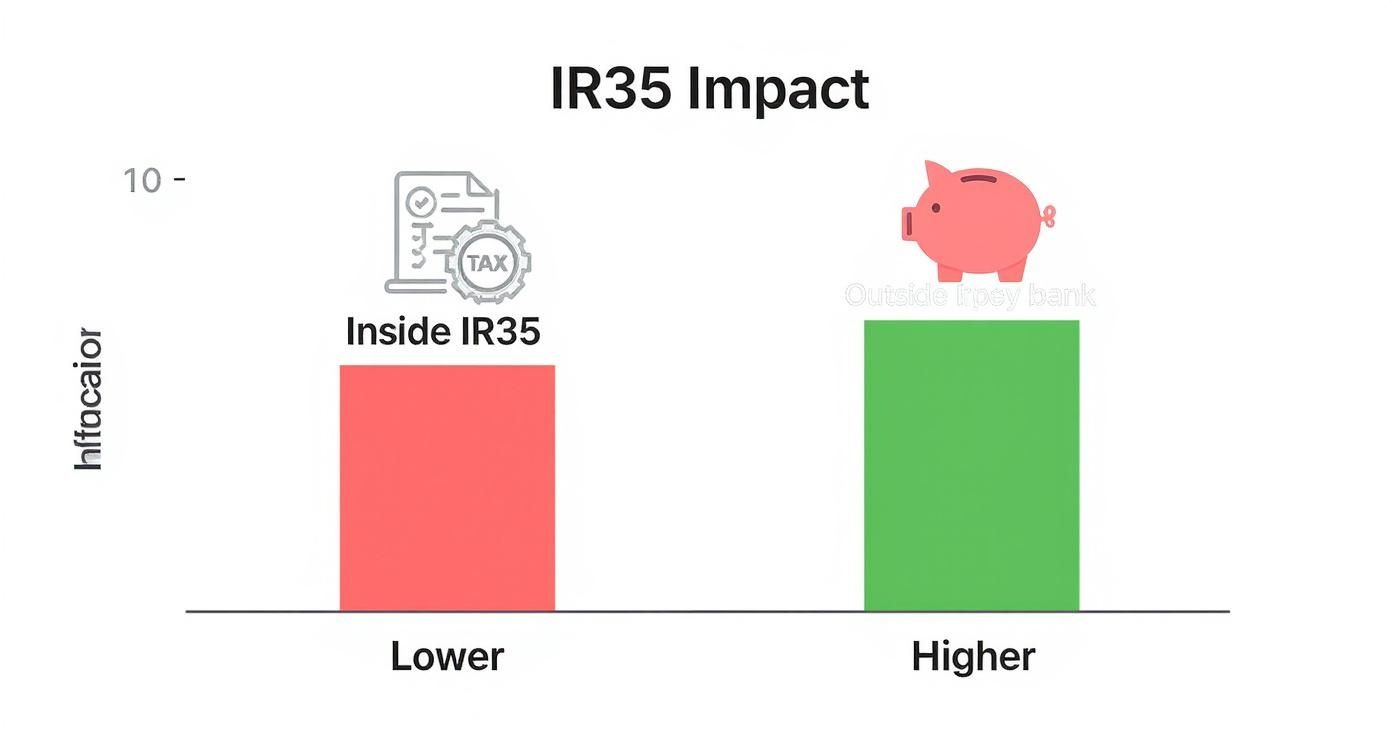
As the chart makes clear, operating outside IR35 through a limited company almost always leads to a higher net income, thanks to the tax efficiencies of blending salary and dividends.
Let’s put some simple numbers to this to make it even clearer.
Umbrella vs Limited Company Take Home Pay Example
| Financial Item | Umbrella Company (Inside IR35) | Limited Company (Outside IR35) |
|---|---|---|
| Contract Value | £60,000 | £60,000 |
| Umbrella/Accountancy Fees | – £1,200 | – £1,200 |
| Corporation Tax | N/A | – £8,893 |
| Salary Drawn | £48,510 | £12,570 |
| Dividends Drawn | N/A | £37,337 |
| Income Tax & NICs | – £11,152 | – £2,207 |
| Approx. Take Home Pay | ~ £36,158 | ~ £47,700 |
Note: These are simplified figures for illustration only and do not include factors like expenses, VAT, student loans, or pensions. Actual take-home pay will vary.
Ultimately, the choice comes down to balancing your priorities. An umbrella company is a compliant, hassle-free solution that is perfect for inside IR35 roles. A limited company, while more work, offers a clear financial upside for those who are genuinely operating outside IR35. Getting your head around these differences is the first real step to picking the structure that will help you hit your financial goals.
A Practical Guide to Calculating Your Take-Home Pay
Right, we have covered the theory, but let's get our hands dirty and see how it works in practice. Truly understanding how you get from your contract rate to the final figure that hits your bank account is the key to feeling confident and being able to spot any discrepancies on your payslip. This guide will walk you through the entire process, step by step.
We will start with the invoice value sent to your client and then methodically peel back each deduction. It is a transparent look at how employment costs and your personal taxes chip away at that headline figure, leaving you with your actual contractor take-home pay.

Step 1: Start with the Assignment Rate
It all begins with the assignment rate. This is the gross amount your umbrella company invoices the agency or client for the work you have done. It is vital to remember this is not your salary. Think of it as the total pot of money available to cover everything, including all employment costs and, eventually, your pay.
Let's use a nice round number for our example. Say your day rate is £500, and you work a full five-day week.
- Weekly Assignment Rate: £500 (day rate) x 5 (days) = £2,500
This £2,500 is our starting line. From here, we first need to subtract the costs of employment before we can even think about your personal gross pay.
Step 2: Deduct the Employment Costs
Before your own salary can be worked out, your umbrella company has to deduct all the statutory employment costs from that initial £2,500. These are the costs that the umbrella, as your official employer, is legally required to pay to HMRC.
These typically include:
- The Umbrella Company's Margin: This is simply their fee for running your payroll. We will assume a weekly margin of £25.
- Employer's National Insurance (NI): A mandatory tax paid by every employer in the UK.
- The Apprenticeship Levy: A tax on larger employers that helps fund apprenticeship schemes.
Once these have been taken out, the amount left over becomes your gross pay for tax purposes. This is the figure that your personal tax and NI will be calculated on.
Step 3: Calculate Your Personal Deductions
Now that we have your gross pay figure, the next step is to work out and subtract your personal deductions. This part of the process looks much more like what a permanent employee would see on their payslip.
The deductions at this stage are:
- Income Tax (PAYE): Calculated based on your earnings and the current UK tax bands.
- Employee's National Insurance: Your own personal contribution towards state benefits.
- Pension Contributions: If you are opted into a workplace pension, your contribution comes off here.
- Student Loan Repayments: If you have one, these will be deducted automatically.
The huge difference in earning potential between contractors and permanent staff makes getting these calculations right absolutely crucial. For context, the Office for National Statistics recently reported median weekly earnings for full-time UK employees at £766.60, which works out to about £39,843 a year. Compare that to IT contractor day rates, which can easily be £500 to over £1,000, and you can see why having a firm grasp on your net pay is so important.
After all the personal taxes and contributions have been subtracted from your gross pay, the figure you're left with is your net pay. This is the money that will actually be transferred into your bank account.
This whole process really shines a light on why your initial assignment rate is so different from what you finally take home. By understanding each step, you can check your payslips with confidence and use handy tools like our contractor payroll calculator to get a solid estimate of your earnings before you even accept a new contract.
Contractor Pay FAQs: Your Top Questions Answered
Stepping into the world of contracting can feel like learning a new language, especially when it comes to your pay. It is completely normal to have questions, and frankly, you should be asking them. Let's tackle some of the most common queries we hear from contractors just like you, breaking them down into simple, clear answers.
Why Is My Take-Home Pay So Much Lower Than My Day Rate?
This is the big one, the classic "sticker shock" for almost every new contractor. You see a juicy day rate and start doing the mental maths, but the figure that hits your bank account looks very different. Why?
It is because your day rate is not your salary; it is the gross income that has to cover both employment costs and your personal taxes. Before a penny is even earmarked as your personal income, deductions for Employer's National Insurance and the Apprenticeship Levy are taken out, along with the umbrella company's margin. Only then is your personal Income Tax and Employee's NI calculated on what is left. When you add it all up, these statutory costs take a significant slice of the pie.
Can I Claim Expenses to Boost My Take-Home Pay?
The short answer is: it depends entirely on your IR35 status. The rules around expenses have tightened considerably over the years, so this is an area you need to get right.
Here is the simple breakdown:
- Inside IR35: If your contract is 'inside IR35' and you are working through an umbrella, you generally cannot claim tax relief on your day-to-day travel and food expenses. HMRC sees you as an employee for tax purposes, so the rules mirror those for permanent staff.
- Outside IR35: This is where things open up. For limited company contractors working 'outside IR35', a much wider range of legitimate business expenses can be claimed. This reduces your corporation tax bill, which in turn frees up more funds for you to take from the company.
How Does Holiday Pay Actually Work?
One of the perks of being an employee of a compliant umbrella company is your legal right to paid holidays. It is a fantastic safety net, but you need to know how it is managed as it directly affects your cash flow.
Most umbrella companies handle it in one of two ways:
- Accrued (or 'banked') Holiday Pay: With this method, a portion of your income is set aside each time you are paid. It builds up in a separate pot, ready for you to draw down on when you decide to take a well-earned break.
- Advanced (or 'rolled-up') Holiday Pay: This option adds your holiday pay entitlement onto your regular payslip. While it gives you more cash in hand each week or month, it means you will not be paid anything when you are actually sipping a cocktail on the beach.
It's vital you check which method your umbrella uses. Knowing this upfront means you can budget properly and avoid any nasty surprises when you take time off.
What's the Biggest Financial Mistake a Contractor Can Make?
Without a doubt, the most costly error we see is getting IR35 status wrong. Misclassifying an 'inside IR35' role as 'outside' is a red flag for HMRC and can trigger an investigation that results in a huge bill for back-taxes, interest, and painful penalties.
You absolutely must get a thorough, impartial IR35 assessment for every single contract. No exceptions. This is not just about ticking a box; it is about making sure you are operating by the book from day one, paying the right tax, and protecting yourself from future trouble. That diligence is the bedrock of a long and successful contracting career.
Putting It All Together
The journey from your gross assignment rate to the cash in your bank account has a few twists and turns. But by now, you should have a solid map of the entire process. The key to maximising your contractor take home pay is not some secret trick; it is simply understanding what happens to your money and why.
Grasping how your operating structure, IR35 status, and all those statutory deductions fit together is what separates confusion from confidence. This is not just theory. It is the practical know-how you need to build a successful, sustainable contracting career. It gives you the power to plan your finances properly and partner with umbrella companies you can actually trust.
From Confusion to Control
You are now armed with the knowledge to manage your finances proactively. No more staring at a payslip wondering what it all means. Now, you can check your earnings, see the deductions coming, and make smart choices that protect your income.
This shift in perspective means you can:
- Compare contracts like a pro, looking past the headline day rate to what you will actually keep.
- Choose the right setup for you, whether that is an umbrella or limited company, based on your IR35 status and goals.
- Budget with real confidence, because you know how your gross pay translates into net pay.
- Spot and sidestep dodgy schemes that promise the world but deliver trouble.
Real financial confidence as a contractor comes from knowing exactly where every pound is going. Once you understand the system, you can make it work for you, ensuring every contract is as profitable and compliant as possible.
Your Next Move
You have got the theory down. The next logical step is to see how it applies to you. Every contractor's situation is unique, shaped by their industry, day rate, and personal finances. To get the full picture, you need to run your own numbers.
Think of this knowledge as your launchpad. The best way forward is to get a tailored estimate of your potential earnings. This will bring all the concepts we have covered to life and help you plan your next contract with total clarity. Whether you are just starting out or you are a seasoned pro, staying informed is your greatest asset.
Ready to see what your take-home pay could be? At UmbrellaCompany.com, our platform makes it easy to compare trusted, compliant umbrella companies and get a clear, personalised pay calculation in minutes.


