


Figuring out what to charge as a contractor can feel like a bit of a dark art, but there is a solid, logical place to start. The best way to get your bearings is to translate your old permanent salary into a competitive, sustainable day rate that covers your costs and reflects your worth. This guide will show you how.
Calculating Your Foundational Day Rate
Nailing your day rate is one of the most critical decisions you will make. Get it right, and you have financial stability. Get it wrong, and you are essentially working for less than you were as an employee. Making the jump from a permanent role means shifting your mindset; you are a business now, and your rate needs to reflect that reality.
The first step is converting your last annual salary into a daily figure. But hold on. You cannot just divide your old salary by the number of working days in a year. That is a classic rookie mistake that completely ignores the realities of contracting, like all the time you will not be earning and the extra costs you now have to shoulder yourself.
Accounting for Non-Billable Time
As a contractor, if you are not working, you are not earning. It is that simple. Your rate needs to build in a buffer for all the days a permanent salary quietly covers.
Think about it:
- Public Holidays: That is typically 8 days a year in the UK.
- Annual Leave: You will want at least 20-25 days off.
- Sick Leave: Budget for an average of 5-10 days.
- Training and Development: Set aside another 5 days to keep your skills sharp.
This handy infographic breaks down how to go from a permanent salary to a realistic day rate by factoring in all those non-billable days and business overheads.
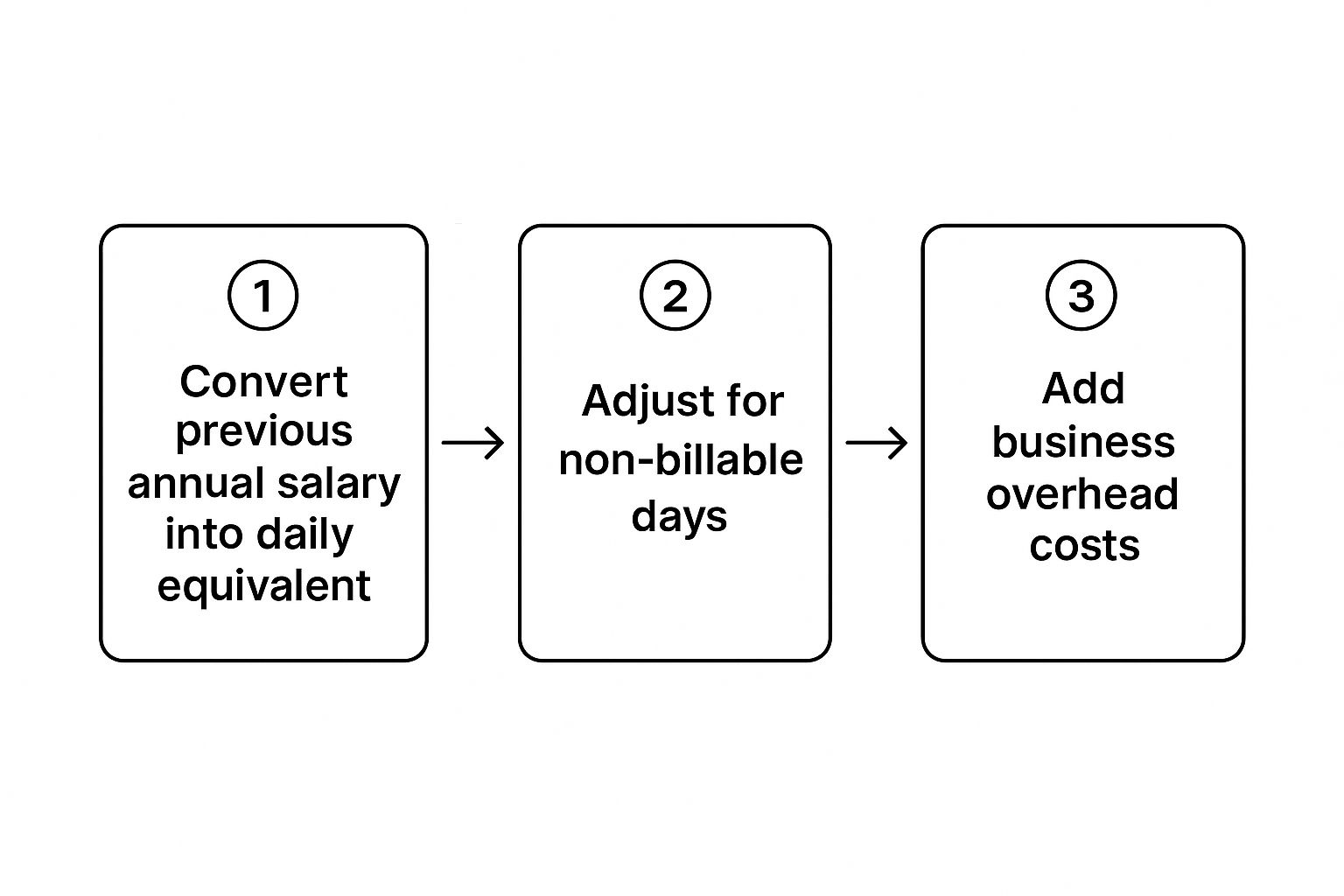
As you can see, it is a multi-step process. A simple division sum just will not cut it.
Let us walk through a quick example to see how this works in practice.
Example Permanent Salary to Contractor Day Rate Conversion
| Calculation Step | Example Value (£) | Description |
|---|---|---|
| Start with Annual Salary | £60,000 | Your last permanent salary is the baseline. |
| Calculate Billable Days | 222 Days | 260 working days minus holidays, sick days, etc. (e.g., 260 – 8 – 25 – 5). |
| Find Your 'Break-Even' Daily Rate | £270.27 | Your annual salary divided by your total billable days (£60,000 / 222). |
| Add a Business Expense 'Uplift' (e.g., 20%) | £54.05 | An added percentage to cover insurance, pension, software, and other overheads. |
| Your Target Day Rate | £324.32 | The break-even rate plus your expense uplift. This is your starting point for negotiations. |
This table shows how a £60,000 salary can be translated into a target day rate of around £325, once you properly account for the time you will not be earning and the costs of running your business.
Factoring in Business Overheads
Next, you have to add in all the costs of running your business that your old employer used to handle. We are talking about things like professional indemnity insurance, accountancy fees, software subscriptions, maybe some marketing, and crucially, your pension contributions.
For a really detailed breakdown tailored to your situation, our dedicated contractor calculator for outside IR35 is the perfect tool. If you are looking for other options, you can also explore free tools online that can help you get a solid estimate. Whatever you do, do not ignore these costs, they will eat into your earnings if you do not account for them upfront.
Looking Beyond the Formula: Adjusting for Market Realities
So, you have run the numbers and have a foundational day rate. That is a great start, but it is a figure that exists in a vacuum. To land on a rate that is genuinely competitive, you have to look outwards and see what is actually happening in the UK contracting market. Simply sticking to a formula without this context is a classic mistake. You could end up seriously undercharging or, just as bad, pricing yourself right out of the running.

The truth is, your industry, specific skills, and years on the job all create distinct pricing tiers. It is only natural that a seasoned fintech contractor in London will command a very different rate to a creative professional based in Manchester. These are not just random differences; they are driven by real market demand, the local economy, and how much value clients place on specialised expertise.
Get a Feel for Current Market Demand
Before you set anything in stone, you need to do your homework on what clients are actually paying for your skillset right now. This means digging deeper than generic job boards and getting into sector-specific data.
Contractor rates are a complex mix of demand and specialisation, something any decent contractor rate calculator should factor in. You will see huge variations by industry. For example, banking and finance contractors often lead the pack, commanding an average of £89.40 per hour. In contrast, the IT sector, while still strong, averages around £74.90 per hour because the market is more saturated with talent. For a closer look, it is worth exploring detailed UK contractor market rates insights.
Understanding this landscape is all about positioning yourself strategically. It ensures your rate is not just a number you have pulled out of a spreadsheet, but one that genuinely reflects what the market expects for someone with your unique skills and experience.
A common pitfall is undervaluing niche expertise. If you have a rare skill or a hard-to-get certification, your rate should absolutely reflect that scarcity. Do not be shy about charging a premium for in-demand knowledge that not many others can offer.
Tweak Your Rate for Project Length and Complexity
Finally, you have to think about the nature of the project itself. Not all contracts are created equal, and your pricing needs to be flexible enough to reflect that.
A few key things to consider:
- Urgency: Is it a fire-fighting role? A short, urgent project often justifies a higher premium. The client is paying for your skills to solve a problem now.
- Duration: A long-term engagement of six months or more offers you stability. It is pretty common to offer a slightly reduced rate in exchange for that security.
- Complexity: A project that demands deep technical know-how or involves managing difficult stakeholders is worth more than a straightforward, run-of-the-mill task.
By layering these real-world market factors on top of your initial calculation, you move from a simple estimate to a strategic day rate that you can confidently defend.
How IR35 and Umbrella Companies Affect Your Rate
When you are trying to figure out your contractor rate, your engagement status is everything. You absolutely have to get your head around the IR35 rules and how an umbrella company fits into the picture, because both will directly affect your take-home pay. They dictate what gets deducted from your day rate before the money ever lands in your bank account.

The first question is always about your IR35 status. If a role is deemed ‘outside IR35’, you are operating as a proper business, usually through your own limited company. This gives you much more control over your tax affairs. But for roles ‘inside IR35’, you are essentially treated as an employee for tax purposes, even though you are on a temporary contract.
Understanding Inside IR35 Deductions
This is where a lot of contractors get caught out. When your contract falls inside IR35, a whole raft of statutory deductions come into play. That "headline" day rate you agreed is not what you will actually receive.
Working through a compliant umbrella company like us makes this much simpler, as we handle all these deductions for you.
For any inside IR35 engagement, here is what gets taken out:
- PAYE Tax: Standard income tax, deducted at source just like a permanent employee.
- Employee's National Insurance: Your personal contribution to National Insurance, taken straight from your earnings.
- Employer's National Insurance: This is the big one. The client or agency is responsible for paying this, but it is deducted from the agreed contract rate before your own gross pay is worked out.
- Apprenticeship Levy: A small percentage paid by larger employers, which also comes out of the assignment rate.
It is crucial to grasp that Employer’s NICs are a cost of employment that the overall project rate has to cover. A very common mistake is to forget about this, which can seriously dent your expected take-home pay.
The Umbrella Company's Role
An umbrella company acts as your employer for the duration of the contract. We process your pay and make sure all the right taxes are paid to HMRC on time. For this service, we charge a small weekly or monthly margin. It is a legitimate business expense, so you should always factor it into your calculations.
Choosing a compliant provider is non-negotiable. Look for accreditations from bodies like the FCSA or Professional Passport. They are a good sign that a company is committed to ethical and legal standards.
Our Inside vs Outside IR35 calculator can show you the financial difference in black and white. It helps you set a day rate that genuinely covers all the costs and leaves you with the earnings you are actually expecting.
Fine-Tuning Your Rate for Specific Industries
A general contractor rate calculator is a brilliant place to start, but it is just that, a start. The UK's contracting world is incredibly diverse, and a one-size-fits-all approach just does not cut it. Your day rate is not only about covering your own costs; it has to reflect what is happening in your specific industry, where you are based, and just how in-demand your skills really are. Get this wrong, and you could be leaving serious money on the table.
A contractor's day rate can swing wildly depending on the job's location and the sector it is in. A specialist on a massive infrastructure project in London is going to command a very different fee to someone with the exact same skills in a less economically booming part of the country. This is where market intelligence becomes your best friend.
A Case Study: The Construction Sector
Let us look at the UK construction industry. It is a perfect example of these market forces in action. You might see an average rate of around £33.50 per hour for a general contractor, but that figure hides a lot. The sector is crying out for skilled people, grappling with an ageing workforce and high numbers of apprentices dropping out. It is creating a real talent vacuum.
This shortage is a golden opportunity for contractors with the right specialisms. If you are a skilled bricklayer or have civil engineering expertise in an area where new houses are popping up everywhere, you hold all the cards. Your rate is no longer just a number from a calculator; it is a direct reflection of urgent market demand.
Understanding your industry’s unique pressures, whether it is a skills gap, new regulations, or a tech revolution, is absolutely key. These are the levers that give you the power to fine-tune your rate with real precision and confidence.
This logic applies right across the board, from IT professionals to financial analysts. Web developers, for instance, have to weigh up how the demand for certain coding languages or platform-specific knowledge affects their value. To see a practical breakdown of this, take a look at our guide on finding the right umbrella company for web developers. When you do your homework on your niche, you can confidently justify a rate that truly matches what you bring to the table.
When to Review and Negotiate Your Day Rate

Setting your day rate is not a "set it and forget it" task. To be a successful contractor, you need to recognise that your value evolves, and your pricing should evolve right along with it. Regularly reviewing your rate is the only way to ensure it reflects your growing experience and stays competitive with current market conditions.
So, when is the right time? The triggers for a rate review are often clear signals that your professional worth has increased. Have you just delivered a major project ahead of schedule? Gained a new, in-demand certification? Or maybe you have just noticed a significant uptick in recruiters calling about your specific skillset? These are all prime opportunities to reassess what you are charging.
Building Your Case for a Rate Increase
When you decide it is time to talk numbers, preparation is everything. You cannot just ask for more money; you need to build a compelling business case that is grounded in the tangible value you bring.
Focus on gathering concrete evidence that backs up your request.
- Project Wins: Document exactly how your work contributed to your client's goals. Did you increase efficiency by 20%? Help boost revenue? Get specific.
- New Skills: Highlight any new qualifications or expertise you have acquired. If you have mastered new software or a methodology, that makes you more valuable.
- Market Data: Do your homework. Research the going rates for contractors with your skills and experience. This shows your request is reasonable and aligned with the market.
A well-structured salary negotiation letter template can be a fantastic resource to help you frame your argument professionally and confidently.
Timing and the Bigger Picture
The wider economic climate definitely plays a part, too. Any good contractor rate calculator has to account for the macroeconomic shifts that affect demand for your services.
Even when certain sectors see cautious growth, things like stabilising inflation or changes to the Bank of England's base rate can have a positive knock-on effect. These factors can free up project financing, which in turn boosts contractor demand.
Ultimately, advocating for a higher rate comes down to proving your value and understanding all the moving parts. By approaching negotiations with solid evidence and a keen awareness of the market, you can confidently secure a rate that truly matches your professional growth.
Answering Your Contractor Rate Questions
Figuring out your day rate can feel like a bit of a dark art when you are starting out. To give you some clarity, here are the answers to a few questions that come up time and again from contractors using a contractor rate calculator.
How Often Should I Re-evaluate My Contractor Rate?
As a rule of thumb, it is wise to review your rate at least once a year. But do not just stick to the calendar. A much better time to reassess is when you have just wrapped up a major project, earned a new in-demand certification, or you start to see a real shift in the market for your skills.
Here is a classic sign: if you are constantly having to turn down work because your diary is full, it is a strong signal that you might be undercharging for the current demand.
Should I Charge a Different Rate for Short vs. Long Contracts?
Absolutely. It is standard practice to charge a higher day rate for short-term projects, think anything under three months. That extra amount is to cover the administration and the risk of being back on the market sooner than you would like.
For longer-term contracts, say six months or more, you can afford to offer a slightly more competitive rate. It is a trade-off: you get the stability and guaranteed income, and the client gets a small discount for the commitment. It is all about balancing risk and reward.
One of the biggest pitfalls for new contractors is simply converting an old permanent salary into a day rate. They forget to add a buffer for all the things an employer used to cover: insurance, accountancy fees, pension contributions, plus sick days and holidays. This always results in a rate that does not reflect the true cost of running your business.
This oversight is a fast track to earning far less than you thought you would. Always factor these costs into your calculations to make sure your rate is not just competitive, but genuinely sustainable for the long haul.
Ready to find a compliant umbrella company that fits your needs? At UmbrellaCompany.com, we make it easy to compare trusted providers and get set up in minutes. Find your perfect match today.


