


For any professional contractor in the UK, getting the right contractor insurance is not just about ticking a box on a client's contract. It is the foundation of your business, a crucial shield protecting your finances, reputation, and future from unexpected events that could otherwise be devastating.
Why Contractor Insurance Is Your Business Lifeline

Think of it as your professional safety net. Whether you work in IT, construction, or creative services, the risks are real. A simple mistake, an accident on-site, or a dispute with a client can spiral into a major financial liability. Without the right cover, you would be personally responsible for legal fees and compensation that could easily threaten your business and personal assets.
This guide will cut through the jargon and give you a clear roadmap to understanding contractor insurance in the UK. We aim to give you the confidence to build your business on solid ground, knowing you are properly protected.
What You Will Learn in This Guide
Navigating the world of insurance can feel overwhelming, so we have broken it down into manageable sections. We want to provide you with the knowledge to make smart decisions for your unique situation.
Throughout this guide, we will explore:
- Essential Types of Cover: We will walk through the core policies every contractor needs to consider, from Professional Indemnity to Public Liability.
- Real-World Risk Protection: You will see exactly how different policies shield you from the practical, day-to-day risks you face.
- The Crucial Link to IR35: We will clarify the vital connection between your insurance and HMRC’s off-payroll working rules.
If you work in a specific trade like construction, understanding your obligations is particularly important. Many contractors operate under frameworks like the Construction Industry Scheme, which runs alongside your insurance requirements and is a key part of staying compliant.
Choosing the right insurance is one of the most important decisions a contractor can make. It transforms risk from a potential catastrophe into a manageable business expense, providing peace of mind and demonstrating professionalism to clients.
By the time you finish this guide, you will have a clear grasp of what you need and why, empowering you to choose the right policies with total confidence.
Getting to Grips with Your Core Insurance Options
First, let's cut through the jargon. To build a solid safety net for your contracting business, you need to understand the main types of insurance available. Each policy is a different tool for a different job, designed to protect you from specific risks you might face.
Think of them as the essential components in your business’s financial toolkit.
We will break down the three most common policies you will encounter. We will explain each one in simple terms, using real-world scenarios you could genuinely find yourself in. This way, you can clearly see which types of cover are non-negotiable for the work you do.

Public Liability Insurance Explained
If you ever interact with clients, suppliers, or the general public, Public Liability insurance is the absolute bedrock of your cover. Its purpose is to protect you if something you do in your work causes an injury to someone or damages their property.
It is easier to picture with an example. Imagine you are a decorator working in a client's home. You leave a dust sheet folded on the stairs, and the homeowner trips over it, breaking their arm. Suddenly, you face a claim for their injury, medical bills, and lost earnings. This is exactly where Public Liability insurance kicks in, covering the legal fees and any compensation they are awarded.
It is not just for personal injuries, either. Say you are an IT contractor and you accidentally knock a cup of coffee over a client's high-end server, frying the circuits. Your Public Liability policy would handle the cost to repair or replace it. Simple as that.
Professional Indemnity Insurance in Focus
While Public Liability deals with physical mishaps, Professional Indemnity (PI) insurance is all about protecting your professional reputation and your bank balance. It is essential for any contractor who gives advice, provides a service, or designs things for clients.
Picture this: you are a business consultant who advises a client to switch to a new inventory management system. Six months later, a flaw in the strategy you recommended causes them to lose thousands in stock. They could sue you for the financial loss they suffered as a direct result of your professional advice.
Professional Indemnity insurance is your shield. It defends you against claims of mistakes, bad advice, or professional negligence. It covers your legal defence costs and any compensation payments if a client argues your work cost them money.
This cover is a must-have for roles like project managers, marketers, and designers. Without it, one simple oversight could trigger a claim big enough to sink your entire business. In fact, many clients will not even consider hiring a contractor who does not have it.
Employers' Liability: A Legal Requirement
This one is not optional. If you hire anyone (even a part-time assistant or a temporary subcontractor) Employers' Liability insurance is a legal requirement in the UK. The law is crystal clear: you must have a minimum of £5 million of cover. If you fail to do so, you could face hefty fines from the Health and Safety Executive (HSE).
Let's say you are a lead developer and you bring in another coder for a three-week crunch period. If they develop a repetitive strain injury while working under your direction and on your equipment, you could be held responsible. Your Employers' Liability insurance would cover their compensation claim and all the legal costs that come with it.
It is a straightforward policy that ensures if someone working for you gets ill or injured because of their job, you can afford to pay any compensation they are due. It is a non-negotiable part of being an employer.
To make it even clearer how these policies fit together, have a look at this quick summary table.
Key Contractor Insurance Policies at a Glance
| Insurance Type | What It Covers | Essential For Contractors Who… |
|---|---|---|
| Public Liability | Injury to third parties or damage to their property caused by your business activities. | Work on client sites, interact with the public, or visit third-party premises. |
| Professional Indemnity | Financial loss suffered by a client due to your professional negligence, errors, or omissions. | Provide advice, design, consultancy, or other specialist services. |
| Employers' Liability | Compensation claims from employees who are injured or become ill due to their work for you. | Hire any staff, including temporary workers, apprentices, or subcontractors. |
By understanding what each of these core policies is for, you can start building an insurance package that truly reflects the risks you face every day. This way, you are not wasting money on cover you do not need, but you are properly protected against the things that really matter.
A Deep Dive into Professional Indemnity Insurance

For many contractors, especially if you are in consulting, IT, or a creative field, Professional Indemnity (PI) insurance is the absolute bedrock of your business protection. This is the cover that steps in if a client claims they have lost money because of your professional negligence, an error you made, or something important you failed to mention.
Think of it like this: Public Liability insurance covers mistakes you make with your hands, like accidentally damaging a client's property. Professional Indemnity covers mistakes you make with your head, such as the advice you give, the code you write, or the designs you create. It is the essential safety net for your expertise.
Let's put that into perspective. Imagine an IT consultant recommends a new software system that later fails, leading to a massive data breach for their client. Or perhaps a project manager’s scheduling error causes a project to run thousands of pounds over budget. These are exactly the kind of professional mishaps that PI insurance is designed for.
Why PI Insurance Is Non-Negotiable
In today’s contracting world, having Professional Indemnity insurance is not just a sensible precaution; it is very often a deal-breaker. Many clients, particularly large corporations and public sector bodies, simply will not work with a contractor who does not have proof of adequate PI cover. It is their assurance that if things go wrong due to your professional services, a financial backstop is in place.
But beyond keeping clients happy, it gives you incredible peace of mind. A single allegation of negligence, whether it is justified or not, can unleash crippling legal defence costs. PI insurance is there to pick up those legal fees from the start, so you can defend your reputation without bankrupting your business.
The numbers back this up. Recent business insurance statistics show that PI claims now make up over 26% of all annual claims in the UK, making it the most common reason for a claim in the sector. The market itself was valued at a huge £3.3 billion in 2023, up from £2.9 billion in 2021, reflecting the growing risks contractors face.
Real-World Scenarios and Coverage
To truly grasp its value, let's look at a few everyday examples where Professional Indemnity insurance would be a lifesaver:
- For a Marketing Consultant: You launch a campaign for a client, but it contains a factual error about their product. This leads to a complaint to the Advertising Standards Authority and a direct financial hit for the client.
- For a Software Developer: You deliver code with a hidden bug. The bug causes your client’s e-commerce site to crash during its busiest sales period, costing them a fortune in lost revenue.
- For an Architect or Designer: You draw up a set of building plans with a critical measurement error, forcing costly rework and delays during the construction phase.
In all of these situations, the client has lost money because of a mistake in your professional service. Your PI policy would cover the legal bills to defend the claim and any compensation you are ordered to pay.
How Much PI Cover Do You Need?
Figuring out the right level of PI cover is a big decision, and there is no one-size-fits-all answer. It all comes down to your unique circumstances.
The level of cover you need is usually dictated by two things: the value of the contracts you work on and the potential financial impact if your work were to cause a major problem for your client.
Here is what to weigh up when choosing your cover level:
- Client Contracts: The easiest starting point is your contract. Most clients will specify a minimum level of PI cover they expect you to have, which is often between £1 million and £5 million. Always check this first.
- Industry Risk: Let’s be honest, some jobs are riskier than others. A financial consultant whose advice could sway multi-million-pound investments needs a lot more cover than a freelance copywriter.
- Project Size and Value: The bigger the project, the bigger the potential fallout. Think about the worst-case scenario. What is the maximum financial damage a mistake on your part could cause? Your cover should reflect that.
We offer more detailed guidance on figuring this out in our complete overview of contractor indemnity insurance, which can help you make a much more informed choice. Getting this right means you are properly protected without paying for cover you do not really need.
How IR35 Legislation Shapes Your Insurance Needs
For almost every contractor in the UK, navigating the world of IR35 is a top priority. This legislation, created to identify ‘disguised employment’, directly influences how you work and, more importantly, the insurance you need. It is no longer just about covering yourself against on-site accidents; insurance is now a crucial part of your IR35 toolkit.
While your standard policies like Public Liability are there for operational mishaps, a specific IR35 insurance policy tackles the unique financial threat of an HMRC investigation head-on. Think of it as your personal legal fund, designed to shield you from the potentially eye-watering costs of a status dispute.
What Does IR35 Insurance Actually Cover?
The moment HMRC decides to open an enquiry into one of your contracts, the costs can start to mount, even if you are confident you have done everything by the book. This is where IR35 insurance really proves its worth.
A good policy is built to handle the biggest financial headaches of an investigation, including:
- Expert Representation: It covers the fees for specialist tax and legal experts who will fight your corner and manage all communications with HMRC.
- Tax Liabilities: If the worst happens and you are found 'inside IR35', the policy can pay the back taxes and National Insurance contributions HMRC demands.
- Penalties and Interest: It can also cover the interest and any penalties HMRC decides to levy on top of the tax bill.
Without this cover, you are on your own, funding a potentially long and expensive legal battle out of your own pocket. It gives you invaluable peace of mind, letting you get on with your work while the experts handle the enquiry.
Using Insurance to Signal Your Business Status
Beyond dedicated IR35 cover, the other business insurance policies you hold play a subtle but powerful role in demonstrating your status as a genuine business. Holding a policy like Professional Indemnity insurance is a strong indicator that you operate as an independent professional, not a disguised employee.
Why does this matter so much? An employee would never be expected to arrange their own professional indemnity cover; their employer takes on that risk. By investing in your own business insurance, you are showing that you accept the financial risks and responsibilities that come with being a legitimate business owner. This seriously strengthens your ‘outside IR35’ argument.
Think of your insurance portfolio as a key piece of evidence in your IR35 defence. It helps paint a clear picture of a professional who is genuinely in business for themselves, shouldering the risks that come with the territory.
This kind of proactive thinking is vital. When HMRC looks at your status, they consider the entire picture of your working relationship. Having the right contractor insurance in the UK sends a clear signal that you treat your work as a professional business venture. For a deeper dive into the legislation, our guide on IR35 and contractors will help you get to grips with the rules.
Is It Worth the Investment?
Ultimately, the decision to get IR35 insurance often boils down to your personal appetite for risk. An HMRC investigation can be a long, stressful, and incredibly expensive ordeal, regardless of the final outcome. The potential bill for back taxes and penalties could be financially crippling for many contractors.
Investing in a policy effectively transfers that financial risk to an insurer. For a modest annual premium, you get access to expert legal support and a financial safety net against a worst-case scenario. It is more than just a policy; it is a strategic defence for your livelihood.
What Determines the Cost of Your Insurance Policy?
Trying to figure out why your insurance premium is what it is can feel like a bit of a mystery. So, let’s pull back the curtain on how contractor insurance in the UK is priced. At its core, the cost is a direct reflection of your business's unique risk profile, calculated using a few key factors.
It is a lot like car insurance. A high-performance sports car parked on a busy city street will always cost more to insure than a family runaround tucked away in a garage. In the same way, an insurer looks at your contracting business to gauge how likely a claim is and what the fallout might cost if it happens.
Let's break down the elements that matter, so you can see your business through an insurer's eyes and get a handle on managing your costs.
Your Trade and the Nature of Your Work
The single biggest factor driving your insurance cost is the type of work you do. Every profession has its own set of risks, and insurers have crunched the numbers to price their policies accordingly.
An electrician on a sprawling construction site, for example, faces a much higher risk of causing property damage or injury than a freelance copywriter working from a home office. It is just common sense.
Likewise, a management consultant whose advice could make or break a client's multi-million-pound project needs a much higher level of Professional Indemnity cover than a graphic designer creating a simple logo. Insurers have vast amounts of data on different trades and the claims that typically arise, which all feeds directly into their pricing models.
You can see these differences play out in the market. For instance, recent industry analysis shows that rates for some construction insurance have dropped due to a competitive market. Yet, the average cost of employers’ liability insurance for a construction worker is far higher than for an office employee, which perfectly illustrates the risk gap.
The Level of Cover You Choose
The next big piece of the puzzle is the level of cover you select. This is the indemnity limit, the maximum amount your insurer will pay out for any single claim. A policy with a £1 million Public Liability limit will, quite naturally, cost less than one with a £5 million limit.
So, how do you land on the right number?
- Contractual Requirements: Your client’s contract is the first place to look. Many will spell out the minimum level of cover you need to have in place, often £2 million or £5 million for Public Liability.
- Risk Assessment: Think about the worst-case scenario. If a mistake in your work caused a catastrophic incident, what would the financial damage be? Your cover needs to be high enough to absorb that hit.
Picking a higher limit than you need will nudge your premium up, but being underinsured could be financially devastating if a big claim comes your way. It is all about finding that sweet spot for your specific circumstances.
Your Business Turnover and Size
Your annual business turnover is another key metric insurers look at, especially for Professional Indemnity and Public Liability cover. To them, a higher turnover suggests you are working on bigger, more valuable, or a higher volume of projects. This automatically increases the potential scale and cost of a claim if things go wrong.
The size of your business also plays a role, particularly for Employers' Liability insurance. The cost is tied directly to how many people you employ and the wages you pay. This is because your premium needs to factor in your employer National Insurance contributions, which are a part of your total payroll costs. If you want a deeper dive into this, you can read our guide on what employer National Insurance contributions are.
Your Claims History
Finally, just like your personal car insurance, your claims history matters. If you have made several claims in the past, an insurer might see you as a higher risk and charge a higher premium. On the other hand, a clean record can help keep your costs down.
A strong, claim-free history shows an insurer that you are a responsible business owner who actively manages risk. This can often lead to better renewal terms and a more stable premium over the long run.
By getting to grips with these four key drivers (your trade, cover level, turnover, and claims history) you get a much clearer picture of your insurance costs. This knowledge puts you in the driver's seat, allowing you to have more informed conversations with insurers and make smarter choices to protect your business.
A Practical Framework for Choosing Your Cover
So, you understand the why and the what of contractor insurance. Now it is time to turn that knowledge into a concrete plan for getting yourself covered. Having a clear process takes the guesswork out of it, letting you move from theory to a package that genuinely fits your business.
First, get your client contracts out and read them carefully. Contracts often have mandatory insurance clauses spelling out exactly what cover you need and the minimum indemnity levels. If you get this wrong, you could be in breach of contract before you have even logged your first hour.
Assess Your Unique Business Risks
Once you know what your client demands, you need to look at your own situation. Your risks as a freelance IT consultant are worlds away from those of a self-employed plumber, and your insurance needs to reflect that reality.
Ask yourself a few honest questions:
- Do I handle sensitive client data?
- Am I working on big-budget projects where a mistake could have a massive financial fallout?
- Will I be on-site at a client's office or interacting with the public?
- Do I have anyone working for me, even on a casual basis?
Answering these helps you build a clear picture of your risk profile, pointing you straight to the policies that actually matter for you.
Determine and Compare Your Cover
Next, you need to decide on the right level of cover for each policy. This is a balancing act. You need enough to protect you from a genuine worst-case scenario, but you do not want to be paying for excessive cover you will never need.
With your requirements list in hand, you can start getting quotes from specialist insurers. It is always better to go with providers who specialise in the contractor market, as they understand the nuances of what you do and offer policies that make sense.
This infographic gives you a quick visual on what drives the cost.
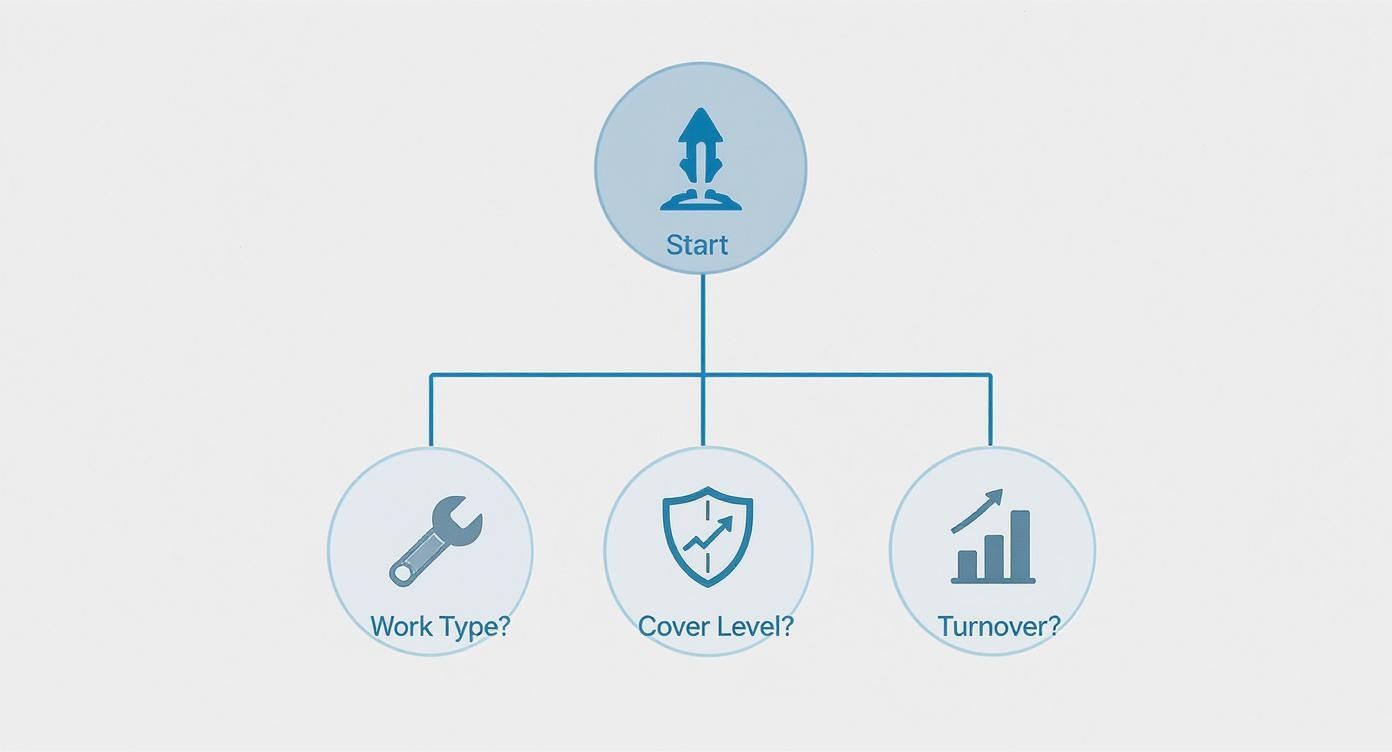
As you can see, the type of work you do, how much cover you need, and your business turnover are the big three that will influence your final premium.
The good news for contractors is that fierce competition among UK insurers is forcing them to offer better, more tailored products. A recent report found that this competition has caused rates to drop, with financial and professional lines falling by 10%. You can dig deeper into UK insurance market trends on Insurance Business Magazine.
Finally, and this is the big one: always check the policy wording. Read the small print. That is where you will find the exclusions and conditions that define what is and is not covered. Overlooking those details could leave you badly exposed right when you need protection the most.
Got Questions? We've Got Answers
Stepping into the world of contractor insurance in the UK often raises a few questions. To help you get straight to the point, we have tackled some of the most common questions we hear from contractors every day.
Think of this as your no-nonsense guide to getting the essentials sorted, so you can understand what you need and why.
Is Contractor Insurance a Legal Requirement?
This is a big one, and the answer is not a simple yes or no. For the most part, holding Professional Indemnity or Public Liability insurance is not a legal demand from the government. The real driver is your client, who almost always makes it a non-negotiable part of your contract.
The one major exception is Employers' Liability insurance. If you employ anyone, even for a short-term job, the law says you must have this cover. But in reality, you will find that most clients simply will not work with a contractor who does not have the right insurance in place, making it a commercial necessity.
How Much Public Liability Insurance Do I Need?
The right amount of Public Liability cover really boils down to your client contracts and where you work. There is no magic number that works for everyone, but a few common figures appear time and again.
- Public sector clients, like local councils, will often demand a minimum cover level of £5 million.
- In the private sector, a limit of £1 million to £2 million is far more typical.
Your contract is your North Star here. It will almost always specify the exact level of cover your client expects. Get that sorted, and you are compliant from day one.
Can I Claim My Insurance Premiums as a Business Expense?
Yes, you absolutely can. Business insurance is a perfectly legitimate trading expense for your limited company. This is great news because it means you can deduct the full cost from your company's profits, which in turn reduces your corporation tax bill.
HMRC’s rule of thumb is that an expense must be 'wholly and exclusively' for business purposes. Since contractor insurance is fundamental to winning and carrying out your work, it passes this test with flying colours. It is a standard, tax-deductible cost of doing business.
At UmbrellaCompany.com, our goal is to help contractors find the best solutions for their working life. If you need to simplify your payroll and tax, compare our trusted, compliant umbrella companies today. Just visit Umbrella Company to get started.


