


You've just been sent a new contract. The rate looks good, the client sounds established, and then the jargon starts. You see references to IR35, self-employment, substitution, control, umbrella payroll, and “outside scope” wording that doesn't tell you what your day-to-day work will look like.
That's where many contractors get stuck.
A contract can call you a contractor, but contractor employment law in the UK looks beyond the label. What matters is how the relationship works in real life, who controls the work, whether you can send someone else, and whether the arrangement feels more like running a business or filling a role in someone else's business.
A large part of the UK workforce operates in this manner. The Office for National Statistics reported that the UK had around 4.23 million self-employed workers in 2023, representing roughly 12.9% of total employment, which demonstrates these status questions affect a substantial part of the labour market, not a niche corner of it (reported here).
If you're new to contracting, or you want a cleaner way to think about status risk, start with this practical guide on how to become a contractor.
Your Guide to UK Contractor Employment Law

Most confusion starts with a simple mistake. People assume employment status is one fixed thing.
It isn't.
In the UK, your legal position depends on the rights question being asked. Employment rights law, tax law, and off-payroll compliance often overlap, but they don't always use the same label in the same way. That's why one contractor can feel independent in practice, but still face tax deductions under IR35, or qualify for some worker protections.
Your contract title matters far less than the reality of the relationship.
A useful way to approach this is to ask three practical questions:
- What status am I likely to have in law: employee, worker, or self-employed?
- What facts shape that decision: control, substitution, and mutuality of obligation?
- What setup fits the role safely: limited company, sole trader approach, or umbrella employment?
Why this topic matters
Status affects more than legal wording. It can shape your pay method, your entitlement to holiday pay, whether PAYE gets applied before money reaches you, and who carries compliance risk in the supply chain.
For new contractors, the hard part isn't usually learning the vocabulary. It's spotting the warning signs before accepting a role. A contract may sound flexible, but if the client decides your hours, supervises your methods, and expects ongoing availability, the working pattern may point in a very different direction.
A simpler way to read the rules
When we explain contractor employment law to new starters, we keep it grounded in real situations:
- How you work on an ordinary weekday
- What the client can require from you
- Whether you're supplying a service or filling a role
- Whether your paperwork matches reality
That approach makes the rest of the law much easier to understand.
The Three Key UK Employment Statuses Explained
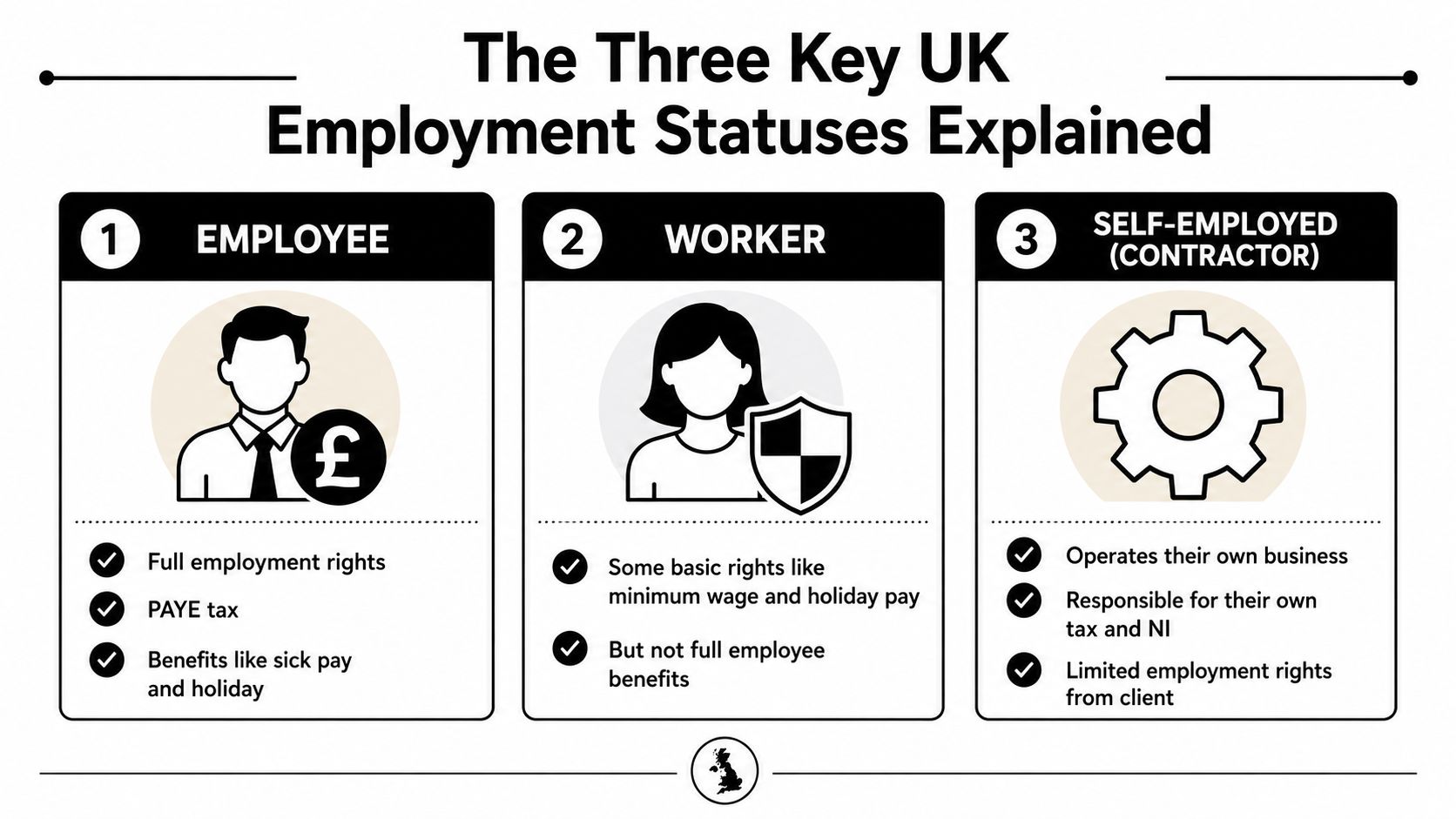
The UK doesn't divide everyone into only “employee” and “self-employed”. There's a middle category too.
That middle category causes a lot of confusion, because many contractors assume they either have full employment rights or none at all. In practice, the law is more layered than that.
Employee, worker, and self-employed
Think of the three statuses like levels of attachment to the organisation you work for.
- An employee is closely tied to the organisation and usually receives the broadest set of statutory rights.
- A worker has some core protections, but not the full set employees get.
- A self-employed contractor operates their own business and usually relies on contract terms rather than employment rights from the client.
A helpful next read, if you're deciding where your setup sits, is this guide on when to register as self-employed.
What each status usually means in practice
| Status | Practical position | Typical rights position |
|---|---|---|
| Employee | Works as part of the organisation, under its direction | Broad statutory protections, such as unfair dismissal and redundancy rights |
| Worker | Personally performs work, but with less complete attachment than an employee | Core protections, including holiday pay and the National Minimum Wage |
| Self-employed | Runs their own business and supplies services to clients | Limited employment rights from the client, with more responsibility for own tax affairs |
Why the worker category matters
This is the status many people miss.
The modern framework was shaped by the Employment Rights Act 1996, which formalised the distinction between employees and workers for rights such as unfair dismissal and redundancy, while later case law developed the separate worker category that can still qualify for holiday pay and the National Minimum Wage even without full employee status.
That means a person can fail to qualify as an employee and still have meaningful legal rights.
Practical rule: If you're expected to do the work personally and the client retains meaningful control, don't assume “contractor” means you have no workplace protections at all.
A quick reality check
Here's where readers often get tripped up:
- Contractor is not a legal status on its own: it's a business label people use in everyday language.
- Self-employed is not the same as outside IR35: one is a broader status idea, the other is a tax result.
- Worker rights can apply even without employee status: that's why status disputes can become expensive and stressful.
The stakes are straightforward. If you're treated as part of the workforce, subject to detailed control, and expected to turn up like any other member of staff, the law may give you more protection than the paperwork suggests.
The Key Tests for Contractor Status
When HMRC and the courts examine status, they don't start with your job title. They look at how the relationship functions.
Three indicators come up repeatedly in UK contractor employment law. They are control, substitution, and mutuality of obligation.
Control
Control asks who really decides the shape of the work.
A client can set a deadline and specify the outcome without creating an employment-style relationship. That's normal in a commercial contract. The risk rises when the client also dictates your hours, methods, location, internal reporting lines, and how each task must be completed.
A simple comparison helps:
- Lower risk pattern: “Deliver this migration by month end. Use your own process.”
- Higher risk pattern: “Work on site from set hours, follow our internal process manual, attend daily team check-ins, and get approval before changing your approach.”
The second arrangement looks much more like somebody filling a role inside the business.
Substitution
Substitution means whether you can send another suitably qualified person to do the work.
This point is often misunderstood because many contracts include a substitution clause that sounds useful but doesn't work in practice. If the client can reject any substitute for broad reasons, or the arrangement would collapse the moment you tried to use one, the right may exist only on paper.
A real substitution right tends to look more commercial. You remain responsible for the service, you source and pay the substitute if needed, and the client is buying the outcome rather than your personal attendance.
Mutuality of obligation
This is usually shortened to MOO.
It looks at whether the client is expected to keep offering work and whether you're expected to keep accepting it. A contract for a specific project with a defined end point tends to look different from an open-ended arrangement where both sides behave as if the work will continue.
If the relationship feels like “you keep showing up and we'll keep finding tasks for you”, status risk usually rises.
The Uber case and why it matters
A major reference point is the Supreme Court's 2021 decision in Uber BV v Aslam, where the Court held that Uber drivers were workers, meaning they were entitled to core employment protections such as paid annual leave and the National Minimum Wage. That decision remains a defining reference point in modern UK contractor law (noted here).
The importance of that case isn't limited to platform work. It reinforced a broader principle that courts look closely at control and dependency in practice, not just the wording drafted into contracts.
A Practical Guide to the IR35 Off-Payroll Rules
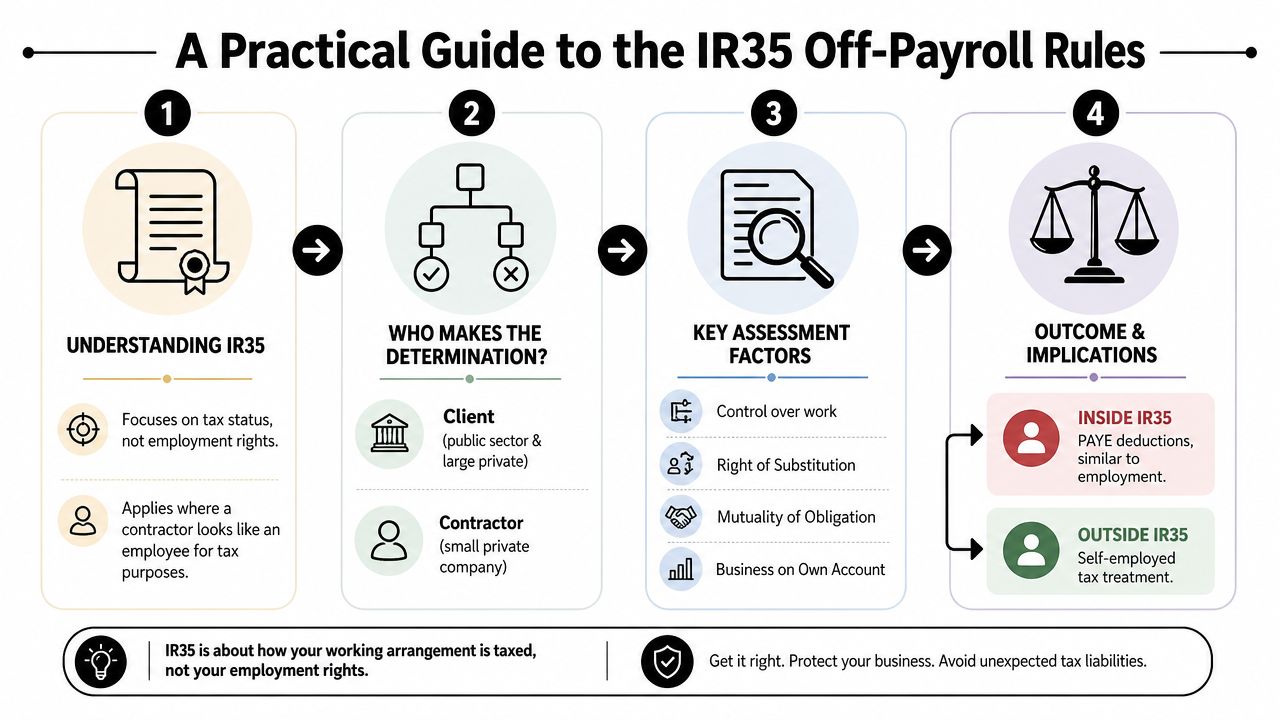
IR35 sits in the tax world, not the employment rights world.
That distinction matters. You can spend hours reading about employee versus worker status and still feel lost if the key question is whether your limited company engagement is treated like employment for tax purposes.
A fuller background is available in our guide to IR35 for contractors.
What IR35 is really asking
IR35 looks at whether, if your intermediary were removed from the chain, the underlying relationship would resemble employment for tax purposes.
The same practical indicators keep appearing. Under the UK off-payroll working rules, status is determined by the actual working practices, and HMRC and the courts place heavy weight on control, substitution, and mutuality of obligation. When a contractor is inside IR35, the fee payer must typically deduct income tax and employee NICs before payment (explained here).
That means a beautifully drafted contract won't rescue a badly structured engagement if daily working life points the other way.
Inside and outside IR35
Here's the simplest practical difference:
| IR35 outcome | What it usually means |
|---|---|
| Inside IR35 | The role is treated more like employment for tax purposes, and deductions are typically made before payment |
| Outside IR35 | The engagement is treated more like a genuine business-to-business service arrangement for tax purposes |
This video gives a quick overview before you review a contract in detail.
Where contractors get caught out
The biggest misunderstanding is assuming IR35 depends on a sentence in the contract. It doesn't.
The more reliable approach is to test the whole arrangement:
- Who directs the work: outcome-based brief or day-to-day supervision?
- Who bears the operational risk: are you delivering a service, or filling a seat?
- Can you work independently: or are you managed like internal staff?
- Does the actual project match the paperwork: because that's what will matter if the arrangement is questioned
If you hear “outside IR35” but the client expects fixed attendance, personal service, internal line management, and continuing availability, treat that as a warning sign rather than reassurance.
How Umbrella Companies Work and Protect You
For many contractors, the cleanest answer to status complexity is to work through an umbrella company.
In that model, the umbrella company employs you. The client or agency still receives your work, but the umbrella handles payroll and employment administration. Instead of trying to operate as a separate business for that assignment, you're paid through PAYE as an employee of the umbrella.
Why that can reduce stress
This setup changes the practical experience of contracting in a few useful ways.
- PAYE is handled for you: tax and National Insurance are processed through payroll.
- Employment rights are clearer: you're employed by the umbrella, so statutory rights linked to that employment relationship are easier to understand.
- Administration is simpler: invoices, payslips, and payroll deductions are usually centralised.
- Continuity can help: moving between assignments may be more straightforward than repeatedly changing your tax setup.
If you want a plain-English breakdown of the model, this guide on how an umbrella company works is a useful next step.
Why provider choice matters
Not every umbrella arrangement is equally safe.
The UK government has been consulting on stronger regulation of umbrella companies because current structures can obscure who is accountable for tax and worker rights. That makes it more important to understand how recent enforcement and policy changes affect the practical risk of working through an umbrella (discussed here).
That's why due diligence matters. Before joining any provider, check the basics carefully:
- Accreditation: look for recognised compliance review schemes such as FCSA or Professional Passport
- Payslip transparency: make sure deductions are clearly explained
- Scheme claims: be cautious if a provider talks about unusually high take-home pay through complex arrangements
- Contract clarity: understand who employs you, who pays you, and who handles holiday pay
Umbrella Company provides a comparison service that helps contractors review umbrella providers by role and IR35 needs, which can be useful when you want to compare options rather than rely on a single recommendation.
A compliant umbrella should make your position easier to understand, not harder.
How to Assess Your Contract and Working Practices
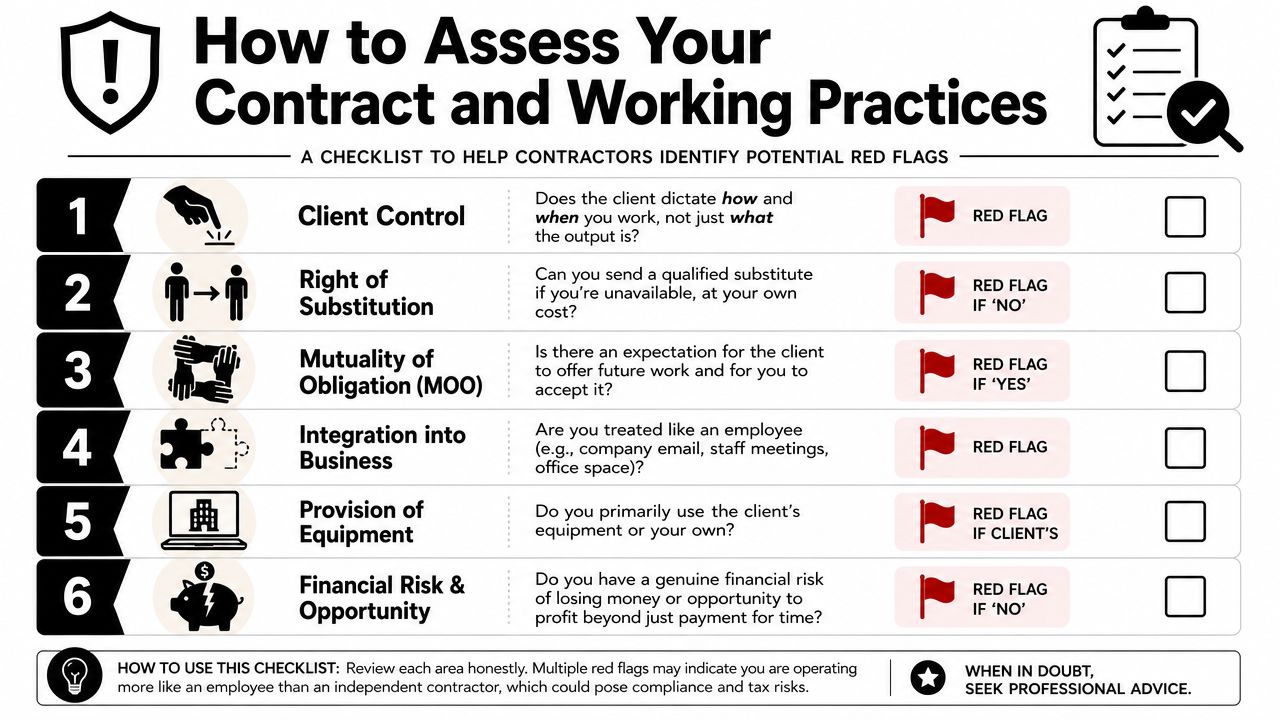
The practical implications of contractor employment law emerge. Before you accept a role, review both the written contract and the likely day-to-day reality.
HMRC guidance says employment status depends on the reality of the relationship rather than the label. The most useful question isn't “what does the contract call me?” but “what facts would an outsider notice if they watched this engagement for a week?” (summarised here).
Red flags to review before signing
Use this checklist as a self-audit.
- Control over your day: Does the client decide not just what needs doing, but exactly how, when, and where you must do it?
- Personal service expectation: If you were unavailable, could you provide a qualified substitute, or is the client clearly hiring you as an individual worker?
- Ongoing obligation: Does the role sound project-based, or does it sound like the client expects to keep feeding you work indefinitely?
- Integration into the business: Will you be treated like internal staff, with team meetings, line-manager style supervision, staff systems, or standard employee processes?
- Equipment and setup: Are you using your own equipment and methods, or mainly relying on the client's environment in the same way an employee would?
- Financial risk: Do you carry any meaningful business risk, such as fixing issues at your own cost or managing delivery commercially?
What borderline roles often look like
Some roles are obvious. Others aren't.
A borderline role often includes mixed signals. The contract might mention independence, but the client still expects fixed attendance. You might invoice through a company, but the actual assignment looks like a staff position with a contractor label attached.
Here are common warning phrases and what they can mean:
| Contract wording or behaviour | Why it can matter |
|---|---|
| “You'll report to the team manager daily” | Points towards control |
| “You must personally perform the services” | Weakens substitution |
| “Hours are aligned with the permanent team” | Can suggest employee-like integration |
| “Extensions are expected if business needs continue” | May raise mutuality concerns |
Keep records of what actually happens at work. If the contract says one thing and the client operates differently, the real working practice is what matters most.
What to do if a role feels wrong
Don't panic, but don't ignore the signs either.
Start by asking direct questions before you sign. Ask who controls hours, whether attendance is mandatory, whether a substitute could be used in practice, and whether the role is tied to a defined deliverable or an open-ended business need.
If you manage teams, agencies, or supply chains, understanding the ROI of contractor management can also help you spot where weak onboarding and poor role design create avoidable status risk for everyone involved.
Then keep evidence. Save the contract, the role description, key emails, and any messages that show how the work is being organised. If the engagement looks much more like employment than contracting, taking advice early is usually far easier than untangling the issue later.
Key Takeaways for UK Contractors in 2026
The clearest lesson in contractor employment law is also the easiest to remember. Reality beats labels.
If a role is advertised as contract work but the client controls your time closely, expects personal service, and treats you like part of the permanent workforce, the legal and tax analysis may move away from genuine independence. That's why reviewing the actual working pattern matters just as much as reading the contract.
A second takeaway is that IR35 is a tax question, not a full answer to employment rights. Contractors often blend these issues together, but it's safer to separate them in your mind. One question asks what rights may apply. Another asks how the engagement is taxed.
Third, compliant partners matter. If a role sits inside IR35 or feels difficult to structure safely through a limited company, an umbrella arrangement can provide a clearer PAYE route. The important part is choosing carefully, understanding deductions, and avoiding any setup that sounds opaque or too clever.
If you're reviewing a new assignment, keep your process simple:
- Read the contract for warning signs
- Test actual working practices
- Check whether the payment model matches the reality
- Ask questions before you start, not after there's a dispute
Contracting can still be flexible, rewarding work. It just works best when you understand the rules well enough to spot risk early and choose a setup that fits the engagement.
If you'd like a practical next step, Umbrella Company helps contractors compare umbrella options and review support for different working arrangements, including roles that sit inside IR35.


