


A payment dispute rarely starts with a dramatic email. It usually starts with something smaller. A timesheet sits unapproved for too long, a remittance advice looks different from last month, or the agency says the client hasn't released funds yet while your umbrella says it can only pay what it has received.
That uncertainty is what makes contractor dispute resolution so stressful. You may have done the work, submitted the paperwork, and still find yourself chasing three different businesses for one clear answer.
We see this often in UK contracting, especially where an end client, recruiter, and umbrella company all sit in the same payment chain. The practical problem isn't just non-payment. It's proving who agreed what, who holds the money, and who is responsible for fixing it.
Your Guide to Navigating Contractor Disputes
If you're dealing with your first dispute, keep one point in mind. Don't start by arguing harder. Start by organising better.
Most disputes become expensive because the contractor reacts before they have a clean record of the facts. A calm timeline, the right documents, and a clear escalation path usually do more than a long emotional message ever will.
This is particularly important if you work through an umbrella arrangement or an agency model, where contractual responsibility and payment administration can sit in different places. If you need a clearer view of how those relationships tend to work in practice, our guide to contracting in business is a useful starting point.
What usually works
The strongest approach is simple:
- Identify the true issue first, whether that's a late payment, disputed deduction, missing holiday pay, rejected timesheet, or scope change.
- Build a paper trail early, before anyone's memory starts shifting.
- Use a staged response, beginning with direct contact and only escalating when you have to.
- Match your route to the dispute, because a payslip issue, an employment status problem, and a construction adjudication are not the same thing.
Practical rule: Treat every dispute as if an outsider may later need to understand it from your documents alone.
What tends to fail
A few habits make matters worse:
- Calling repeatedly without following up in writing
- Accepting vague answers, such as “finance is looking into it”
- Mixing separate issues together in one complaint
- Threatening legal action too early without evidence or a clear demand
Contractor dispute resolution in the UK usually rewards the party who can show what happened, when it happened, and what resolution was requested. That's what we'll focus on throughout this guide.
Recognising the Early Signs of a Dispute
Most payment disputes give warning signs before they become formal. The problem is that contractors often explain them away because they don't want to look difficult, especially on a live assignment.
That hesitation is understandable, but it can cost you. In the UK, the Employment Agency Standards Inspectorate opened 1,771 investigations in 2023/24 and recovered £1.4 million for workers, according to reporting cited in this summary on dispute prevention and enforcement activity. That matters because it shows disputes over pay, deductions, and agency practices are significant enough to require formal intervention.

Red flags in the payment chain
In agency and umbrella arrangements, the earliest warning signs often look administrative rather than legal.
- Different figures in different places. Your contract, rate confirmation, timesheet total, remittance advice, and payslip should broadly line up. If they don't, ask why immediately.
- Unexplained deductions. If a deduction appears without a clear itemised explanation, don't assume it will be corrected next payroll.
- Changing explanations from different parties. The agency blames the client, the umbrella blames missing approval, and no one gives you one written account.
- A sudden slowdown in replies. People who were responsive during onboarding sometimes become vague once money is disputed.
- Verbal approval of extra work without written confirmation of the rate, scope, or authoriser.
Scope problems often become payment problems
This happens a lot in project work. A client asks for “just one more deliverable” or extends a piece of work informally. You complete it, but nobody updates the statement of work, purchase order, or variation approval.
That gap becomes the dispute. Not because the work wasn't done, but because the paperwork no longer matches the actual situation on the job.
Information gaps create many disputes before anyone openly refuses to pay.
What to do at the first sign
When you notice a pattern, don't wait for payday to confirm your suspicion. Start a dispute file on the same day.
Create one folder and save:
- Your signed contract
- Assignment schedule or statement of work
- Rate confirmation
- Timesheets and approvals
- Invoices or remittance advice
- Payslips
- Emails or messages confirming changes
If the dispute later widens, you won't need to reconstruct events from memory. You'll already have the backbone of your case.
Effective Communication and Evidence Gathering
When payment goes wrong, your first job is to make the record stronger than the argument. Courts and advisers don't work from frustration. They work from documents.
UK best practice also favours a staged process. Direct negotiation is usually the first step because it's faster, cheaper, and more likely to preserve a working relationship. Courts can penalise parties who unreasonably refuse Alternative Dispute Resolution, as explained in this guide to staged contractor dispute resolution and ADR expectations.
Build a usable evidence pack
A folder full of random emails isn't enough. You need a pack that tells a clear story.
Include these in order:
Core contract documents
Signed contract, key schedules, rate confirmation, assignment details, and any later amendments.Performance records
Approved timesheets, deliverables sent, meeting notes, acceptance emails, and work logs.Payment records
Invoices, remittance advice, payslips, deduction breakdowns, and bank statements showing what was or wasn't paid.Dispute timeline
A one-page chronology with dates, people involved, and the exact issue at each stage.
If you want a more forensic approach to preparing records, these financial documentation tips for litigators are useful because they show how professionals structure evidence for review, rather than just storing paperwork.
Keep your message short and specific
A good dispute email does three things. It states the problem, attaches the evidence, and asks for a deadline-based response.
Here's a simple first follow-up you can adapt.
Subject: Payment query for assignment [reference]
Hello [name],
I'm writing regarding payment for work completed on [date or period]. My understanding is that [brief statement of agreed rate, approved time, or expected payment].
I've attached the relevant documents, including [timesheet / remittance / payslip / rate confirmation]. Please confirm by [date] whether payment will be made, or explain in writing what is preventing release of funds.
If another party in the chain needs to respond, please identify them clearly and confirm who owns resolution of this issue.
Regards,
[Your name]
That last sentence matters in umbrella and agency disputes. It forces the recipient to stop hiding behind the chain and name the responsible party.
When informal contact fails
If your reminder is ignored or answered vaguely, move to a more formal written demand. Don't make it aggressive. Make it precise.
Formal letter before action template
Dear [name],
I refer to my previous correspondence regarding the unpaid / disputed sum of [amount, if known]. The basis of my claim is as follows:
- work carried out during [period]
- approval or acceptance confirmed by [document or email]
- payment due under [contract / assignment / agreed terms]
Despite earlier requests, the matter remains unresolved. Please treat this as a formal request for payment or a full written response explaining the legal and contractual basis for non-payment or deduction.
Unless I receive a satisfactory response by [date], I will consider further action through the appropriate dispute resolution route.
Yours sincerely,
[Your name]
Good records start before the dispute
Many contractors only think about paperwork once something goes wrong. It's better to tighten your documents at the contract stage. A sensible starting point is a well-structured freelance contract template for UK contractors, then adapt it to the actual assignment and payment chain.
The practical standard is simple. If someone new picked up your file tomorrow, they should be able to understand the dispute in ten minutes.
Navigating Internal Escalation Paths
A lot of contractor disputes get stuck because the contractor contacts the wrong party first. In a simple direct client arrangement, that's manageable. In an agency and umbrella structure, it creates delay.
Here's the usual reality. The end client approves work and controls project-side acceptance. The agency often manages the commercial relationship and invoices the client. The umbrella company processes payroll and issues payslips based on the information and funds it receives. If one link breaks, each party may say the problem sits elsewhere.

A practical escalation ladder
Start with the party closest to the immediate issue, but copy in others when responsibility is unclear.
Timesheet not approved
Contact the client-side manager or named approver first. Ask for written confirmation of approval status.Agency says payment is pending
Ask the agency to confirm whether it has invoiced the client, whether payment has been received, and whether any dispute has been raised.Payslip or deduction issue
Raise it with the umbrella payroll or compliance team, with the relevant remittance advice and payslip attached.Conflicting answers
Send one consolidated email to all relevant contacts with a bullet-point timeline and a direct request for one named owner of the issue.
A realistic example
A contractor submits a weekly timesheet on Friday. The client manager verbally confirms everything is fine. Monday passes with no approval notification. On Tuesday, the agency says it can't invoice without sign-off. On Wednesday, the umbrella says payroll cut-off has passed.
The mistake many people make at this point is firing off separate complaints to everyone. A better move is one controlled escalation email:
- state the week worked
- attach the submitted timesheet
- note the verbal approval
- ask the client to confirm approval status in writing
- ask the agency whether invoicing has been raised
- ask the umbrella whether payment can be included in the next payroll once confirmed
That kind of message creates accountability. It also exposes whether the issue is approval, invoicing, or payroll timing.
Working rule: If three parties are involved, your email should separate approval, invoicing, and payroll into three distinct questions.
What to ask each party
Don't ask, “Can you sort this?” Ask questions they can answer clearly.
For the client:
- Was the work accepted
- Who has authority to approve it
- Was any concern raised about quality, time, or scope
For the agency:
- Have you invoiced the client
- Has payment been received
- Is there any hold, dispute, or missing document
For the umbrella:
- What gross amount was received
- What deductions were applied
- What document explains the calculation
Once internal escalation starts going in circles, it's time to look at formal external routes.
External Dispute Resolution Routes in the UK
Friday's work was signed off by the client manager. The agency says it is still waiting to invoice. The umbrella says it cannot run payroll without cleared funds. At that point, the dispute is no longer just “someone has not paid me.” It is a payment-chain problem, and the right external route depends on where the blockage sits.
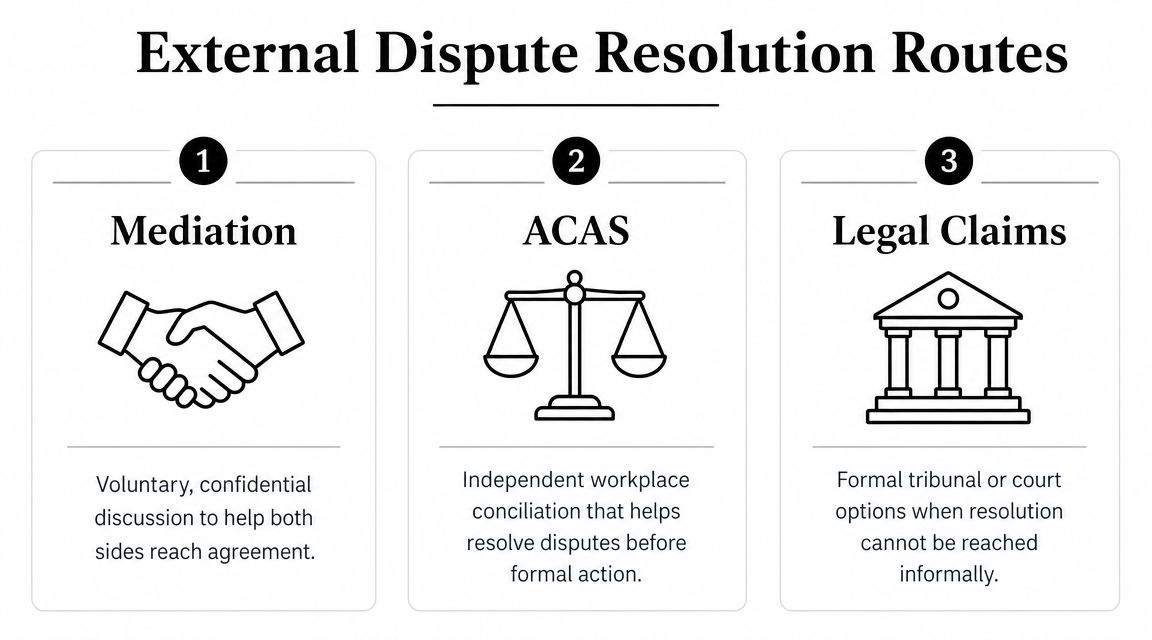
Before choosing a forum, identify the legal relationship in dispute. Is the argument with the end client over approval, with the agency over invoicing and contract terms, or with the umbrella over payroll, deductions, or employment rights. Contractors lose time and money by issuing the right complaint to the wrong party.
Mediation
Mediation works well where nobody wants a public fight and the facts are disputed rather than cleanly proved. In agency and umbrella arrangements, that often means one party accepts the work was done but blames delay elsewhere in the chain.
A mediator does not decide who is right. The job is to get all decision-makers into one process and push the parties toward a settlement they can live with. That can be useful where each business controls only part of the payment path and no single email thread has forced a clear answer.
Use mediation where:
- The dispute involves blame being passed between client, agency, and umbrella
- You want payment, correction, or a practical timetable rather than a formal ruling
- The amount in dispute does not justify full litigation
- You may still need references, future work, or a clean commercial exit
Mediation is usually faster and less damaging to working relationships than court. It still takes preparation. Bring the contract chain, timesheets, approval evidence, remittance records, and a short chronology. If one party attends without authority to settle, the session often goes nowhere.
ACAS Early Conciliation
ACAS matters when the dispute may fall into employment territory. That is common with umbrella arrangements, where a contractor may be an employee of the umbrella for payroll purposes even though the assignment sits with an agency and work is delivered to the end client.
If the complaint is about unpaid holiday pay, unlawful deductions, payslip issues, or other employment rights, ACAS Early Conciliation may be the proper route before any tribunal claim. If the complaint is that the agency has not paid under a business contract, ACAS may not help. The hard part is that some contractor disputes contain both elements.
That split should be checked early. A payment argument can start as a missing timesheet issue and turn into a dispute about who employed you, who was entitled to deduct what, and which deadlines apply.
Small claims and other court claims
Court is usually the practical route where the claim is a defined sum, your documents are in order, and the defendant is identifiable. In contractor payment-chain disputes, that last point matters more than people expect. You need to sue the party that owes the money under the contract or employment arrangement, not the party that feels most responsible.
A court claim tends to fit cases like these:
- The agency accepted the invoice terms and has not paid
- The umbrella received funds but there is a dispute over deductions or withheld sums
- The other side has stopped engaging and you need an enforceable result
- The documents show a clear debt rather than a wider argument about performance
Small claims can look cheaper on paper, but time, preparation, and stress still count. If the contract wording is messy, or if several parties may each blame the other, a claim can become more complicated than the amount suggests.
Adjudication for construction contracts
Construction disputes follow a different route. Adjudication is commonly used for payment and valuation disputes because it produces a quick, temporarily binding decision and keeps cash moving. A practical explanation of the process is set out in Fenwick Elliott's introduction to adjudication basics.
That speed cuts both ways. If your notice is weak, your records are incomplete, or the claim is aimed at the wrong contractual party, adjudication can expose those problems very quickly. It is powerful, but it is not forgiving.
UK Contractor Dispute Resolution Routes at a Glance
| Route | Best For | Typical Cost | Typical Timeline | Outcome |
|---|---|---|---|---|
| Mediation | Multi-party commercial disputes where settlement is still realistic | Mediator fees and preparation costs vary | Often quicker than court if parties engage properly | Binding only if a settlement is signed |
| ACAS Early Conciliation | Employment rights disputes, especially in umbrella arrangements | Usually low-cost compared with formal litigation | Depends on the parties and the issues raised | Binding only if a settlement is reached |
| Small claims or court claim | Clear debt or contract claims against the party that legally owes payment | Court fees, preparation time, and possible legal costs | Slower and more formal than mediation | Binding court judgment |
| Adjudication | Construction payment disputes needing a rapid interim decision | Preparation still costs money, even on a fast timetable | Commonly very fast | Temporarily binding decision |
Choosing the right route
Start with the question, “Who owes what to whom, under which agreement?” That discipline matters in the agency and umbrella model because one dispute can involve three contracts and three different explanations.
Choose the route that matches the legal issue:
- Mediation suits multi-party deadlock where a commercial solution is still possible.
- ACAS suits disputes with a real employment-rights element, especially around umbrella payroll and deductions.
- Court claims suit clear debt or breach cases where you need judgment and enforcement.
- Adjudication suits qualifying construction disputes where speed matters more than perfect finality.
Insurance can also affect your options. Before issuing a claim, check whether you have legal expenses or related cover under your contractor insurance in the UK arrangements.
The route matters. Naming the right respondent matters more.
When to Seek Professional Legal Advice
The first solicitor's letter usually lands after weeks of mixed messages. The agency says the end client has not released funds. The umbrella says it can only process what it receives. You are left trying to work out whether the actual problem is non-payment, a disputed timesheet, a status issue, or a contract term you did not focus on when the assignment started.

That is the point to stop relying on instinct. In straightforward disputes, careful records and a firm paper trail can carry you a long way. In payment-chain disputes, legal advice often pays for itself because the first job is identifying the right target, the right contract, and the right remedy.
Construction adjudication is a good example of why early legal input matters. The process is built for speed and interim enforceability. If your dispute falls into that territory, weak drafting, the wrong responding party, or a missed notice point can put you on the back foot before the merits are tested. The principle is often described as pay now, argue later. That speed helps cash flow, but it leaves little room to correct basic errors.
Get advice early if any of the following applies:
The payment chain is unclear
If the client approved the work, the agency issued the contract, and the umbrella handled payroll, do not assume the party causing the delay is the party that legally owes you money.The contract documents do not line up
A schedule says one thing, the agency terms say another, and the assignment confirmation says something else. That usually needs a legal reading, not a hopeful one.You have received formal legal papers
A letter before action, adjudication notice, tribunal response deadline, or court form changes the position immediately. Delay becomes expensive very quickly.Employment status, tax, or payroll treatment is part of the dispute
This comes up often in umbrella arrangements where payment arguments overlap with deductions, holiday pay, or status questions. Before speaking to a solicitor, it helps to review the contractual structure around IR35 and contractors.The amount at stake would cause real business pressure
If the unpaid sum affects rent, tax liabilities, subcontractor costs, or your ability to keep taking work, treat it as a legal risk issue, not just an admin problem.
A good solicitor does more than draft a threat letter. They test whether your claim is against the agency, the umbrella, or another party in the chain. They also tell you when to settle, when to press for disclosure, and when a quick commercial deal is better than spending months chasing a point you may win only on paper.
Cost still matters. Legal advice is not cheap, and full representation can outweigh a smaller claim. But a short paid review of your contracts, emails, timesheets, invoices, and notices is often enough to stop a bad decision. I have seen contractors lose their advantage because they argued with the wrong company for three months.
If you are also reviewing wider exposure around claims and defence costs, this guide to commercial insurance for client lawsuits is a useful companion read.
Here's a short explainer that helps many contractors understand when specialist support becomes worth the cost.
A short consultation can save weeks of pursuing the wrong route.
Contractor dispute resolution is stressful enough without guessing who is responsible. Clear advice, taken early, helps you protect cash flow, avoid procedural mistakes, and focus your effort on the party that carries the legal obligation.
If you're reviewing an umbrella arrangement, comparing providers, or trying to understand where responsibility sits before your next contract starts, Umbrella Company can help you assess your options and make the payment chain clearer from day one.


