


Trying to figure out your take-home pay as a contractor can often feel like a guessing game, but our contractor calculator outside IR35 is designed to give you clarity. This guide explains how to forecast your earnings, what numbers you need, and how to avoid common mistakes. When you operate outside IR35, you are recognised as genuinely self-employed, which can unlock significant financial upsides compared to a standard PAYE job.
How to Forecast Your Earnings Outside IR35

Getting a solid grip on your potential earnings is the first step towards financial confidence as a contractor. When your contracts land outside IR35, you are running a proper business, usually through your own limited company. This setup opens the door to much more tax-efficient income planning than being 'inside IR35', where you are essentially taxed just like an employee.
The purpose of the IR35 legislation, first introduced in 2000, was to clamp down on 'disguised employment'. This is where contractors act like employees but enjoy a lower tax bill. For those of us who are genuinely outside IR35, the tax savings can be substantial, often ranging from 20-30% of gross earnings. That is a massive boost to your net income.
To help you understand it, let's break down the key financial points you need to know:
- Corporation Tax: This is the tax your limited company pays on its profits before you take your money out.
- Dividends: This is the common, tax-efficient method for drawing profits from your company after paying yourself a small salary.
- Business Expenses: These are the legitimate costs you can claim back to reduce your company's profit and, therefore, its tax bill.
Of course, to make the most of your outside IR35 status, you need a steady stream of well-paid contracts. It is a competitive world out there, so strategies like optimizing your LinkedIn profile to secure new contracts are more important than ever.
The idea here is to demystify these concepts before you punch numbers into a calculator. Once you understand how they fit together, you can see why running a limited company the right way leads to much healthier take-home pay.
If you want to see a direct comparison of the numbers, our inside vs outside IR35 calculator is the perfect tool to experiment with.
Getting Your Ducks in a Row for an Accurate Calculation
Any good forecast starts with good data. Before you plug numbers into a contractor calculator outside IR35, it is crucial to have your key financial details lined up. Think of it like a chef preparing ingredients, a bit of groundwork now makes the final result far more reliable.
Taking a few minutes to gather this information does not just make the process quicker; it ensures the figures you see are a realistic reflection of what you will actually take home. Your headline day rate is just the start of the story.
The Key Numbers You'll Need
To get a truly dependable financial picture, you will need more than just a back-of-the-envelope guess. Having these details handy will make our calculator a powerful tool rather than just a toy.
Here is a simple checklist of what to pull together:
- Your Contract Day Rate: This is the gross figure you will be billing your client daily. If you are struggling to land on a number, our guide on using a contractor daily rate calculator is a great place to start your research.
- Contract Length and Billable Days: Be honest with yourself here. Do not just multiply your day rate by 365. You need to account for public holidays, your own planned holidays, and a buffer for sick days or that inevitable downtime between projects.
- Allowable Business Expenses: Jot down a list of the legitimate business costs you expect to incur. This usually includes items like professional indemnity insurance, accountancy fees, essential software subscriptions, or business travel.
- Pension Contributions: Have you decided how much you are putting into a personal or company pension? Have that figure ready. It is one of the most tax-efficient moves a contractor can make.
- Director's Salary: You will need to decide on the small, tax-efficient salary you plan to pay yourself from your limited company. Most contractors set this at or near the National Insurance threshold.
Factoring in non-billable days from the get-go is what turns a vague estimate into a solid financial forecast. It is probably the single most important step for avoiding nasty surprises down the line.
Once you have these details, you are not just guessing anymore. You are building a clear and dependable projection of your take-home pay, which is essential for proper financial planning.
A Practical Breakdown of Your Take-Home Pay
Right, let’s crunch the numbers. Knowing exactly where your money is going is the key to financial control, so we will walk you through a proper calculation to show how your take-home pay works when you are outside IR35. This is not just theory; it is a real-world look at how your gross earnings are reduced to what you actually keep.
To make it tangible, let's use a standard scenario: a contractor on a £500 day rate. We will follow the money from the initial invoice right through to the funds landing in your bank account.
From Gross Income to Company Profit
Everything starts with the total amount you invoice your client. If we assume you work a fairly typical 44 weeks a year (which is 220 days), the first number is easy enough to work out.
- Gross Annual Income: £500 (day rate) × 220 (working days) = £110,000
From this top-line figure, you need to subtract your legitimate business expenses and the director's salary you pay yourself. Let’s say you have £5,000 in annual business expenses and draw a tax-efficient director's salary of £12,570 (matching the 2024/25 personal allowance).
- Taxable Company Profit: £110,000 (Gross Income) – £5,000 (Expenses) – £12,570 (Salary) = £92,430
This £92,430 is your company's profit, and it is the figure HMRC will use to calculate your Corporation Tax bill.
This handy flowchart gives you a visual on how your gross income is reduced by various deductions before you get to your final take-home figure.
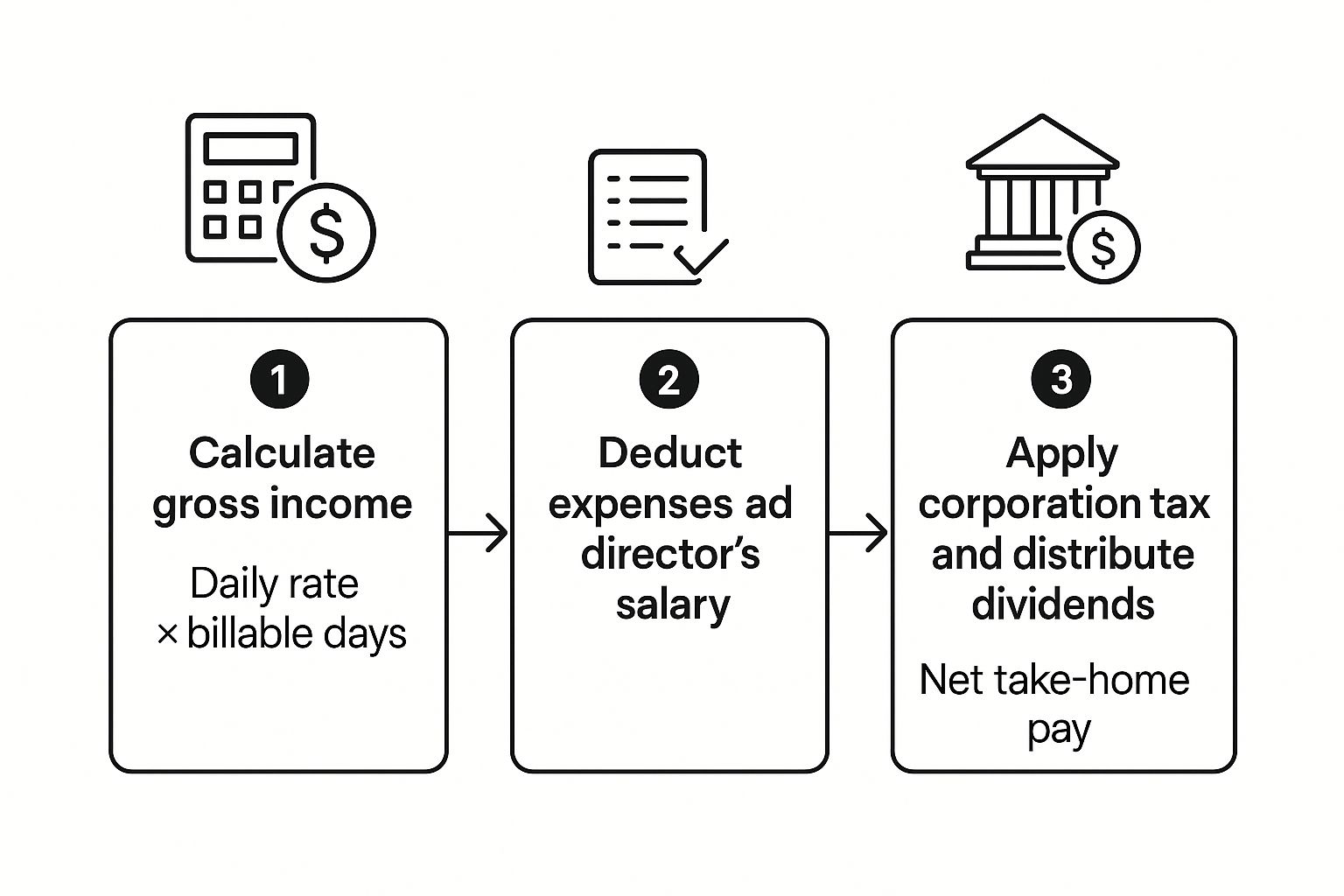
It is a good reminder that your gross contract value goes through several stages of deductions, including business costs and multiple taxes, before it becomes your net income.
Example Outside IR35 Calculation for a £500 Day Rate
To pull all of this together, here is a simplified table that walks through the key stages of the calculation. It clearly shows how we get from the initial £110,000 gross income down to the final net pay.
| Calculation Stage | Description | Example Amount (£) |
|---|---|---|
| Gross Annual Income | £500/day for 220 days | £110,000 |
| Business Expenses | Legitimate costs claimed against the company | – £5,000 |
| Director's Salary | Tax-efficient salary up to personal allowance | – £12,570 |
| Taxable Profit | The amount liable for Corporation Tax | £92,430 |
| Corporation Tax | Calculated at the main rate of 25% | – £23,107.50 |
| Funds for Dividends | Profit remaining after Corporation Tax is paid | £69,322.50 |
| Total Personal Income | Salary + Dividends (before personal taxes) | £81,892.50 |
| Estimated Net Pay | Final take-home after personal dividend tax | ~ £78,000 |
This example gives you a clear, step-by-step look at the financial journey from gross revenue to the money in your pocket, illustrating the impact of taxes and expenses along the way.
Calculating Your Final Take-Home Pay
Now we tackle the Corporation Tax on your company’s profit. With the main rate currently at 25%, the maths is straightforward.
- Corporation Tax Due: £92,430 × 25% = £23,107.50
After paying that, the amount left in the company pot is £69,322.50 (£92,430 – £23,107.50). This is what is available for you to take out as dividends. Add that to your salary, and your total potential income before any personal tax is £81,892.50. Once you factor in your personal tax on those dividends, the final figure you get to keep becomes much clearer.
The difference in earnings can be striking. A contractor with a £500 daily rate working 220 days a year outside IR35 could expect a net income around £78,000 post-tax. Compare that to roughly £52,000 for the same contract inside IR35, and you see why getting the status right is so crucial. For more on the official definitions, you can always check the government's employment status guidance.
Doing this manually is a great way to understand the mechanics, but for a quick and accurate answer, your best bet is to plug your own numbers into our IR35 take-home calculator. It does all the heavy lifting and accounts for all the current tax thresholds in an instant.
Using the UmbrellaCompany.com Calculator
While it is useful to know how to calculate your take-home pay manually, it can be a chore. That is why we built our own contractor calculator outside IR35 to make the whole process quick and completely painless. We designed it to take all the guesswork out of your financial planning.
Our tool gives you a simple, visual guide on where to pop in your day rate, any business expenses you have, and pension contributions you plan to make. Crucially, we keep it constantly updated with the latest tax and National Insurance rates directly from HMRC. You can trust the results to be accurate and compliant.
Get Instant Financial Clarity
The real benefit here is the time you save and the confidence you get from avoiding simple manual errors. In just a few seconds, you get a reliable snapshot of your finances. All you need to do is enter your details to see a clear projection of what you will actually earn.

As you can see from the screenshot, the interface is very simple. It is all about quick data entry so you can get an instant take-home pay estimate without any fuss.
The goal of any good financial calculator is to provide a clear forecast based on the numbers you put in. This idea is not unique to contracting. For instance, understanding the mechanics of using a forex trading profit calculator shows how different variables can impact potential returns, a concept that is just as relevant when you are trying to project your contractor income.
By using our tool, you can assess new contract offers with real confidence and plan your finances for the year ahead.
Ready to see your numbers? You can try our reliable umbrella company calculator today for an instant and accurate picture of your potential take-home pay. It is a simple step that removes a huge amount of uncertainty, empowering you to make genuinely informed decisions about your contracts and your financial future.
Common Mistakes to Avoid in Your Forecasts

A small slip-up when using a contractor calculator outside IR35 can quickly spiral into a major financial headache, or worse, draw unwanted attention from HMRC. We have seen it happen. Knowing the common pitfalls that contractors fall into when forecasting their pay is vital for running your limited company with confidence.
One of the most frequent errors we see is simply underestimating the taxman's cut. It is easy to get fixated on your day rate, but forgetting to earmark enough cash for Corporation Tax and the tax due on your dividends will give you a nasty shock when the bill lands. Proper planning means that money is already sitting in a separate account, ready to go.
Industry reports have shown just how big the gap can be. Miscalculating your liabilities can completely wipe out the financial perks of working outside IR35. For a contractor on a £400 day rate, getting caught inside IR35 can slash their net income by around 40%. That is a huge shortfall, which is why accurate forecasting is so critical.
Overlooking Business Realities
Another classic mistake is being too optimistic about how much you will actually be working. If you do not account for holidays, the odd sick day, or those inevitable quiet spells between contracts, you end up with a financial plan that is pure fantasy. A solid forecast is grounded in reality, not just a best-case scenario.
Mishandling business expenses is just as risky. This tends to go one of two ways:
- Overclaiming expenses: Trying to claim for costs that are not ‘wholly and exclusively’ for your business is a massive red flag for HMRC and can land you in serious trouble.
- Poor record-keeping: If you do not have detailed receipts and invoices for everything, you have no leg to stand on if HMRC decides to investigate your claims.
By getting ahead of these common mistakes, you are no longer just guessing at your income, you are actively managing your finances. It is a proactive approach that does not just improve your forecast's accuracy; it gives you far greater peace of mind throughout the year.
Answering Your Burning Questions on Contractor Pay
When you are navigating the world of contracting, it is only natural that a few financial questions pop up. Let's tackle some of the most common queries we hear from contractors operating outside IR35 to give you a bit more clarity.
What Sort of Expenses Can I Actually Claim?
The golden rule from HMRC is that allowable business expenses must be 'wholly and exclusively' for your business. It is a simple phrase, but it is the bedrock of legitimate claims.
So, what does that cover in the real world?
- Professional indemnity insurance: An absolute must for most contractors.
- Fees from your accountant or solicitor: The cost of getting professional advice.
- Home office costs: A proportionate amount of your household bills if you work from home.
- Essential kit and learning: This includes software, relevant training courses, and professional subscriptions.
- Business travel: Journeys made purely for work purposes.
The key is to keep meticulous records. Every receipt, every invoice, hold onto it. This is not just good practice; it is your evidence if HMRC ever comes knocking.
How Often Should I Run the Numbers on My Take-Home Pay?
Think of it this way: checking your forecast is just good financial housekeeping. We always recommend using a contractor calculator outside IR35 whenever a new contract lands on your desk. It is the quickest way to see if the rate is genuinely viable for you.
It is also a smart move to do a fresh calculation at the start of every tax year. Tax and National Insurance rates can (and do) change, so this ensures your projections are based on the latest figures. A quick check-in every quarter can also keep you on track with your savings goals and tax planning.
Online calculators are fantastic for getting a solid estimate and for planning ahead. But remember, they are a guide. They cannot replace a proper chat with a qualified accountant who understands your individual financial situation.
Can I Trust Online Contractor Calculators?
A good quality online tool, like the one we have built here at UmbrellaCompany.com, is a highly reliable way to get a snapshot of your potential earnings. We make it our business to keep our calculators completely up-to-date with the latest UK tax and National Insurance thresholds.
Their real value is giving you a dependable estimate in seconds, helping you make informed decisions without the guesswork. It cuts out the risk of a simple miscalculation and gives you a solid base for your financial planning.
Ready to get a real handle on your contracting finances? The team at UmbrellaCompany.com has the tools and expertise to help you compare compliant solutions and maximise your earnings with confidence. Explore our services at umbrellacompany.com.


