


You've just been offered a new contract. Then the paperwork lands in your inbox and one line jumps out: “Please provide evidence of Public Liability and Professional Indemnity insurance before start date.”
That's the moment many contractors realise insurance isn't just background admin. It can decide whether you start work on time, renegotiate terms, or lose the contract entirely. It also gets confusing fast, especially if you're asking a very sensible question: do I need my own contractor business insurance, or does my umbrella company already cover this?
A lot of contractors mix up three different things. Legal requirements. Client requirements. And sensible protection for the way they work. They aren't the same, and treating them as if they are is where expensive mistakes begin.
If you're juggling contracts, timesheets, expenses and compliance, it helps to get the admin side organised too. Strong practical financial workflows make it easier to keep policy documents, certificates and contract paperwork in one place, especially when a client asks for proof at short notice.
For contractors who are still deciding how to operate, our guide to contracting in business is a useful starting point alongside the insurance side.
Why Contractor Insurance Is More Than Just a Box-Ticking Exercise
You win the contract, send over your company details, and then the client asks for insurance certificates before they will issue a start date. That request often feels administrative. In practice, it is closer to a gate on the job. If the paperwork is wrong, missing, or in the wrong name, the contract can stall before any work begins.
That point catches contractors out because insurance does two jobs at once. It protects you if a claim lands. It also proves to a client, agency, or procurement team that your business is set up in a way they can work with.
The part many people miss is who "you" are in the contract chain.
If you trade through your own limited company, the client is usually checking the insurance held by that company. If you work through an umbrella, the legal setup is different. The umbrella is normally the employer and may hold certain policies for the work done under its arrangement. Those are not interchangeable positions. A certificate in an umbrella company's name does not automatically satisfy a contract issued to your limited company, and a policy bought by your company does not answer every question if you are working as an umbrella employee.
That is why insurance should match your trading setup, your contract terms, and the work you do day to day.
A lot of confusion starts with labels. "Contractor insurance" sounds like one product sitting on a shelf, ready for everyone. It is closer to a toolbox. The policies that matter depend on whether you are giving advice, visiting sites, hiring staff, using subcontractors, or signing contracts through your own company rather than an umbrella.
Three common misunderstandings come up again and again. A desk-based specialist assumes insurance is mainly for site trades. A subcontractor assumes one broad policy covers every risk. An umbrella worker assumes the umbrella covers every possible claim. Each of those assumptions can leave a gap, and gaps usually show up when a client asks for evidence or when a dispute starts.
The legal side matters too. The UK Health and Safety Executive explains that employers' liability insurance is required for most businesses that employ staff, and the minimum cover is usually £5 million under the Employers' Liability (Compulsory Insurance) Act 1969 (HSE guidance on employers' liability insurance). For many contractors, though, the bigger day-to-day issue is contractual rather than legal. A client may ask for public liability, professional indemnity, cyber cover, or a specific limit of indemnity because their procurement rules say so.
So insurance is not just about disasters. It affects whether you can start on time, whether your company structure fits the agreement you signed, and whether a client sees you as properly set up.
If you are still deciding whether to contract through your own company or another arrangement, this guide to operating as a contractor in business helps frame the insurance question properly. It also helps to keep certificates, schedules, and contract documents organised. Good practical financial workflows make those documents much easier to find when an agency or client asks for proof at short notice.
Understanding Your Core Insurance Needs
If insurance jargon makes your eyes glaze over, keep it simple. Most contractor business insurance discussions start with three policies.
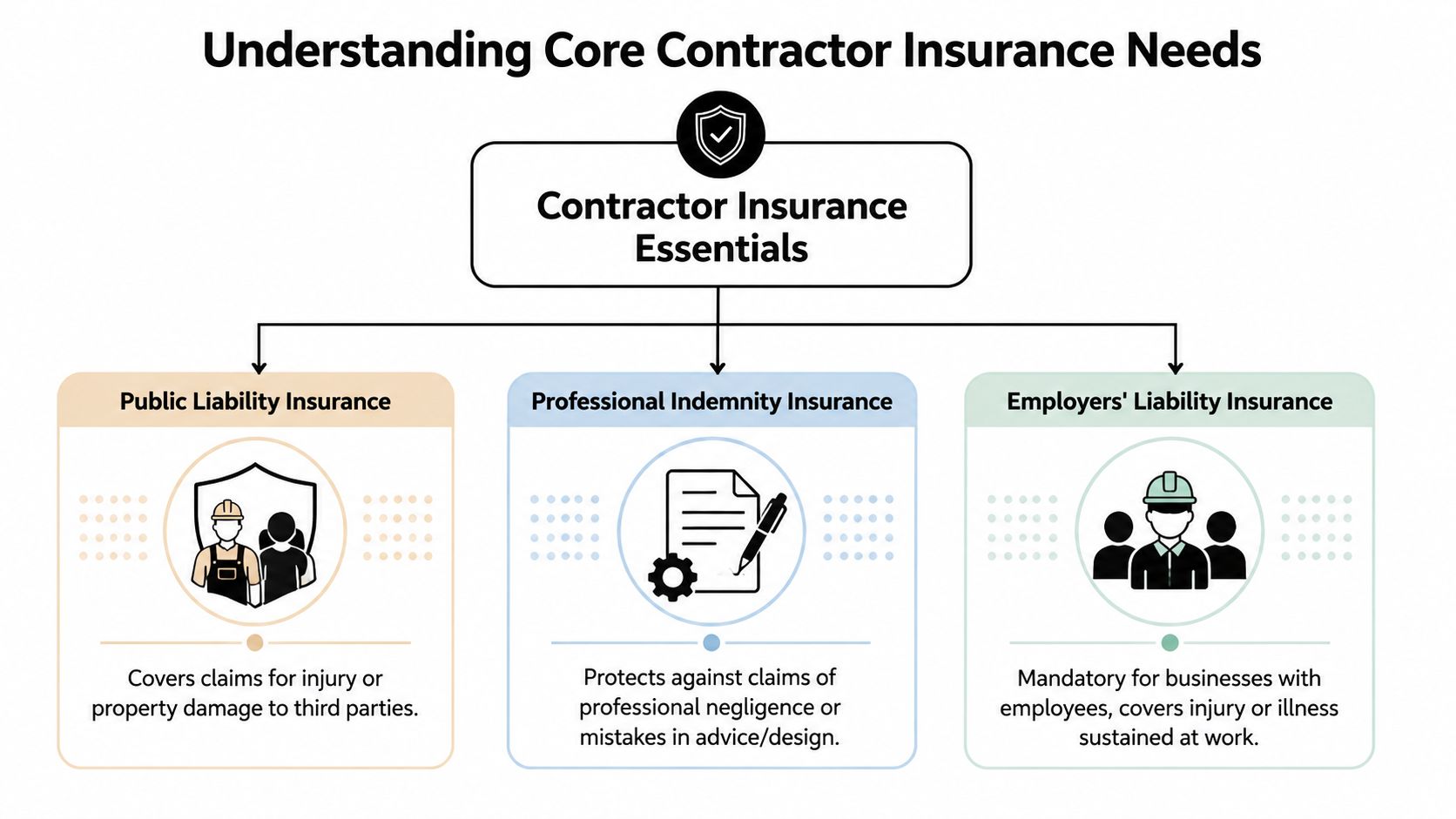
Public Liability Insurance
Think of Public Liability as protection against the physical knock-on effects of your work.
If your activity causes injury to a third party, or damages somebody else's property, this is the policy people usually mean. For a site-based contractor, that could be damage caused while working on premises. For a freelance specialist visiting a client office, it could still matter if your actions cause damage in a real-world setting.
This type of cover is about third-party bodily injury and property damage. It's not about bad advice, and it's not about injuries to your own employees.
Professional Indemnity Insurance
Professional Indemnity deals with a different kind of risk. Not a smashed window or a flooded floor, but a financial loss caused by what you advised, designed, specified or recommended.
If your work includes consultancy, design, technical advice, planning, architecture, engineering input, compliance guidance, or any judgement-based service, this is often the policy that matters most. It responds to negligence-style claims where the loss is financial rather than physical.
That's why this cover matters so much for desk-based contractors too. If your output lives in documents, designs, reports, software decisions or recommendations, you're not low risk just because you don't wear a hard hat.
For a deeper look at this cover, see our guide to contractor indemnity insurance.
Professional Indemnity becomes more important when your biggest risk isn't what you might break, but what a client says your judgement got wrong.
Employers' Liability Insurance
Employers' Liability is the one many small firms overlook until someone asks for proof.
Guidance on contractor cover notes that the core stack usually includes Employers' Liability, Public Liability and Professional Indemnity, and that Employers' Liability is legally required for most businesses with employees and must provide at least £5 million cover (core contractor insurance overview).
If you run a limited company and have employees, or engage labour in a way that creates employer-type exposure, this is not a nice-to-have. It's a compliance issue.
A quick way to tell them apart
| Policy | What it mainly covers | Typical trigger |
|---|---|---|
| Public Liability | Injury or property damage to third parties | Something happens physically because of your work |
| Professional Indemnity | Financial loss from advice, design or professional judgement | A client says your work product caused loss |
| Employers' Liability | Injury or illness suffered by people working for your business | Someone working under your business is harmed through work |
If you store stock, tools or kit off-site, it helps to separate those risks too. A good guide to self storage insurance is useful because many contractors assume business property is automatically covered wherever it is kept, and that often isn't something to guess at.
Navigating Legal and Contractual Insurance Obligations
You accept a contract on Monday, plan to start on Wednesday, and on Tuesday afternoon the agency asks for your insurance certificate. That is the moment many contractors find out they were answering the wrong question.
The useful question is not only, “What insurance does the law require?” It is also, “Who is the insurer expected to be in this supply chain?”
That second question matters a lot if you work through your own limited company versus an umbrella company. If you trade through a limited company, the client or agency will often expect the policy to sit with your company. If you work through an umbrella, some of the cover may sit with the umbrella instead, and some may not. The contract wording decides who carries the obligation, so it is worth checking before you assume you are covered.
What the law requires
Legal duties come first because they are about compliance, not preference.
For many contractors, the main legal issue is Employers' Liability if the way the business operates creates an employer type exposure. Earlier in the article, we covered the basic rule and the minimum cover level commonly required by law in those cases. Here, the practical point is simpler. If the duty applies to your company, the client cannot waive it, and buying a different policy will not fix the gap.
A limited company contractor should read this as a company-level obligation. An umbrella worker should read it differently. The umbrella may be the party with the employer responsibility, not you personally. That does not mean “ignore insurance.” It means you need to confirm what the umbrella's policy covers, and whether the contract expects anything in your own name.
What the contract requires
Contracts usually ask for more than the law does.
An agency, consultancy, end client, or framework agreement may require Public Liability, Professional Indemnity, specific indemnity limits, proof of insurance before the start date, and a promise to keep that cover in force for the life of the engagement. Public sector work often spells this out in tender documents, and this public sector bid insurance advice is a useful reference if you are trying to match the policy limit to the wording in a bid response.
That is risk transfer in plain terms. The client wants an insurer standing behind the work if something goes wrong.
Limited company versus umbrella. Who is responsible for what?
Contractors often get tripped up.
If you run a limited company, the contract often treats your company as the supplier. In that setup, insurance obligations usually sit with your company unless the contract says otherwise. If the schedule says the supplier must hold £1 million or £5 million of Public Liability, the client usually wants a certificate in the company name that signed the contract.
If you use an umbrella company, the umbrella is often the legal employer and sometimes the insured party for certain risks. That can cover some employment-related exposure. It does not automatically satisfy every contract requirement. A client may still ask whether Professional Indemnity applies to your work, whether the umbrella's policy covers the specific services you perform, and whether there are exclusions for subcontracted or off-site work.
The easiest way to picture it is this. Legal responsibility and contractual responsibility are like two columns on a form. Your limited company may sit in both columns. Under an umbrella, the umbrella may sit in one column, while the contract still leaves questions in the other.
What to check before you start
A few checks save a lot of last-minute scrambling:
- Read the insurance clause and note who the contract calls the supplier.
- Check the policyholder name on the certificate matches that structure.
- Confirm the required policy types and limits, not just the existence of cover.
- Ask whether the policy covers your actual services, especially advice, design, or specification work.
- If you are under an umbrella, ask for written confirmation of what the umbrella policy covers and what it does not.
If your engagement also touches status and supply-chain compliance, this guide to IR35 insurance for contractors and umbrella workers helps explain where those issues can overlap.
A contractor can be fully compliant in one sense and still be unable to start work. The gap is often not “no insurance.” It is “the wrong party holds it,” or “the contract asks for a type or limit the current policy does not provide.”
Estimating Your Contractor Insurance Costs
Price matters, but averages only help if you understand what drives them.
The broad market guidance is that small business liability cover often starts around £500 to £2,500 per year, while larger operations can exceed £10,000 depending on revenue, trade type and claims history (contractor insurance cost ranges).
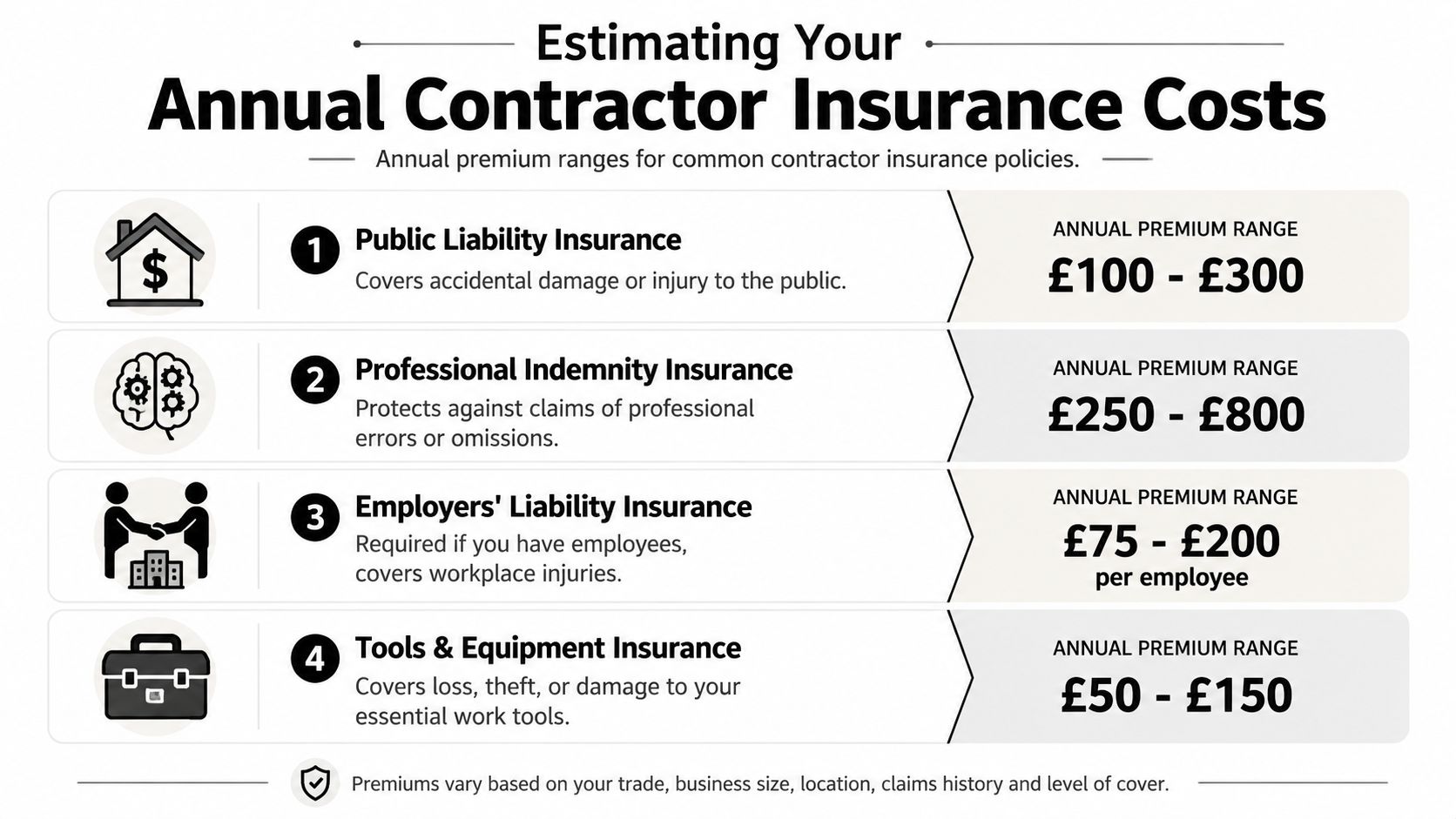
Use that as a rough budgeting frame, not a promise. Two contractors with similar turnover can still get very different quotes if the insurer sees their work very differently.
What usually pushes the premium up or down
Here are the details insurers care about most:
- Your trade and exposure. Higher-hazard work generally costs more to insure than lower-hazard advisory work.
- Turnover and project size. Bigger contracts can mean bigger claims exposure.
- Claims history. A clean record usually helps. Prior claims can change both price and appetite.
- Required limit of indemnity. If a client wants a higher limit, the cost can rise with it.
- Use of labour or subcontractors. The more moving parts in delivery, the more careful underwriters become.
Site-based versus desk-based work
Construction and engineering contractors often feel the difference in pricing most sharply because the underlying risk is more severe. Guidance tied to contractor market practice notes that the Health and Safety Executive reports 138 construction worker fatalities in Great Britain in 2023/24, and construction remains one of the highest-risk sectors for fatal and non-fatal injury (construction risk and policy design guidance).
That doesn't mean desk-based contractors get a free pass. Professional negligence, contractual disputes and cyber-related exposures can still make quotes move around. It does mean insurers price physical trade risk differently from advisory work.
If you bid for public contracts, insurance limits often become part of the tender response. This public sector bid insurance advice is useful for understanding how those requirements can shape what you need to buy before you can even compete.
The useful budgeting mindset
Don't ask only, “What's the cheapest policy?”
Ask:
- Will this meet the contract requirement?
- Does the trade description match what I do?
- Would the policy still work if the claim happened in the messiest version of the job?
The cheapest quote often looks less impressive once you read what it excludes.
Insurance Responsibilities When Using an Umbrella Company
Many contractors get stuck at this point, and fairly understandably.
Two people can do similar work for similar clients and still have different insurance responsibilities because their trading setup is different. The big divide is usually between working through your own limited company and working as a PAYE employee through an umbrella company.
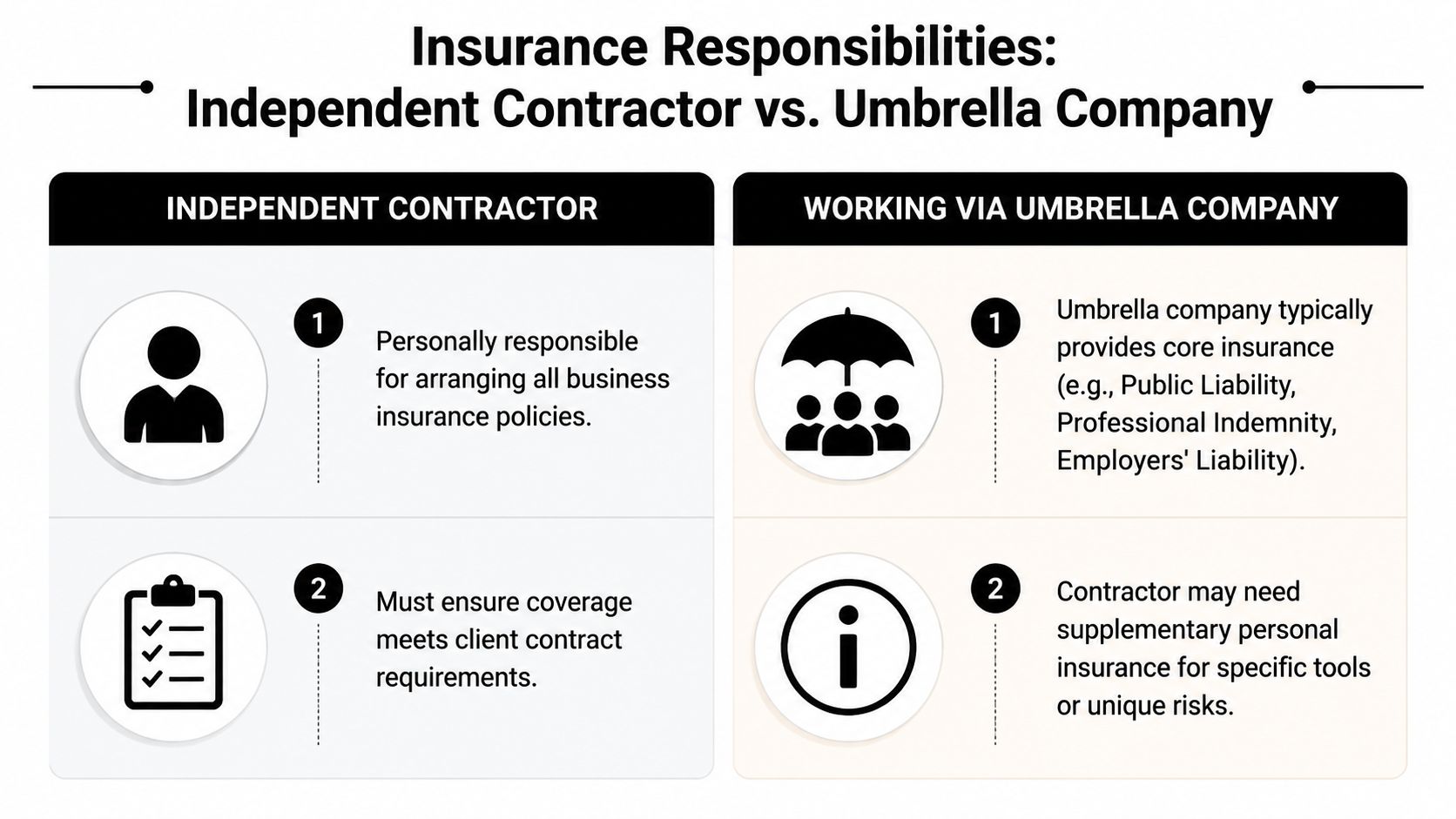
If you run your own limited company
When you operate through your own company, the responsibility usually sits with you.
You arrange the policies. You pay for them. You check they satisfy the contract. You make sure the business description, limits and endorsements are right for the work.
If your client contract says you need Public Liability and Professional Indemnity, it's your company that has to provide the evidence. If the business engages staff or creates an Employers' Liability obligation, that sits with your company too.
If you work through an umbrella company
The position changes because you're usually a PAYE employee of the umbrella.
The verified guidance highlights the issue well. Many contractors are confused about whether they need business insurance when working through an umbrella company. As PAYE employees of the umbrella, key employment risks shift to the umbrella company. However, with ongoing reforms and IR35 complexities, it's vital to understand which risks the umbrella covers and which, if any, remain with the individual contractor (umbrella company insurance responsibilities).
That shift is the key point. The umbrella is typically the employing entity. So the umbrella usually carries the core business insurances associated with that employment and supply model.
For freelancers comparing options, our page on an umbrella company for freelancers can help you understand the broader setup.
A side-by-side view
| Working model | Who usually arranges core business cover | What you should personally check |
|---|---|---|
| Limited company contractor | Your company | Contract limits, trade wording, subcontractor position, policy scope |
| Umbrella company worker | The umbrella company usually handles the core cover tied to its employment model | What the umbrella policy includes, what the client requires, and whether any niche personal risks sit outside that cover |
The question to ask an umbrella
Don't just ask, “Are we insured?”
Ask more specific questions:
- What core policies are in place?
- Does the cover extend to my assignment type?
- Are there restrictions around certain professions or activities?
- If the client asks for evidence, who provides the certificate?
- Is there anything I still need to arrange myself?
The confusion doesn't come from the word “insurance”. It comes from the word “responsibility”. The cover may exist, but you still need to know who holds it and what it actually covers.
For some contractors, particularly those doing advisory, digital or specialist work, the umbrella's standard cover may not answer every concern. The answer depends on the assignment and the contract wording, not just the payroll model.
Your Step-by-Step Checklist for Choosing a Policy
A common contractor mistake looks harmless at first. You get a contract on Tuesday, the client asks for insurance certificates by Friday, and the cheapest quote online seems close enough. Then the wording turns out to fit a different kind of work, or the policy sits with an umbrella company when the contract assumes your own limited company is carrying the risk.
That is why choosing a policy needs the same care you give a statement of work. You are matching insurance to real obligations, not buying a generic product.
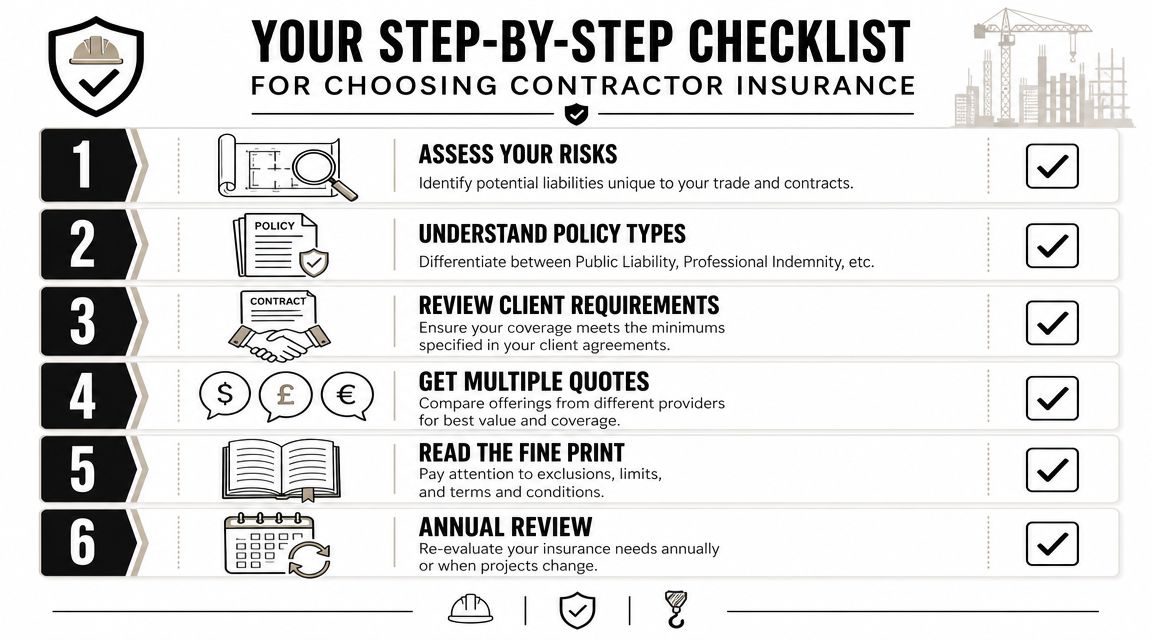
Step one, confirm who is supposed to insure the work
Start with the working model before you compare any policy.
If you contract through your own limited company, the responsibility usually sits with your company. If you work through an umbrella, the umbrella may already hold core cover linked to its employment model. That does not automatically mean every client requirement is satisfied. Some contracts are written as if the contractor's own company is providing the insurance, so check who the contract names and who must produce the certificate.
This first step saves a lot of wasted shopping.
Step two, read the contract like a risk document
Go straight to the insurance schedule, indemnity clauses, and onboarding documents. Pull out three things: the type of policy required, the limit required, and when proof has to be provided.
Recruiters often summarise this in plain English, which is helpful, but the contract wording is the part that matters if there is a dispute. If one page says £1 million and another says £5 million, clear that up before the start date.
Step three, describe your work the way a claim would describe it
Insurers care about the actual activity. A client also cares about the actual activity. Those two descriptions need to line up.
If you advise on architecture, configure systems, manage delivery, and bring in a specialist subcontractor for part of the job, say that clearly. Do not reduce it to a vague label like "IT consultant" and assume the rest will be inferred. Insurance works a bit like a tool spec on site. If the spec says one thing and the tool does another, the problem only shows up when pressure is applied.
Step four, check the details that decide whether a policy really fits
Price matters, but wording decides whether the cover matches the job. The UK Government's guidance on how to choose business insurance is a useful reminder to check exclusions, conditions, and the nature of your work before you buy.
Pay close attention to these points:
- Business or trade description. It should reflect the work you perform.
- Subcontractors. Check whether the policy covers work you subcontract, or only work done directly by you.
- Limit structure. Find out whether the limit applies per claim, per event, or across the whole policy period.
- Territory and jurisdiction. Remote work for an overseas client can change the risk even if you never leave your desk.
- Contract assumptions. Some policies are priced on the basis that you do not design, do not handle data, or do not give advice. If you do any of those, say so.
To help you think through the process, this short explainer is worth a look:
Step five, compare quotes on fit, not just premium
Ask each broker or insurer the same questions and compare the answers side by side.
What work have you listed me as doing? What is excluded? Does this policy satisfy the contract limit? How are subcontractors treated? If I move from umbrella work to a limited company next month, would this still be suitable?
A cheaper policy can cost more if you have to replace it halfway through onboarding or explain to a client why the certificate does not match the contract.
Step six, review it whenever your setup changes
Insurance should follow the work as it changes.
A new client sector, a wider scope, overseas exposure, hired help, or a switch between umbrella and limited company working can all change who is responsible and what cover makes sense. Buy for the assignment you are taking on now, and for the contract sitting in front of you now.
Frequently Asked Questions About Contractor Insurance
Do I need run-off cover when I stop contracting
If you've had Professional Indemnity insurance, run-off cover is often worth discussing before you close a company or stop trading. Professional Indemnity is commonly written on a claims-made basis, which means claims can arise after the work was done. If your past work could still be challenged later, switching everything off on your final day can leave an awkward gap.
Does my policy cover remote or overseas work
Never assume it does.
Remote work sounds low risk, but policy wording may still limit territory, jurisdiction, client type or the kind of work you do from home. If your contract involves overseas clients, foreign legal exposure or access to external systems, ask the insurer to confirm the position in writing.
What's the difference between Professional Indemnity and Cyber Insurance
They solve different problems.
Verified contractor guidance points out that many insurance guides still focus on physical risks, while a growing share of contractors deliver digital or advisory work. For those contractors, Professional Indemnity covers negligence-style claims, while Cyber Insurance is more relevant to data breaches, system recovery and related first-party cyber costs, and clients increasingly ask for evidence of one or both before onboarding (professional indemnity versus cyber insurance for contractors).
A simple way to remember it is this:
- Professional Indemnity usually responds when a client says your judgement or service caused financial loss.
- Cyber Insurance is more about the operational fallout from digital incidents such as data compromise, system disruption and recovery costs.
If I'm under an umbrella, can I ignore insurance completely
Not quite.
You may not need to arrange the same core cover yourself, but you still need to know what the umbrella provides, what your client expects to see, and whether your assignment creates any unusual risk that sits outside standard arrangements.
If you're weighing up whether to contract through your own company or use an umbrella, Umbrella Company helps you compare trusted UK umbrella companies and understand how different setups affect compliance, admin and practical issues like insurance responsibility.


