


Landing a first contract often feels brilliant right up until the money questions start. Should you join an umbrella company or open a limited company? What does IR35 change? Why does one payslip look so different from an invoice? And if you're using a limited company, what records do you need to keep so HMRC doesn't become a future problem?
That confusion is normal. Contractor accounting has more moving parts than standard employment because your tax position, your paperwork, and your take-home pay all depend on how you operate.
At UmbrellaCompany.com, we speak to contractors who are excellent at what they do but understandably unsure about the finance side. The good news is that contractor accounting becomes much easier once you separate it into a few practical decisions. Your operating model, your tax responsibilities, your IR35 status, and your record-keeping habits all fit together.
If you're still working out the basics of going freelance, our guide on how to become a contractor is a useful starting point. If you're also thinking about software, this practical piece of advice on cloud accounting for UK firms gives a helpful overview of digital bookkeeping tools and why they matter in day-to-day finance work.
Your Guide to UK Contractor Accounting
Contractor accounting is the way you track income, expenses, tax, and compliance when you work on a contract basis rather than as a permanent employee. In the UK, that usually means one of two setups. You either work through an umbrella company, where tax is handled through PAYE, or through your own limited company, where you run the business and take on more responsibility.
The reason this matters is simple. The same contract can lead to very different admin, tax treatment, and take-home pay depending on the structure behind it.
Why contractors get stuck
A lot of accounting content is written for larger firms or traditional businesses. Contractors don't always fit neatly into those examples. You might move between payroll-based assignments, inside IR35 work, and project-based engagements over time. Each arrangement changes what “good accounting” looks like in practice.
That's why generic advice can feel frustrating. It tells you how bookkeeping works in theory, but not always what to do when your income arrives through an umbrella one month and through your own company the next.
Practical rule: Start with how you're being engaged, not with tax-saving ideas. The contract setup usually decides what accounting approach makes sense.
What good contractor accounting looks like
In plain language, you're trying to do four things well:
- Choose the right structure: Your umbrella or limited company setup affects admin, liability, and tax treatment.
- Handle tax correctly: That includes PAYE, National Insurance, VAT, Corporation Tax, and dividends where relevant.
- Stay compliant: IR35 and HMRC reporting rules can change how you're paid and what records you need.
- Keep clean records: Good records protect your cash flow and make tax deadlines far less stressful.
If you keep those four priorities in view, most contractor finance decisions become much easier to judge.
Choosing Your Path Umbrella vs Limited Company
This is the decision that shapes almost everything else.
An umbrella company gives you an employment-style arrangement. A limited company, often called a personal service company (PSC), means you're running your own business. Neither route is automatically right for everyone. The best option depends on your contracts, your appetite for admin, and whether your work sits inside or outside IR35.
Why the choice matters
Mainstream accounting advice often misses the reality of mixed contractor work. Many contractors move between PAYE-style payroll, fixed-fee projects, and inside-IR35 engagements, and those models create very different tax and reporting duties under HMRC rules, as noted in this discussion of mixed engagement models in contractor accounting.
That's why choosing a structure isn't a paperwork detail. It affects how income reaches you, what deductions happen before you're paid, and how much responsibility sits with you.
Umbrella company at a glance
With an umbrella company, you become an employee of the umbrella for payroll purposes. The umbrella invoices the agency or client, processes your pay, deducts tax and National Insurance, and issues payslips.
This tends to suit contractors who want simplicity, need support with inside-IR35 contracts, or don't want the burden of running a company.
Typical advantages
- Lower admin: You don't run payroll, file company accounts, or manage Corporation Tax.
- Straightforward compliance: PAYE deductions happen before you're paid.
- Useful for inside IR35 work: It often aligns more naturally with tax being deducted at source.
Typical trade-offs
- Less control: You won't have the same flexibility over how income is drawn.
- Employment-style deductions: Your take-home pay usually feels more like a salary than business profit.
- Provider choice matters: You still need a compliant, transparent umbrella.
Limited company at a glance
Running a limited company gives you more control, but also far more responsibility. Your company contracts with the client or agency, receives income, pays business costs, and then pays you through salary and possibly dividends, depending on your circumstances and the contract terms.
This route often suits contractors working on genuine business-to-business terms, particularly where contracts are outside IR35.
Typical advantages
- More control: You decide how the company is run and how records are kept.
- Business identity: It can suit project-based or consultancy-style work.
- Planning flexibility: You have more moving parts to manage income and costs, subject to the rules that apply.
Typical trade-offs
- More admin: Bookkeeping, payroll, tax returns, and company filings all become your responsibility.
- Higher compliance risk: Mistakes can affect both the company and your personal tax position.
- Not always suitable: Some contracts, especially inside IR35 ones, reduce the practical benefit of operating this way.
Umbrella Company vs Limited Company at a Glance
| Feature | Umbrella Company | Limited Company (PSC) |
|---|---|---|
| Tax treatment | PAYE deductions at source | Company-level and personal tax responsibilities |
| Admin burden | Lower | Higher |
| Payslips and payroll | Handled by umbrella | You arrange payroll for your company |
| IR35 suitability | Often practical for inside IR35 | Often more suitable for outside IR35 work |
| Control over finances | Lower | Higher |
| Compliance responsibility | Shared with umbrella for payroll processes | Mostly sits with you and your accountant |
| Business bank account | Usually not needed in your own company name | Needed |
| Best for | Contractors who want simplicity | Contractors comfortable running a company |
A more detailed side-by-side breakdown is available in our guide to umbrella company vs limited company.
A good test is this. If you want the cleanest route from assignment rate to payslip, umbrella usually feels easier. If you want full business control and you're ready for the admin, a limited company may fit better.
Understanding Your Tax and National Insurance Obligations
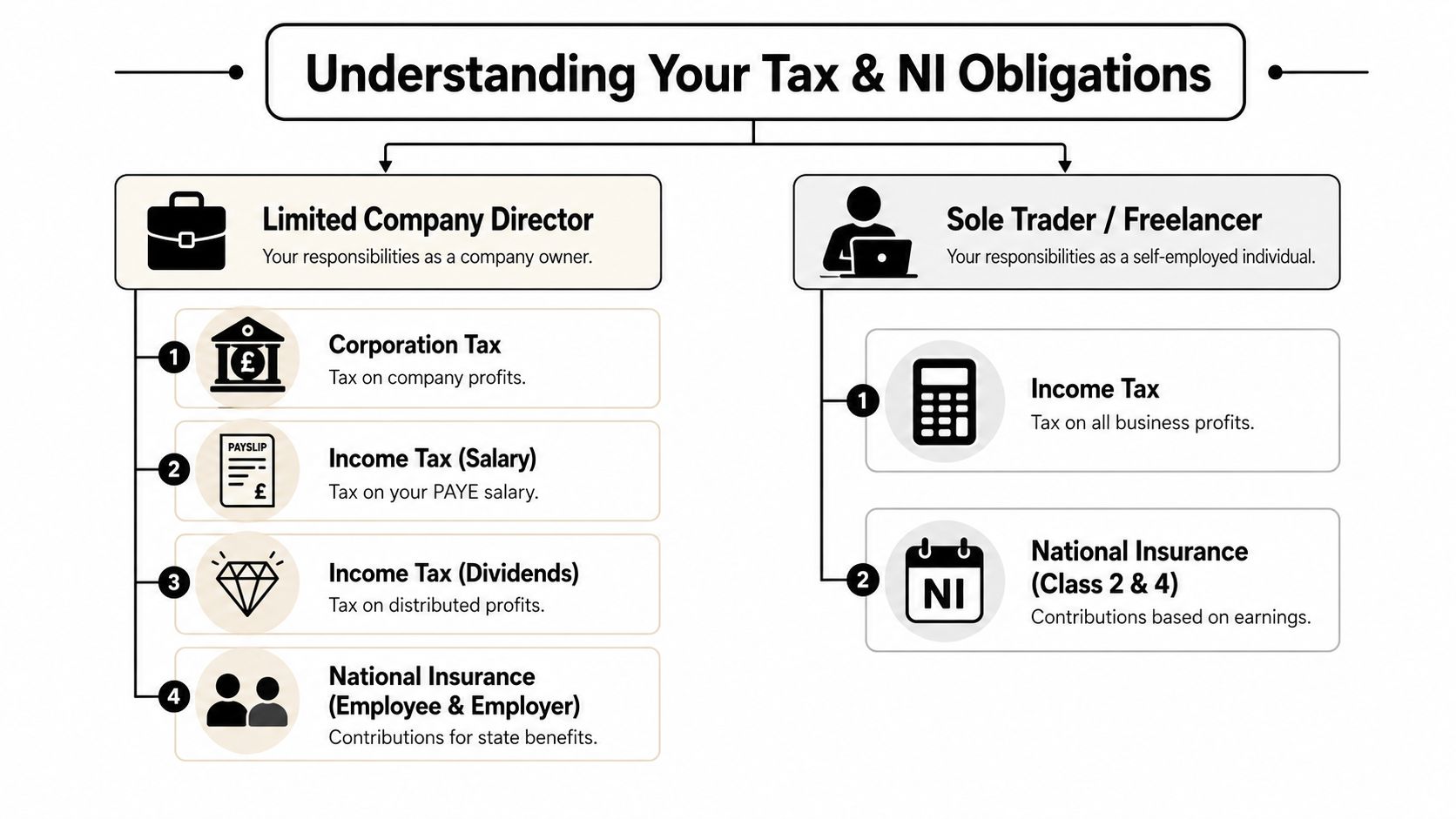
Taxes feel complicated because contractors can be taxed in very different ways. The easiest way to make sense of it is to separate the rules by operating model.
If you use a limited company
With a limited company, your company receives income. That income is not automatically your personal pay. First, the company records sales, expenses, and profit. From there, several tax layers can apply.
The main ones are:
- Corporation Tax: Your company pays this on taxable profits.
- PAYE on salary: If you pay yourself a salary, the company runs payroll.
- Dividend tax: If you take dividends, those are treated differently from salary.
- VAT: If your business is VAT-registered, you must charge and report VAT correctly.
One major rule changed how this works in practice. Under Making Tax Digital for VAT, VAT-registered businesses above the £85,000 threshold had to keep digital records and use software from 1 April 2019, and this was extended to all VAT-registered businesses from 1 April 2022 according to this summary of MTD for VAT requirements. For limited company contractors, that means digital bookkeeping isn't just tidy admin. It's part of compliance.
If you work through an umbrella company
An umbrella contractor is normally paid through PAYE, much like a permanent employee. The umbrella processes your pay and deducts Income Tax and employee's National Insurance before your net pay reaches your bank account.
That sounds simple, but one part often causes confusion. Contractors see a contract rate and assume that figure will become taxable gross pay on the payslip. It doesn't work that way.
The employer's National Insurance question
When you work through an umbrella, the assignment rate usually has to cover more than just your taxable salary. It may also need to cover employment costs connected to processing that assignment, including employer's National Insurance.
That's why your payslip can look lower than expected if you compare it directly with the contract rate. The assignment rate is not the same thing as your personal gross salary figure.
Keep this distinction in mind. Assignment rate, taxable gross pay, and net pay are three different numbers.
A simple practical example
If you run a limited company, you might receive client income into the company bank account, pay for approved business costs, then decide how much salary and dividend to take, with records supporting every step.
If you use an umbrella, you usually submit timesheets, the umbrella gets paid by the agency or client chain, and then you receive a payslip with deductions already applied.
Both are valid. They just answer different needs. One prioritises control, the other prioritises simplicity and payroll compliance.
Navigating IR35 and Off-Payroll Working Rules
IR35 is one of the biggest reasons contractor accounting feels different from normal small business bookkeeping. It changes how some contract income is taxed and can remove much of the advantage of invoicing through your own company.
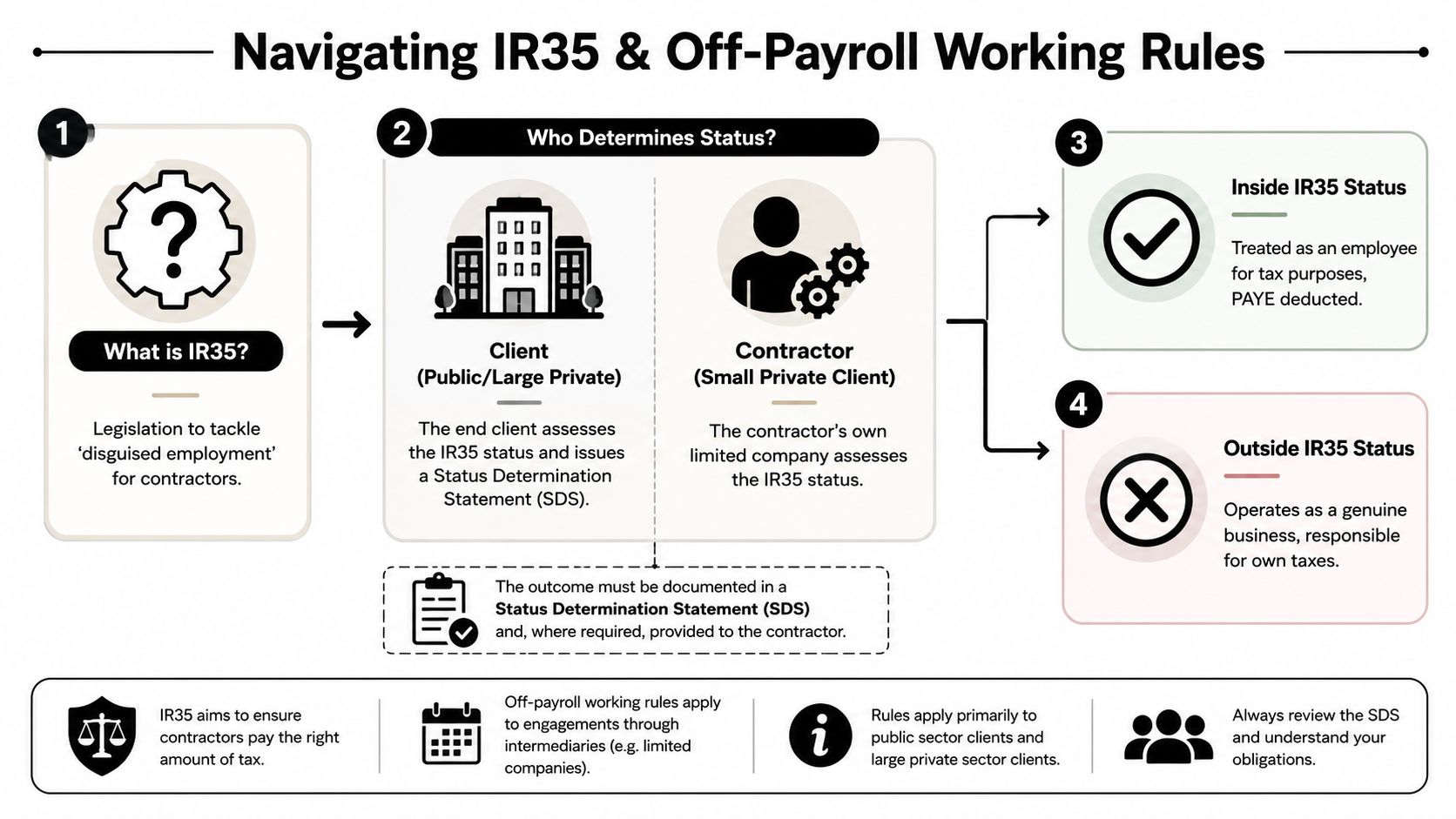
To see the decision flow visually, this summary helps:
What IR35 means in plain English
The off-payroll working rules, commonly called IR35, are designed to identify cases where a contractor works in a way that looks more like employment than genuine self-employment. If a contract falls inside IR35, the income is generally taxed more like employment income. If it falls outside IR35, the contractor is more likely to be operating as an independent business.
The rules were introduced in the public sector in April 2017 and extended to medium and large private sector clients in April 2021, as outlined in this overview of IR35 reform and contractor tax treatment. That reform changed contractor accounting in a practical way. Many contractors moved from invoicing through their own company to having tax deducted at source.
Who decides the status
For many engagements, the end client now plays a key role in deciding status. That matters because the accounting treatment follows the status decision.
If the client says the contract is inside IR35, you usually won't be dealing with that income in the same way as a clean business-to-business invoice from an outside-IR35 project. Instead, the payment route often shifts towards payroll-style deductions.
A fuller explanation of the rules sits in our guide to IR35 for contractors.
Inside IR35 versus outside IR35
Inside IR35 usually means:
- Tax is deducted at source: Your pay is treated more like salary for tax purposes.
- Take-home pay changes: The difference is often visible immediately.
- Admin choices narrow: An umbrella company often becomes the more practical route.
Outside IR35 usually means:
- Your company stays central: If you operate through a PSC, normal company accounting remains relevant.
- Record-keeping still matters: Contracts and working practices need to support the status.
- You carry more responsibility: You need clean paperwork and good accounting discipline.
A short explainer video can also help if you prefer to hear the concepts spoken through:
Key judgement: Don't choose a limited company first and try to force every contract into that model. Check the contract status first, then choose the structure that fits the tax reality.
Record-Keeping and Invoicing Best Practices
Good contractor accounting isn't just about tax returns. It's also about cash flow, timing, and having evidence ready when someone asks for it.
Contractors can run into cash-flow problems when billing, payment timing, or records are weak. Good invoicing and careful records help stop a contract from looking profitable on paper while still creating strain in real life, as discussed in this guidance on cash-flow risk and record-keeping for contractors.
If you run a limited company
You need a system, not a shoebox.
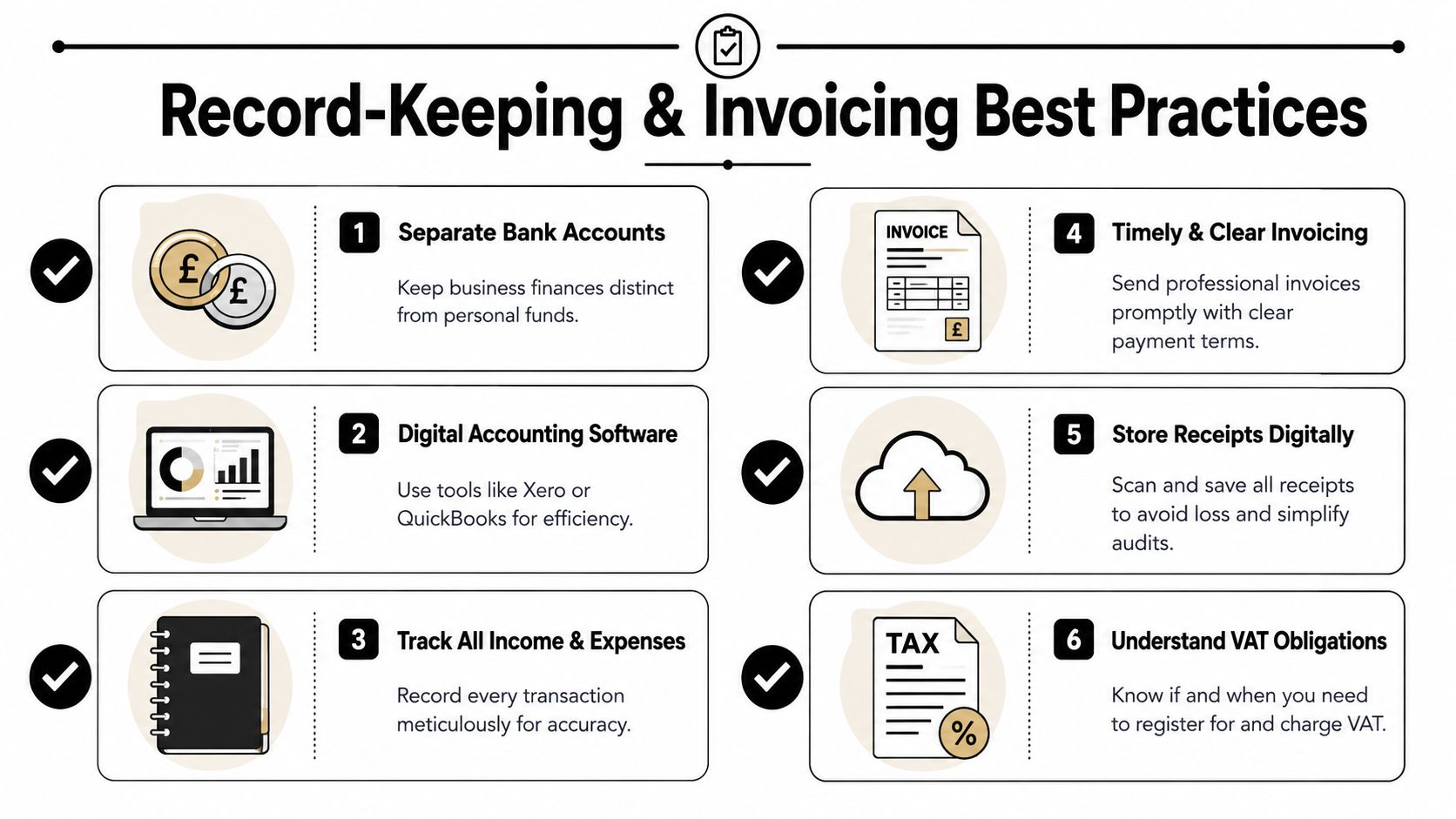
A limited company should normally keep a separate business bank account, use accounting software, store receipts digitally, and reconcile transactions regularly. If your bookkeeping is always behind, you'll struggle to see what you've really earned, what tax you need to set aside, and whether a client payment delay is becoming a problem.
Helpful tools often include Xero, QuickBooks, and FreeAgent. If you want different systems to share data cleanly, this overview of Recurrr's integration solutions is useful for understanding how software connections can reduce manual work.
If you work through an umbrella
Your admin load is lighter, but it isn't zero.
You should still keep copies of contracts, assignment schedules, timesheets, payslips, and expense records where relevant. Check every payslip. Small errors are easier to fix quickly than months later.
Habits that prevent headaches
- Use one place for records: Keep contracts, invoices, payslips, and receipts in an organised digital folder.
- Check dates carefully: Late timesheets or late invoices can delay payment and create avoidable cash pressure.
- Review every payment: Make sure the amount received matches what you expected from the contract terms.
- Separate business and personal spending: If you use a limited company, this is essential for clean bookkeeping.
- Store receipts as you go: Don't wait until year-end and hope you can reconstruct everything.
Why invoicing quality matters
For limited company contractors, invoices need to be clear, timely, and consistent with the contract. If your invoicing is vague or late, payment delays become more likely, and that affects your personal cash flow long before year-end accounts are prepared.
If you're comparing tools, our guide to best invoicing software for contractors can help you shortlist practical options.
Clean records do two jobs at once. They support compliance, and they help you spot money issues before they become stressful.
Your Contractor Accounting Checklist and Next Steps
You do not need to master every part of contractor accounting at once. What matters now is choosing a setup that fits the contract in front of you, your tolerance for admin, and the way you want your income to reach your bank account.
For UK contractors, that choice changes more than paperwork. IR35 affects how tax is handled, umbrella working changes who runs payroll, and a limited company gives you more control but also more responsibility. The practical question is simple. Which option leaves you compliant without creating admin you will struggle to keep up with?
A practical checklist
- Check your contract setup: Are you being engaged in a way that points toward payroll, or are you supplying services business-to-business?
- Confirm your IR35 position: This shapes your tax treatment and often determines whether umbrella or limited company is the more sensible route.
- Choose your operating model: Pick the structure that matches the contract, your admin capacity, and the level of control you want over your finances.
- Put a record system in place: Use software, folders, and regular reviews so nothing piles up near a deadline.
- Review cash flow regularly: Money invoiced, money paid, and money available to spend are three different things.
- Get professional help early: A short conversation with an accountant or compliant provider can protect your take-home pay and reduce the risk of mistakes.
What this looks like in real life
A contractor on an inside-IR35 assignment often wants predictable payroll, clear deductions, and less admin. An umbrella arrangement usually fits that need. A contractor taking on outside-IR35 project work may prefer a limited company because it offers more control over invoicing, bookkeeping, and how income is drawn. The better choice depends on the engagement, not on a general rule about what contractors "should" do.
That is why generic accounting advice can fall short for contractors. The tax rules matter, but the contract model matters just as much.
If your next step is comparing providers rather than setting up a company from scratch, Umbrella Company lets contractors compare umbrella companies based on their circumstances, including support for inside-IR35 work.

A good accounting setup is one you can keep running month after month. The right structure, clear records, and regular checks usually do more for compliance and take-home pay than a complicated plan.
If you have decided an umbrella setup is the right fit, Umbrella Company can help you compare compliant providers and choose one with more confidence.


