


Your first contract has landed. The rate looks good, the work sounds promising, and then the admin starts arriving all at once. Should you invoice through a limited company, join an umbrella, register for VAT, worry about IR35, or buy software before you've even sent your first invoice?
That mix of freedom and uncertainty is normal. Contractor accounting feels complicated at the start because you're no longer just earning money. You're choosing a trading setup, handling tax differently, and taking responsibility for records that an employer used to manage for you.
Good contractor accounting isn't just about staying out of trouble with HMRC. It helps you understand what you're really earning, when cash will arrive, and which operating model suits the contract in front of you. If you get the foundations right early, the rest becomes far easier.
Your Guide to Contractor Accounting in the UK
When you go independent, your finances stop being automatic. No payroll team is tidying up deductions in the background. No finance department is chasing a missing timesheet or explaining why a payment looks light. You have to know what the contract says, how you'll be paid, and which deductions apply.
That's why contractor accounting needs a practical approach. The right setup depends on the kind of work you do, how long the contract runs, and whether the role sits inside or outside IR35. A short inside IR35 assignment often points in one direction. A longer outside IR35 engagement may point in another.
A lot of new contractors assume accounting starts at year end. It doesn't. It starts when you accept the assignment, agree payment terms, and decide how you'll trade.
If you want a deeper overview of the moving parts, our guide to accounting for contractors is a useful companion.
Starting rule: choose your operating model around the contract you actually have, not the one you hope to have later.
What Is Contractor Accounting?
Contractor accounting is the financial system behind your working life as an independent professional. It covers invoicing, expenses, tax, National Insurance, payroll treatment, record-keeping, and the timing of income. If you work on projects, it also means tracking profitability job by job rather than looking only at your bank balance.
It's more than bookkeeping
Basic bookkeeping records what happened. Contractor accounting helps you decide what to do next.
For example, two contractors can both earn the same contract income and still end up in very different positions. One may have clear records, money set aside for tax, and a sensible payment structure. The other may be chasing overdue invoices, mixing personal and business spending, and discovering too late that a contract changed their tax position.
That difference usually comes down to systems, not intelligence.
A sound setup normally includes:
- Cash flow tracking: knowing when invoices go out, when payment is due, and what money is already spoken for.
- Expense discipline: separating genuine business costs from personal spending, and keeping evidence for each item.
- Contract review: checking whether payment terms, billing schedules, and status decisions affect the way you account for income.
- Compliance records: keeping enough detail to support VAT, payroll treatment, and year-end filings.
Why timing matters so much
Many new contractors focus on rate and ignore timing. That's risky. A project can look profitable on paper while still putting pressure on your cash if the client pays slowly, holds back part of the fee, or disputes milestones.
Retentions are a common example in project-based work. A client may hold back part of the amount due until a later stage. That means your accounts need to show both what you've earned and what hasn't yet been released. Cash flow timing matters even more in sectors where working capital pressure is high, and recent commentary on construction accounting highlights the need for strong tracking of retentions and payment timing in that environment construction accounting methods and cash flow timing.
Keep two questions separate. “Have I earned it?” and “Has it been paid?” are not always the same thing.
What good accounting gives you
A well-run contractor setup gives you practical control:
| Area | What you need to know |
|---|---|
| Income | What each contract is worth and when it should pay |
| Costs | What you've spent to deliver the work |
| Tax | Which liabilities are building up as you earn |
| Risk | Where IR35, VAT, or poor paperwork could cause problems |
That's the core job of contractor accounting. It turns scattered admin into useful decisions.
Limited Company or Umbrella Company
This is usually the biggest early decision, and it often gets framed too superficially. People talk about “best” as if one model wins every time. It doesn't. The better question is this. Which model fits this contract, this client, and this stage of your contracting life?
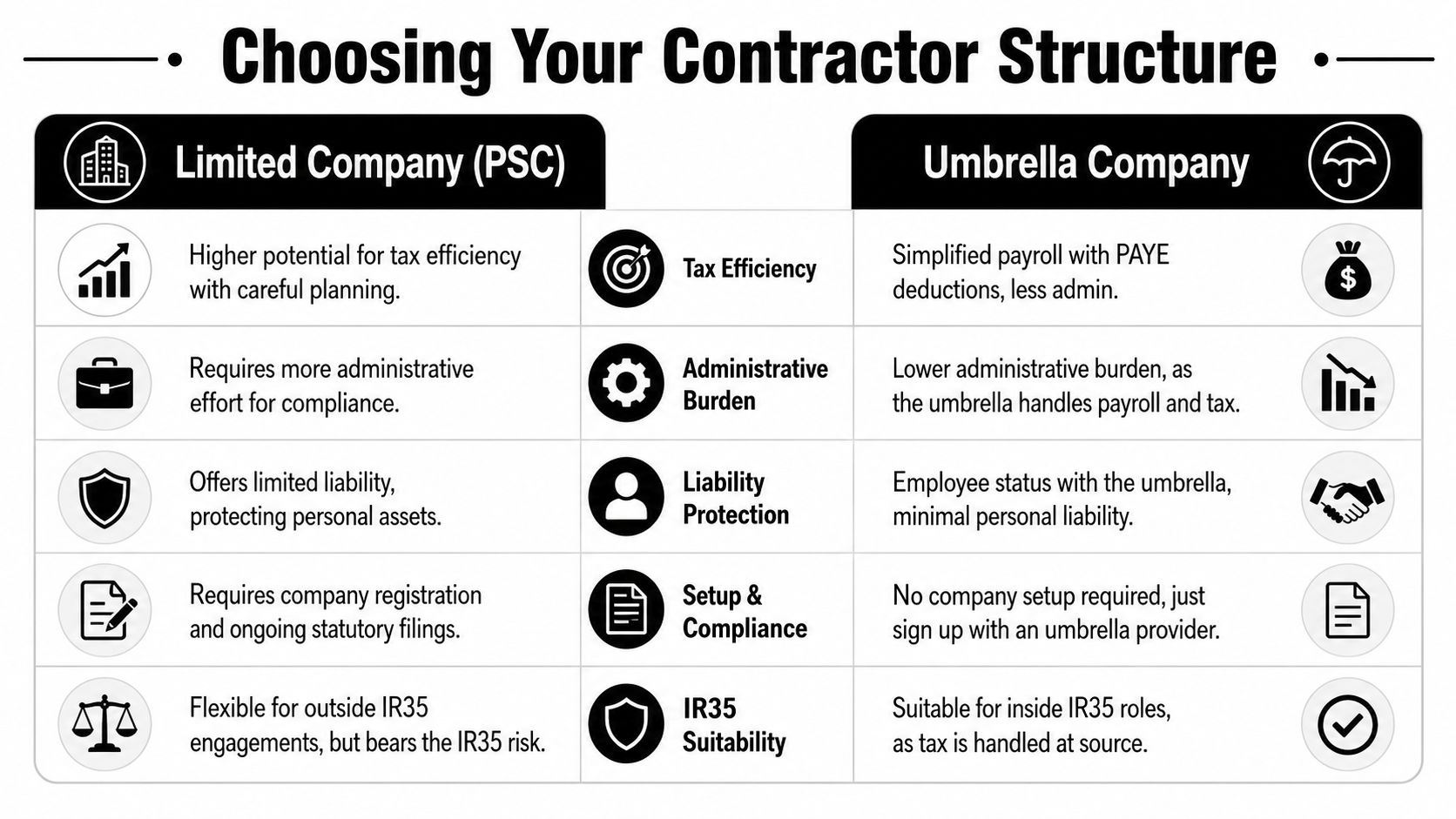
If you want a broader side-by-side breakdown, compare umbrella company vs limited company.
Start with the contract, not the structure
A short assignment with an agency, a client-led status decision, and payroll-style deductions often suits an umbrella arrangement. A longer engagement where you're genuinely operating as a separate business may make a limited company more suitable.
The choice becomes clearer if you test it against four decision points.
Admin burden and headspace
A limited company gives you more responsibility. You'll usually need company records, bookkeeping, invoicing, company filings, and a plan for how money moves from the company to you.
An umbrella company strips away much of that admin. You submit timesheets or approved hours, the umbrella processes payroll, and tax is deducted through PAYE before you're paid.
That doesn't mean one is “easy” and the other is “hard”. It means they ask different things of you.
- Choose limited company if: you're comfortable running a business process and want more direct control over the company's finances.
- Choose umbrella if: you want a simpler route where payroll and tax treatment are handled for you as part of the service.
Control and visibility
A limited company usually gives you more control over invoicing, timing, and how you organise the company's finances. That can be valuable when you work with multiple clients or have wider business costs to manage.
With an umbrella, you gain simplicity but accept a different kind of visibility. Your payslip becomes the key document, and understanding it matters. Commentary on off-payroll working continues to note confusion around gross-to-net pay and how deductions appear on payslips, which is one reason the choice between an umbrella and a limited company needs careful thought IR35 payslip and deduction confusion.
If you don't understand your payslip, don't assume it's wrong. Ask what each line means before you decide the model doesn't work.
Tax position and IR35 reality
Many contractors often make a mistake. They choose a structure first, then try to force every contract into it.
In practice:
| Decision factor | Limited company may fit better | Umbrella may fit better |
|---|---|---|
| IR35 status | Outside IR35 engagements | Inside IR35 engagements |
| Contract length | Longer-term and repeat client work | Shorter or stop-start assignments |
| Admin appetite | Higher | Lower |
| Need for flexibility | Strong business control | Fast setup and straightforward payroll |
A limited company can be attractive when the engagement is outside IR35 and you're operating like a genuine business. An umbrella often makes more sense when the contract is inside IR35 and tax needs to be handled at source.
A practical way to choose
Ask yourself these questions in order:
- Who decided the IR35 status? If the client or agency says the role is inside IR35, that heavily shapes the answer.
- How long is the assignment? A short contract may not justify setting up and running a company.
- Will you have several clients or just one? One client on one assignment often favours simplicity.
- Do you want to manage company admin yourself? If not, don't build a structure you'll resent maintaining.
- What do you need right now, efficiency or certainty? Sometimes certainty is the smarter choice.
There isn't a universal winner. There's only the model that matches your current contract and your tolerance for responsibility.
Understanding Your Tax and NIC Obligations
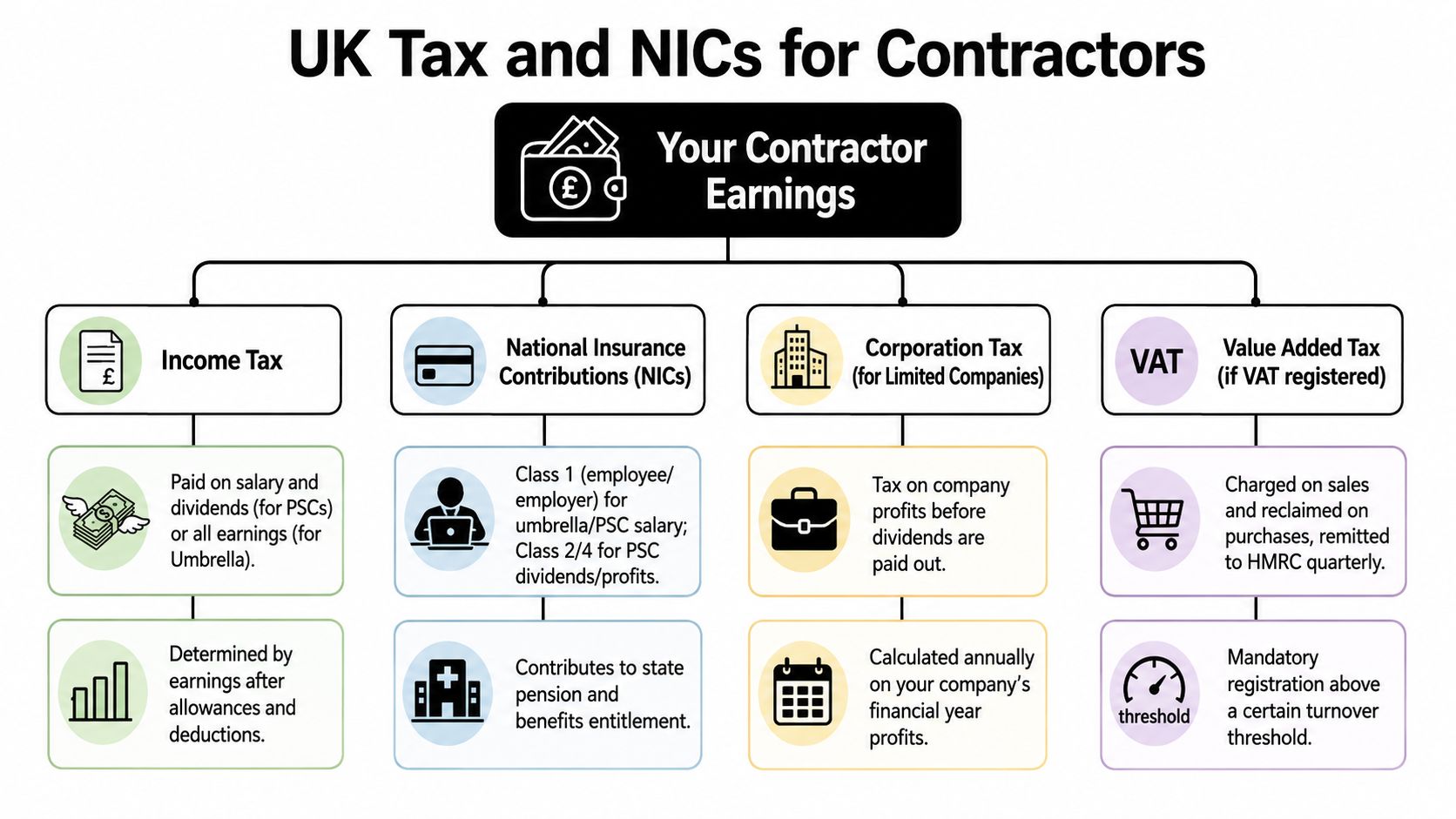
Tax feels more manageable once you split it by operating model. The bills and reporting duties aren't the same for a contractor using a limited company and a contractor paid through an umbrella.
If you work through an umbrella
An umbrella usually pays you through PAYE. That means Income Tax and National Insurance contributions are deducted before your net pay reaches your bank account. Your payslip becomes the main record of what was earned, what was deducted, and what you received.
This model is often simpler because the tax handling happens as part of payroll. The trade-off is that you need to read the payslip properly and understand why the gross figure you see from the client or agency isn't the same as your take-home pay.
If you trade through a limited company
A limited company adds more layers. You may need to think about:
- Corporation Tax: charged on company profits.
- VAT: if registration applies, you charge VAT on sales and account for it to HMRC.
- Salary and dividends: many directors take money out in more than one way, which creates different tax and reporting consequences.
- NICs: these can apply depending on how salary is structured.
The most important early trigger is VAT. The registration threshold is £85,000 in taxable turnover, and once your business crosses that level you must register for VAT, which changes your record-keeping and reporting duties to HMRC VAT threshold and contractor reporting duties.
The taxes are different, but the discipline is the same
Whatever structure you use, good habits matter more than clever theory.
- Separate money early: if you use a limited company, don't treat the company account like a personal wallet.
- Read every payment document: invoices, remittances, and payslips tell different parts of the story.
- Know what you're responsible for: some contractors assume “someone must be sorting the tax”. That's not safe thinking.
- Keep evidence: when HMRC asks questions, records matter more than memory.
A simple mental model
Use this as a quick guide:
| Operating model | Main tax handling |
|---|---|
| Umbrella company | PAYE deductions made before payment to you |
| Limited company | Company-level taxes and director extraction planning |
The mistake to avoid is mixing the two in your mind. Umbrella income usually behaves like employment income for tax purposes. Limited company income belongs to the company first, not automatically to you.
That distinction changes how you budget, how you save for tax, and how you read your earnings.
Navigating IR35 and Its Accounting Impact
IR35 is the point where contractor accounting becomes very practical. It changes how income is taxed, what paperwork matters, and how much of the contract value you'll keep.
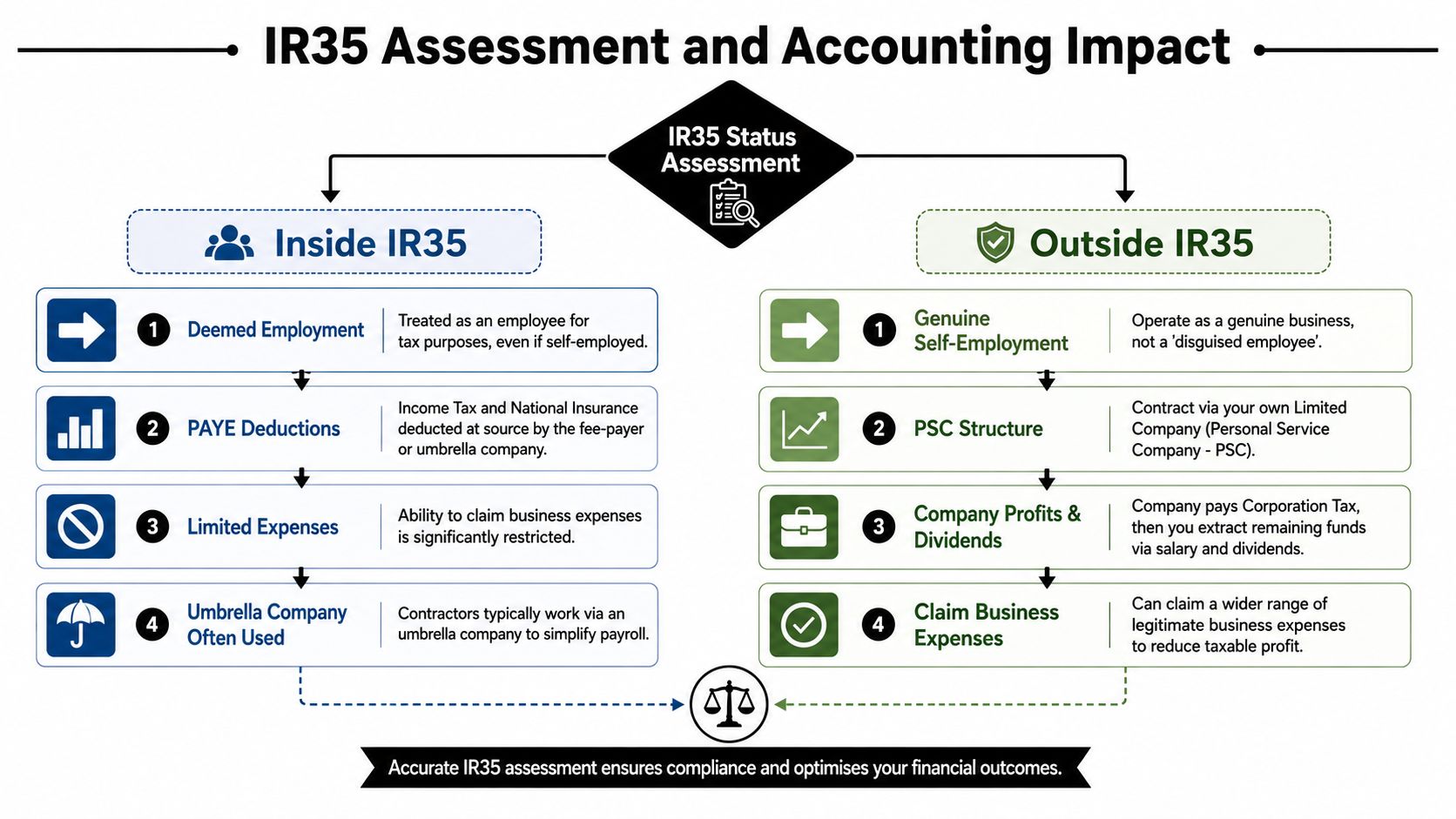
For a fuller primer, see our guide to IR35 for contractors.
What inside and outside IR35 really mean
If a contract is inside IR35, HMRC treats that engagement more like employment for tax purposes. You might still be a contractor in commercial terms, but the tax treatment shifts towards payroll-style deductions.
If a contract is outside IR35, the arrangement is treated as genuine self-employment for tax purposes, assuming the underlying working practices support that position.
The key point is that IR35 is not just a label. It changes the accounting.
Why the status affects your numbers
Inside IR35, the payment calculation has to reflect employment-style deductions. That's why contractors often feel a gap between the headline contract income and the amount that lands in their account.
One verified example shows the effect clearly. For a contractor inside IR35 earning £60,000 annually, the deemed employment payment calculation results in a net salary of approximately £42,000 after all taxes and NICs, because 95% of the income is treated as salary and a 5% allowance for administrative costs is applied before tax is calculated inside IR35 deemed payment example.
How to read that in plain English
That example doesn't mean every contractor on the same income gets the exact same result. It does show why an inside IR35 role often feels very different from an outside IR35 assignment, even when the contract value looks similar at first glance.
A sensible way to assess an inside IR35 offer is to ask:
- What is the quoted rate based on? Day rate language can hide how deductions will work in practice.
- Who is processing the payment? The fee-payer or umbrella arrangement affects what documents you'll receive.
- What will your payslip show? If you can't follow the gross-to-net path, ask for a worked illustration.
- Which expenses are allowed? Don't assume past practice still applies.
A contract rate is only half the story. Your real benchmark is the amount that reaches your bank after the correct tax treatment.
The accounting habits that matter under IR35
When IR35 applies, contractors need tighter records, not looser ones.
Keep these documents together for each assignment:
- Status documentation: any determination, contract wording, and agency communication.
- Payment records: payslips, remittances, and bank entries.
- Assignment-specific notes: especially if your working practices differ from the written contract.
- Expense evidence: only where the rules allow it and the treatment is clear.
IR35 creates confusion when contractors rely on assumptions. It becomes manageable when each contract has a clean paper trail and you check the numbers before the first payment arrives.
Invoicing and Record-Keeping Best Practices
A lot of accounting problems begin as paperwork problems. Late invoices delay cash. Missing receipts weaken your records. Poorly organised files turn simple HMRC questions into stressful ones.
What a good invoice should do
A professional invoice needs to be clear enough that the client can approve it quickly and detailed enough that you can defend it later if needed.
Include the basics every time:
- Your trading details: use the correct legal name and contact details for the entity sending the invoice.
- A unique invoice number: keep the sequence consistent.
- Dates that make sense: invoice date, service period, and payment due date should all be easy to follow.
- A clear description of work: link it to the contract, milestone, timesheet, or agreed deliverable.
- Payment instructions: make it easy for the client to pay without chasing you for bank details.
If the client uses purchase order numbers, approval portals, or agency timesheets, match their process exactly. Plenty of invoices are “late” because they were valid in principle but wrong for the client's workflow.
Keep records in a way HMRC would understand
Your future self should be able to answer three questions quickly. What did I earn? What did I spend? What evidence do I have?
That usually means keeping:
| Record type | Why it matters |
|---|---|
| Invoices issued | Evidence of sales and billing dates |
| Receipts and bills | Support for expenses and purchases |
| Bank statements | Proof of what was paid and received |
| Contracts and amendments | Context for status, rates, and terms |
| Payslips or remittances | Essential where payroll deductions apply |
Digital records are no longer optional for many contractors
Making Tax Digital changed the practical side of bookkeeping. From 1 April 2019, VAT-registered businesses have had to keep digital records and submit returns using compatible software, and that digital record-keeping expectation extends to Income Tax Self Assessment from April 2026 for many sole traders Making Tax Digital for VAT and future Income Tax changes.
That means old habits like paper folders and informal spreadsheets can leave gaps, even if they once felt “good enough”.
Use software that helps you work monthly, not software you only open at tax return time.
A simple workflow that works
Most contractors don't need a complicated finance stack. They need a routine.
- Raise invoices promptly after the work is approved.
- Capture receipts as you go, not in a pile at month end.
- Reconcile the bank account regularly so missing items stand out.
- Store contracts with payment records so the commercial and accounting story stays connected.
- Review one month at a time instead of trying to fix a whole year in one weekend.
Consistency beats intensity in contractor accounting. Small weekly actions prevent large year-end messes.
A Practical Checklist for Getting Started
The early setup matters more than commonly realized. If you make the right choices at the start, your admin becomes routine instead of disruptive.
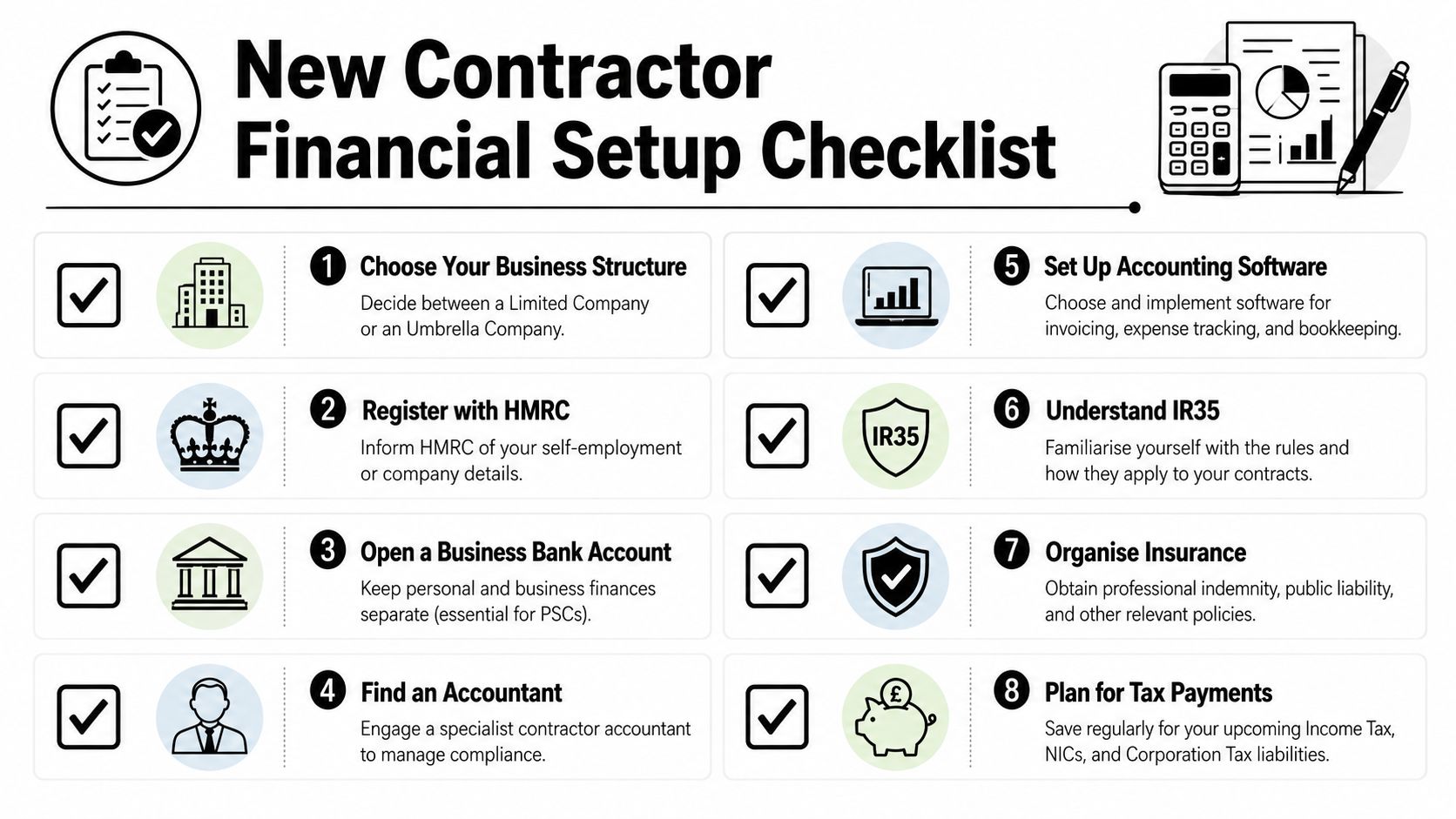
Use this checklist before your first payment arrives:
- Pick the right operating model: decide based on contract type, likely duration, and IR35 status, not instinct.
- Read the contract properly: confirm rates, billing terms, notice periods, and who handles status decisions.
- Set up the right account structure: if you're using a limited company, keep business and personal money separate.
- Choose your record-keeping method: use digital tools that support invoices, receipts, and regular reviews.
- Know your tax touchpoints: understand which deductions happen automatically and which ones you must plan for.
- Check how you'll be paid: invoice, payroll, or agency remittance all create different paperwork.
- Keep compliance documents together: contracts, payslips, invoices, and tax records should be easy to retrieve.
- Get specialist support early: it's easier to start clean than to fix a messy first year.
A contractor who starts with a simple system usually makes better decisions later. You don't need perfection. You need clarity, consistency, and enough structure to spot problems before they grow.
Take Control of Your Contractor Finances
Contractor accounting gets easier once you stop treating it like one big mystery. It's really a set of linked decisions. How will you operate, how will you be paid, what tax treatment applies, and what records prove it all?
The strongest setup is usually the simplest one that fits your contract properly. If the role is inside IR35 and short term, simplicity may matter most. If you're building a longer-term business outside IR35, control may matter more. Either way, clear records and a realistic view of take-home pay will save you stress.
Good habits also travel well. Even if you branch into broader self-employment later, many of the same principles appear in accounting insights for growing companies, especially around consistency, separation of finances, and disciplined record-keeping.
You don't have to know everything on day one. You do need a structure that matches the work you're doing now, and the confidence to ask questions before signing up to the wrong model.
If an umbrella company looks like the right fit for your next contract, Umbrella Company can help you compare compliant providers and find an option that suits your rate, sector, and IR35 position.


