


We at UmbrellaCompany.com have created this guide to explain the essentials of contracting in business in the UK, from choosing contract types to staying compliant with IR35 and HMRC rules. You will learn practical steps, review real examples and discover how an umbrella company can simplify your process.
Contracting in business means engaging specialist talent for a defined project or time frame instead of hiring someone permanently. It allows organisations to adjust headcount in line with demand, while contractors enjoy flexibility and varied assignments. To explore how to become a contractor, see our guide on how to become a contractor.
How Contracting In Business Works

Imagine your organisation as a stage and contractors as guest performers. You agree the scope, duration and fees in a contract. For example, you might engage a graphic designer on a three-month fixed-term contract to create marketing assets for a new campaign.
Below are some of the key advantages contractors and clients mention most:
- Cost Efficiency: Only pay for the agreed scope and duration.
- Access To Skills: Bring in niche experts exactly when you need them.
- Operational Agility: Ramp your workforce up or down in line with demand.
Quick Overview Of Contracting In Business
Before we dive deeper, here’s a snapshot of common contract forms, their standout feature and when you’d use them:
| Contract Type | Key Feature | Typical Scenario |
|---|---|---|
| Fixed Term | Set duration and scope | A software project lasting six months |
| Consultancy | Expert advice and deliverables | Business strategy review by a specialist |
| Umbrella Company | PAYE handled via an umbrella employer | Contractors seeking simplified administration |
This table gives you a quick guide to decide which path suits your next hire or engagement.
Key Topics Covered
We cover compliance, payment models and specialist expertise. You will learn to identify contract forms, assess IR35 status and decide if an umbrella company suits your needs. Each section builds on the last, giving a clear roadmap for businesses and contractors alike.
Contracting in business injects targeted expertise into your organisation without the long-term ties of permanent hires.
For instance, a finance firm might take on an interim CFO for six months to steer a merger. Likewise, a tech start-up could deploy blockchain specialists for a short campaign, avoiding the full costs of in-house onboarding.
Structure Of This Guide
We begin with essential definitions and simple frameworks before tackling procurement techniques, IR35 regulations and compliance checks. Later chapters share best practices, real-world examples and an FAQ to help you apply these insights.
You can also visit UmbrellaCompany.com to compare accredited providers or read our deep dive on IR35 compliance. Use the internal links to jump straight to the sections relevant to your contracting journey.
Let’s get started.
Understanding Key Concepts
Contracting in business gives organisations the agility to call in expert talent exactly when they need it. It’s like borrowing a specialist camera for a shoot instead of buying one.
Unlike permanent hires, contractors deliver a specific outcome and then move on, with no payroll or long-term benefits.
- Contracting involves bringing in specialist skills for a set timeframe or project, with clear deliverables.
- Self-employment means running your own business, handling tax through self-assessment and picking your clients.
- Procurement Methods are the routes an organisation takes to find and engage contractors, from open tenders to direct awards.
- Service Agreements spell out the tasks, milestones and payment terms between a contractor and their client.
Procurement Methods
Procurement methods shape how quickly and cost-effectively you secure top talent. The choice you make affects budget, timeline and risk.
- Competitive Tendering asks multiple suppliers to pitch, driving price competition.
- Direct Sourcing taps a known expert or a niche provider without a public bid.
- Framework Agreements lock in pre-approved terms with a pool of contractors, simplifying repeat hires.
Whichever path you choose, your service agreement should clearly define roles, deliverables and payment schedules. Always weigh risk appetite, deadlines and budget constraints before deciding.
Key Stakeholders
On a contracting project, several players share the stage:
- Clients set the scope, budget and success criteria.
- Agencies scout and vet suitable candidates.
- Intermediaries (for example, umbrella companies) manage PAYE, National Insurance and compliance.
As of August to October 2024, there were approximately 4.38 million self-employed professionals in the UK, contributing an estimated £150–£200 billion a year. Demand is especially strong in tech, where cybersecurity contractors command daily rates of £500–£750. Read the full analysis on IT Contractors UK.
The image highlights the 4.38 million self-employed professionals generating up to £200 billion, underscoring robust demand, particularly in tech roles.
Benefits For Businesses And Contractors
- Operational Agility: Scale teams up or down quickly without long-term commitments.
- Expert Access: Plug skill gaps instantly, whether it’s a data scientist or a cybersecurity guru.
- Cost Control: Fixed fees and transparent payment schedules keep budgets on track.
- Administrative Ease: Agencies and intermediaries handle vetting, payroll and compliance.
UK Regulatory Landscape
Contracting must align with HMRC guidelines, IR35 rules and sector-specific regulations. Get this wrong and you could face back taxes, interest and fines.
Use HMRC’s Check Employment Status for Tax (CEST) tool (https://www.gov.uk/guidance/check-employment-status-for-tax) for initial guidance, but remember tribunal rulings carry real weight.
- Gather Evidence: Collect contracts, emails and records of working patterns.
- Run Status Checks: Use CEST and seek professional advice.
- Document Decisions: Issue signed Status Determination Statements to create an audit trail.
Properly structured contracts create clarity for both parties and reduce the risk of misclassification.
Contractors Versus Employees Comparison
| Aspect | Contractor | Employee |
|---|---|---|
| Control | High autonomy | Employer direction |
| Benefits | No statutory rights | Paid leave, pension contributions |
| Tax | Self-assessment or PAYE via umbrella | PAYE and National Insurance |
| IR35 Risk | Subject to status checks | Not applicable |
This table shows that contractors trade employee benefits for greater autonomy, making accurate status checks essential.
Practical Illustration
A tech start-up needed a blockchain specialist for six months to build a secure ledger. They drafted a service agreement with clear milestones and a daily rate.
An IR35 review confirmed substitution rights, ensuring compliance and mutual clarity.
- Draft a concise service agreement outlining scope and payment terms.
- Conduct and record status checks.
- Agree on reporting lines while protecting contractor autonomy.
- Submit timesheets and invoices as per the contract.
- Keep communication channels open to avoid disputes.
This step-by-step example demonstrates setting up a compliant contractor engagement from start to finish.
Check out our guide on how to become a contractor for practical steps to launch your own contracting journey with confidence.
Types Of Contracts And Procurement Methods
Picking the right contract can feel like choosing the perfect tool for the job. Organisations need agreements that match their project’s scale, timescales and budget. You might opt for a fixed-term role, a flexible framework or a direct-sourcing arrangement. Below, we unpack each option and explain when to call for competitive bids or simply award work to a single provider.
Common contract types:
- Fixed-Term Contracts set a clear start and finish date, with deliverables agreed in advance.
- Rolling Contracts continue on an open-ended basis until one party gives notice.
- Framework Agreements pre-approve a roster of suppliers under standard terms for multiple call-offs.
- Direct-Sourcing Contracts let you appoint a known expert or trusted partner without opening up to the market.
Fixed-Term And Rolling Contracts
Fixed-term agreements work well when your project has clear milestones. You lock in budgets, deadlines and deliverables from day one, so there’s minimal guesswork.
In contrast, rolling contracts give you breathing space. They roll on automatically but demand clear notice periods if either side wants to wrap things up. This flexibility suits projects that may need to pivot or extend on the fly.
Key differences:
- Fixed Timeline vs Open-Ended: A defined end date or an ongoing arrangement.
- Budget Certainty vs Adaptability: Locked-in costs or room to adjust as needs change.
That chart from the MOD highlights a growing shift towards non-competitive awards.
Framework Agreements And Direct Sourcing
Framework agreements shine when you foresee repeat purchases. You negotiate terms once, then tap into a pool of pre-approved suppliers whenever the need arises. This approach slashes bid time and nails down governance up front.
Direct sourcing, on the other hand, suits urgent or highly specialised tasks. When you know the right person or outfit for the job, you can bypass an open competition and get to work fast.
Advantages at a glance:
- Frameworks bring standardisation and efficiency.
- Direct sourcing delivers speed and trusted expertise.
In 2024/25, the UK Ministry of Defence channelled 49% of its new spend — £20.9 billion — through direct or single sourcing, the highest level since 2015/16. Learn more about these findings
Procurement Methods Overview
When you choose a procurement route, you’re weighing cost, speed and risk. Do you invite the market to compete? Or do you tap a proven supplier straight away? Here’s a side-by-side view.
| Method | Percentage of Contracts | Annual Spend | Key Features |
|---|---|---|---|
| Competitive Tendering | 51% | £21.9 billion | Open bids, transparent scoring |
| Single Sourcing | 49% | £20.9 billion | Faster awards, limited market testing |
| Framework Agreements | Varied | Varies by sector | Pre-approved terms, supplier pools |
This table shows how each route balances transparency, speed and flexibility.
When to pick each route:
- Competitive Tendering: Clear requirements, broad market interest.
- Single Sourcing: Tight deadlines or niche expertise needed.
- Framework Agreements: Recurring projects with predictable volumes.
You might also find our freelance contract templates in the UK useful for a ready-made structure.
Direct sourcing can cut procurement time by up to 30% when you work with pre-vetted suppliers.
Case Examples
A local authority ran an open tender for a four-year IT support contract. Eight suppliers pitched in, driving costs down by 12% and raising service levels.
Key success factors:
- Clear evaluation criteria linked to project goals.
- Stakeholder input at every review stage.
- Strict timelines to keep bidders on track.
Meanwhile, a defence contractor direct-sourced a cybersecurity specialist. They filled a vital role in just two weeks.
Top benefits:
- Instant start without lengthy tender prep.
- Access to niche skills for sensitive work.
- Confidentiality on technical details.
Assess each method against your objectives, involve stakeholders early and log every decision. Our comparison portal at UmbrellaCompany.com offers a quick view of umbrella-pay options across contract types.
Stay agile, stay compliant and pick the procurement route that meets your goals from day one.
IR35 Rules And Compliance
Navigating IR35 can feel like choosing the right path in a maze. At its core, IR35 decides whether a contractor is really acting as an employee for tax purposes. Get this wrong, and both the contractor and the end client could face unexpected bills from HMRC.
In April’s private sector reforms, the onus shifted squarely onto the end client. Now they must issue a Status Determination Statement (SDS) and explain the reasoning behind it. Contractors, in turn, need to scrutinise these statements to make sure their IR35 status is accurate.
Below is an infographic that outlines decision points around procurement choices and contracting routes.
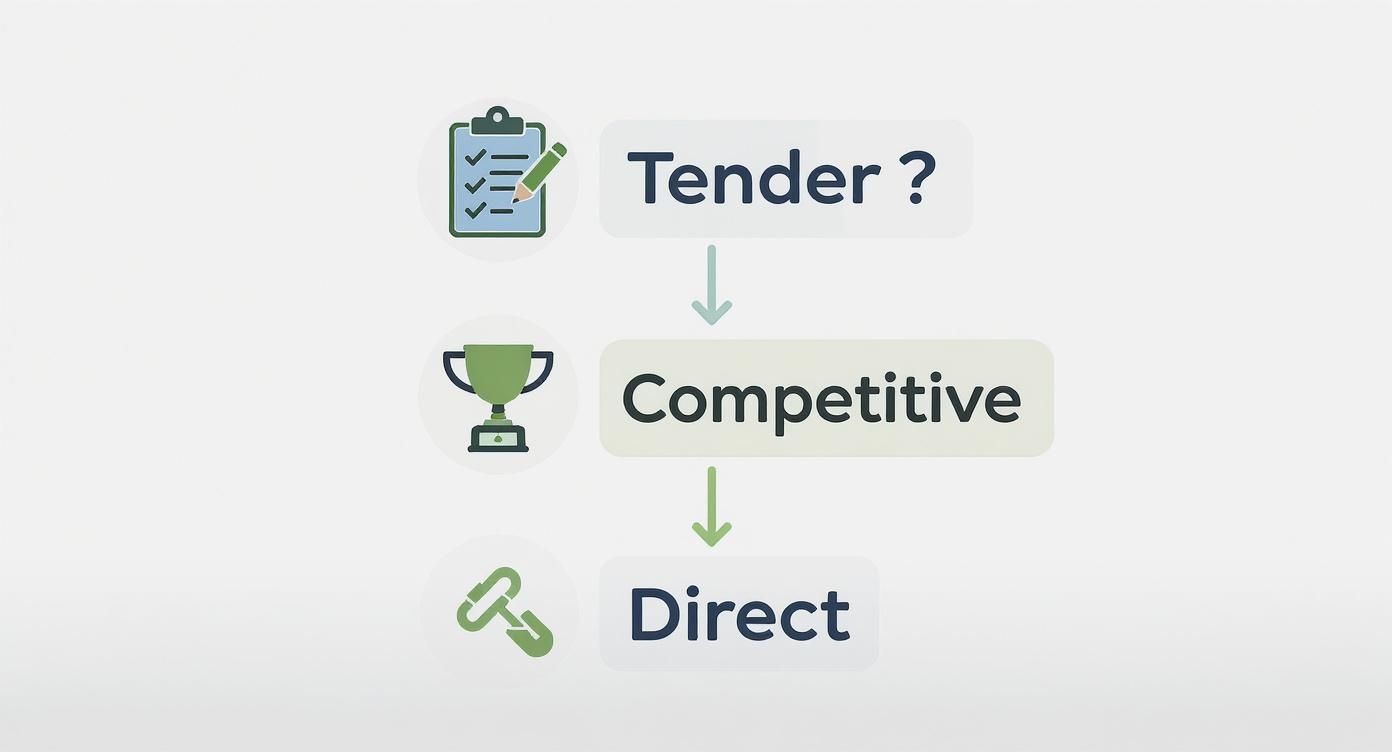
After you’ve taken in the graphic, the next step is to understand the exact tests HMRC uses to settle any disputes.
HMRC Status Tests
HMRC breaks down IR35 into three straightforward checks. Think of them like checkpoints on a drive, you either pass each one, or you might find yourself inside IR35.
- Control: How much say does the client have over your day-to-day work? It’s not just about tasks, but setting your hours and priorities too.
- Substitution: Are you free to send someone else in your place? A genuine right to substitute usually points to being outside IR35.
- Mutual Obligations: Does the client have to offer follow-on work, and do you have to accept it? True autonomy is a strong sign of being outside IR35.
Key Takeaway
If HMRC finds you inside IR35, you could face liabilities of up to 100% of unpaid tax plus interest.
IR35 Status Comparison
| Status | Employment Rights | Tax Responsibilities | Typical Use Cases |
|---|---|---|---|
| Inside IR35 | Paid leave, pension, payslips | PAYE and NIC deducted by client | Long-term projects with fixed hours |
| Outside IR35 | No employment benefits | Contractor handles tax directly | Project-based work with true autonomy |
This table highlights how a small change in oversight can tip your engagement from one category to the other. Keep these contrasts in mind when you’re negotiating terms.
Documentation Best Practice
Think of paper trails as your safety net in any IR35 review. The clearer your records, the more robust your defence.
- Gather signed contracts, all emails and any committee minutes.
- Track working patterns, reporting lines and supervision levels.
- Ensure the client issues signed Status Determination Statements to every contractor.
- Store everything securely for at least six years in case HMRC comes knocking.
Key Mitigation Tips
Staying ahead of IR35 is about consistent vigilance, not one-off checks.
- Review each contract at least once a year to capture scope changes.
- Consider professional status review services for complex roles.
- Archive contracts and communications in a searchable, secure system.
- Engage a legal specialist to double-check borderline cases.
- Join industry forums to keep up with evolving IR35 interpretations.
Penalties And Mitigation
If you slip up, HMRC won’t just send a polite reminder. Expect sharper measures.
- Tax liabilities and interest on any unpaid amounts.
- Penalties soaring up to 30% of the outstanding tax.
- Lengthy audits that can tie up valuable resources.
Proactive assessments and clear, ongoing dialogue with stakeholders will reduce your exposure to these risks.
Action Plan For Contractors And Businesses
- Run HMRC’s CEST tool for a quick status indication.
- Bring a qualified tax adviser or legal expert into the conversation early.
- Document any changes in scope or working patterns straight away.
- Embed status checks into project kick-off processes.
- Communicate and agree status determinations with all parties, then sign off.
- Schedule periodic reviews at major milestones so nothing slips through the cracks.
For an in-depth walkthrough, check our detailed IR35 guide.
Top Takeaways
- Confirm status early under HMRC’s three tests
- Keep substitution and control clauses crystal clear
- Maintain a complete, well-organised audit trail
By following this roadmap, you’ll not only meet compliance requirements but also build stronger trust between everyone involved.
Role Of Umbrella Companies

For many contractors, an umbrella company feels like a safety net. It becomes your employer on paper, handling PAYE, National Insurance and payslip production so you don’t have to.
By taking care of the entire payroll cycle, you can dedicate yourself to the work that really matters. From holiday pay calculations to day-to-day tax deductions, everything stays on the right side of HMRC.
Key Advantages
- Simplified Administration: Payroll, invoicing and compliance all happen behind the scenes.
- Statutory Protections: You gain rights such as paid holiday and statutory sick pay.
- Access to Benefits: Many umbrella providers offer pension schemes and insurance cover.
However, this convenience comes at a cost. Providers typically charge a margin of 3%–10% to cover their services and overheads.
How Umbrella Employers Operate
When you sign up through UmbrellaCompany.com’s portal, we pair you with an accredited umbrella provider. They officially employ you for each assignment and route your timesheets and expenses through PAYE.
- You submit timesheet and expense claims.
- The umbrella company issues an invoice to your end client or agency.
- Payroll processes deductions and transfers your net salary.
This approach cuts down on paperwork and reduces risk for you, the agency and the client alike.
Key Insight
85% of contractors report a significant drop in admin time after moving to an umbrella company.
Choosing The Right Provider
Picking a compliant umbrella firm is vital if you want to protect your take-home pay and stay onside with HMRC. Use this checklist when evaluating options:
- Check for FCSA or Professional Passport accreditation.
- Compare provider margins and insist on transparent fee breakdowns.
- Read user reviews and ratings on UmbrellaCompany.com.
- Review service level agreements covering support, expenses and insurance.
| Feature | Umbrella Company | Direct Contract |
|---|---|---|
| Admin Burden | Low | High |
| PAYE Compliance | Managed by employer | Contractor responsibility |
You might be interested in a deeper explanation of this model. Learn more about umbrella companies in our umbrella company definition.
Example Case Study
Think of an umbrella company as a protective shield, covering compliance and paperwork so you can focus on what you do best. For instance, one software developer joined an FCSA-accredited provider via our portal and saw a 50% drop in admin hours.
They enjoyed faster invoice turnaround and were free to take on extra contracts without any extra overhead. To protect yourself further, always check:
- Provider Stability: Verify the company’s financial health to avoid service disruptions.
- Response Times: Ensure they offer prompt support and clear communication channels.
Drawbacks To Consider
While umbrella companies simplify administration, there are a few trade-offs:
- Provider Margin Impact: Fees can reduce your net income compared to a limited company route.
- Expense Limitations: Not all expenses qualify, so always read the provider’s policy carefully.
- Dependency on Provider: Your experience hinges on the umbrella firm’s processes and stability.
Choosing the right partner means balancing convenience against cost and control. Our portal lets you compare service-level details side by side, so you can weigh these factors before you commit.
Start your free comparison today.
Best Practices And Case Studies
Contracts can trip you up if the terms aren’t clear or if you underestimate IR35 exposure. Below, you’ll find tested methods to draft rock-solid agreements, reduce tax risk and push for fees that reflect your worth.
Drafting Clear Contract Terms
Imagine your contract as a building plan. A well-defined blueprint stops misunderstandings before they start. Open with a straightforward scope of work, spelling out what you will deliver, by when and for how much.
Next, slip in a substitution clause to support an outside IR35 position. It’s like having an emergency exit, it shows you can send in a peer to cover tasks when necessary.
- Scope and Deliverables – List tasks, milestones and acceptance criteria.
- Payment Terms – State your daily or hourly rate, invoicing schedule and any late-payment fees.
- Termination and Notice – Agree notice periods and outline what happens if things don’t go to plan.
Managing IR35 And Rates
IR35 can feel like navigating a maze. The trick is to get a written status determination from your client, documenting how they test control, substitution and mutual obligation.
When you discuss your daily fee, use market data to justify your figure. Remember to build in a buffer for any tax liabilities handed back by HMRC.
- Compare your rate against similar roles in your sector.
- Add a risk premium to cover potential IR35 challenges.
- Agree on a review clause so rates can be revisited if rules shift.
Key Insight
Keep all signed status letters and contracts in one place. This creates a clear audit trail and saves headaches later.
Case Study And Screenshot
A cyber-security specialist won a direct award after proving genuine substitution rights and presenting precise timesheets. Clear dialogue and IR35-proof clauses quieted client doubts quickly.
Meanwhile, a public-sector construction supplier clinched 74 contracts worth £3.1 billion in 2024/25. That haul included framework deals like SCAPE Civil Engineering valued at over £20 million, underlining how vital contract labour is for large-scale projects. Discover more in the Tussell report.
The screenshot below shows how strategic framework call-offs drive scale.
Case Study 2 looks at a supplier that used repeated framework call-offs to grow quickly. They kept standardised timesheets and matched each contract clause to the framework rules. The result? Faster call-offs and stronger client trust.
- Stuck to consistent pitch templates.
- Secured several call-off orders with minimal paperwork.
- Built long-term rapport by meeting deadlines every time.
These stories emphasise the power of detailed documentation and clear negotiation. You can adapt their contracts as templates for your next deal.
Applying These Practices
You don’t need a fancy toolkit to apply these lessons. Follow these simple steps on any project:
- Keep accurate timesheet records to show how and when you work.
- Secure written status determinations to outline your IR35 standing.
- Nurture client ties through regular check-ins and consistent delivery.
| Practice | Benefit |
|---|---|
| Clear Scope Clauses | Reduces scope creep |
| Written Status Determination | Clarifies tax responsibilities |
| Rate Benchmarking | Ensures competitive compensation |
Put these best practices into action, and you’ll sharpen your contract clarity, cut down IR35 risk and make stronger fee agreements.
FAQ
What Is Contracting In Business And How It Differs From Employment
Contracting in business means you’re hired for a specific project or fixed timeframe, rather than a permanent role. You agree on deliverables, enjoy greater flexibility and often control your own working hours.
By contrast, employees work set hours under company direction and receive statutory benefits like paid holiday and pension contributions. Contractors invoice for their services; employees simply wait for their payslips via PAYE.
For instance, a marketing agency might engage a specialist designer on a six-month contract to refresh its brand identity.
- Contractors handle their own tax through self-assessment or via an umbrella company.
- Employees benefit from employer pension contributions and holiday pay.
- Contractors concentrate on project outcomes instead of team-based responsibilities.
How Can I Determine My IR35 Status
Working out your IR35 status boils down to three main factors: control, substitution and mutual obligation. HMRC’s Check Employment Status for Tax (CEST) tool offers a quick assessment, but seeking professional advice ensures you cover all bases.
A clear contract and accurate records of your day-to-day working habits can guard against misclassification.
Key steps to follow:
- Review how much control your client has over your schedule and methods.
- Ensure substitution rights are explicitly written into your contract.
- Confirm there’s no ongoing obligation beyond the project’s end.
When Should I Use An Umbrella Company
An umbrella company becomes your employer for PAYE, National Insurance and payslip management. This route suits contractors who’d rather focus on the job than wrestle with admin.
- Register with an accredited provider such as FCSA or Professional Passport.
- Submit timesheets and expense claims via their online portal.
- Receive your net salary without handling PAYE deductions yourself.
Tip: Always compare fee structures and ask for full transparency on any margins.
Example: One contractor cut down 10 hours of monthly admin after switching to an FCSA-accredited umbrella provider.
What Are The Tax Implications For Contractors
Contractors can operate as self-employed, through a limited company or via an umbrella company. Each model has its own tax rules and record-keeping requirements.
| Structure | Tax Treatment |
|---|---|
| Self-Employed | Self-assessment return; pay Class 2 and Class 4 NI |
| Limited Company | Corporation tax; plan dividend distributions |
| Umbrella Company | PAYE deductions for tax and NI; both employer and employee NI |
You’ll also need to monitor VAT registration thresholds, track allowable expenses and consider pension contributions. With the right strategy, you could increase your net income by up to 15%.
For example, a limited company contractor typically pays 19% corporation tax on profits, then 8.75% tax on dividends as a basic-rate taxpayer. Thoughtful dividend planning can translate into significant savings.
- Keep an eye on your VAT turnover each quarter.
- Claim legitimate expenses — travel, subsistence or home-office costs.
- Contribute to a pension to reduce your taxable profits.
Get tailored advice from an accountant to make sure your tax strategy fits your personal circumstances.
Where To Find Further Guidance
Official UK guidance, including the CEST tool, is available on HMRC’s website. You can also explore IR35 and umbrella company checklists on UmbrellaCompany.com.
Conclusion
Contracting in business offers operational agility, access to specialist skills and cost control. You can choose from fixed-term, framework or direct sourcing contracts, each with clear benefits. By following HMRC’s IR35 status tests and using robust documentation you minimise tax risk. An umbrella company can simplify administration and deliver statutory protections. Put these best practices into action to build clearer contracts, reduce compliance risks and secure the talent you need.
Ready to simplify your contracting journey with clear guidance and side-by-side comparisons? Visit UmbrellaCompany.com to start your free comparison today.


