


You're probably in one of two positions right now. You're either an engineer in a permanent role who's tired of annual pay reviews that lag behind your market value, or you've already seen contract roles advertised and aren't sure whether the higher rate is worth the extra complexity.
That hesitation is sensible. Contracting engineering jobs can give you more control over the work you take, the sectors you move between, and the way you price your expertise. They also bring sharper commercial realities. You have to win work, assess contract terms, understand IR35, and choose a payment structure that won't create problems later.
The engineers who do well in contracting usually treat it as a professional service, not as a short-term escape from employment. They learn how assignments are classified, how project terms affect risk, and how to protect margin after tax, travel, and downtime are taken into account.
Your First Step into Engineering Contracting
A maintenance shutdown overruns on Friday. By Monday, the client needs an engineer who can get on site, work safely within a live project, and start solving problems without weeks of onboarding. That is the commercial logic behind engineering contracting in the UK. Clients buy access to delivery capacity when permanent teams are stretched, project milestones are fixed, or specialist experience is only needed for part of a programme.
For engineers, that creates opportunity, but only if the move is treated as a business decision rather than a reaction to frustration with a permanent role. Higher day rates can disappear quickly once you factor in unpaid gaps, travel to site, certification renewals, and the tax position of the assignment. That matters even more in engineering, where project work often involves site allowances, mobility expectations, and role-specific IR35 risk that general contracting advice tends to ignore.
Start with your commercial profile
Before you apply, define what a client is buying from you.
A permanent CV usually explains progression. A contract CV needs to show usable delivery value. Recruiters and hiring managers want to see the systems you know, the project stages you can own, the environments you have worked in, and how fast you can become productive.
Good evidence usually includes:
- Project examples with scope and outcome such as design packages delivered, commissioning completed, compliance issues resolved, outages supported, or controls faults diagnosed
- Tools, platforms, and standards you can use without supervision, including CAD packages, PLC environments, regulated documentation, permit systems, QA processes, or reporting requirements
- Practical deployment details such as notice period, right to work, site readiness, travel radius, security clearance status, and whether you can work nights, shutdowns, or rotations
- A contractor-style CV structure that puts assignments, deliverables, and technical relevance ahead of internal promotion history
If you're repositioning your background from employee to contractor, this guide to self-employed resumes is a useful reference for presenting your experience in a more commercial format.
One more point matters at the start. Decide how much uncertainty you can carry.
Some engineers move into contracting with six months of cash reserve and a clear target sector. Others resign after seeing one attractive rate on a job board. The second route creates avoidable pressure and usually leads to poor decisions on rate, payment model, or travel commitments. Read through how to become a contractor before you hand in notice, then test the numbers against your own likely costs and downtime.
Practical rule: Leave a permanent role once you understand how you will win work, how the assignment is likely to be taxed, and what your real take-home looks like after gaps, travel, and site-related costs.
Finding and Winning Your First Engineering Contract
It is 4:30pm on a Thursday. A recruiter calls about a controls contract starting Monday on a food manufacturing site. The hiring manager wants someone who can walk into a live environment, handle the PLC platform already in use, work with maintenance and production, and get productive without hand-holding. That is how many first contracts are won. Speed matters, but relevance matters more.
Technical ability gets you considered. Commercial clarity gets you shortlisted.

Where good contract leads actually come from
General job boards have a place, especially for tracking who is hiring and which sectors are active. They are rarely the strongest source of first assignments on their own. In engineering, the better opportunities often sit with recruiters already supplying into specific programmes, shutdowns, upgrade works, validation projects, or framework-backed delivery teams.
The most reliable channels are usually:
- Specialist engineering recruiters with active clients in manufacturing, energy, utilities, rail, defence, building services, or infrastructure
- LinkedIn recruiter searches built around exact software, standards, equipment, and sector keywords
- Former employers, subcontractors, and suppliers who know how you perform under project pressure
- Niche industry groups and referral networks where short-term demand appears before a full advert is written
Public sector and regulated work needs a slightly different approach. Procurement rules, onboarding checks, and project approvals can slow the process, but they also create repeat demand for engineers who are already known to the supply chain. If that route interests you, this guide to winning govcon is useful background reading.
Build a profile recruiters can place fast
Recruiters search LinkedIn and CV databases using terms that match the job spec. A vague profile forces them to guess. Good contractor profiles remove guesswork.
State the things that affect deployability straight away:
| What to include | Why it matters |
|---|---|
| Core technical keywords | Recruiters search exact systems, software, standards, and equipment names |
| Project setting | Site, design office, regulated plant, shutdown, commissioning, cleanroom, offshore, hybrid |
| Availability | Contract start date, notice period, and whether you can mobilise quickly |
| Location and mobility | Travel radius, UK-wide travel, lodge away, shifts, nights, weekends |
| Clearance or access status | BPSS, SC, DBS, or site-specific readiness where relevant |
A headline such as "Mechanical Engineer" says very little.
A headline such as "Mechanical Design Engineer, SolidWorks, special purpose machinery, CE marking exposure, open to UK contract work from July" gives a recruiter something they can sell.
Your CV needs to show low hiring risk
First-time contractors often submit CVs that read like internal promotion histories. That format works poorly in the contract market.
Hiring managers want evidence that you can enter a live project and produce useful output quickly. Put assignments, systems, deliverables, and operating conditions near the top. If you supported FAT and SAT, closed snagging lists, revised P&IDs, produced drawing packs under change control, wrote validation documents, or coordinated contractors during outages, say so plainly.
Use detail that signals real project exposure. Site permits. Shift patterns. Handover requirements. Document control. Client reporting. RAMS input. Regulated change processes. Those points matter because engineering clients are buying reduced delivery risk, not just technical knowledge.
Apply with a contractor's logic
Volume alone is a poor strategy. Six well-targeted applications usually beat forty generic ones.
For a first contract, aim for work where your background matches the brief closely enough that a recruiter can explain your fit in one sentence. "Process engineer with wastewater upgrade experience and immediate availability." "EC&I engineer who has done commissioning support on packaging lines." "Civil engineer with rail drainage and asset renewal exposure." That level of fit gets traction.
Be realistic about what the client is really buying. A design office contract may favour software speed and drawing output. A site role may prioritise permits, toolbox talks, isolation awareness, and confidence around subcontractors. A field service role may pay well on paper but become less attractive once travel time, unpaid downtime, and accommodation patterns are considered. Sense-check those trade-offs early with a contractor rate calculator for engineering assignments.
Engineering demand in the UK remains strong in many technical niches, as noted earlier, but demand does not remove the need for sharp positioning. Contractors get hired faster when they present themselves as safe, relevant, and ready to deliver from day one.
Setting Your Rate and Vetting the Contract
A first engineering contract often looks straightforward. The rate looks better than your salary equivalent, the recruiter wants a quick answer, and the client says they need someone on site by Monday. Then the detail shows up. Long travel days, capped expenses, weekly timesheets with delayed approval, and a scope written so loosely that extra work is treated as part of the original brief.
That is where margin disappears.
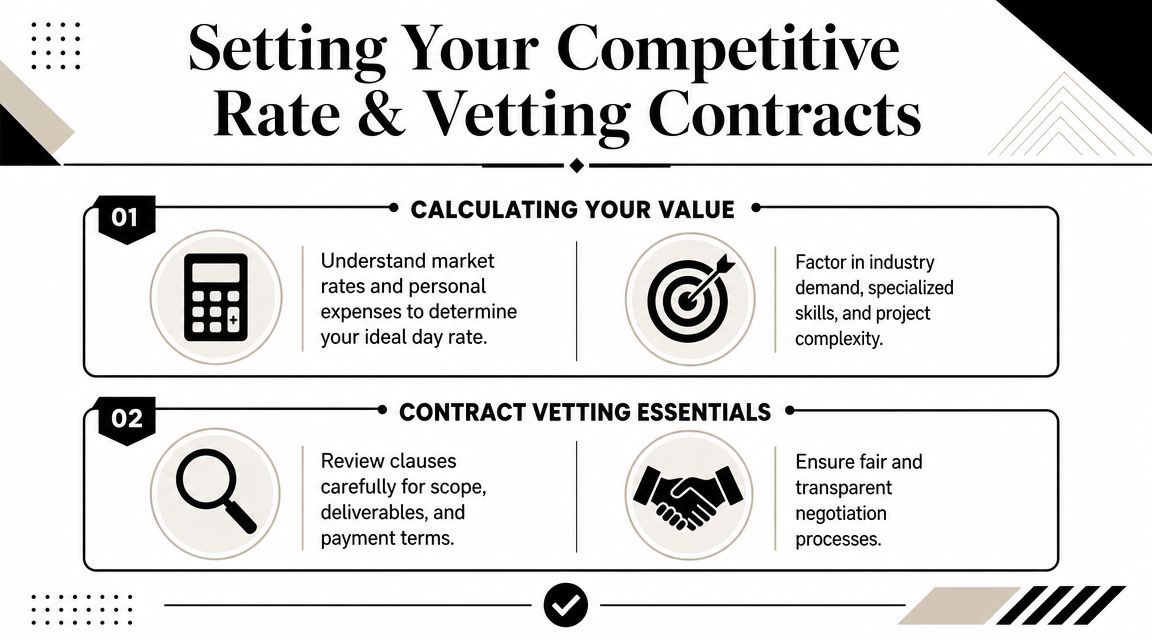
Set a rate that reflects the real move
Engineering contractors do not price work the same way permanent staff price a salary move. The rate has to absorb uncertainty, cover non-billable time, and reflect the practical demands of the assignment.
For UK engineers, that usually means checking more than the headline day rate:
- Gaps between projects and the fact you are only paid when engaged
- Loss of employee benefits such as holiday pay, sick pay, bonus potential, and employer pension contributions
- Travel and site patterns, including mileage, accommodation, parking, early starts, and whether the site is local enough to be sustainable
- Admin and payment friction, especially if timesheets, purchase orders, or milestone approvals can hold up payment
- Role-specific pressure, such as shutdown work, commissioning weekends, permit-heavy environments, or regulated documentation burdens
A controls engineer covering a fast-track factory installation should not price themselves the same way as a design engineer doing steady remote CAD support. A rail site role with nights and weekend possessions also needs a different calculation from an office-based water sector assignment. Same discipline. Different commercial reality.
Use a sense check before you agree terms. This contractor rate calculator for engineering assignments is a useful starting point, but apply engineering judgement to the result. Ask what the job demands, what it stops you taking on elsewhere, and what happens if the project slips by six weeks.
Vet the contract before you accept the rate
The contract decides how easy this assignment will be to deliver and how expensive it will be if something goes wrong.
Read it like someone reviewing a specification. Focus on what triggers payment, what counts as extra work, and where liability sits. On engineering projects, loose wording causes predictable problems. The client assumes broad availability. The contractor assumes a defined package of work. The gap between those two positions usually appears halfway through the assignment, when deadlines tighten and nobody wants to revisit commercials.
Check these points carefully:
- Scope of work. Is the work package specific, or are you being hired for general support with no clear boundary?
- Deliverables and sign-off. Who accepts the work, and what evidence is needed for approval?
- Change control. What happens if drawings, reports, commissioning support, or site attendance expand beyond the original brief?
- Payment terms. Is payment tied to a weekly timesheet, monthly invoicing, or milestone acceptance? How long is the approval chain?
- Expenses and allowances. Are travel, lodge, mileage, and subsistence covered, capped, or rolled into the rate?
- Notice and termination. How much income risk do you carry if the project pauses or the client reshuffles priorities?
- Liability and indemnities. Are you being asked to accept a level of risk that does not match the value or nature of the assignment?
This matters more in engineering than many new contractors expect. Site-based roles often blur into ad hoc support. Project managers ask for "just one more day" on commissioning. Design changes arrive late. If the paperwork does not define the edges, the contractor usually absorbs the extra time.
Watch for contract wording that weakens your position
Some phrases deserve immediate scrutiny.
“Support as required.” “Reasonable additional duties.” “Work across multiple sites.” “Rate inclusive of all travel and incidental costs.” None of these are automatically unacceptable, but each one can reduce your control over time, costs, and scope.
The safest position is clarity. If a client needs flexibility, pin down what that means in practice. Which site locations are covered? How many days per week on site? Are overnight stays expected? Is overtime paid, included, or subject to prior approval? For engineers on project work, those details affect net income far more than a small uplift in the advertised rate.
If you will invoice directly for an outside-IR35 assignment or separate project work, keep your admin clean from day one. A simple process using Google Docs invoice templates is often enough if the assignment does not justify full accounting software.
One final point. If the wording is vague before you start, administration rarely gets cleaner once the project is under pressure. Ask the awkward questions early. Solid clients answer them clearly. Weak clients usually dodge them, and that tells you something useful before you commit.
Navigating IR35 and Your Payment Options
In this scenario, many engineering contractors make costly assumptions. They see a rate, assume they can invoice through a limited company, and only discover later that the role has been assessed differently.
The off-payroll rules changed the shape of the UK contract market. The rules were introduced into the public sector in April 2017 and extended to medium and large private-sector organisations on 6 April 2021. HMRC estimated the 2021 reform would raise around £1.3 billion over four years, reflecting how many engagements were expected to shift from personal service companies into PAYE-style umbrella arrangements, according to this market trends summary.
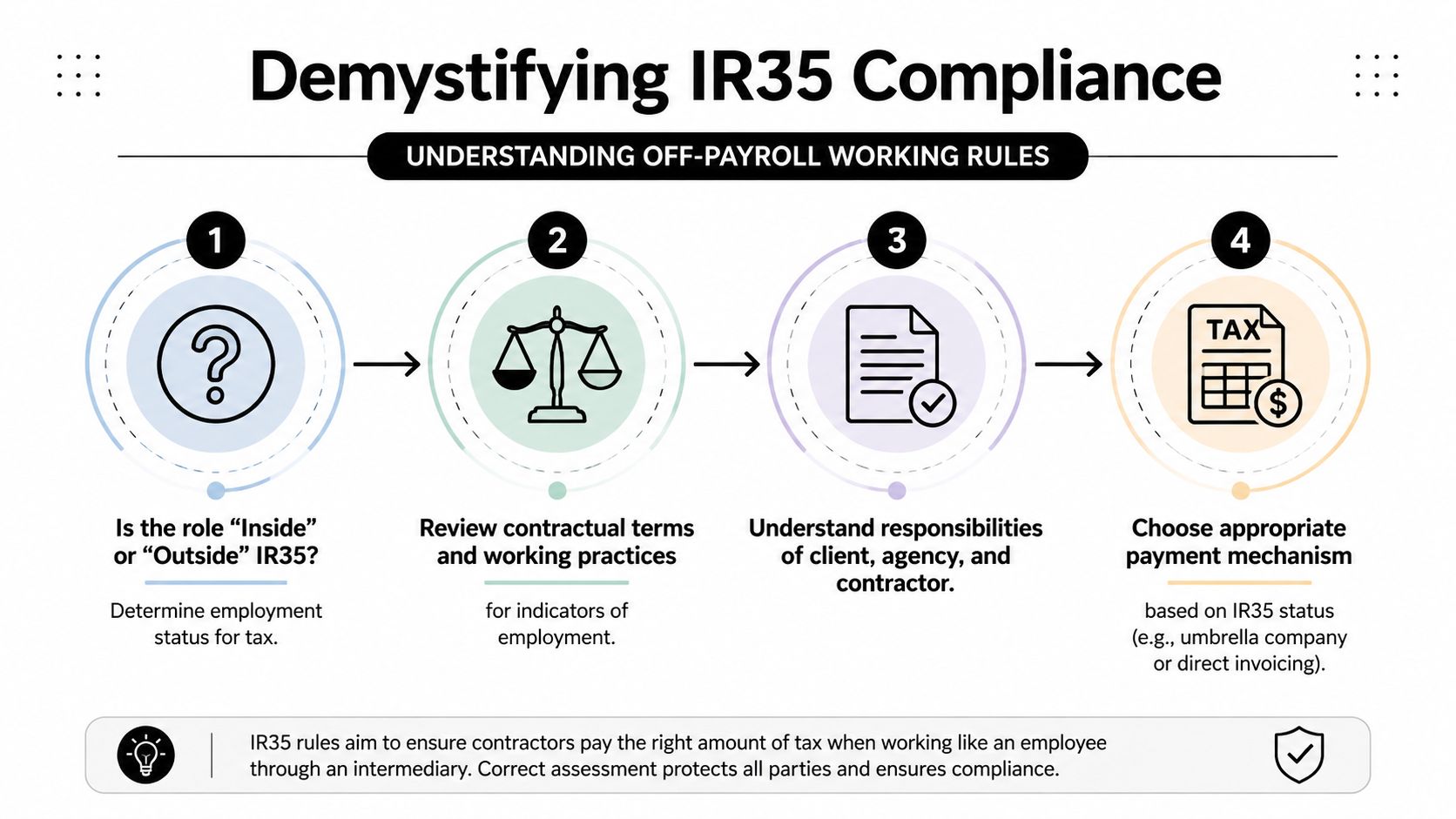
What IR35 means in plain English
IR35 is about whether, for tax purposes, the engagement looks more like employment or a genuine business-to-business service.
That distinction matters because it affects how you're paid and how much reaches your account after deductions.
A simple comparison helps:
| Status outcome | Practical effect |
|---|---|
| Inside IR35 | The role is treated like employment for tax purposes |
| Outside IR35 | The engagement is structured more like a genuine contracted service |
The difficult part isn't the label. It's the evidence behind it. Contract wording, actual control over the work, substitution rights, and the day-to-day reality all matter.
Who decides the status
For most medium and large private-sector clients, the client is responsible for determining status. That's not an administrative detail. It shapes the entire payment route.
If a client issues an inside-IR35 determination, agencies and payroll intermediaries will usually avoid anything that looks like personal service company risk. That is why so many engineering contractors working on temporary projects are now paid through umbrellas.
Here's a practical explainer before the video.
Why inside IR35 often leads to an umbrella
An inside-IR35 role doesn't automatically mean the assignment is bad. It means the tax treatment is tighter and the payment path needs to be compliant.
In practice, umbrella companies often become the sensible option because they:
- Run PAYE payroll so tax is handled through an established employment model
- Reduce status risk in the payment chain for agency-supplied assignments
- Provide payslips and statutory employment rights under the umbrella employment model
- Remove the need to operate a limited company for a role that won't be paid in a limited-company-friendly way
That link between status and structure is what many generic articles miss. They explain IR35 in theory but don't explain what engineers face on real assignments. If you're on a site-based project, working fixed hours, reporting into a client hierarchy, and following their delivery controls, the commercial reality often points to an umbrella arrangement if the determination is inside.
What works and what doesn't
What works:
- getting the status decision before you resign from a permanent role
- asking for the status determination and reading the assignment terms together
- understanding whether travel patterns, site location, or temporary allowances affect take-home expectations
- choosing a compliant payment route that matches the engagement
What doesn't:
- assuming “contract” means “outside IR35”
- focusing only on the headline day rate
- joining any scheme that promises unusually high take-home pay without clear explanation
- ignoring the difference between contract wording and actual working practice
If you need a practical grounding before accepting an offer, IR35 guidance for contractors is worth reviewing alongside the assignment paperwork.
Choosing and Onboarding with an Umbrella Company
By the time an engineer reaches this point, the urgent question is usually simple. Which umbrella can handle the role properly without making payroll confusing?
That matters more in engineering than many providers admit. Project-based work, travel, temporary sites, and changing shift or rota patterns can all affect how straightforward, or messy, your pay experience becomes.
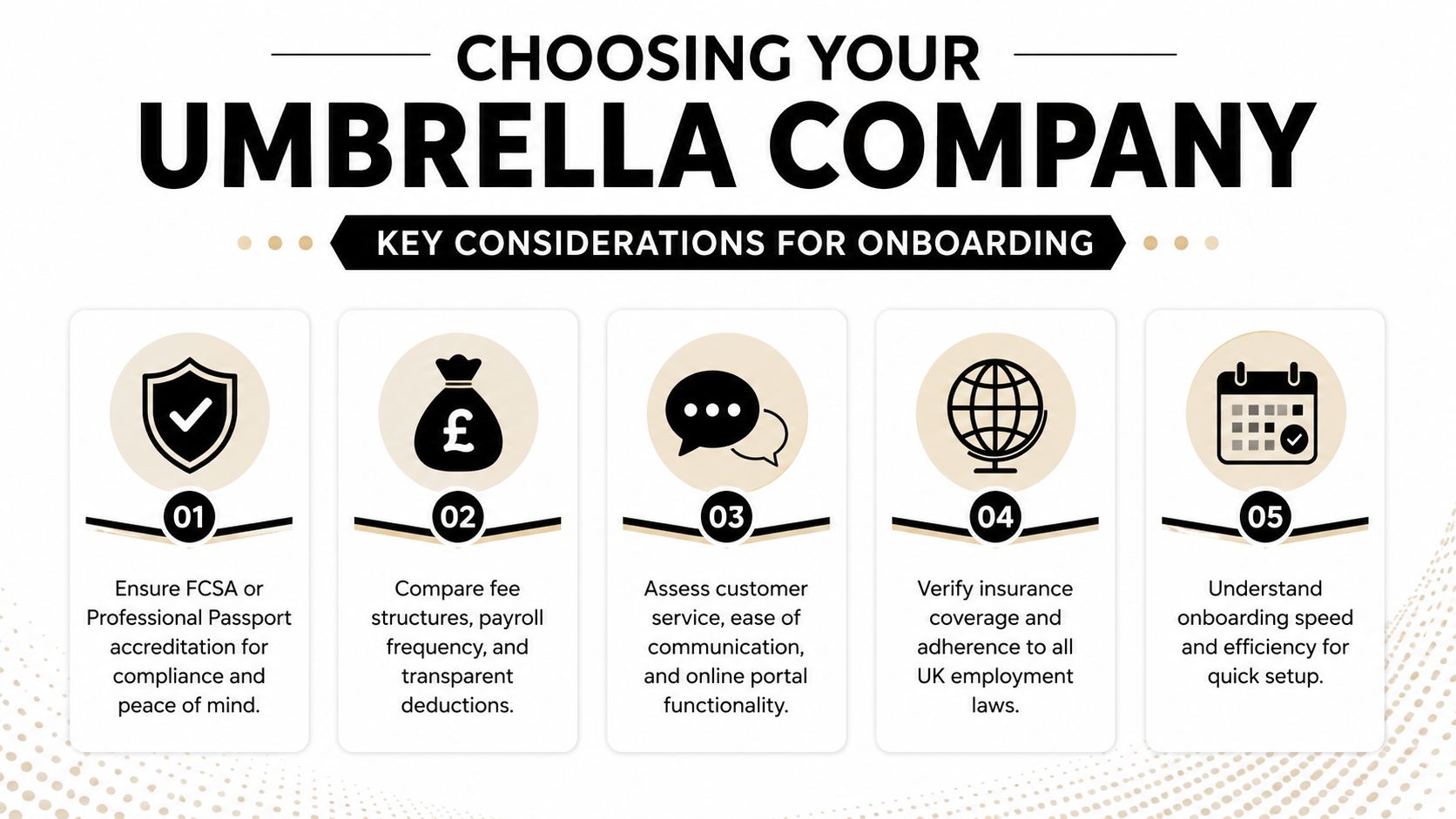
The checklist that actually matters
A common question often missed in generic contractor content is this: how do you compare umbrella companies when your engineering role is project-based, site-based, or involves travel? Recent UK employment-market commentary notes that construction and energy-linked engineering work remains project-driven, making expenses and temporary site allowances materially important when choosing a compliant provider, as discussed in this contract engineer jobs overview.
Use that reality as your checklist.
- Compliance standing. Look for recognised oversight such as FCSA or Professional Passport. Accreditation isn't a magic shield, but it's a sensible starting filter.
- Payslip clarity. You should be able to understand gross pay, tax deductions, employer costs where shown, the umbrella margin, and net pay without needing a long explanation every week.
- Engineering-specific handling. Ask how they deal with travel-heavy assignments, changing sites, rotation patterns, and agency-led timesheet approvals.
- Speed of onboarding. Contract starts often move quickly. If setup drags, your first payment can too.
- Support quality. You want a provider that answers practical payroll questions clearly, not one that hides behind vague wording.
Choose the umbrella that explains less with marketing and more with process. If they can't show you how pay is calculated before you join, keep looking.
Red flags engineers should take seriously
The red flags are usually obvious once you know what to look for.
Avoid providers that:
- Promise unrealistic take-home pay
- Can't explain deductions in plain language
- Use evasive wording around tax treatment
- Make site or travel arrangements sound more generous than they can document
- Rush you into signing without showing sample payslips or key terms
This is one area where optimism becomes expensive very quickly. If something sounds engineered to beat normal PAYE outcomes without a clear compliant basis, treat it as a risk, not a benefit.
What onboarding usually looks like
The process is usually straightforward when the provider is organised.
You'll normally need:
| Typical step | What you provide or confirm |
|---|---|
| Registration | Personal details, right-to-work documents, bank details |
| Assignment setup | Agency details, role information, rate, start date |
| Payroll readiness | Tax information and employment paperwork |
| Timesheet flow | Approval route, submission deadline, payment cycle |
For most engineers, the best outcome is boring. You submit time, the agency approves it, payroll runs when expected, and your payslip makes sense. If you want a starting point for comparing providers, umbrella company options for contractors can help narrow the field.
Thriving as a Professional Contract Engineer
Monday morning, a hiring manager wants you on site by Wednesday, the rate looks decent, and the project sounds right. Six weeks later, the scope has drifted, the site pattern is heavier than first described, and the extra travel time is yours to absorb. Good contract engineers avoid that squeeze before the start date, not after it.
Long-term contracting success comes from treating each assignment as a commercial decision as well as a technical one. In UK engineering, that matters more than many new contractors expect. Project phases shift, site attendance can change with very little notice, and allowances or travel expectations often sound clearer in a call than they appear in the paperwork.
The engineers who build stable contract careers stay visible in the market, keep evidence of delivery, and check whether the working reality matches the written terms. They also protect cash flow. A strong day rate can still produce a poor outcome if unpaid travel, extended site days, weak timesheet processes, or the wrong payment setup eat into margin.
The habits that keep you stable
Start with your own numbers. Know the minimum rate that works once you account for gaps between contracts, commuting or digs, training, insurance, and the actual cost of being available at short notice. Engineers who know that figure make better decisions under pressure.
Keep a record of what each assignment involved. That means project type, sector, systems used, site pattern, reporting line, overtime expectations, and whether the client treated the role as delivery-based or staff augmentation. Over time, that record shows which agencies place you well, which clients run clean projects, and which types of work pay properly for the disruption involved.
A few habits improve outcomes consistently:
- Keep project evidence as you go so your CV and technical summary are based on delivered work, not memory
- Check margin, not just rate including travel time, accommodation, overtime rules, notice terms, and payroll deductions
- Confirm how the role will run in practice especially site attendance, supervision, substitutions, deliverables, and sign-off
- Get changes documented when scope, location, shift pattern, or expected hours move after the start
This matters most on engineering assignments because practical delivery often changes faster than the contract does. A design engineer may start on a defined package of work, then get pulled into daily client management. A commissioning engineer may accept a role based on limited travel, then spend most of the month on different sites. If the written terms stay static while the working arrangement shifts, compliance risk and financial leakage follow.
Think like a service provider
The strongest contractors act like specialists brought in to solve a defined project problem. That changes how they speak to clients and agencies. Questions get sharper. Scope gets tested earlier. Payment options are chosen for compliance and net position, not sales language.
It also changes how you protect your market value. Engineers who stay in demand can explain what they delivered, under what constraints, and in what environment. They do not rely on a job title alone. In sectors such as rail, energy, manufacturing, civils, and automation, that detail often determines whether a client sees you as immediately useful or just generally available.
One point is easy to miss. Site allowances, travel patterns, and rotation arrangements do not sit outside the wider tax and employment picture. They affect your real earnings and can create confusion if they are described casually during the hiring process. Get the treatment confirmed in writing, check what appears on the payslip, and challenge anything that does not match what was agreed.
The contractors who last are usually the ones who are organised, commercially aware, and hard to push into weak terms.
Contracting engineering jobs can pay well and keep your skills sharp, but only if you keep control of the basics. Protect your rate. Protect the written position. Keep evidence of delivery. Stay active with recruiters even when you are fully booked.
If you're weighing up an inside-IR35 engineering role and want a simpler way to compare compliant providers, Umbrella Company helps contractors review umbrella company options based on their role, rate, and working arrangement.


