


Figuring out your target day rate is not as simple as dividing a salary by the number of working days in a year. To build a sustainable contracting career in the UK, your contract daily rate calculator needs to be smarter than that. It has to account for all the time you're not earning, such as holidays, sick days, and even keeping business admin ticking over.
In this guide, we will walk you through setting a realistic day rate, understanding the UK market, and calculating your take-home pay.
Setting Your Foundation: A Base Daily Rate Calculation
Before you think about negotiating with a client or plugging numbers into a complex calculator, you need a solid base daily rate. Think of this as your starting point. It is how you translate the security of a permanent salary into the world of contracting.
The biggest shift is realising what you have lost. When you move from a permanent job, you leave behind employer pension contributions, sick pay, and paid holidays. Your new rate has to absorb all those costs. Forgetting to factor in non-billable days for admin, training, or hunting for your next contract is one of the most common pitfalls new contractors fall into.
As a rule of thumb, most experienced contractors plan for around 46 to 48 billable weeks a year. This gives you a realistic buffer for time off and keeping your skills sharp, and crucially, stops you from selling yourself short.
A Practical Example
Let's break it down with a simple example. Say you want to match a permanent salary of £60,000.
First, let’s get that base calculation sorted. A simple table can help map this out.
| Step | Calculation | Example Value |
|---|---|---|
| 1. Target Annual Income | Your desired permanent salary equivalent | £60,000 |
| 2. Add a Buffer for Lost Benefits (15%) | £60,000 + (£60,000 x 0.15) | £69,000 |
| 3. Estimate Billable Days Per Year | 5 days/week x 46 weeks | 230 days |
| 4. Calculate Your Base Daily Rate | £69,000 ÷ 230 days | £300 per day |
This gives us a much more realistic day rate of £300. You can see how quickly that initial salary figure needs to be adjusted once you account for the realities of contracting.
This basic process, starting with a salary, adding a buffer, and dividing by your actual working days, is the cornerstone of setting your rate correctly.
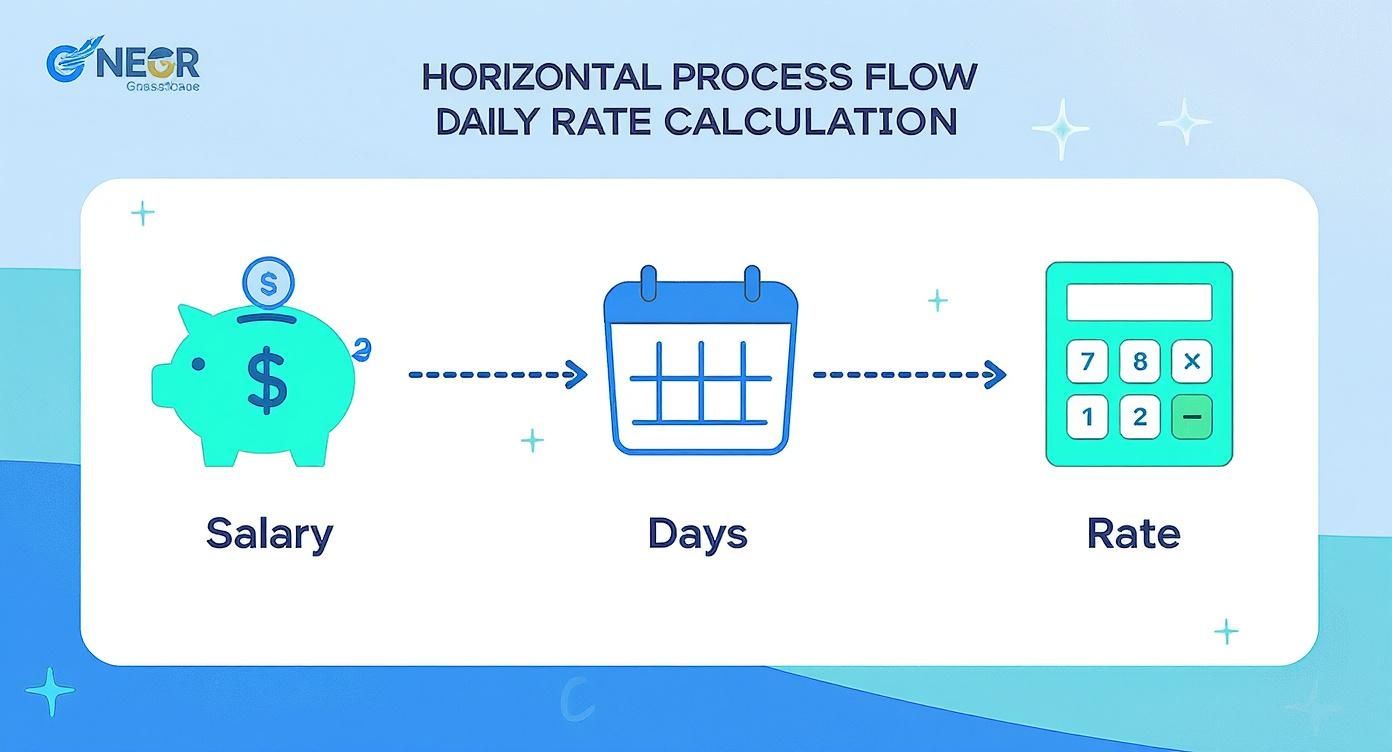
As the infographic shows, your target salary and the number of days you can realistically work are the two core ingredients. Getting this right gives you a strong foundation for all your financial planning. And if you're ever wondering how it works the other way around, you can check out our guide on converting your day rate to an equivalent salary.
Key Takeaway: Your daily rate is not just your salary divided by days worked. It is a carefully calculated figure that includes compensation for lost employment benefits, holidays, sick days, and essential non-billable time. Getting this foundation right is critical for a sustainable contracting career.
Understanding the UK Contractor Market

Your daily rate does not just appear out of thin air. It is a direct response to what is happening in the market. Before you can confidently use a contract daily rate calculator, you need to get a feel for the UK contractor landscape and figure out where you fit in. Getting this right is the key to setting a competitive rate you can justify.
The UK market is incredibly varied. You will see huge differences in what people earn depending on their industry, their specialism, and, of course, their experience. Hot sectors like IT, finance, and engineering can often demand a premium because good people are hard to find and projects are urgent. It goes without saying that a cybersecurity specialist in London will not be charging the same as a marketing consultant in Manchester.
How Your Industry and Niche Affect Your Rate
The single biggest factor driving your earning potential is your field of expertise. Niche skills will always beat generalist abilities. If you have specialised in an emerging technology or a particularly tricky area of regulation, you are in a position to charge a lot more.
Think about it this way:
- High-Demand Sectors: IT is still the leader of the pack, especially in booming areas like data science and cloud engineering. The demand and the day rates reflect that.
- Specialist Skills: If you're an expert in specific software, complex compliance frameworks like GDPR, or project management styles like Agile, you have immediately boosted your market value.
- Experience Level: This is a big one. Clients will pay more for a proven track record. The more successful projects you have under your belt, the higher the rate you can command.
For anyone just dipping their toes into contracting, it is really important to get the fundamentals down first. Our guide on how to become a contractor is a great starting point for launching your independent career.
Keeping an Eye on Economic Trends
It is impossible to ignore the wider economy. Recent trends, particularly inflation, have definitely had an impact on how contractors are pricing their services. To put it simply, many professionals have had to nudge their rates up just to maintain their standard of living, and you can see this ripple across the whole market.
The data backs this up. The UK contractor sector has proven pretty resilient, with average freelance day rates jumping from around £457 to £576 during 2024. That's a huge 26% increase, showing that contractors have been able to adjust their pricing to cope with the rising cost of living.
Right now, as we move through 2025, the median daily rate for a consultant in the UK is holding steady at a solid £550. What is really interesting is that this figure is pretty consistent whether you are in London or not, which suggests a fairly stable pricing structure across the country.
Of course, that is just the middle ground. The numbers show a massive spread, with the top 10% of contractors pulling in up to £725 a day, while the bottom 10% are closer to £403. It just goes to show how much your experience and specialism really matter. By understanding where you sit within these benchmarks, you can avoid the classic mistakes of pricing yourself too low or aiming way too high for the current climate.
Calculating Your Take-Home Pay Through an Umbrella Company
https://www.youtube.com/embed/roHfqOB1Qh8
Once you have settled on a solid daily rate, the big question is always the same: how much of that will actually land in your bank account? Figuring out your net pay through an umbrella company is essential for budgeting and financial planning. It helps to think of it as a chain of deductions, starting from the total amount your client pays us.
First off the top are the employment costs. As your official employer, the umbrella company has to pay Employer’s National Insurance Contributions and the Apprenticeship Levy. These are non-negotiable, standard costs for any UK employer, and they are deducted from the assignment rate we receive from your agency or client.
Unpacking Your Payslip Deductions
After the statutory employment costs are covered, the next set of deductions comes from your gross pay. This is where your personal tax obligations are sorted, making sure you are fully compliant with HMRC and have nothing to worry about down the line.
The main deductions you will see on your payslip at this stage are:
- Our Margin: This is simply our fee for running the payroll and handling all the admin that comes with being your employer. A trustworthy provider will always be upfront about this; it is usually a flat weekly or monthly amount.
- Your Personal Taxes: We deduct Income Tax and your own National Insurance Contributions (NICs) through the PAYE system, exactly as a permanent employer would.
- Pension Contributions: If you are part of a workplace pension scheme, your contributions will be deducted here as well.
It is absolutely crucial to work with a compliant umbrella company, like those accredited by the FCSA or Professional Passport. They give you crystal-clear payslips that account for every penny, so you know there are no dodgy fees or non-compliant schemes that could land you in hot water with HMRC.
A Worked Example of Take-Home Pay
Let's walk through a quick, simplified example to see how this all fits together. Imagine you have agreed to a daily rate of £500. For a standard five-day week, the total value invoiced to the client or agency would be £2,500.
So, how does that £2,500 find its way to you? The table below gives a simplified illustration of the process.
Example Umbrella Company Payslip Breakdown (Based on £500 Daily Rate)
| Item | Description | Example Amount |
|---|---|---|
| Assignment Rate | The total amount invoiced to the client for one week's work. | £2,500.00 |
| Employment Costs | Employer's NI & Apprenticeship Levy deducted from the assignment rate. | – £305.00 |
| Gross Pay (Your Income) | The remaining amount, which is your taxable income for the week. | £2,195.00 |
| Umbrella Margin | Our fixed weekly administration fee. | – £25.00 |
| Income Tax & Employee NI | Your personal PAYE tax and National Insurance deductions. | – £740.00 |
| Net Pay | The final amount paid into your bank account. | £1,430.00 |
This example shows exactly how your day rate gets translated into take-home pay. While the figures here are just for illustration, they really highlight the journey your money takes.
For a more accurate figure based on your own circumstances, it is always a good idea to use a reliable umbrella company calculator to get a personalised estimate. This kind of transparency means no nasty surprises, letting you plan your finances with total confidence.
How Your IR35 Status Shapes Your Daily Rate

If you're contracting in the UK, IR35 is probably the single biggest factor affecting your finances. It is not just a bit of tax admin. Whether a contract is deemed 'inside' or 'outside' IR35 fundamentally changes your tax obligations and how much cash you actually take home. Getting your head around this is non-negotiable before you even think about signing on the dotted line.
A contract that is ‘inside IR35’ essentially means that, for tax purposes, you are treated as an employee. This triggers a whole series of deductions that are taken at source, usually through an umbrella company's payroll. You will find yourself paying PAYE Income Tax, plus both Employee's and Employer's National Insurance Contributions.
On the flip side, an ‘outside IR35’ role confirms you are operating as a genuine business, typically through your own limited company. This gives you far more flexibility with your finances and claiming business expenses, which almost always leads to keeping more of your earnings. The catch? You are responsible for getting your tax status right and paying HMRC what you owe.
Factoring in an 'Inside IR35' Determination
Here is the rub: because of all those extra deductions, an inside IR35 contract must have a higher daily rate to give you the same net income as an outside role. The real killer is the Employer's National Insurance, a hefty chunk that has to be paid from the funds the client or agency sends over.
This deduction hammers your gross pay before your own personal taxes are even touched. To make up for it, you absolutely have to negotiate a higher, or 'uplifted', daily rate.
Key Takeaway: If you do not secure an uplifted rate for an inside IR35 role, you are effectively paying the client's employment costs out of your own pocket. This will cause a massive drop in your take-home pay.
As a rule of thumb, most experienced contractors will look for an uplift of 15% to 25% on their usual outside IR35 rate just to cover these costs. When you are punching numbers into a contract daily rate calculator, you have to account for these employment costs to see what you will actually be left with.
How to Approach the Negotiation
When a role is determined as inside IR35, you need to be ready to justify why your rate needs to be higher. It is not about being greedy; it is about financial reality.
- Be direct and transparent. Explain to the client or agency that the rate needs to cover statutory employment costs. They know this, but you need to say it.
- Show them the maths. A simple breakdown showing how Employer's NI and the Apprenticeship Levy eat into the gross figure can be very powerful.
- Reiterate your value. Gently remind them that your skills, experience, and the value you deliver are exactly the same, regardless of the contract's tax status.
You need to go into these conversations armed with the facts. To see exactly how the numbers play out, it's worth running a few scenarios through an inside vs outside IR35 calculator. This will give you the confidence to negotiate a rate that truly reflects what you're worth while keeping your finances healthy.
Benchmarking Your Rate Against the UK Market
Running the numbers is a great start, but those figures exist in a vacuum. To really nail down a competitive daily rate, you have to get a feel for what the market is actually paying for your skills. This is not about guesswork. It is about benchmarking your experience against current industry standards to justify your fee and make sure you are not leaving money on the table.
The UK's technology sector is a brilliant case study in how much rates can fluctuate. Your specialism, seniority, and just how in-demand your particular skills are will have a massive impact on your earning potential. You simply cannot pull a number out of thin air.
What Are UK Tech Contractors Earning?
Let's look at some real-world figures to see what this means in practice. The tech contracting market has a pretty clear hierarchy when it comes to pay, reflecting experience and expertise.
Take data science, for example. An entry-level contractor might start around £350 per day, but with a few years under their belt, they could be commanding £450. This jumps to £750 for managers and principals, and can even hit £1,100 for director-level roles. That is a staggering 214% increase from the starting point.
This kind of progression is not unique to data science. A solid DevOps engineer averages around £600 daily, with the top talent pushing past £750. A cybersecurity consultant has a median rate of £675, but the top 10% can easily charge £900 or more. Even roles like business analysts and IT project managers see similar patterns, averaging £500 and £550 a day, respectively. You can find more insights into contractor rate trends and how different roles stack up.
To give you a clearer snapshot, here is how rates tend to progress across a few key tech specialisations.
UK Technology Contractor Daily Rates by Specialisation and Seniority
This table breaks down the typical pay scales you can expect as you move from junior to senior positions in some of the UK's most popular contracting fields.
| Role/Specialisation | Entry-Level Daily Rate | Mid-Level Daily Rate | Senior/Principal Daily Rate |
|---|---|---|---|
| Data Science | £350 – £450 | £450 – £700 | £750 – £1,100+ |
| Cybersecurity | £400 – £500 | £550 – £675 | £700 – £900+ |
| Cloud Engineering | £450 – £550 | £600 – £750 | £800 – £1,000+ |
| Java Development | £400 – £500 | £575 – £650 | £700 – £850+ |
As you can see, gaining experience and specialising in a high-demand area provides a clear path to significantly increasing your daily rate over time.
Using Benchmarks in Your Negotiations
This kind of industry data is your single best tool when it is time to negotiate. When a client pushes back on your proposed rate, you can confidently point to the going market rate for someone with your specific skills and experience.
Key Insight: Benchmarking is not about hitting the average. It is about understanding the entire pay scale for your role. This lets you position yourself properly, whether that is at the median or aiming for the top 10% because your track record justifies it.
At the end of the day, a good contract daily rate calculator gives you a solid starting point. But it is the process of benchmarking that number against the live market that truly validates it. Doing your homework ensures you walk into any negotiation from a position of strength, armed with the evidence to back up your worth.
Common Questions About Contractor Rates
Even with the best contract daily rate calculator, a few questions always seem to crop up. Getting your head around contractor finances can feel like a minefield, but nailing these common queries will give you the confidence to set your rate and stick to it.
Let's break down some of the most frequent questions we hear from contractors just like you.
Should I Include Business Expenses in My Daily Rate?
This is a classic point of confusion. Our advice is always to calculate your base daily rate first, then treat any billable expenses as a completely separate conversation with your client. Trying to bake everything into one single figure just overcomplicates negotiations and often is not very practical.
For instance, if you are working an inside IR35 contract through an umbrella company, your ability to claim expenses is already heavily restricted by HMRC. For outside IR35 roles, you have a lot more flexibility, but any expenses you plan to charge back to the client absolutely must be agreed upon in your contract from day one.
It is much cleaner to factor your general business running costs, things like professional indemnity insurance, software, and accountancy fees, into the 'buffer' you add when working out your base rate.
How Often Should I Review My Daily Rate?
The contractor market can change in a heartbeat, so you cannot afford to 'set it and forget it'. As a rule of thumb, you should be reviewing your daily rate at least once a year. The start of a new contract is also the perfect time to reassess your value and see how it stacks up against the latest industry benchmarks.
You should also give it a rethink if your own circumstances change. For example:
- You've earned a new qualification: A fresh, in-demand certification can immediately boost your market value.
- You've developed a specialist skill: Mastering a niche technology or a complex piece of regulation makes you a much more valuable asset.
- Market conditions have shifted: High inflation or a sudden spike in demand for your skills are both excellent reasons to revisit your pricing.
What Is the Biggest Mistake Contractors Make When Setting Rates?
Without a doubt, the most common and costly mistake new contractors make is failing to account for non-billable time. It is such an easy trap to fall into. You take your old annual salary, divide it by 260 working days, and end up with a rate that massively undervalues your time and effort.
This simple calculation completely ignores public holidays, your own holidays, potential sick days, time spent training, and the crucial gaps between contracts when you are hunting for the next gig. This one oversight will always lead to a much lower annual income than you planned for.
Always, always use a formula that builds in a buffer for at least four to six weeks of non-billable time each year. This is the only way to ensure your daily rate is realistic, sustainable, and actually reflects the earnings you need to hit your financial goals.
Calculating your contractor daily rate correctly is the first step towards a successful independent career. By setting a realistic base, understanding market trends, and knowing how deductions affect your take-home pay, you can negotiate with confidence and achieve your financial goals.
At UmbrellaCompany.com, we provide the tools and guidance to help you navigate every aspect of your contracting career. Compare compliant umbrella companies and find the perfect fit for your needs in just minutes.


