


You've landed the contract, the agency has confirmed it's inside IR35, and then the admin starts. A shortlist of umbrella companies lands in your inbox. Every site says it's compliant. Every margin looks “competitive”. Every promise sounds reassuring until you look at the sample payslip and realise you're not comparing like with like.
That's where most contractors get tripped up.
When people compare umbrella companies, they often focus on the weekly margin and ignore the details that really affect pay, compliance, and day-to-day sanity. A cheap-looking umbrella can cost more once employer costs, holiday pay handling, payroll timing, and support quality are taken into account. A slick-looking umbrella can still leave you with poor communication and a messy first pay cycle.
The market is crowded, but it isn't random. As of 2025, the top 10 umbrella companies process approximately 70% of the total £45 billion annual contractor payroll value, which tells you two things. First, established providers hold a big share of the market. Second, comparing them properly matters because the gap between a solid provider and a weak one is real, not cosmetic, according to UK umbrella market analysis.
Starting Your Search for an Umbrella Company
A familiar scenario goes like this. A contractor accepts a role, the recruiter says payment must go through an umbrella, and within an hour there are three “recommended” providers on the table. None of them are known to the contractor. All of them claim fast onboarding, full compliance, and strong take-home pay.
That's a poor moment to make a rushed decision.
The right umbrella company isn't just a payroll processor. It becomes the employer in the chain, handles PAYE, issues payslips, receives funds from the agency, and pays you after the right deductions. If you need a quick refresher on the mechanics, this guide on how an umbrella company works gives the basic structure clearly.
What actually matters at the start
At the search stage, most contractors want answers to three practical questions:
- Will I be paid correctly and on time
- Will the umbrella keep me away from tax trouble
- What will my actual take-home pay look like after all deductions
Those are the right questions.
The wrong question is, “Which one has the lowest headline fee?” A low margin can still sit alongside poor holiday pay administration, weak support, confusing payslips, or aggressive interpretations of what should be deducted and when. Equally, a slightly higher margin can be worth it if the provider is transparent, responsive, and good at getting the first payroll right.
Practical rule: If an umbrella can't explain your payslip in plain English before you join, don't expect clarity after you're on payroll.
A better mindset for comparing providers
Treat the choice like you'd treat any supplier that touches your income and compliance position. Ask for evidence. Read the pay illustration carefully. Check whether the provider answers direct questions directly. If the sales process feels slippery, the payroll process usually follows the same pattern.
The good news is that once you know what to compare, the field narrows quickly.
The Core Criteria for Evaluating Umbrella Companies
Before you compare umbrella companies properly, you need a working grip on the terms that affect your pay and protection.

Margin, employment costs, and what your payslip is really showing
An umbrella margin is the provider's fee for employing you and running payroll. That's the easy part.
The part contractors often misunderstand is employment costs. In an umbrella arrangement, the assignment rate from the agency usually has to cover more than your taxable pay. It can also include employer-related costs that sit within the contract income before your PAYE calculation is applied. That's why two umbrellas can show different illustrations even when the day rate looks the same at first glance.
Ask the provider to walk through:
- The contract rate basis. Is the quoted rate the assignment rate to the umbrella?
- The umbrella margin. Is it fixed or variable?
- Employer costs treatment. How are they shown in the illustration?
- Any additional charges. Are there administration fees beyond the stated margin?
If any of that is vague, you're not looking at a clean comparison.
Holiday pay, pension, and statutory rights
Holiday pay causes endless confusion because providers don't always present it the same way. Some accrue it. Some advance it. Neither approach is automatically wrong, but the method should be clearly explained and reflected consistently on the payslip.
Then there's pension auto-enrolment and statutory rights. A proper umbrella arrangement gives you employee status and the related framework that comes with it. The point isn't just legal formality. It affects what support exists if there's a payroll issue, a period off work, or a dispute over pay.
A good umbrella doesn't rely on jargon. It can explain deductions, holiday pay, and statutory entitlements without making you feel you need an accountant on the call.
Accreditation and why it matters
Accreditation isn't a magic shield, but it is a useful filter. If a provider holds recognised industry accreditation and is willing to show how it operates, that's a better starting point than a provider asking for trust with no proof behind it.
For contractors in agency-led hiring, some of the same practical checks used when evaluating recruiters are worth applying here too. This piece on 10 considerations for IT staffing agencies is useful because it reinforces something contractors often forget. Operational reliability matters just as much as marketing claims.
Support quality is not a soft extra
Contractors underestimate support until the first payroll problem appears. Then it becomes the only thing that matters.
Check how the umbrella handles:
- First payment issues
- Missing timesheets
- Incorrect tax codes
- Agency remittance delays
- Holiday pay queries
- Leaver processing
A provider can have a polished onboarding team and a poor payroll support team. Make sure you ask about both.
A Detailed Comparison of Umbrella Company Models
The quickest way to compare umbrella companies is to stop comparing brand slogans and start comparing operating models.
Below is the split that matters in practice.
Compliant vs High-Risk Umbrella Company Comparison
| Feature | Compliant & Accredited Umbrella | High-Risk & Non-Compliant Umbrella |
|---|---|---|
| Fee presentation | Clear margin, explained in writing | Headline fee looks low, other deductions are unclear |
| Payslip clarity | Full breakdown, easy to reconcile | Hard to follow, unexplained adjustments |
| IR35 handling | Treats inside-IR35 income through standard payroll processes | Uses language designed to suggest unusual tax efficiency |
| Holiday pay | Method clearly stated and applied consistently | Vague wording, inconsistent treatment |
| Support | Payroll team answers direct questions with specifics | Sales-heavy before sign-up, evasive after |
| Compliance posture | Open about process, accreditations, and documentation | Relies on reassurance, avoids detail |
| Risk to contractor | Lower risk when paperwork and payroll are transparent | Higher risk of disputes, tax issues, and payment confusion |
What the financial trade-off really looks like
Many contractors make the wrong call at this stage. They see one umbrella with a smaller headline deduction and assume it must be the better option. In reality, contractor surveys from 2024 to 2025 found average annual take-home pay variations of £2,500 to £4,000 depending on the umbrella company chosen, mainly because of differences in margins and how employer costs are handled, according to contractor market survey data.
That doesn't mean the cheapest-looking payslip is the best one. It means the cleanest and most transparent model often wins over time.
What a compliant provider does differently
A compliant umbrella tends to be boring in the best possible way. It explains the contract flow, gives you a written pay illustration, sets expectations for payment timing, and answers direct questions without dancing around them.
It also doesn't try to sell “higher retention” through gimmicks. If a provider keeps steering the conversation back to how much more of your pay you can somehow keep, pause there. Legitimate umbrellas sell process quality and compliance first.
If you're weighing direct agency PAYE against an umbrella route, this comparison of umbrella vs PAYE helps frame where the costs and responsibilities sit.
Where risky umbrellas usually give themselves away
The danger signs are usually visible early:
- The illustration is incomplete
- The consultant can't explain deductions cleanly
- The provider talks more about “maximising retention” than payroll accuracy
- The paperwork feels rushed
- The payslip example doesn't reconcile sensibly
That pattern should concern you even if the margin looks attractive.
What works: Transparent arithmetic, ordinary payroll language, written answers, and no pressure to sign immediately.
Risk management matters as much as take-home pay
A lot of contractors think of umbrellas as a narrow payroll choice. It's wider than that. You're effectively outsourcing part of your employment administration and compliance chain, which is why some of the same principles behind outsourcing HR to manage employment risk are relevant here. If the outsourced provider is sloppy, the operational pain lands back on you.
The strongest umbrella model is rarely the one with the loudest sales message. It's the one with the least mystery.
Comparing Companies for Your Specific Sector
The best umbrella for one contractor can be a poor fit for another. Sector matters because the pressure points are different.

A provider that works well for a short-term IT consultant might not be the strongest choice for a healthcare worker on a long-running public sector assignment. The difference usually comes down to support depth, familiarity with assignment patterns, and how well the provider handles the admin quirks that come with that sector.
The 2026 FCSA Accreditation Audit found that sector-specialised providers achieved a Net Promoter Score of 72, compared with an industry average of 58, linked to profession-specific IR35 guidance and personalized support.
IT and digital contractors
IT contractors usually care about speed, clarity, and accurate handling of higher-value assignments. If projects are short and the move between roles is frequent, onboarding efficiency and responsive payroll support matter more than polished branding.
For this group, I'd look closely at:
- Fast onboarding so a contract start isn't delayed
- A payroll team that understands agency timesheet workflows
- Clear treatment of deductions on higher day rates
- Support that can answer IR35-related questions without reading from a script
A provider that regularly works with developers, analysts, cyber specialists, and project consultants usually understands the pace of agency-led placements better.
Healthcare and public sector contractors
Healthcare workers, locums, and allied professionals often need something different. Public sector engagements tend to produce more admin friction, tighter process requirements, and a stronger need for consistency in pay runs.
That makes these points more important:
- Experience with public sector payment chains
- Reliable handling of recurring assignments
- Clear holiday pay administration
- Support that can deal with urgent payroll questions quickly
A missed or delayed payment is a nuisance in any sector. In healthcare, it can create immediate personal and professional pressure.
Here's a useful explainer if you want a visual overview of how these arrangements fit together in practice.
Finance, engineering, and specialist consulting
Contractors in finance, engineering, and specialist advisory roles usually need fewer hand-holding features and more operational competence. They often ask sharper questions, and rightly so.
The best-fit provider here is usually one that can handle:
- Detailed pay illustrations without fluff
- Strong documentation standards
- Responsive support for contract changes
- A professional approach when agencies or clients need information quickly
Sector fit matters. A provider can be fully legitimate and still be the wrong choice if its support model doesn't suit the way your assignments run.
Generic umbrella comparisons often miss this point. If you compare umbrella companies without filtering for your sector, you can end up with a provider that is compliant on paper but awkward in daily use.
Spotting Red Flags and Non-Compliant Schemes
If you remember one thing, remember this. Take-home pay promises don't override tax law.
Most serious umbrella problems start with a sales pitch that sounds better than ordinary payroll has any right to sound. The language varies, but the pattern is familiar. The provider hints that other umbrellas are too traditional, too expensive, or not flexible enough, then presents a payment structure that doesn't feel like normal PAYE.
That's when you need to slow down.
The warning signs that should stop you
A risky scheme often shows itself through one or more of these behaviours:
- Unclear payment structure. You can't tell what is salary, what is a deduction, and what sits outside standard payroll.
- Strange terminology. The provider avoids ordinary umbrella language and uses phrases that seem designed to blur what's happening.
- Pressure selling. You're pushed to sign quickly before your contract start date.
- Poor documentation. The pay illustration is incomplete or doesn't line up with the contract arrangement.
- Deflection on compliance questions. Straight questions get vague reassurance instead of straight answers.
A legitimate umbrella should welcome scrutiny. A risky one tends to treat scrutiny as a sales obstacle.
Why this matters financially
The fallout isn't theoretical. A 2025 ContractorUK survey found that 62% of freelancers switched umbrella companies due to IR35 mishandling, and HMRC penalties for non-compliance averaged £3,200 per case in 2024, according to industry reporting on umbrella company compliance issues.
Those aren't figures any contractor should shrug off.
If you're checking accredited options, this list of an FCSA umbrella company is a sensible place to narrow the field. It doesn't remove the need for your own due diligence, but it does improve the starting point.
What good providers never need to do
A sound umbrella doesn't need to create mystery around your pay. It doesn't need to imply there's a secret route to much better retention than everyone else can offer. It doesn't need to bury key terms in vague illustrations.
Non-negotiable check: If the umbrella can't show you, in writing, how money moves from assignment rate to taxable pay to net pay, walk away.
Contractors sometimes worry that asking hard questions will make them look difficult. It won't. It makes you look like someone protecting your income, which is exactly what you should be doing.
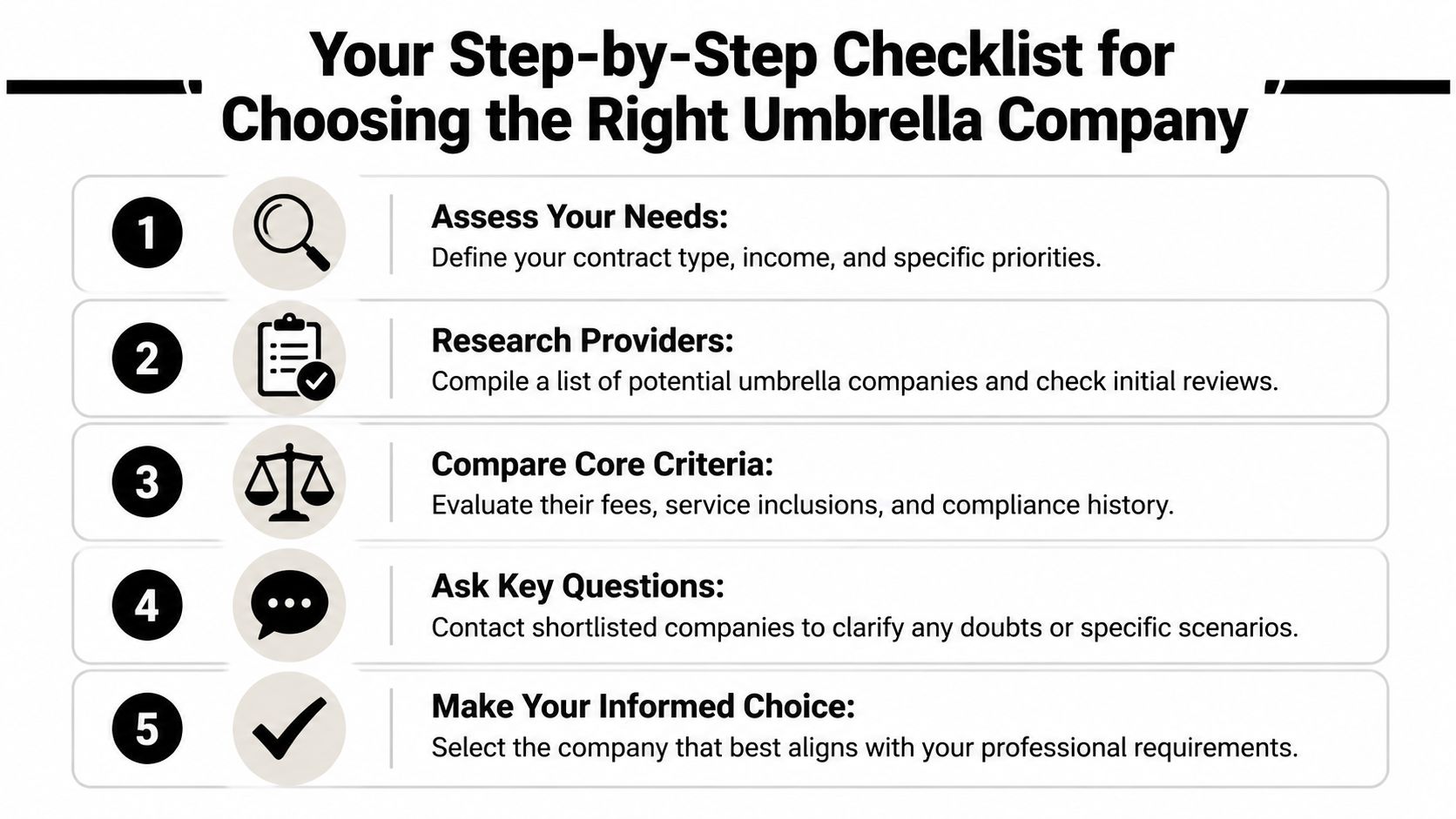
Your Step-by-Step Checklist for Choosing
The cleanest way to compare umbrella companies is to turn the decision into a shortlist process. Don't browse endlessly. Test each provider against the same set of checks.
Start with the contract, not the umbrella
Write down the essentials of your assignment first. Your day rate, payment frequency, contract length, sector, and whether the role is definitely inside IR35 all shape what “good” looks like.
That stops you being distracted by generic sales copy.
Use this working checklist
Define your priorities
Decide what matters most for this contract. For one assignment that might be fast onboarding. For another, it might be strong public sector payroll experience or clearer holiday pay handling.Build a shortlist
Keep it tight. Three to five providers is enough if they are realistic contenders. More than that usually creates noise rather than insight.Request a written pay illustration
Don't accept a vague verbal estimate. You want a document that shows the contract rate basis, margin, deductions, and expected net pay clearly.Check accreditation and transparency
Confirm whether the provider presents its compliance standards openly and whether its documentation is easy to follow. If a provider is hard to verify, that's a sign in itself.Test support before joining
Call or email with a few specific questions. Ask how first payroll works, how holiday pay is handled, what happens if an agency pays late, and who you contact if something is wrong on a payslip.Compare the actual answers, not just the marketing
One provider may answer in two plain paragraphs. Another may send a glossy PDF that says very little. Back the one that communicates clearly.
Questions worth asking directly
Use practical questions, not generic ones:
- Can you explain this payslip illustration line by line
- How do you handle holiday pay in practice
- What will I need to submit each week or month
- Who do I contact for payroll queries after I've joined
- What happens if my agency changes timesheet cut-off dates
- How do you deal with leaving mid-assignment
Choose the provider that gives the clearest operational answers. Contractors live with processes, not slogans.
The final sense check
Before you sign, read every document as if you'll need to explain it later to someone else. If you can't explain it, don't sign it yet.
That single habit saves a lot of grief.
Making Your Choice and Getting Started
Once you've done the comparison properly, the final choice is usually clearer than people expect. One provider will have better paperwork, cleaner answers, and fewer grey areas. That's normally the right answer, even if it isn't the cheapest by headline margin.
Onboarding with a good umbrella should feel straightforward. You'll typically need proof of identity, bank details, tax information, and the assignment details needed to link the agency or client into the payroll chain. The provider should explain what it needs, when it needs it, and what happens before the first pay cycle.
If you're still narrowing the field, this guide to the best umbrella company in the UK is a useful next step for refining your shortlist.
The practical takeaway is simple. Compare umbrella companies on compliance, clarity, sector fit, and support quality first. Use fee level as part of the decision, not the whole decision. When you do that, you protect your take-home pay legally and reduce the chance of nasty surprises after you start.
If you want a faster way to compare trusted providers, Umbrella Company helps contractors review umbrella companies by role, sector, pay rate, and IR35 needs, so you can make a confident choice and get started quickly.


