


A new contract lands in your inbox, the day rate looks strong, and then the question appears almost immediately. How much of that money will reach your bank account?
That’s where many contractors get stuck. Most online tools labelled a company tax calculator are built for US freelancers or general small business owners, not for UK contractors dealing with PAYE, National Insurance, dividend planning, and IR35. That gap matters because HMRC data shows 1.1 million contractors were affected by IR35 reforms since April 2021, with a 2025 IPSE survey showing 70% are now inside IR35, yet few tools model those situations properly, as noted in this overview of a typical tax calculator market gap.
A good calculator should do more than throw out a rough estimate. It should help you understand what each deduction means, why your contract structure changes your take-home pay, and what choices are worth considering before you accept an assignment.
Your Essential Guide to Contractor Tax Calculation

If you're new to contracting, the biggest surprise usually isn't the rate. It's the deductions.
A contract might be quoted as a day rate, a weekly amount, or a project fee. None of those figures tells you your real take-home pay on its own. Your result depends on how you're engaged, whether the role sits inside or outside IR35, what expenses you can claim, and whether you're using a limited company or an umbrella company.
Why standard calculators often mislead
A generic calculator tends to assume one simple tax route. UK contracting rarely works that way.
For contractors, a useful company tax calculator has to recognise things like:
- IR35 status: This can completely change how income is taxed.
- Payment structure: Salary, dividends, or umbrella PAYE produce very different outcomes.
- Employer costs: In some arrangements, costs such as employer's National Insurance affect what is left for you.
- Business deductions: Pension contributions and allowable expenses can change the final figure materially.
Practical rule: Never judge a contract by the headline day rate alone. Judge it by estimated net pay under the correct tax structure.
What clarity looks like
When the numbers are laid out properly, the process becomes much less intimidating. You stop guessing and start making decisions based on your own circumstances.
That might mean:
- comparing two offers with different IR35 determinations
- checking whether a rate increase improves your net income
- deciding whether the admin of a limited company is worth it
- seeing whether an umbrella route gives you enough certainty and simplicity
Many freelancers worry that tax calculation is only for accountants. It isn't. You don't need to become a tax technician. You just need to understand the few moving parts that have the biggest impact on your wallet.
Once those parts are clear, a company tax calculator becomes less of a mystery and more of a planning tool.
Understanding the Building Blocks of Company Tax
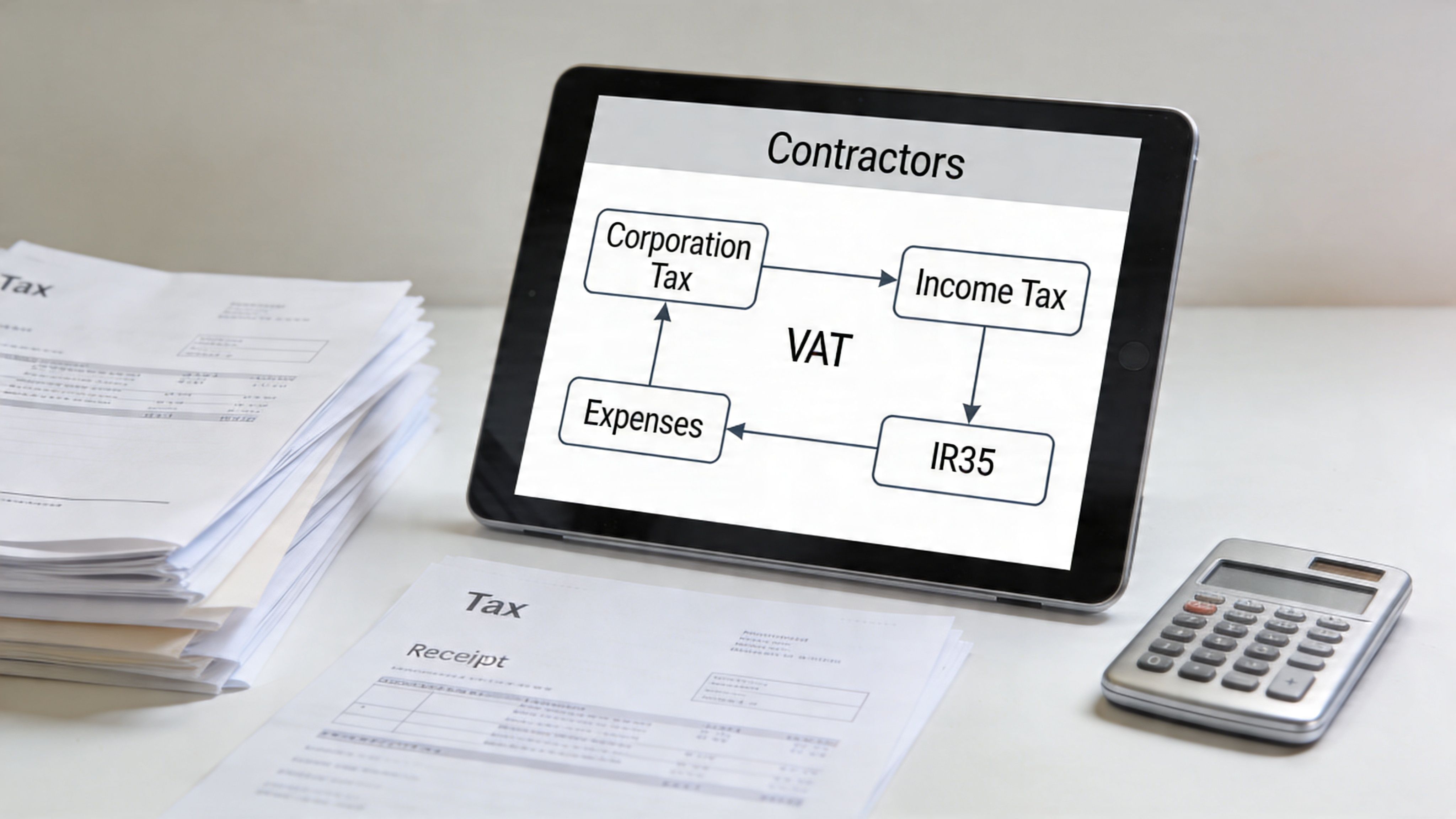
You finish a contract, send the invoice, and see a healthy amount land in the company account. It feels like you've been paid. For tax purposes, that is only the starting pot. A contractor company tax calculator has to work out what happens before that money becomes spendable income.
For UK contractors, the moving parts are usually Corporation Tax, PAYE, National Insurance, pension contributions, and sometimes VAT. Generic calculators often miss the contractor-specific mix. They may assume a simple business owner setup or a US tax model, which does not help much if you are weighing up limited company income, umbrella pay, or IR35 status.
Corporation Tax and company profit
If you trade through your own limited company, the company pays tax on profit, not on everything it invoices. HMRC sets the current bands in its Corporation Tax rates guidance.
That distinction matters because turnover and profit are different pots. Turnover is the contract income billed to the client. Profit is what remains after allowable business costs have been taken off. Those costs can include salary, employer pension contributions, software, accountancy fees, insurance, and other genuine business expenses.
A simple way to view it is this: turnover is the full contract value, profit is the slice left after the company has paid its own bills. Corporation Tax applies to that remaining slice.
If you want a broader non-HMRC explainer on the topic, this Guide to Corporation Tax gives a helpful overview of how the rules work in practice.
PAYE and why salary is handled separately
PAYE is the payroll system used to collect Income Tax from salary. If you work through an umbrella company, your earnings are usually processed this way from the outset. If you run your own limited company, you may still pay yourself a salary through PAYE and then take some income in dividends, depending on what suits your circumstances.
A frequent misunderstanding among new freelancers is that money earned by the company is not automatically personal pay. HMRC taxes salary and dividends under different rules, so a calculator needs to separate them properly.
If you want to see how those two routes compare in practice, our guide to salary versus dividends for contractors explains the trade-offs clearly.
The route the money takes changes the tax result. That is why contractor calculations need more than one line of maths.
National Insurance and the cost sitting behind the payslip
National Insurance can feel confusing because there is more than one layer to it. There is employee National Insurance, which affects your own pay. There is also employer's National Insurance, which is a cost the company or umbrella has to cover on qualifying earnings. HMRC sets out the current rules on its National Insurance rates and categories page.
For a contractor, the practical point is simple. Part of the contract money may be used to meet employer costs before it ever reaches you as taxable pay.
That is especially important in umbrella work. A quoted assignment rate is not the same thing as gross salary, because the umbrella usually has to fund employer's National Insurance and other employment costs from that contract income. With a limited company, the same principle affects how much salary the company can pay while staying tax-efficient.
Pension contributions and tax efficiency
Pension contributions can change the picture more than many contractors expect.
If your company makes employer pension contributions, that can reduce taxable profit and support your retirement planning at the same time. In plain English, some money goes to your future instead of being lost to tax now. A calculator that ignores pensions can make one option look less attractive than it really is.
VAT in simple terms
VAT sits slightly to one side of your personal take-home pay, but it still matters if you trade through a limited company and register for VAT. It affects invoicing, reporting, and cash flow.
VAT is usually not your income to keep. It is money collected and then paid over under the VAT rules, subject to the scheme you use. That is why a company tax calculator may focus mainly on direct taxes and deductions, while wider planning also checks whether VAT changes the cash position of the business.
| Tax element | Who usually deals with it | Why it matters |
|---|---|---|
| Corporation Tax | Limited company | Reduces company profit before money is drawn out |
| PAYE | Umbrella company or your own payroll | Deducts Income Tax from salary |
| Employer's NI | Employer, including umbrella or limited company | Reduces the funds available before net pay |
| Pension contributions | You or the company | Can lower taxable profit and change take-home planning |
| VAT | VAT-registered business | Affects invoicing, reporting, and cash flow |
What a Company Tax Calculator Needs From You
A calculator can only give a reliable answer if you feed it the right information. If you miss one key input, the result can look cleaner than reality.
Start with the contract details
Gather the commercial basics first. These shape the whole calculation.
- Your rate: Day rate, hourly rate, or fixed fee all work, but the calculator needs one clear starting point.
- Contract length: A short engagement and a long one can produce different planning choices.
- Working pattern: Expected working days, gaps between contracts, and unpaid leave all affect annual income.
If you're still sense-checking what a quoted rate means before tax, a contractor rate calculator is a sensible place to start.
Add the deductions that apply to you
Such oversights often lead to inaccurate estimates. New contractors often leave these out, then wonder why the first payslip is lower than expected.
A useful checklist includes:
- Allowable expenses: These may include software, training, or certain business costs, depending on your setup and the rules that apply.
- Pension contributions: These can alter your tax position and your monthly net pay.
- Student loan deductions: If you have one, it changes your final figure.
- Holiday approach: Whether holiday pay is accrued or rolled up can affect what you see in regular pay.
A rough estimate becomes a useful estimate only when you include the deductions you’d actually face.
The question that changes everything
IR35 status is the most important input for many contractors.
If the role is inside IR35, the tax treatment usually looks much closer to employment. If it's outside IR35, a limited company may offer more flexibility in how income is taken. One answer changes the entire path of the money.
That’s why a proper company tax calculator shouldn’t ask only for your rate. It should ask how the contract is classified.
Check your assumptions before relying on the result
Before you act on any forecast, sense-check the following:
- Have you used the correct contract value?
- Have you included any ongoing company or umbrella costs?
- Are your expenses realistic, not optimistic?
- Are you modelling the right IR35 position?
A calculator is there to help you plan. It isn't a substitute for reading your contract properly or confirming how the engagement will be handled for tax.
Worked Examples Limited Company vs Umbrella Company
A side by side example makes this much easier to judge.
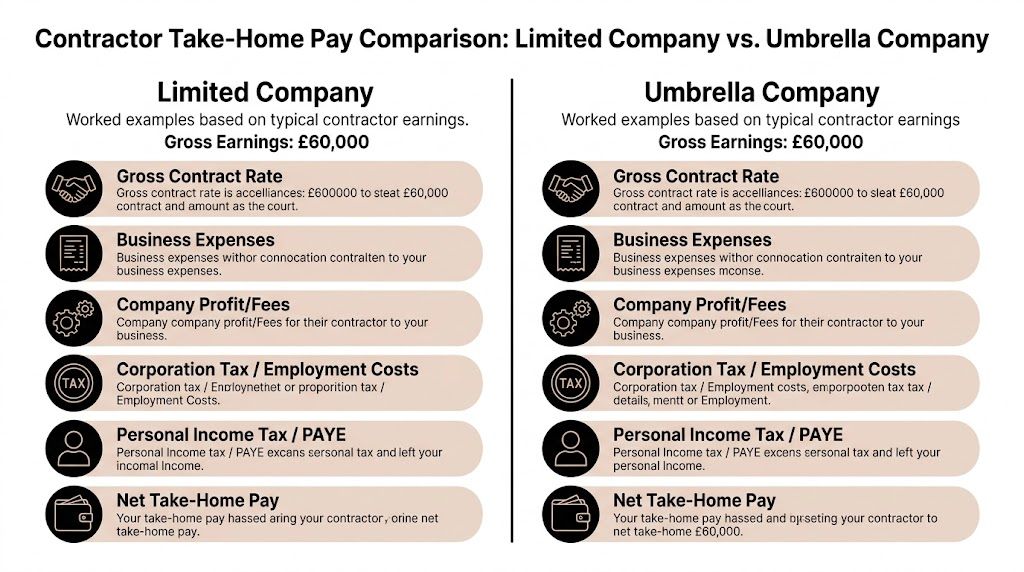
Say two contractors each land work worth £80,000 over the year. One takes the contract through a limited company on an outside-IR35 basis. The other takes a role taxed through an umbrella company on an inside-IR35 basis. The headline income looks identical. What reaches their bank accounts can look very different.
That gap is why generic company tax tools often confuse UK contractors. They may show a basic company result, but they miss the practical differences between a personal service company, PAYE umbrella pay, and the way IR35 changes the route the money takes.
Example one outside IR35 through a limited company
Assume a contractor has an £80,000 contract and works outside IR35 through a personal service company.
The company receives the income first. From there, it can pay allowable business costs, accountant fees, a small salary, and other legitimate expenses before working out taxable profit. Corporation Tax applies to the profit. After that, the remaining money can be taken out, often as dividends alongside salary.
The main attraction is flexibility.
It works a bit like choosing how to draw water from a tank rather than having the whole amount pushed through one pipe at once. You still pay tax, but the timing and type of extraction matter. For your wallet, that usually means a stronger take-home position than an equivalent role taxed fully through payroll, provided the contract is properly classified as outside IR35 and the company is run properly.
Some contractors compare this with sole trader treatment before they decide on a structure. If you want broader background on how company taxation differs from trading personally, this overview of Sole Trader vs Company Tax gives useful context.
Example two inside IR35 through an umbrella company
Now take the same £80,000 contract, but assume the role is inside IR35 and you use an umbrella company.
The money flow changes straight away. The contract income is used to cover the employment costs linked to that assignment before your taxable salary is processed under PAYE. The umbrella handles payroll, deducts tax and National Insurance, and pays you as an employee.
That reduces flexibility, but it also strips out much of the admin.
For many contractors, this is the trade-off in plain terms. You usually keep less of the contract value, but you avoid running a company, filing company returns, and dealing with the extra compliance work yourself. If you want a fuller side by side breakdown, see our guide to umbrella company vs limited company.
The comparison in plain English
For an outside-IR35 contract, a limited company often leaves more room for tax planning because not all income has to be treated as salary at the point it is earned. For an inside-IR35 contract under an umbrella, the pay process is closer to ordinary employment, so the take-home figure is usually lower.
Here is a simplified view of the same contract value under each route.
| Line Item | Limited Company (Outside IR35) | Umbrella Company (Inside IR35) |
|---|---|---|
| Contract value | £80,000 | £80,000 |
| Tax treatment | Company profits and personal extraction planning | PAYE payroll treatment |
| Main taxes in play | Corporation Tax, salary tax, dividend tax | Income Tax and National Insurance through payroll |
| Flexibility | Higher | Lower |
| Admin burden | Higher | Lower |
| Typical net outcome | Usually higher | Usually lower |
Wallet view: Two contracts can advertise the same day rate and still leave you with very different take-home pay. What matters is not just the rate, but how the income is taxed.
A video can help if you prefer to see the concepts explained visually.
Where readers often get caught out
Three mistakes come up again and again.
- Treating the contract value as personal pay: Under an umbrella, the contract sum is not the same as the salary that lands in your account.
- Assuming a limited company always saves tax: It can help on a genuine outside-IR35 contract, but it does not create the same advantage on work taxed like employment.
- Ignoring running costs: Accountancy fees, software, insurance, and your own time all affect the true value of the limited company route.
A company tax calculator becomes useful when it compares like with like. Same contract value. Same assumptions. Different structure. That is the point where the result starts to mean something for your wallet.
How IR35 Rules Reshape Your Tax Calculation
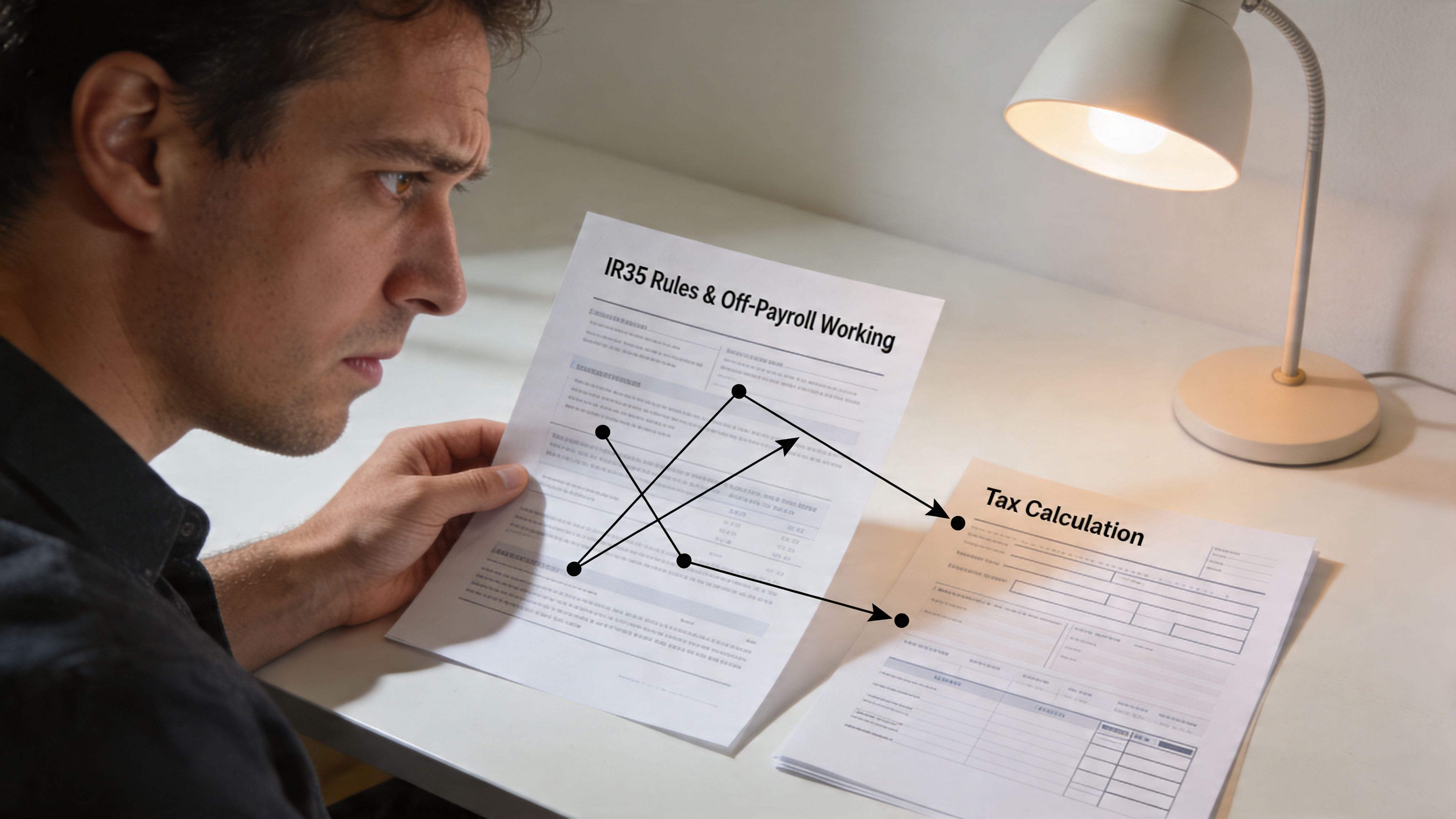
You agree a strong contract rate, run the numbers in a generic company tax calculator, and expect one level of take-home pay. Then the client says the role is inside IR35. Suddenly the same contract can produce a very different result in your bank account.
That is why IR35 matters so much for UK contractors. A calculator that works for a US small business, or even for a standard UK company owner, can miss the point if it does not ask how the contract is treated under off-payroll rules.
Why IR35 exists
IR35 decides whether HMRC views an engagement as genuine business-to-business work or as employment in all but name.
The rules were introduced in 2000, then expanded through later public and private sector reforms, as set out in the government's off-payroll working rules review. The aim is fairly simple. If the working arrangement looks like a job, HMRC expects the tax to look more like a job too, even if you invoice through a limited company.
What changes in the calculation
A company tax calculator needs to answer one question early. Are you outside IR35 or inside it?
That single answer changes the whole method.
Outside IR35, the calculator is working with company profits. It can allow for business costs, Corporation Tax, and how you take money out of the company. Inside IR35, the calculation shifts toward employment-style tax. PAYE becomes the main engine, and the room for dividend planning is much smaller.
It works like choosing between two measuring systems. If you use the wrong one from the start, the final figure may look tidy but still be wrong.
Inside IR35 versus outside IR35
| Status | What it usually means for tax | What the calculator needs to do |
|---|---|---|
| Outside IR35 | You are taxed more like a business supplying services | Model company income, allowable costs, and how salary and dividends may be taken |
| Inside IR35 | The income is taxed more like employment pay | Model PAYE deductions and employer-style costs linked to that engagement |
For your wallet, this is the practical difference. Outside IR35 often leaves more control over timing and extraction of income. Inside IR35 usually produces a simpler but heavier tax treatment, especially if you expected limited company efficiency on that contract.
If you want a fuller explanation of status tests, responsibilities, and contractor-specific examples, our guide to IR35 rules for contractors explains the detail.
Why contractors get caught out
The frustration is rarely the existence of tax itself. The frustration is building your plan on one assumption, then finding the engagement is taxed another way.
A new freelancer often focuses on the day rate first. Seasoned contractor accountants usually ask about status almost immediately, because a higher rate on an inside-IR35 contract can still leave less net pay than a lower rate outside IR35 once the deductions are applied.
So the order matters. Check the IR35 position first. Then calculate.
A company tax calculator is only useful when it reflects the legal and commercial reality of the contract. If it skips IR35, it can give a neat answer that does not match what you keep.
Choosing Your Path Umbrella or Limited Company
The decision is rarely just about chasing the highest possible number. It’s about choosing the setup that fits your contract, your tolerance for admin, and the amount of compliance responsibility you want to carry.
When a limited company often suits you
A limited company can be a strong fit when your contracts are outside IR35 and you want more control over how you run your business.
That route can offer:
- More planning flexibility: You can decide how to structure company costs and income extraction within the rules.
- Business identity: Some contractors prefer operating as a company with their own brand and processes.
- Longer-term control: If you're building a consultancy rather than taking one-off assignments, the company route can feel more natural.
The trade-off is admin. You have legal duties, tax filings, records to maintain, and decisions to make throughout the year. The route can be rewarding, but it asks more of you.
When an umbrella company often makes more sense
For many inside-IR35 roles, an umbrella company is the cleaner answer.
You’re paid through payroll, deductions are handled for you, and the compliance process is far more straightforward from the contractor’s point of view. You also get the familiarity of employment-style pay administration.
That simplicity matters even more as the rules keep evolving. The government’s Making Tax Digital collection notes the rollout of Making Tax Digital for Income Tax from April 2026, and the same verified data indicates 25% of contractors experience mid-year IR35 status shifts in Q1 2026. For contractors who want stability, that can make the umbrella route more appealing.
A practical decision filter
If you’re deciding between the two, ask yourself these questions:
Is the contract inside or outside IR35?
This is the first filter, not the last.Do you want admin responsibility?
Some contractors are happy to run a company. Others want to focus on delivery, not filings.How valuable is certainty to you?
If predictable payroll treatment helps you sleep at night, that matters.Are your contracts likely to change status?
If your engagements move around, the simpler route may save hassle.
The best structure is not the one with the most impressive spreadsheet. It’s the one you can operate confidently and compliantly.
What this means in the real world
A contractor on a clearly outside-IR35 engagement may decide the extra administration is worth it for the added flexibility. Another contractor, earning a similar rate but working inside IR35, may prefer the simplicity of an umbrella because there is little value in maintaining a company for payroll-style taxation.
That is why a company tax calculator is a decision tool, not just a maths tool. It helps you see whether a higher gross figure still makes sense after the structure, the rules, and the workload are taken into account.
From Calculation to Action Your Next Steps
A good company tax calculator gives you something more valuable than a number. It gives you context.
You can see what the contract is likely to feel like in real life, after tax, after deductions, and after the rules have done their work. That makes it easier to judge offers properly, plan your cash flow, and avoid the disappointment that comes from focusing on the headline rate alone.
Keep your next move simple
Use what you’ve learned to sense-check your current or next contract:
- Confirm the IR35 position early
- Estimate take-home pay under the correct structure
- Allow for real deductions, not ideal ones
- Choose the route you can manage confidently
If your engagement is inside IR35, simplicity and compliance usually matter most. If it’s outside IR35, you have more room to weigh tax efficiency against administration.
A clear estimate helps you negotiate better, budget better, and choose better.
The main point is reassurance. Contractor tax can look complicated at first, but once you break it into structure, status, and deductions, it becomes manageable. You don’t need to memorise tax law. You need a clear method and the right assumptions.
That’s what a proper company tax calculator should give you.
If you're ready to compare compliant options and move forward with confidence, Umbrella Company helps UK contractors find suitable umbrella companies based on role, pay rate, and IR35 needs.


