


A company's SIC code, that's Standard Industrial Classification code, is a five-digit number that tells Companies House and other organisations what a business actually does. Think of it as a crucial bit of admin, a label that categorises your company's main line of work. This guide explains what a company SIC code is, why it matters, and how to choose the right one for your business.
What Is a Company SIC Code?
Imagine a colossal library containing every single registered business in the UK. A company SIC code is the cataloguing system that keeps it all organised, making it simple to find and group companies by their industry. When you set up a limited company or a Limited Liability Partnership (LLP), you have to choose at least one of these codes.
But this five-digit number is much more than just a bureaucratic tick-box. It has real-world consequences for how your business is seen and how it operates. It is a key part of your company's public identity on the Companies House register, offering a quick snapshot of your activities to anyone who looks you up.
Why Your SIC Code Matters
The SIC code you choose has a surprisingly wide reach. It is not just for company formation paperwork; it is a piece of data that banks, insurers, and potential business partners look at to understand and assess your company. When you go to open a business bank account, for instance, the bank will almost certainly check your SIC code to confirm your activities and figure out their risk.
For contractors and freelancers running their own limited company, getting this code right is vital. It sets a professional and accurate tone for your services from day one. Choosing the right classification can lead to much smoother dealings with official bodies and financial services. To get a better handle on structuring your business, have a look at our complete guide on the different types of business structures open to UK contractors.
A company's SIC code is its official statement on its 'nature of business'. It might feel like a minor detail, but the wrong code can cause unnecessary headaches with banks, insurers, or even clients trying to vet you.
The Bigger Picture: SIC Codes and the UK Economy
Looking beyond individual companies, SIC codes are essential for tracking the health of the UK economy. The Office for National Statistics (ONS) gathers all this data to spot economic trends, analyse which industries are growing, and produce key statistics about UK commerce. Every time a company files its code, it is adding a small piece to a much larger puzzle.
For contractors, this system is important for two main reasons:
- Getting Your Own House in Order: We ensure your own limited company is registered correctly from the start, properly reflecting your specialist skills.
- Checking Out Partners: It gives you a way to do your own due diligence on potential partners, including umbrella companies, to see if they are classified as you would expect.
Getting this right from the beginning helps build a solid foundation of compliance and professionalism for your entire contracting career.
How to Find and Verify Any Company SIC Code
Checking a company’s SIC code is one of the quickest yet most powerful bits of due diligence you can do. It takes just a few minutes, but it gives you a clear window into what a business actually does.
Whether you are vetting a potential umbrella company or picking a code for your own new limited company, the process is simple. Here’s how to find and make sense of this crucial piece of information, so you can partner with the right firms and classify your own business correctly from day one.
Using the Companies House Service
The official Companies House online search is your go-to tool. It is a free, public register of every UK-registered company, making it the definitive source for this kind of information.
Here’s the step-by-step process for looking up any company’s SIC code:
- Head to the GOV.UK Website: Start at the official "Find and update company information" service.
- Search for the Company: Pop the full company name or, even better, its registration number into the search bar for the most accurate result.
- Select the Right Company: Click on the correct company from the list to open its profile.
- Find the SIC Code: On the company’s main overview page, scroll down to the heading "Nature of business (SIC)". You will see the five-digit code and a brief description right there.
This simple lookup helps you classify your own business, check what a potential partner officially does, and confirm they are who they say they are.
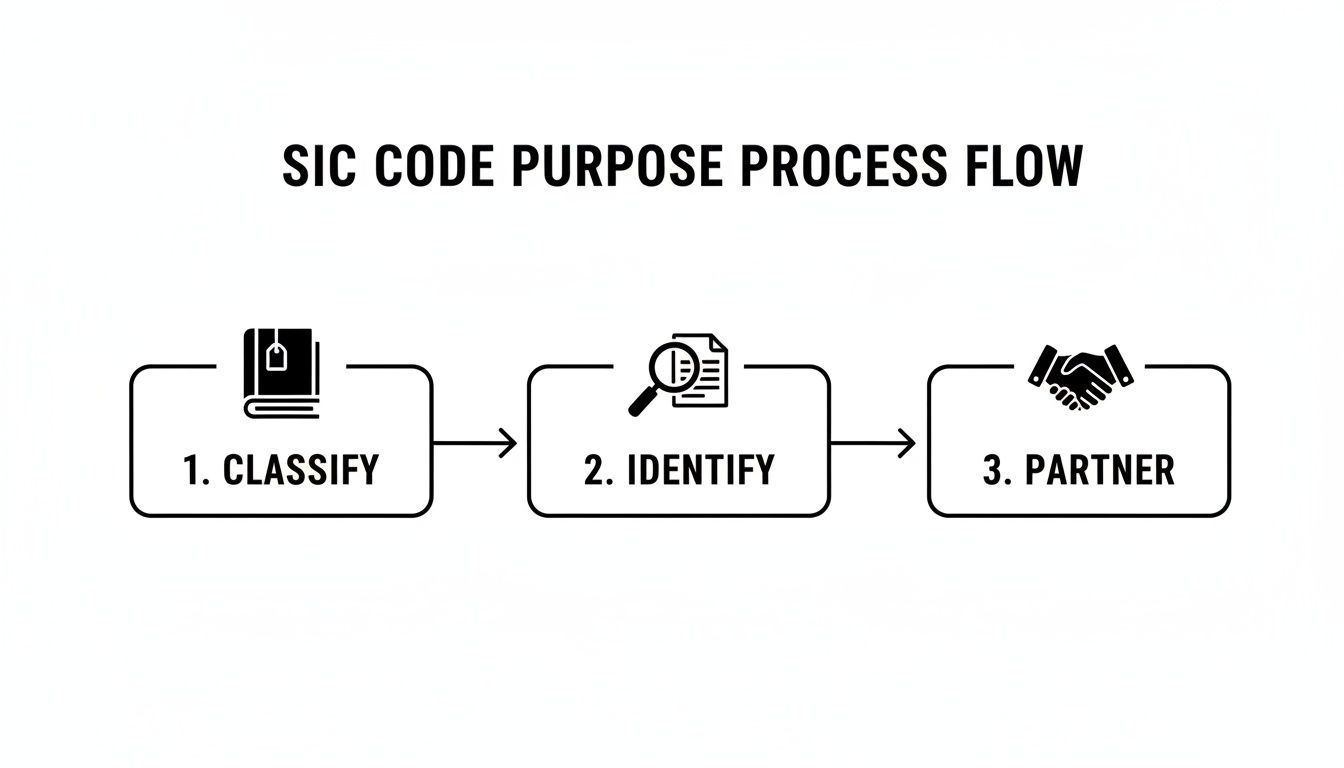
As you can see, this five-digit number plays a surprisingly big role in business transparency, helping you classify, identify, and ultimately decide who to work with.
Choosing a Code for Your Own Company
If you are setting up your own limited company, you have to select at least one SIC code. This is not just a box-ticking exercise; it is a mandatory part of registering with Companies House and forms the backbone of the UK’s economic data.
Companies House provides a condensed list of just over 600 individual codes to choose from, drawn from the much larger official ONS framework. It is critical you pick from this specific list, as they point out on the official Companies House blog, using a code from outside it will get your filing rejected.
To find the right code for your business:
- Check the Condensed List: Companies House has a searchable PDF list of all approved SIC codes. Scan through it to see what is available.
- Match Your Main Activity: Find the description that best fits what your business primarily does. Be as accurate as you can.
- Use Up to Four Codes: Does your business have a few different income streams? No problem. You can select up to four different SIC codes to give a complete picture of your activities.
Getting this right from the start is a key step in setting up your company correctly. For a full walkthrough of everything involved, have a look at our guide on how much it costs to set up a limited company.
Common SIC Codes for Contractors and Umbrella Companies
When setting up a limited company or vetting a new umbrella partner, the company SIC code is one of the first things you will encounter. It might seem like just another bit of admin, but getting it right, and knowing what to look for, is surprisingly important.
Think of it as your company's official job title. It tells Companies House, banks, and potential clients what your business actually does. This guide breaks down the common codes used by contractors and explains what you should expect to see from a compliant umbrella company.
Choosing a SIC Code for Your Contractor Limited Company
As a contractor, your SIC code should be a clear and accurate reflection of the services you sell. Getting this right helps avoid any confusion down the line. If you’re a freelance engineer, your company should not be registered as a retail business.
While there are thousands of codes, most contractors fall into a few common categories.
- 62020 – Information technology consultancy activities: This is the default for most IT contractors. It covers everything from strategic advice and systems analysis to hands-on technical support.
- 74100 – Specialised design activities: The perfect fit for creative professionals. If you are a graphic designer, UX/UI specialist, or product designer, this is likely your code.
- 71129 – Other engineering activities: A broad but popular choice for engineers whose specialism does not have a more specific code. It signals your expertise in the engineering field.
- 70229 – Management consultancy activities other than financial management: This is ideal for contractors providing business strategy, project management, or operational improvements.
Do not worry if your work crosses over into multiple areas. You can register up to four SIC codes to give a full and honest picture of your company's activities.
The Right SIC Codes for an Umbrella Company
Here’s where things get a bit different. When you look up an umbrella company on Companies House, you will not see a code for IT or engineering. That’s because the umbrella is not providing those services, you are. Their business is employment and payroll.
A compliant umbrella company acts as an employer for contractors across hundreds of different professions. Their SIC code must reflect this core function.
A legitimate umbrella company’s company SIC code should clearly point to employment services. If you see a code for something totally unrelated, like property development or retail, it is a major red flag and you should ask some serious questions.
These are the two codes you should expect to see from a genuine umbrella company:
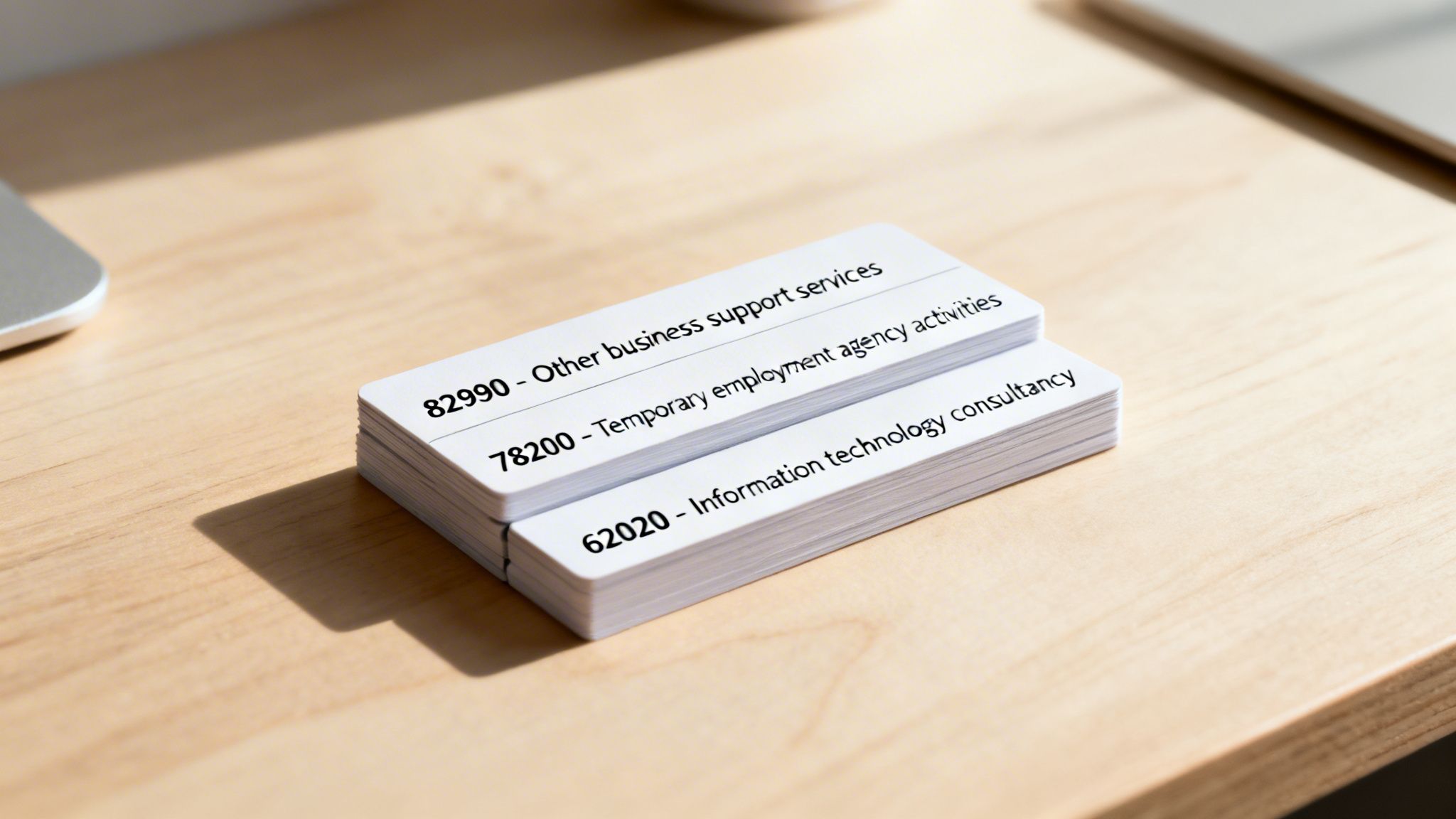
- 78200 – Temporary employment agency activities: This is arguably the most accurate description. The umbrella company employs temporary workers (contractors) and supplies their services to end clients. This is the very essence of the umbrella model.
- 82990 – Other business support service activities n.e.c.: The "n.e.c." simply means 'not elsewhere classified'. This is another perfectly acceptable and common choice. It is a catch-all for businesses providing support services, which accurately describes the payroll and administrative work an umbrella performs.
Seeing one of these codes is a good sign. It shows the provider understands its role in the supply chain and is registered correctly. Their business is to handle your payroll, not to pretend they are a specialist consultancy. Understanding this distinction is key, and our guide on what an umbrella company is explains it in more detail.
Why Your Umbrella's SIC Code Is a Crucial Compliance Check

A company SIC code might seem like just another piece of admin, but it’s one of the most revealing clues you have when vetting an umbrella company. Think of it as the business’s official, public declaration of what it actually does.
When you are weighing up your options, checking the SIC code gives you a quick, factual way to see if an umbrella’s marketing matches its reality. This simple check is a powerful first step in your due diligence, helping you spot mismatches early and steer clear of trouble down the line.
A Powerful Red Flag Detector
It really is common sense: what a company says it does should line up with its official classification. If an umbrella presents itself as a specialist payroll provider for contractors, its company SIC code ought to reflect activities like employment, payroll, or business support.
Let us say you are looking at an umbrella that talks a big game about its payroll expertise. You pop over to Companies House and discover its SIC code is '68209 – Other letting and operating of own or leased real estate'. That’s a massive red flag. Why would a payroll specialist be officially registered as a property firm? A mismatch like this demands answers.
For Small and Medium-sized Enterprises (SMEs), getting this right is not just about looking professional; it is a fundamental part of staying compliant. An incorrect code can cause all sorts of problems, which is why checking the code of any business you work with is such a vital first step.
How SIC Codes Relate to IR35
While a SIC code will not directly determine your IR35 status, it does paint a bigger picture of the supply chain’s integrity. HMRC and even some clients may look at a company’s registered activities to get a feel for how the whole arrangement is structured.
An umbrella with a clear, appropriate code like ‘78200 – Temporary employment agency activities’ immediately looks the part of a legitimate employer. This fits perfectly with the compliant employment model required for contractors working on assignments inside IR35. For a deeper dive, check out our complete guide to IR35 for contractors.
On the flip side, a misleading code could raise serious questions in a wider investigation about what the business is truly up to. It suggests a lack of transparency or a basic misunderstanding of its own function, neither of which are qualities you want in a payroll partner.
A Contractor's Due Diligence Checklist
When you find an umbrella company’s SIC code, do not just tick a box. Use it as a conversation starter. Asking the right questions at this stage helps you quickly filter out providers that are not transparent or compliant.
A mismatched SIC code is not instant proof of wrongdoing, but it is a clear signal to dig deeper. A transparent and compliant provider will have no problem explaining its choice of code and how it relates to the services they offer you.
If an umbrella's company SIC code seems off, here are the key questions you should be asking:
- Why did you choose this specific SIC code for your company? Their explanation should be confident, clear, and make perfect sense.
- How does this code reflect the payroll and employment services you provide to contractors? They must be able to connect their official classification to their day-to-day operations.
- Can you explain why you are not registered under a more common code for employment or payroll services? If they have picked an unusual code, there had better be a very good reason for it.
The UK's Standard Industrial Classification system has been around since 1948, creating a consistent way to categorise economic activity. When a company registers with Companies House, it must choose at least one code. Getting it wrong can lead to filing rejections and delays that could impact your pay and compliance.
How to Use Multiple SIC Codes to Your Advantage
It is rare for a contractor’s skills to fit neatly into one box. You might be an IT consultant who also manages projects, or a writer who has branched out into digital marketing. Thankfully, the company SIC code system is built for this kind of flexibility.
Companies House allows you to register up to four SIC codes. This is not just an administrative quirk; it is a valuable tool. It lets you give a complete and honest picture of your business activities, whether you are describing your own limited company or vetting a potential umbrella partner.
Building a More Accurate Business Profile
Using multiple SIC codes allows you to create a detailed snapshot of the services you offer. This is particularly useful when your work straddles traditional industry lines. By selecting more than one code, you ensure anyone looking at your company’s public record understands the full scope of your expertise.
Think of an IT contractor whose work has evolved. What began as pure tech support might now involve strategic business advice.
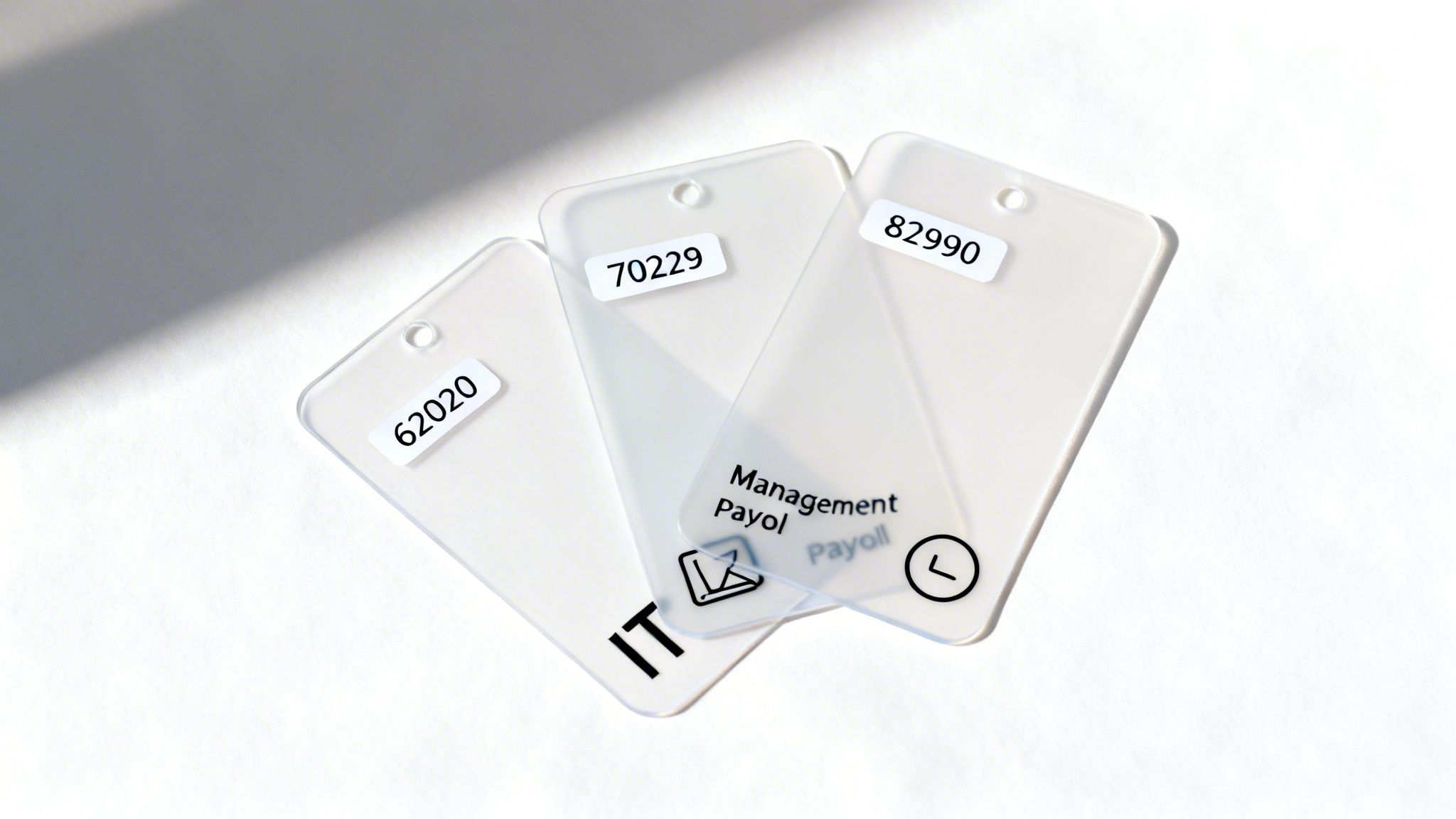
- Primary Activity: Their main income is from IT, so their first code could be 62020 – Information technology consultancy activities.
- Secondary Activity: They now also spend significant time helping clients with operational strategy. Adding 70229 – Management consultancy activities other than financial management makes perfect sense.
This combination paints a much more accurate picture than a single code ever could. It is a simple way to show the breadth of your value to clients without any ambiguity.
Reading Between the Lines of an Umbrella Company's Codes
The same logic applies when you are checking out an umbrella company. A compliant provider will have a primary code that reflects their core function as an employer, but they might also list secondary codes for other administrative services.
For instance, you might see an umbrella company with:
- Primary Code: 78200 – Temporary employment agency activities, covering their main role as an employer for contractors.
- Secondary Code: 82110 – Combined office administrative service activities, representing the payroll and HR support they provide.
A logical combination like this is often a good sign. It suggests the company understands its business model and has been transparent in registering its different functions. It points to a professional approach to its own corporate governance.
Remember, the key is relevance. Multiple codes are perfectly fine as long as they tell a coherent story about the business. If the codes seem totally unrelated, like payroll services and agricultural farming, it is a clear signal to start asking some hard questions.
The Devil Is in the Detail
Choosing between codes with similar-sounding descriptions is a common hurdle. The small differences matter, and taking a moment to understand them ensures you pick the most accurate classification.
Let us go back to our IT contractor who also manages projects. They might be stuck between two codes that seem almost identical but have distinct meanings:
- 62020 – Information technology consultancy activities: This is all about advising on and designing computer systems. The focus is squarely on the technology.
- 70229 – Management consultancy activities: This code is for advising on business strategy, operations, and project management. The focus is on business processes.
An IT contractor who plans a software migration would use 62020. But if they also manage the project’s timeline, budget, and team, adding 70229 would be entirely appropriate. Using both gives a precise and professional account of a multifaceted role.
How to Change Your Company SIC Code
As your business grows and its services change, the SIC code you picked when you first set up your company might start to feel a bit out of date. Changing it might sound like a hassle, but it is actually a pretty routine bit of admin, and much more straightforward than you might think.
Keeping your classification accurate is just good business housekeeping. It ensures your company is correctly represented on the public record at Companies House, which affects how you’re seen by banks, insurers, and potential clients. It is a small detail, but one worth getting right.
When to Change Your SIC Code
The most common reason to update your SIC code is simple: your business has changed. Maybe you have developed a new specialism, moved into a different sector, or your main source of income has shifted. If your current code no longer reflects what your business actually does, it is time for an update.
Think of it like this: if you started out as an IT consultant (62020) but now find most of your work is in project management (70229), your SIC code should reflect that reality.
You should think about a change if:
- Your main business activity has fundamentally changed.
- You have diversified and want to add up to three more codes to represent your new services.
- You realise the code you originally chose just was not the most accurate one.
The Easiest Way to Update Your Code
For most limited company contractors, the simplest way to change a company SIC code is when you file your annual confirmation statement. This is the yearly check-in you do with Companies House to confirm your company’s details are still correct.
It is a mandatory filing anyway, so updating your SIC code at the same time is just efficient. When you complete the statement online, you will be asked to review your company’s details, including the "Nature of business (SIC)". At this stage, you can easily remove old codes and add new ones from the official condensed list.
You are not locked into your SIC code for a full year. If your business changes significantly and you need to update your classification sooner, you can do so at any time without waiting for your next confirmation statement.
How to File a Change Sooner
But what if you cannot wait? If there is a pressing reason to change your SIC code, for instance, to secure a business loan or a specific type of insurance, you can simply file a new confirmation statement early.
You can file as many confirmation statements as you need throughout the year, though you will have to pay the standard filing fee each time. This lets you update your public record almost immediately, making sure your company’s profile is always current and reflecting the work you do today.
Common Questions About Company SIC Codes
To finish up, let's walk through some of the questions we get asked all the time by contractors trying to make sense of company SIC codes.
Is a SIC Code Mandatory for My Company?
Yes. Every single limited company and Limited Liability Partnership (LLP) in the UK must have at least one SIC code on record with Companies House. It is a non-negotiable part of the incorporation process and a key piece of your public company information.
What Happens if I Use the Wrong SIC Code?
Getting your SIC code wrong can lead to some real headaches. At best, Companies House might reject your filings, causing delays. More seriously, it can create problems when you’re trying to open a business bank account or arrange insurance, as these firms use the code to understand your business and assess risk.
How Often Should I Review My SIC Code?
It is good practice to check your SIC code at least once a year, usually when you’re filing your confirmation statement. You should also revisit it whenever the main focus of your business changes. This ensures the code always gives an accurate picture of the work you actually do.
Can an Umbrella Company Have a SIC Code for My Industry?
Not really, and you would not want them to. A compliant umbrella company acts as an employer for contractors across dozens of different sectors.
Because of this, they use very broad, general codes like ‘82990 – Other business support service activities’ or ‘78200 – Temporary employment agency activities’. A specific code for IT or engineering would not accurately reflect their diverse workforce.
At UmbrellaCompany.com, we make it simple to find and compare compliant, accredited umbrella companies you can trust. Start your comparison today and find the right payroll partner in just a few clicks. Find out more at https://umbrellacompany.com.


