


Starting a limited company often feels like a milestone. You’ve chosen a name, completed the registration, and finally have a business that looks real on paper.
Then the admin starts.
For many contractors, this is the moment the questions pile up. Who keeps the records? What has to go to Companies House? What happens if you miss something? And if you’re deciding between your own limited company and an umbrella arrangement, which jobs are yours to manage?
This guide is written for that exact point. It explains company secretarial responsibilities in plain English, shows what matters most for a contractor, and compares what you handle in a limited company with what an umbrella company typically takes care of for you.
Your New Limited Company and Its Hidden Admin
A lot of new contractors assume the hard part is forming the company. In reality, incorporation is the starting line.
You might have spent a weekend choosing between names, opening a business bank account, and reading up on tax. You may even have checked the likely setup costs first, using a guide like this breakdown of how much it costs to set up a limited company. That part is useful, but it doesn’t tell you much about the ongoing legal housekeeping.

The hidden admin usually looks small at first. A confirmation statement here, a register update there, some minutes after a decision you made alone at your kitchen table. But together, these tasks form the compliance record of your business.
Why contractors get caught out
Contractors usually focus on delivery. You’re thinking about contracts, invoices, timesheets, and getting paid. Company secretarial work feels secondary because it doesn’t generate revenue directly.
That’s why it slips.
Common points of confusion include:
- What counts as a formal company record: Not every business decision needs a solicitor, but key company decisions still need proper records.
- What “statutory” means: It means the law requires it.
- Whether software solves everything: Tools help, but you still need to know what you’re responsible for.
Practical rule: If a task relates to Companies House, ownership, directors, or formal company decisions, treat it as part of your compliance routine, not optional admin.
A simple digital workflow can make this far easier. If you’re building your admin stack from scratch, this list of essential apps for business success is a sensible starting point for document storage, calendar reminders, and task tracking.
Think of it as business maintenance
You don’t need to become a corporate lawyer. You do need a repeatable routine.
For a one-person contractor company, company secretarial responsibilities are usually less about complexity and more about consistency. If you diarise the right dates, keep records current, and deal with changes promptly, the work is manageable. If you ignore it for months, it becomes stressful and expensive very quickly.
Understanding the Role of a Company Secretary
The phrase company secretary sounds more formal than it is. Many contractors hear it and assume it means a dedicated employee in a larger business.
In UK company law, it’s better to think of it as a bundle of compliance and governance duties. Someone must make sure records are maintained, filings happen, and meetings or written decisions are documented properly.
What the law says for private companies
Under the UK’s Companies Act 2006, private companies are not statutorily required to appoint a company secretary, a change from April 2008 that shifted the burden of compliance directly onto directors. Public companies must still appoint one. The Institute of Directors explains this point clearly in its guide to the role of the company secretary.
For a contractor operating through a private limited company, that creates one important reality. Even if you never appoint a company secretary, the legal work doesn’t disappear.
It sits with the director.
What that means in practice
If you’re the sole director, you are usually the person who must make sure the company stays organised and compliant. That includes keeping records accurate, filing on time, and preserving evidence of company decisions.
That’s why the term can be misleading. Some contractors think, “I don’t have a company secretary, so those responsibilities don’t apply to me.” They do.
The title may be optional for a private company. The duties are not.
The tasks people usually mean
When people talk about company secretarial responsibilities, they usually mean work such as:
- Maintaining statutory registers: Keeping records of members, directors, and people with significant control up to date.
- Handling Companies House filings: Sending required forms and annual filings on time.
- Supporting decision-making records: Recording board decisions, shareholder decisions, and key changes.
- Organising meeting paperwork: Notices, agendas, and minutes where formal meetings are needed.
If you need a practical starting point for documenting meetings and decisions, a simple meeting agenda template can help you avoid the blank-page problem that stops many directors from recording things properly.
The company secretary role and your accountant are not the same
This is another area where contractors get mixed up. Your accountant may help with accounts and deadlines, but that doesn’t automatically mean they are handling every part of your company secretarial responsibilities.
Some accountants offer broader support, some don’t. If you’re weighing that up, this guide on choosing the best accountant for limited company contractors is a useful checkpoint.
Always ask direct questions:
- Will you maintain statutory registers?
- Will you prepare or remind me about confirmation statements?
- Will you record director and shareholder resolutions?
- Will you notify Companies House of company changes?
If the answer is unclear, assume the task remains yours until you confirm otherwise in writing.
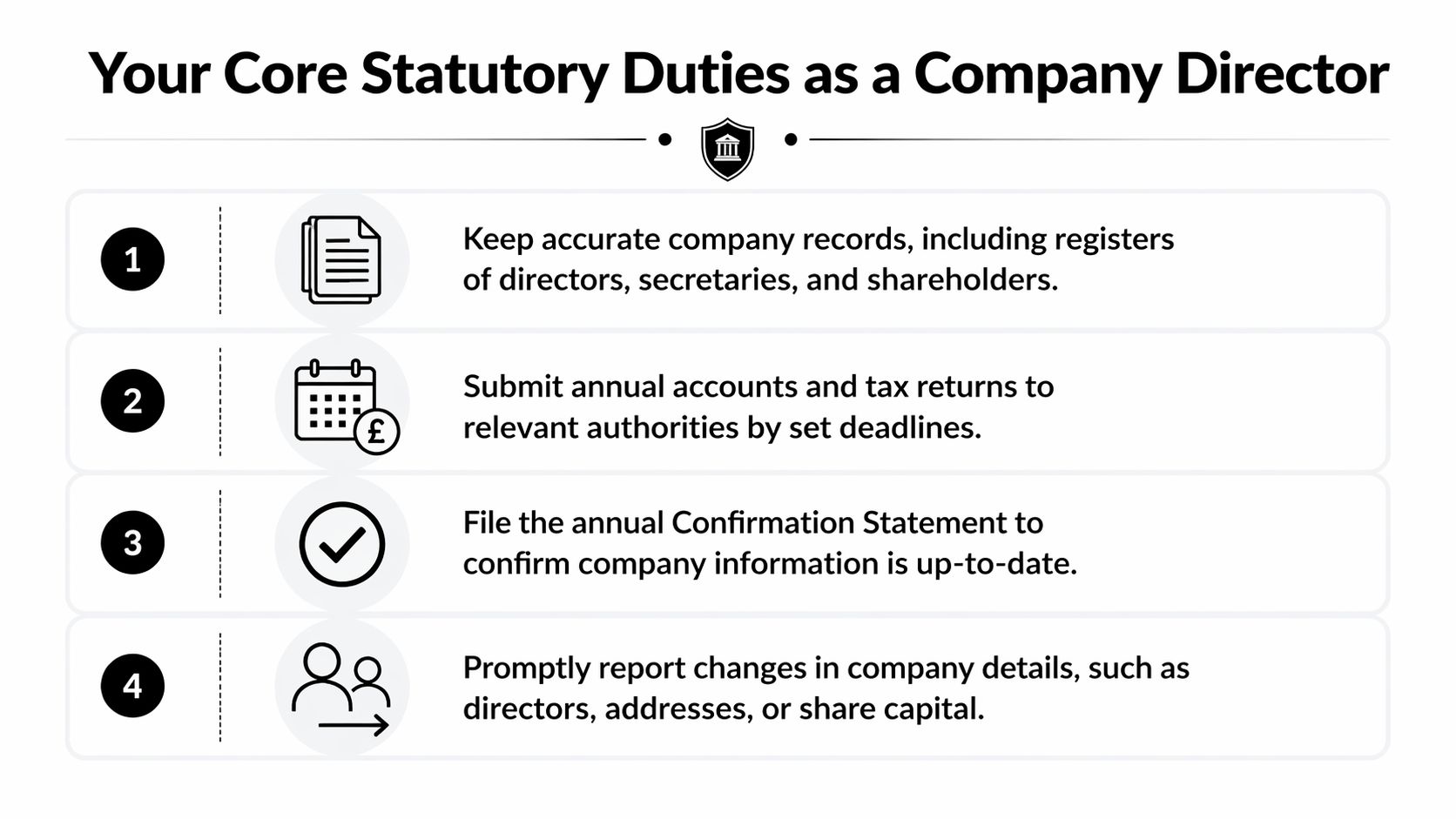
Your Core Statutory Duties as a Company Director
For most contractor companies, the day-to-day version of company secretarial responsibilities boils down to a few recurring jobs. None of them are glamorous. All of them matter.
Keeping statutory registers up to date
Your company must maintain certain official records. These are often called statutory registers.
For a contractor’s limited company, the most relevant usually include:
- Register of members: Who owns the shares in the company.
- Register of directors: Who is appointed as director.
- PSC register: The record of any Persons with Significant Control.
- Register of secretaries: If you appoint one.
The PSC register catches people out regularly because ownership changes can feel informal in a small business. A share transfer between family members, a new investor, or a restructuring with an adviser can trigger an update requirement.
Benchmark data indicates that 25% of UK SMEs face errors in their PSC register annually, often because beneficial ownership details are not updated after transactions. That point is covered in the earlier Institute of Directors source, but the practical lesson is simple. If ownership changes, review your PSC record immediately.
Filing the confirmation statement
The confirmation statement is not the same as your annual accounts. It is your company’s way of confirming that key information on the public register is accurate.
That usually includes details such as:
- registered office
- directors
- shareholders
- share capital
- PSC information
A lot of first-time directors assume this is something their accountant automatically handles. Sometimes they do. Sometimes they only remind you. Sometimes they don’t touch it.
Good habit: Put the confirmation statement review date in your calendar well before it falls due, then check the Companies House record against your own internal records line by line.
Preparing and filing annual accounts
Annual accounts are part accounting task, part compliance task. Even if your accountant prepares them, you still need to understand the filing responsibility because the company, and ultimately its directors, remain accountable for filing on time.
Contractors often confuse three separate obligations:
- Company accounts
- Corporation Tax submissions
- Your personal Self Assessment
They connect, but they are not interchangeable. If you need to map your personal tax dates alongside company work, keep a separate note of the UK Self Assessment deadlines.
Recording decisions and minutes
A one-person company still needs a paper trail. If you appoint a director, issue shares, approve accounts, or make other formal decisions, keep a written record.
That may include:
- board minutes
- written resolutions
- shareholder resolutions
- dated copies of key approvals
This doesn’t need to be elaborate. It does need to be clear. If someone looks at the file later, they should be able to see what was decided, when, and by whom.
Reporting changes to Companies House
When key company details change, you usually need to notify Companies House. The most common examples are:
| Change | What to check internally |
|---|---|
| Director details | Service address, appointment, resignation |
| Registered office | Whether company records move too |
| Share structure | Whether registers and PSC details also change |
| Company name or articles | Whether supporting resolutions are filed and stored |
Contractors often update one system and forget the rest. For example, they may tell their accountant about a new address but forget to update the company’s own records. Or they update the shareholding internally but not the PSC register.
A workable monthly routine
The easiest way to stay on top of company secretarial responsibilities is to turn them into a short monthly review.
- Check filings due soon: Review Companies House and tax deadlines.
- Review ownership records: Confirm no share, director, or PSC details have changed.
- File decision records: Save signed minutes or resolutions in one folder.
- Match public and private records: Make sure your internal documents align with the public register.
If you use WebFiling, cloud storage, and a shared accountant portal, the admin becomes much easier to control. The key is having one place where the current truth of the company lives.
The Real Cost of Non-Compliance Penalties and Risks
Ignoring company secretarial responsibilities usually doesn’t cause immediate drama. That’s part of the problem. The first missed task can feel harmless.
Then the reminder notices arrive.

Late filing penalties are automatic
According to 2023/24 Companies House data, over 1.2 million late filings resulted in more than £15 million in penalties, with fines escalating from £150 for filings up to one month late to £1,500 for filings over six months late. That data is referenced in the Institute of Directors material already noted earlier.
For a contractor business, those aren’t abstract figures. A preventable filing penalty can wipe out part of a month’s margin, especially if it lands alongside accountancy fees, software costs, and a tax payment.
The financial hit isn’t the whole risk
Late or inaccurate filings can also create problems that are harder to measure but just as real:
- Stress at year end: Small errors pile up and become a larger clean-up job.
- Poor records for lenders or clients: Disorganised filings can make the business look less reliable.
- Regulatory exposure: Repeated non-compliance can draw further scrutiny.
- Director consequences: Serious failures can create personal risk for directors.
If you’re building your own compliance process, it helps to understand the broader discipline of regulatory compliance, not just the filing dates themselves. The wider point is that good compliance is a system, not a last-minute scramble.
What missed admin often looks like in real life
Most contractor problems don’t begin with deliberate avoidance. They begin with ordinary life.
A project overruns. You postpone some paperwork. Your accountant asks a question by email and you mean to reply later. A registered office change is discussed but not documented. Months pass.
That’s how small gaps become filing issues.
Here’s a short explainer that many new directors find useful before they handle Companies House deadlines themselves:
Missing a deadline is rarely a sign that the task was difficult. It usually means nobody owned it clearly enough.
The fix is practical. Assign each filing, each register, and each update to a person and a date. In a one-director company, that person is usually you.
Contractor Checklist Ltd Company vs Umbrella Company
If you’re deciding how to contract, this is the comparison that matters most. A limited company can offer control, but it also leaves you responsible for more administration. An umbrella arrangement reduces that burden because the company structure and its formal maintenance sit elsewhere.
For a broader look at tax, admin, and working style, compare the options in this guide to umbrella company vs limited company.
Who handles the admin Limited Company vs Umbrella Company
| Responsibility | Your Limited Company (You Handle It) | Umbrella Company (We Handle It) |
|---|---|---|
| Incorporation records | You keep company records organised after formation | Not your responsibility as a worker under the umbrella |
| Statutory registers | You must maintain and update them | The umbrella maintains its own company records |
| PSC register | You must identify and update relevant control details | Not something you maintain personally |
| Confirmation statement | You must ensure it is filed correctly and on time | Not your filing obligation |
| Annual accounts | You arrange preparation and filing for your company | The umbrella files its own accounts |
| Companies House changes | You report changes such as directors, address, or share issues | The umbrella handles its own corporate changes |
| Board minutes and resolutions | You record formal company decisions | You usually don’t need to create company minutes for the umbrella’s governance |
| Payroll for your work | You run payroll if taking a salary from your company | The umbrella runs PAYE payroll for you |
| Payslips | You or your payroll provider produce them | The umbrella issues your payslips |
| PAYE and National Insurance administration | You manage this if paying yourself through your company | The umbrella handles PAYE and related payroll processes |
| Workplace administration linked to employment | You arrange what applies within your company setup | The umbrella handles employment administration within its model |
What this means in practice
With a limited company, flexibility comes with responsibility. You control the company, but you also carry the admin that keeps it legal and current.
With an umbrella company, you’re not running the company entity yourself. That means many company secretarial responsibilities do not sit with you personally.
The decision point for contractors
A limited company usually suits contractors who are comfortable managing or paying for ongoing administration. That includes staying on top of records, approving filings, and checking that advisers have performed as expected.
An umbrella arrangement usually suits contractors who want to focus on the assignment rather than maintain a company. You still need to read your payslips and understand your engagement, but the corporate filing and register work is not part of your weekly to-do list.
Choose the structure that matches the amount of admin you’re genuinely willing to own, not the amount you hope you’ll get around to later.
Your Next Steps and Recommended Resources
If you’ve recently set up a limited company, don’t try to memorise everything at once. Put a working system in place instead.
Start with these actions
- Diarise key dates: Add Companies House and tax deadlines to your calendar with advance reminders.
- Create one compliance folder: Store confirmation statements, accounts, resolutions, and register updates in one place.
- Review your public record: Check your Companies House profile against your internal records.
- Confirm adviser responsibilities: Ask your accountant exactly what they do and do not handle.
- Record decisions promptly: Don’t leave minutes and resolutions until months later.
Useful official resources
Use the official Companies House and GOV.UK services for the practical side of filings and records:
- Companies House WebFiling: For many online filing tasks
- GOV.UK guidance on running a limited company: For director obligations and company administration
- Companies House service search: To check the public company record
These tools won’t replace judgement, but they do reduce the risk of missing the basics.
If the admin is getting in the way
Many contractors reach a simple conclusion after doing this for a while. They can manage the company admin, but they don’t want to.
That’s a reasonable position. If you’d rather spend your time on client work than confirmation statements, registers, and payroll administration, it’s worth comparing umbrella options carefully and choosing a setup that matches your working style.
Frequently Asked Questions for Contractors
Can I be my own company secretary
For a private limited company, you don’t usually need to appoint a company secretary at all. If you don’t appoint one, the relevant compliance burden sits with the director. In a one-person contractor company, that usually means you handle the duties yourself or pay an adviser to help.
What’s the difference between a confirmation statement and annual accounts
A confirmation statement confirms that core company information on the public register is correct.
Annual accounts report the company’s financial position for the relevant period.
They are different filings with different purposes. Contractors often mix them up because both happen regularly and both involve Companies House.
Does my accountant automatically cover company secretarial responsibilities
Not always. Some accountants do a lot. Others focus mainly on accounts and tax returns.
Ask what’s included. If they don’t explicitly maintain registers, prepare resolutions, or file confirmation statements for you, assume you still need to manage those tasks.
How much time does this admin actually take
It depends on how organised you are and whether the company structure changes often. A stable one-director company with a good filing routine is far easier to manage than a company with frequent changes, poor records, and last-minute deadlines.
The time cost rises sharply when you leave things until year end.
What records should I keep in one place
Keep your incorporation documents, share records, PSC details, Companies House filings, board minutes, written resolutions, and correspondence about company changes together. Cloud storage with clear folder names is usually enough for a small contractor company.
If I use an umbrella company, do I still need to worry about this
Not in the same way. You should still review your contract terms, payslips, and employment paperwork carefully. But the company secretarial responsibilities discussed in this guide relate to running your own limited company, not working through an umbrella structure.
If you want a simpler way to work, compare your options with Umbrella Company and find an umbrella setup that fits your contract, pay rate, and IR35 position.


