


Your current contract is winding down. The end date is in sight, the inbox is quieter than you'd like, and you're weighing up the next move. Do you chase another direct contract, speak to recruiters, or look at larger companies that subcontract work and need specialist support through their delivery chain?
For many UK contractors, subcontracting sits right in the middle of that decision. It can open doors to bigger projects, more consistent pipelines of work, and clients you might never reach directly. It can also bring extra layers, such as agencies, prime contractors, payment terms, CIS deductions, and IR35 questions that aren't obvious at first glance.
At UmbrellaCompany.com, we see this confusion all the time. A role can look straightforward until you ask who the end client is, who sets the status decision, who pays you, and what happens if payment is delayed. Those details matter just as much as the day rate.
Your Guide to Subcontracting in the UK
A typical example looks like this. A software contractor finishes a transformation project with a medium-sized client and wants their next assignment to be more stable. Instead of pitching directly to another end client, they join the supply chain of a larger consultancy that has won the main contract and now needs specialist delivery support.
That arrangement is subcontracting. It's common, legitimate, and often a smart route into work that would otherwise be hard to access. It's especially relevant in the UK, where contractors often operate through layered engagement models involving an end client, recruitment business, consultancy, and sometimes an umbrella company.
Subcontracting also isn't just a casual handshake arrangement. It's a structured commercial relationship, and that matters because larger clients and public-sector style buyers expect traceability, reporting, and compliance controls across the supply chain, as outlined in the SBA guide to prime and subcontracting relationships. In plain terms, when work is passed down, someone still needs to show who did it, who got paid, and who carried which responsibility.
If you're exploring companies that subcontract work, the practical questions usually come fast:
- Who am I really working for
- Who decides whether the role is inside or outside IR35
- What contract terms protect me if the project changes
- How do I get paid safely and compliantly
Those are the questions that shape a good subcontracting decision. The strongest contractors don't just find opportunities. They understand the chain, read the paperwork carefully, and choose a payment structure that fits the engagement.
Understanding Subcontracting and Who Uses It
Subcontracting is most easily understood when considering a building project. The organisation funding the work wants the finished result, but it doesn't hire every specialist directly. Instead, it appoints a main supplier to run delivery, and that supplier brings in specialists for defined parts of the job.
That same pattern appears far beyond construction. A bank might hire a consultancy to deliver a systems migration. The consultancy then hires a cloud architect, test lead, and cyber specialist on a subcontract basis. The bank is the end client, the consultancy is the prime contractor, and the specialists are subcontractors.
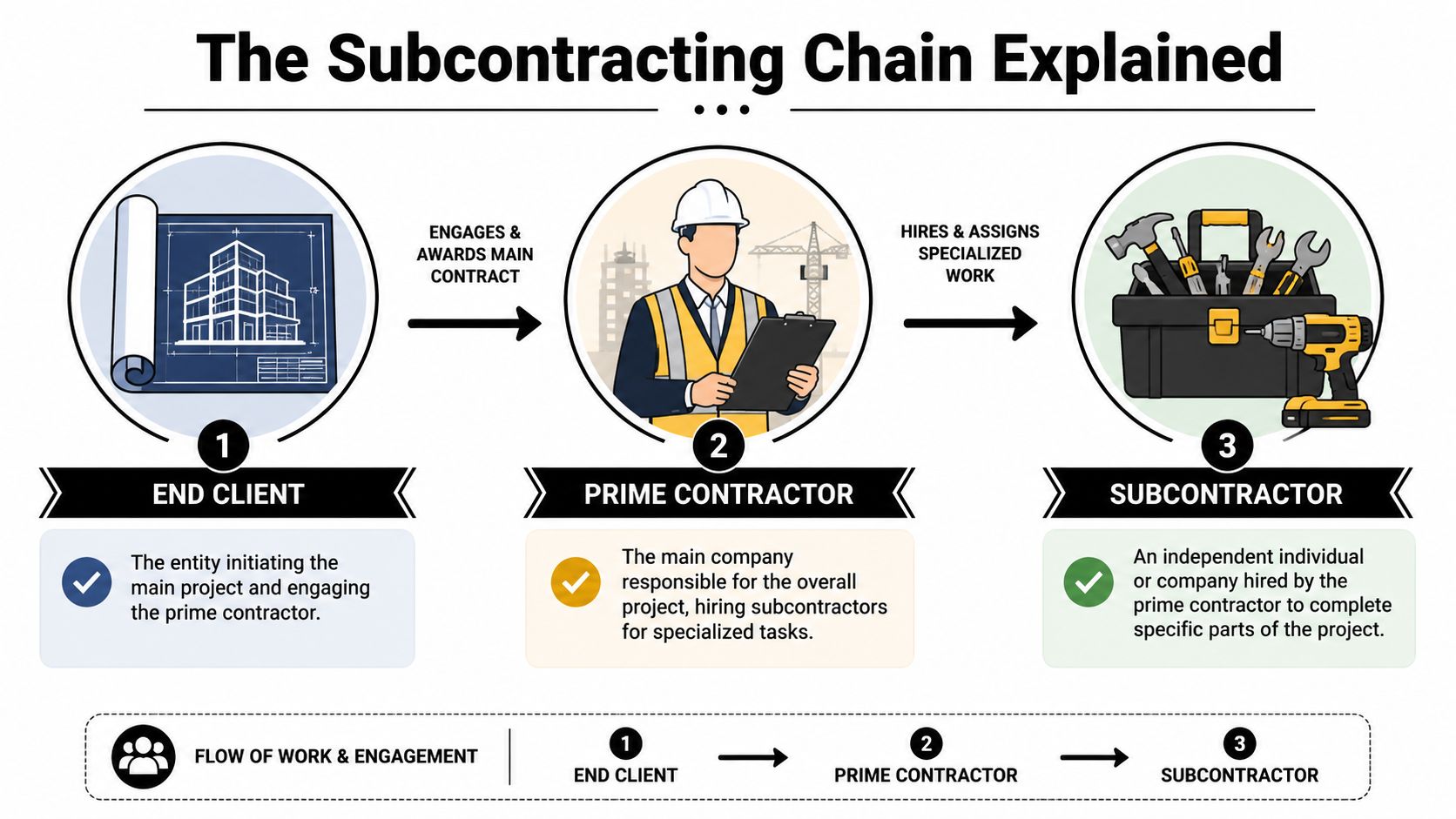
The three parties in simple terms
Here's how the chain usually works:
- End client: The organisation that needs the project completed. It wants outcomes, deadlines met, and risk controlled.
- Prime contractor: The company with the main contract. It manages delivery and remains accountable to the end client.
- Subcontractor: The specialist business or contractor brought in to handle a defined part of the work.
This distinction matters because the subcontractor often has less visibility over the full commercial picture. You may know your work package very well, but not every clause in the main contract above you. That's one reason experienced contractors ask careful questions before they start.
Practical rule: If you don't know who sits above you in the chain, you can't properly assess your risk.
Where subcontracting is common
Many readers hear “subcontracting” and think only of trades. In reality, companies that subcontract work operate across a wide spread of sectors, including:
- Construction and engineering, where specialist trades, labour-only services, and package-based work are standard.
- IT and digital delivery, where consultancies often bring in developers, architects, data specialists, and cyber professionals.
- Marketing and creative services, where agencies outsource design, media buying, content, and technical production.
- Facilities and maintenance, where hard and soft services are regularly broken into specialist scopes.
- Professional services, including project management, transformation, compliance, and operational support.
Why companies subcontract work
Large organisations subcontract for practical reasons, not because they want complexity for its own sake.
- Specialist expertise: They need niche skills for a defined piece of work.
- Flexible capacity: They can scale delivery up or down without hiring permanent staff.
- Project timing: They may need people quickly when deadlines tighten.
- Risk management: The prime contractor can distribute parts of delivery to firms with proven capability.
- Commercial structure: Some clients prefer one main supplier to manage the wider programme.
In public procurement and major enterprise work, subcontracting is formal enough to be tracked and reported. Prime suppliers on large contracts may need to report subcontracting spend and supplier activity, which is one reason clean compliance and delivery records matter when you want to be selected.
How to Find Subcontracting Opportunities
A lot of subcontracting work never appears as a simple public advert. It moves through relationships, preferred supplier lists, specialist recruiters, and delivery teams that need trusted people quickly. If you're serious about working with companies that subcontract work, you need a search approach that reflects how these opportunities move.
Build recruiter relationships that fit your niche
Generalist recruiters can help, but specialist recruiters often understand the chain better. They know which consultancy has won a programme, which prime contractor is expanding a team, and where a subcontractor is needed to fill a capability gap.
Approach them like a business partner, not like a generic applicant.
- Send a focused profile: Make your CV and LinkedIn summary clear about your niche, tools, sectors, and availability.
- State your working preferences: Say whether you can work through a limited company, umbrella, or another structure depending on status.
- Ask chain questions early: Find out who the end client is, whether there is an agency layer, and who will issue the contract.
- Stay visible: A short update when your project end date changes keeps you in their active shortlist.
Use LinkedIn as a subcontracting tool
LinkedIn works best when you stop treating it as a CV archive. It's a mapping tool for supply chains. Search for delivery managers, programme directors, resource managers, and practice leads inside consultancies and specialist firms.
Then make your outreach specific. Don't send a vague note saying you are “open to work”. Mention the type of subcontract support you provide and the sort of projects you slot into well.
A simple message can work better than a polished sales pitch if it shows that you understand delivery pressure and can solve a defined problem.
Look at public procurement routes
Public-sector and large-contract supply chains create genuine openings for smaller suppliers and independent specialists. Prime suppliers on large contracts must report their subcontracting spend, which means they actively vet smaller businesses and contractors as part of supply-chain management, as described in the subcontracting resources for prime supplier reporting.
That doesn't mean every contractor should rush into public-sector work. It does mean you should pay attention to firms already delivering into those environments, because they often need compliant subcontract support.
Make yourself easy to vet
Prime contractors are cautious for good reason. They carry delivery responsibility, so they look for subcontractors who reduce risk.
You'll stand out faster if you can show:
- Clear compliance documents, including right-to-work and business details where relevant
- A concise capability statement, not just a long CV
- Evidence of reliability, such as references, portfolio examples, or sector experience
- A realistic availability window, so buyers can plan around you
If you want a practical starting point, our guide to jobs for subcontractors can help you map where opportunities typically appear.
Navigating Your Legal and Financial Responsibilities
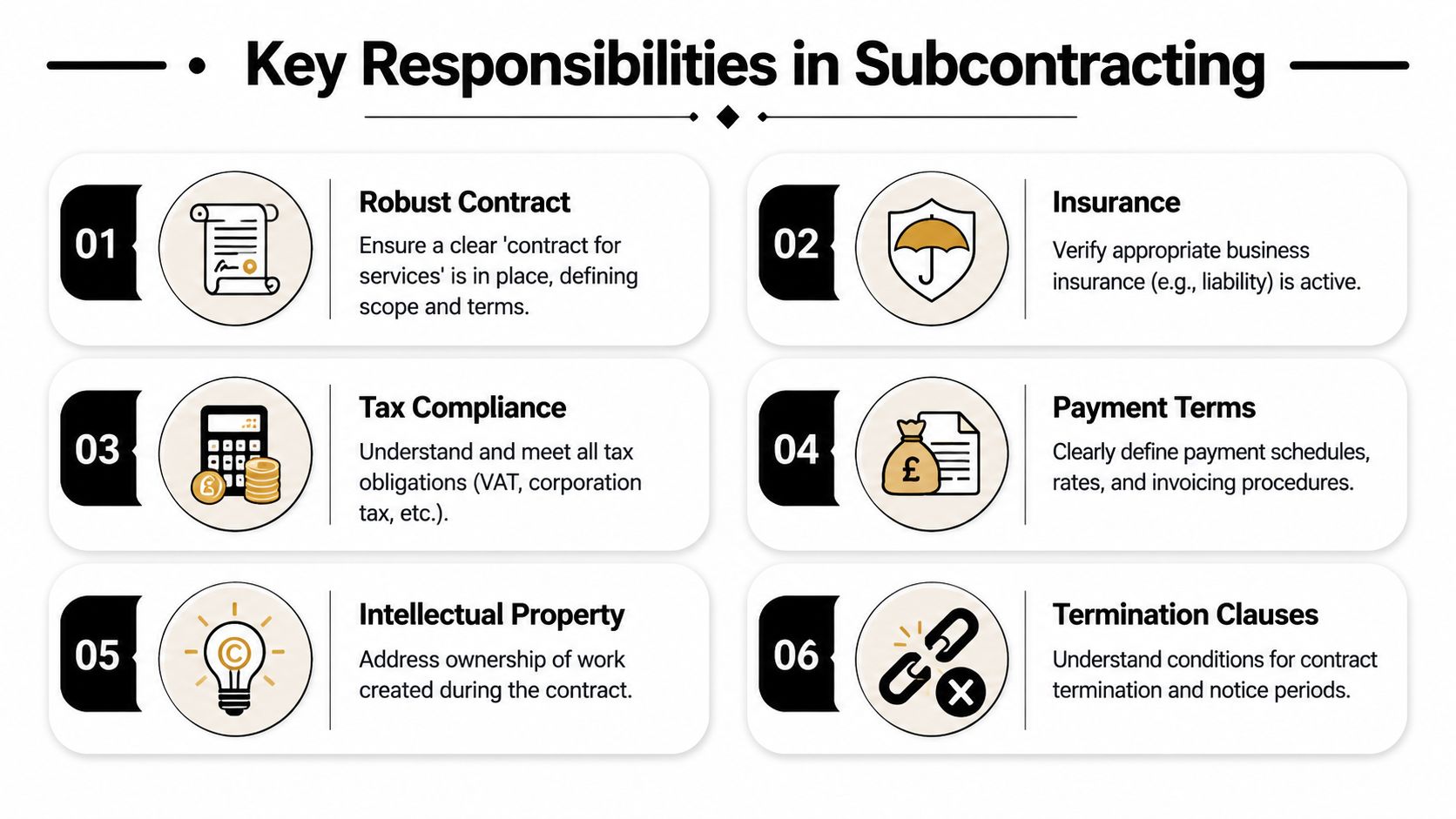
Subcontracting can be commercially rewarding, but it only works well when you treat it as a business arrangement. The rate matters, but the contract, payment chain, tax treatment, and credit risk matter just as much. Contractors often focus heavily on winning the work and only later realise they've accepted vague terms or exposed themselves to avoidable delays.
If a main contractor has a problem, the pressure often moves straight down the chain to the subcontractor who can least afford disruption.
Contracts that say what the work actually is
A proper contract for services should define the job with enough precision that both sides know what has been agreed. If the scope is woolly, disagreements usually appear later around deliverables, timelines, change requests, or who pays for extra effort.
Check these points carefully:
- Scope of work: What exactly are you delivering, and what sits outside that scope?
- Payment terms: When do you invoice, when do they pay, and what approvals are required first?
- Liability and indemnities: Are you taking on obligations that don't match your role or insurance cover?
- Termination rights: Can either side end the arrangement quickly, and if so, what notice applies?
- Intellectual property: Who owns what you create during the contract?
If you work in construction or labour-heavy sectors, CIS can also affect cash flow. Under CIS, contractors must verify subcontractors with HMRC and usually deduct 20% from registered subcontractors, or 30% if unregistered, before labour-only payments are passed on, which can affect when cash reaches you according to this overview of tech subcontractor market context and CIS-linked deductions. If CIS applies, factor that into your budgeting before you agree the assignment.
Vet the company, not just the role
A good project inside a weak payment chain can still become a bad contract.
Before you start, look into:
- Who is paying you: The end client, agency, prime contractor, or another intermediary
- How established the payer is: Check company details and whether their communication is consistent
- Whether approvals are clear: Delayed sign-off often causes delayed invoicing
- What happens if work is paused: You need to know whether payment depends on upstream events
For contractors supporting overseas teams or cross-border operations, payment administration can become more complex. If your project involves international staffing elements, this guide on how to pay international employees is useful background on how businesses structure compliant payments across countries.
Protect your cash flow and your position
A frequent concern is what happens when a main contractor pays late, disputes an invoice, or becomes insolvent. In the UK, especially in construction, statutory payment notice regimes and clear contract terms are important because payment disputes can cascade down the chain, as discussed in this guide to subcontractor payment protection and notice processes.
That means you should:
- Get invoicing rules in writing
- Keep written approval trails for work completed
- Match your invoice wording to the contract
- Chase quickly when a due date passes
- Avoid relying on verbal assurances
If CIS is part of your setup, our article on CIS registration as a contractor is a useful next read.
The Impact of IR35 on Subcontracting Work
For many UK contractors, the hardest part of subcontracting isn't finding the role. It's working out how the role should be taxed, who makes that decision, and what the payment chain means in practice. That's where IR35, also called the off-payroll working rules, comes in.
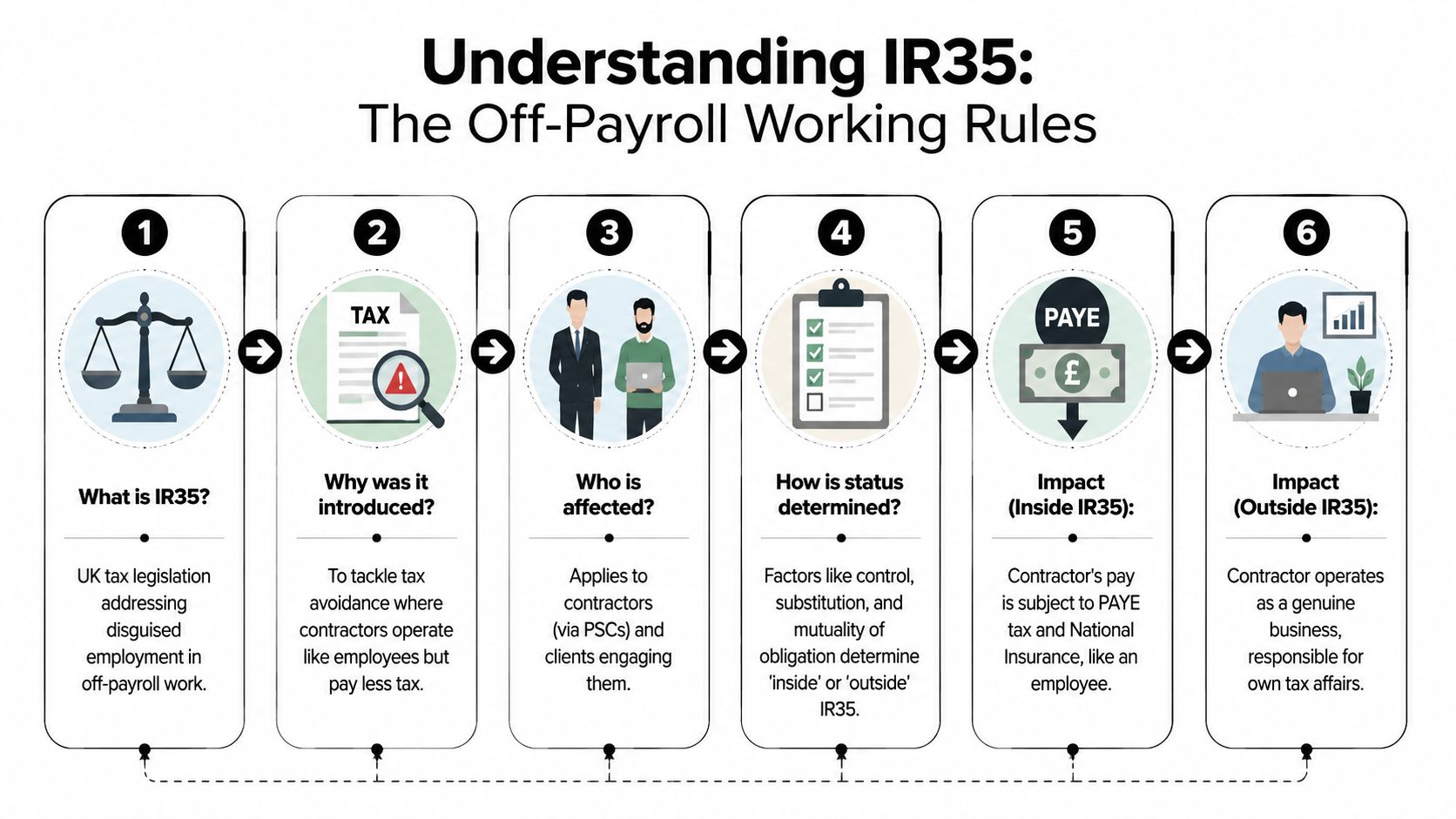
What IR35 is
IR35 is tax legislation designed to address situations where someone works like an employee but supplies their services through an intermediary, often a personal service company. In subcontracting chains, that question can become harder to assess because the actual working relationship may involve several parties.
Most generic advice about subcontracting focuses on winning work. In the UK, though, the bigger issue is often IR35 risk, because off-payroll rules can shift tax liability and make status determinations and payment chains far more important for personal service company contractors, as noted in the SBA overview of subcontracting opportunities and compliance risk.
Why it matters in a subcontracting chain
When you're several layers away from the end client, it's easy to assume somebody else has sorted the status position. That's risky. You need to know who assessed the role and on what basis.
A subcontracting arrangement may still be inside IR35 if, in substance, the engagement looks more like employment for tax purposes. Equally, some subcontracted work may be outside IR35 where the service is delivered business-to-business.
A simple way to think about it is this:
| Position | What it usually means |
| | |
| Inside IR35 | Tax is generally handled more like employment income through PAYE mechanisms |
| Outside IR35 | The contractor operates more like a genuine independent business providing services |
How status gets determined
In roles covered by the off-payroll rules, the end client usually has a key part in deciding status and should take reasonable care when doing so. That decision is commonly communicated through a Status Determination Statement, often shortened to SDS.
An SDS is important because it tells the parties in the chain how the role has been assessed. You shouldn't accept vague wording such as “this is probably inside” or “we usually treat these roles as outside”. Ask for clarity.
Watch this short explainer if you want a visual overview:
Questions worth asking before you accept the role
- Who issued the status decision
- Has an SDS been provided where required
- Does the contract reflect the actual working practices
- Who is the fee payer in the chain
- Will you be paid through payroll, umbrella, or another route
A contract can say one thing while the day-to-day reality says another. For IR35, both matter.
If you need a more detailed breakdown of the reforms, our guide on what changed with the IR35 reforms and how they affect contractors covers the background in more depth.
Choosing Your Working Structure Inside IR35
Once a role is classed as inside IR35, the practical question becomes simple. How are you going to work and get paid in a compliant way?
For many contractors, continuing to use a personal service company for an inside-IR35 role creates extra administration without giving the clean business-to-business treatment they might want. The tax position is already constrained by the status decision, so the structure needs to fit that reality.

The expansion of the UK's off-payroll rules pushed more contractors and clients towards intermediaries, making compliant umbrella arrangements a mainstream labour model in IT and professional services as well as construction, as described in Investopedia's explanation of subcontracting and outsourced delivery models.
Why many contractors choose an umbrella company
An umbrella company employs the contractor and runs payment through PAYE. That means the umbrella handles payroll processing, deductions, and the administration attached to employment-style payment.
For inside-IR35 work, that can be more straightforward because:
- PAYE is handled for you, reducing the need to manage the same role through a limited-company structure
- Payslips are clearer, which helps you understand deductions and net pay
- Statutory rights apply, such as holiday pay and pension access where relevant
- The payment chain can be cleaner, especially where agencies and end clients already expect umbrella engagement
That doesn't mean every umbrella is the same. Contractors should still check margin transparency, compliance approach, and how expenses, holiday pay, and onboarding are explained.
Compare the structure, not just the headline rate
A high quoted rate can still leave you worse off if the payment model is unclear or the provider's processes are poor. Compare working structures by asking:
- Who employs me
- How is tax handled
- What deductions will appear on the payslip
- What support is available if the client or agency changes details
- Is the arrangement clearly described in writing
If you're weighing up whether umbrella working fits your role, our article on whether IR35 applies if you work through an umbrella company is worth reviewing.
UmbrellaCompany.com provides a comparison service that helps contractors review umbrella options based on their role and inside-IR35 needs.
Your Path to Successful Subcontracting
Subcontracting can be a strong route into serious client work, but the safest contractors don't stop at finding the opportunity. They look at the whole chain, from who owns the project to who issues the paperwork and who ultimately pays them.
Three habits make the biggest difference:
- Understand the chain: Know the end client, the prime contractor, and any intermediary sitting between you and payment.
- Protect the engagement: Use a clear contract, check the payment mechanism, and don't ignore warning signs around approvals or vague terms.
- Match the structure to the role: If IR35 applies, choose a compliant route that fits the status decision and keeps payroll straightforward.
That combination turns subcontracting from a gamble into a plan. It helps you judge companies that subcontract work more clearly, ask better questions before you sign, and avoid common mistakes that can damage cash flow or create tax problems later.
If your next role sits inside IR35, taking a few minutes to compare payment options can save a lot of stress down the line.
If you're moving into an inside-IR35 contract and want a simple way to review compliant umbrella options, Umbrella Company lets you compare providers based on your role and working needs.


