


You’ve won the work, the start date is close, and the practical jobs list is getting longer by the hour. Then CIS lands on your desk. Suddenly you’re not just planning labour, materials and timelines, you’re trying to work out how HMRC expects you to register, verify subcontractors and file returns without getting something expensive wrong.
That’s a familiar position for new and growing contractors. CIS registration as a contractor can feel more complicated than it ought to be, especially if you’re handling it for the first time or moving from occasional subcontractor use into regular project delivery. The good news is that the process is manageable when you break it into clear stages and treat compliance as part of the job setup, not an afterthought.
Your Essential Guide to the Construction Industry Scheme
A lot of contractors first meet CIS at the least convenient moment. The contract is signed, a subcontractor is ready to start, and someone asks whether you’ve registered with HMRC. If you haven’t, you’re immediately on the back foot.
The Construction Industry Scheme, usually shortened to CIS, is HMRC’s system for collecting tax from payments made for construction work. If you pay subcontractors for qualifying work, you may need to register as a contractor and operate the scheme correctly from the first payment.

What makes CIS easy to underestimate is its scale. CIS tax receipts for the 2022/23 financial year exceeded £6.3 billion, and over 1.2 million businesses were registered under the scheme, which shows how central it is to construction tax compliance in the UK, as noted in this overview of the Construction Industry Scheme and its reach.
That matters because HMRC doesn’t treat CIS as an edge case. It treats it as routine industry administration. If your business is paying subcontractors, HMRC expects registration, correct deductions, accurate records and regular returns.
Where contractors usually get stuck
Most problems start in one of three places:
- Timing slips because registration starts too late
- Role confusion because the business doesn’t realise it counts as a contractor
- Admin overload because no one owns the monthly process
Practical rule: If you expect to pay a subcontractor soon, treat CIS setup as urgent, not something to tidy up later.
If you want a broader grounding first, this plain-English guide to what the Construction Industry Scheme is is a useful companion before you deal with the registration mechanics.
Understanding Your CIS Obligations as a Contractor
Some businesses assume CIS only applies to established building firms. That assumption causes trouble. Under HMRC rules, a contractor is not just a main contractor running large sites. In practice, it can include any business that pays subcontractors for construction work.
If your business engages other businesses or self-employed workers to carry out qualifying construction operations, you need to assess whether CIS applies. That includes sole traders, partnerships and limited companies. It can also catch businesses outside the construction sector where construction spending is substantial.
Who counts as a contractor
You’re usually dealing with CIS contractor duties if you:
- Pay subcontractors for construction work carried out in the UK
- Run a construction business directly, whether large or small
- Operate outside construction but spend heavily on construction work, because some non-construction businesses can still fall into HMRC’s contractor rules
The key point is simple. HMRC looks at what your business is paying for, not just what your business calls itself.
What work is commonly covered
CIS generally applies to payments for construction operations. In practical terms, contractors should pay close attention where work involves:
- Site preparation, such as groundwork and related setup
- Building work, including alterations and extensions
- Repairs and dismantling, where the work forms part of construction activity
- Installation work connected to buildings and structures
- Decorating or finishing work that falls within CIS rules
Borderline cases are where mistakes happen. If a package includes mixed services, don’t assume the whole invoice sits outside CIS because part of it looks non-construction in nature.
The safest habit is to review the actual work being paid for, line by line, before you decide whether a deduction should apply.
Your core responsibilities
Once you’re within the scheme, your job is more than just registration. You need a repeatable process.
| Responsibility | What it means in practice |
|---|---|
| Register correctly | Get set up with HMRC before paying subcontractors |
| Verify subcontractors | Check status with HMRC before applying deductions |
| Deduct the right amount | Use the rate HMRC confirms for that subcontractor |
| Keep records | Store payment details, verification results and deduction evidence |
| File returns | Submit monthly CIS information on time |
| Pay HMRC | Pass over deductions within the required timeframe |
Contractors who stay compliant usually do one thing well. They make CIS operational. It sits in onboarding, invoice checking and month-end routines, rather than living in someone’s memory.
How to Register as a Contractor for CIS
Direct registration is usually straightforward when you prepare properly. It becomes messy when contractors rush the online form, miss the PAYE step or assume CIS is a separate process that stands alone from employer setup.

The first point to get right is the most important one. When registering as a contractor, you must first set up as an employer for PAYE. HMRC data from 2026 shows that failure to do this correctly is a common pitfall, with fines for late or incorrect first returns starting at £100 and escalating. Online registration achieves a 95% approval rate within five working days, according to this guide on CIS contractor registration and PAYE setup.
What you need before you start
Have these details ready before you log in:
- Your Unique Taxpayer Reference
- Business name and trading details
- Business address
- VAT details if registered
- Government Gateway login
- A clear idea of who in the business will handle payroll and CIS administration
If you’re still setting up the wider business, it helps to sort the basics first. This guide on how to start a contracting business is worth reading because it covers the commercial setup issues that usually sit alongside CIS.
The registration route that works best
Most contractors should complete the process online through HMRC’s services. The sequence matters.
Register as an employer for PAYE
Even if you don’t have traditional employees, this step matters because CIS contractor status is tied into employer setup.Select the option for engaging subcontractors in construction
This is the trigger point. If you miss it, you can create delays and extra admin for yourself.Enter your business details carefully
Small input errors create bigger problems later, especially when references don’t match across HMRC systems.Wait for confirmation and your PAYE reference
Keep the confirmation details somewhere accessible. You’ll need them for filing and general administration.
Working rule: Don’t delegate the setup blindly. Whoever completes the registration should understand how subcontractors will actually be engaged and paid.
A lot of first-time contractors also benefit from reviewing the wider move into contract work before registration. If that’s relevant, our guide on how to become a contractor gives useful context around business structure and working arrangements.
What good setup looks like afterwards
Registration is only a strong start if you connect it to your internal workflow. That means deciding:
- who verifies subcontractors
- who checks invoices before payment
- who files the return
- who signs off the payment to HMRC
A short walkthrough can help if you prefer to see the process in action.
Contractors who avoid CIS problems rarely do anything clever. They just build a simple process early and stick to it.
Managing Your Ongoing CIS Duties
Once registration is done, the ongoing work begins. CIS compliance is monthly, repetitive and unforgiving of loose admin. That’s why the best approach is to treat it like payroll, not like an occasional tax task.

There are three moving parts every contractor needs under control. Verification, deduction and reporting. If one slips, the rest usually follow.
Verify before you pay
This is the point where many businesses become too casual. They assume a subcontractor is registered because they’ve worked in the industry for years, or because someone on site says “they’re all sorted”. That isn’t enough.
Contractors are fully responsible for verifying a subcontractor's status to apply the correct deduction rate. Subcontractors who are not verified with HMRC are subject to a 30% deduction, a significant 10 percentage point difference from the standard 20% rate. Recent data shows CIS deductions generate substantial revenue, with April 2024 alone accounting for £692.5 million, as shown in the UK government’s CIS data for 2024 to 2025.
That verification result tells you whether to deduct:
- 20% for registered subcontractors
- 30% for unverified subcontractors
- 0% where gross payment status applies
Build a monthly routine
A workable CIS month-end usually looks like this:
Before payment runs
Check the subcontractor has been verified and that the invoice only includes items that should be considered for deduction.At payment stage
Apply the correct deduction rate and keep a record of how you reached it.After payment
Prepare the monthly return with all relevant payments and deductions.By your reporting deadline
Submit the return and arrange payment to HMRC.
Missed verifications are rarely a software problem. They’re usually a workflow problem.
Keep records that answer questions quickly
When HMRC queries something, speed matters. Good records should let you answer basic questions without digging through emails and screenshots.
Keep copies of:
- Verification outcomes
- Subcontractor details
- Invoices and payment dates
- Deduction calculations
- Monthly return submissions
- Evidence of payment to HMRC
A simple cloud filing structure often works better than a cluttered shared drive. If you’re reviewing tools, this rundown of the best accounting software for contractors can help you compare options that support recurring compliance work.
Software helps, but only if the inputs are right
Xero, QuickBooks and Sage can all support contractor admin when configured properly. Some businesses also use dedicated payroll or CIS modules to reduce manual handling. The key benefit isn’t just speed. It’s consistency.
That said, software won’t rescue bad habits. If your team enters the wrong subcontractor details, skips checks or misreads the invoice, the system will process the wrong answer efficiently.
| Monthly task | What good practice looks like |
|---|---|
| Verification | Done before first payment and recorded clearly |
| Deduction | Based on HMRC status, not assumption |
| Return filing | Scheduled into month-end, not left to memory |
| Document storage | Central, searchable and accessible |
For contractors who also want cleaner management reporting around labour costs and deductions, our guide to accounting for contractors is a useful next step.
Common CIS Registration Mistakes to Avoid
The most expensive CIS errors usually don’t come from obscure tax law. They come from ordinary assumptions that turn out to be wrong.
A common one is this. “We registered once, so we’re sorted.” That mindset causes issues because CIS isn’t a one-and-done admin task. Registration gets you into the system. It doesn’t remove your duty to manage every payment correctly afterwards.
Mistaking registration for compliance
Some contractors relax once the HMRC confirmation arrives. Then the practical cracks appear:
- Subcontractors aren’t checked properly
- Invoices are paid before verification is complete
- Returns are left until the deadline week
- Records sit across inboxes, phones and paper files
Those aren’t unusual mistakes. They’re what happens when no one owns the process.
Good CIS control usually comes from one named person, one checklist and one calendar routine.
Overlooking the dual-role problem
Another issue is more subtle. Some businesses act as a contractor on one job and a subcontractor on another. Owners often assume one HMRC setup covers both positions. It doesn’t.
A frequent point of confusion is for businesses operating in a dual role as both a contractor and a subcontractor. These roles require two separate HMRC registrations. Failing to manage this distinction correctly is a leading cause of reporting errors and can delay approvals, as explained in this piece on CIS registration mistakes and dual-role confusion.
That matters in practice because dual-role businesses can easily:
- use the wrong records for the wrong function
- confuse deductions suffered with deductions made
- assume one registration changes the tax treatment everywhere
The habits that usually cause trouble
Rather than chasing every rare edge case, focus on the routine errors that keep repeating:
| Mistake | Why it causes problems |
|---|---|
| Paying before verification | You may apply the wrong deduction |
| Treating all labour invoices the same | Different work and statuses need different handling |
| Missing monthly returns | Penalties and avoidable HMRC contact follow |
| Mixing contractor and subcontractor records | Reporting becomes inaccurate quickly |
One practical fix is to separate your CIS process into two views. “Money we deduct from others” and “money deducted from us”. Once teams do that, the dual-role issue becomes much easier to manage.
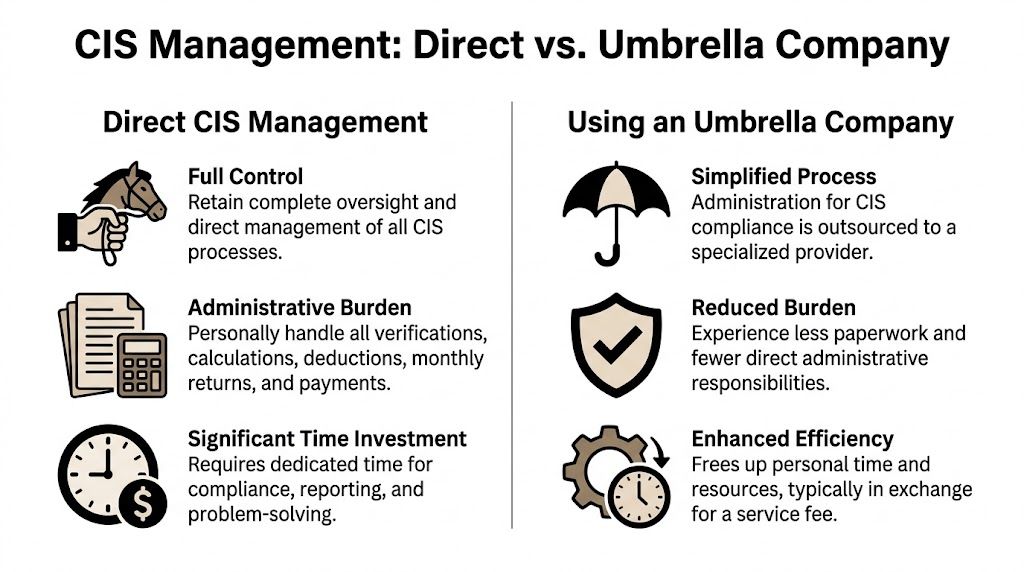
Direct CIS Management vs Using an Umbrella Company
For some contractors, direct CIS management is the right fit. It gives you full visibility and direct control over how subcontractors are onboarded, verified and paid. If you already have a capable payroll or finance function, that may be entirely workable.
For others, it becomes one more compliance system competing for time with delivery, hiring and cash flow management. That’s where an umbrella arrangement can be worth considering, especially when engagement models and IR35 status make direct administration less attractive.
The trade-off in plain terms
Direct management gives you control, but it also leaves you holding the risk. You need to manage verification, deductions, returns, payment deadlines and records yourself.
An umbrella company shifts much of that administrative burden away from the engager in the chain, depending on how the working arrangement is structured. For contractors working inside IR35, this can be especially relevant because PAYE employment through an umbrella often creates a cleaner, more straightforward route than trying to force a self-employed model where it doesn’t fit.
| Responsibility | Direct CIS Management (You) | Subcontractor Uses Umbrella Company |
|---|---|---|
| Onboarding admin | You manage setup checks | The umbrella handles employment and payroll setup |
| Tax handling | You operate deductions and reporting where CIS applies | Payroll is generally managed through the umbrella |
| Monthly compliance workload | You keep the calendar, records and filings on track | Your admin burden is reduced |
| Control | Highest | Lower direct control over payroll processing |
| Time commitment | Ongoing internal effort | Usually lighter for the engager |
When each route tends to work best
Direct CIS management usually suits businesses that:
- regularly engage subcontractors
- already run strong payroll or finance processes
- want close control over labour administration
Using an umbrella company tends to appeal where:
- the contractor is inside IR35
- the business wants simpler payroll handling
- compliance certainty matters more than direct control of every step
If your current process depends on one busy person remembering dates and statuses, it probably isn’t robust enough.
If you’re weighing up that option, this guide to an umbrella company for contractors gives a useful overview of how the model works in practice.
Frequently Asked Questions About CIS
Do I need to file a CIS return if I haven’t paid any subcontractors that month
You still need to deal with the month properly. Don’t assume silence is enough. Review your HMRC obligations for that period and make sure your records show why no payments were reported.
What if I make a mistake on a CIS return
Act quickly. The longer an error sits, the more awkward it becomes to unwind. Keep the original working papers, identify what was wrong, and correct the position through the appropriate HMRC process rather than trying to hide the mistake in a later month.
Does CIS decide whether someone is employed or self-employed
No. CIS and employment status are not the same thing. A worker can fall within construction tax rules and still need a separate employment status assessment. That matters even more where IR35 is in play.
I’m both a contractor and a subcontractor. Can I use one registration
No. If your business operates in both roles, keep the registrations and records distinct. That avoids confusion between deductions you make and deductions suffered on your own income.
Is direct CIS always the best option
Not always. It suits some businesses well, especially where internal admin is already strong. For others, particularly contractors working inside IR35 or businesses that want less payroll complexity, an umbrella route can be easier to manage.
If you’re comparing your options and want a simpler, compliant route for contract work, especially inside IR35, Umbrella Company helps you compare trusted UK umbrella providers quickly and choose a setup that fits how you work.


