


To get a real grip on your take-home pay, you need to start with your total earnings, what we call gross pay, and then strip away all the mandatory deductions. For any UK worker, the two biggest chunks that come out are always Income Tax and National Insurance Contributions (NICs). They make a serious dent in what actually lands in your bank account.
This guide will show you how to calculate your net pay, explaining each deduction step-by-step so you can understand your earnings with confidence.
Your Gross Pay and Core Deductions
Getting to your net pay figure all starts with understanding your gross pay and the main deductions that come off it. Gross pay is simply the full amount you have earned before anyone takes a penny. For most contractors, that is your day rate multiplied by the number of days you have worked.
From there, we have to deal with the taxman.
These deductions are not just random numbers; they are set by the government to fund public services. Nailing these initial calculations is the bedrock of understanding your finances. If you get this wrong, you cannot accurately forecast your earnings or even check if your payslips are correct.
Understanding Income Tax Bands
Your Income Tax is not a flat rate. It is calculated using a tiered system, meaning you pay different rates on different portions of your income. Everyone in the UK gets a Personal Allowance, which is the amount you can earn completely tax-free.
For the current tax year, that magic number is £12,570. Anything you earn above that gets taxed in slices:
- Basic Rate: 20% on earnings between £12,571 and £50,270.
- Higher Rate: 40% on earnings between £50,271 and £125,140.
- Additional Rate: 45% on anything you earn over £125,140.
This progressive system means the more you earn, the higher the percentage of your income goes towards tax.
Calculating National Insurance Contributions
On top of Income Tax, you have also got National Insurance Contributions (NICs) to pay. These contributions are what build up your entitlement to things like the State Pension. Just like tax, NICs are calculated as a percentage of your earnings once you go over a certain threshold.
If you are working through an umbrella company, you are treated as an employee for tax purposes, so you will pay Class 1 National Insurance. The main rate is currently 8% on your earnings between £12,570 and £50,270 per year. For any earnings above that top figure, the rate drops to 2%.
A lot of contractors get tripped up when they see both Employee's and Employer's NI on their payslip reconciliation. We will dig into Employer's NI a bit later, but for now, we are just focused on the Employee's contribution to work out your personal take-home pay.
A Practical Calculation Example
Let's run the numbers. Say you are a contractor on a good wicket, earning a gross annual income of £50,000 through an umbrella company (so, inside IR35).
Here is a quick breakdown of how those first two major deductions would look:
Example Calculation For a £50,000 Gross Income
| Item | Description | Amount (£) |
|---|---|---|
| Gross Income | Your total earnings before any deductions. | £50,000 |
| Personal Allowance | The amount you can earn tax-free. | (£12,570) |
| Taxable Income | The portion of your income subject to tax. | £37,430 |
| Income Tax | Calculated at 20% on your taxable income. | (£7,486) |
| Employee NICs | Calculated at 8% on income between £12,570 & £50,270. | (£2,994) |
| Subtotal | Your income after initial tax and NI. | £39,520 |
As you can see, those two deductions alone have already taken over £10,000 out of your gross pay. This leaves you with £39,520 before we have even considered other things like your pension, student loan, or the umbrella company’s margin.
Understanding how these core deductions work is the most important step. Once you have got this down, you can start factoring in the other pieces of the puzzle. For a more detailed look at decoding your earnings statement, check out our guide on how to read a UK payslip.
How Umbrella Companies Affect Your Pay Calculation
For many UK contractors, working through an umbrella company is just part of the job. But it does add a couple of extra layers to figuring out your take-home pay. The key thing to get your head around is the difference between the 'rate' your agency pays and the salary that actually lands on your payslip.
When you join an umbrella, you technically become their employee. This is a good thing in many ways, as they handle all your payroll, making sure Income Tax and National Insurance get paid correctly to HMRC. But before any of your personal tax is worked out, a few crucial employment costs need to be covered first.
From Assignment Rate to Gross Pay
That headline figure you agree with your recruitment agency? That is called the assignment rate. It is important to realise this is not your personal salary. Think of it as the total pot of money the agency pays the umbrella company for your services, which has to cover both your earnings and all the costs of employing you.
These employment costs are deducted from the assignment rate to calculate your gross pay for tax purposes. It is this lower gross pay figure that is then used to work out your personal Income Tax and Employee NI contributions.
This diagram shows the basic flow from the total amount earned down to what you actually take home.
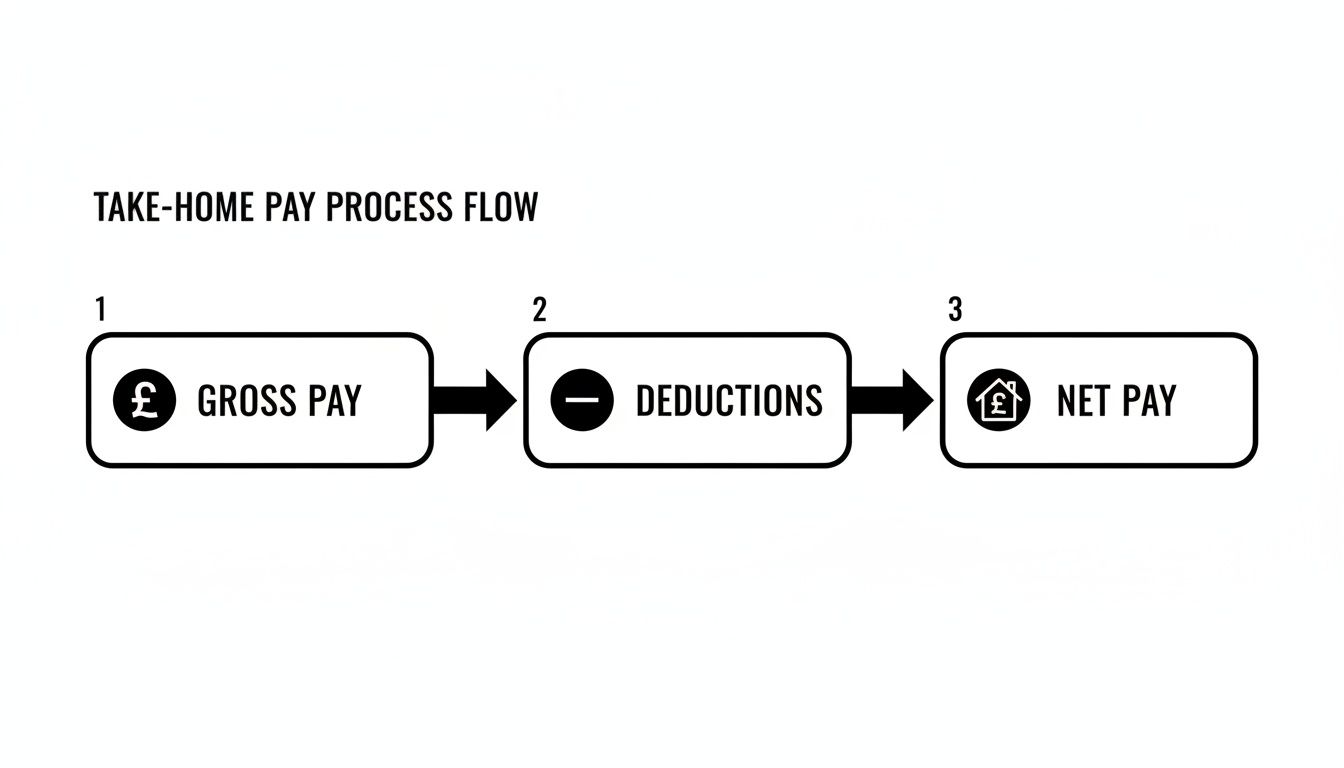
This process ensures every legal employment cost is settled before your personal deductions are applied, which ultimately determines your final net pay.
Understanding Employment Costs
It is really important to know that these employment costs are not hidden fees or extra charges from the umbrella company. They are statutory, non-negotiable costs that every single employer in the UK has to cover for their staff. They are simply factored into the assignment rate that the end client or agency pays.
The main employment costs you will see are:
- Employer’s National Insurance: A contribution the employer must make to HMRC, calculated at 13.8% on earnings above the secondary threshold.
- Apprenticeship Levy: A UK-wide levy that larger employers must pay, set at 0.5% of their annual pay bill.
- Employer’s Pension Contributions: Under auto-enrolment rules, employers have to contribute a minimum amount to their employee's pension pot.
Grasping that these costs come out of the assignment rate is fundamental. Any compliant umbrella company will show these deductions transparently on your pay reconciliation statement, so you can see exactly how your gross pay has been calculated.
The Umbrella Company Margin
On top of the employment costs, the umbrella company will also deduct its margin. This is simply their fee for providing their payroll and employment services; it is the only income they get for the work they do for you.
This fee covers all the essential admin, such as:
- Processing your payroll and issuing payslips.
- Managing all the tax and NI payments to HMRC.
- Providing you with statutory employment rights like holiday and sick pay.
- Covering you with professional indemnity and liability insurance.
The margin is usually a fixed weekly or monthly amount and should be laid out clearly in your contract. A small silver lining is that it is deducted from your gross income before tax is calculated, giving you a tiny bit of tax relief on the fee. To see how this works in the real world, check out our guide on using an umbrella company for freelancers.
A Worked Example With Employment Costs
Let's put some numbers to this to make it clearer. Imagine you have secured a contract with an assignment rate of £400 per day. You work a full five-day week, making the weekly assignment value £2,000.
Here is a rough breakdown of how the umbrella would calculate your taxable pay:
- Start with the Assignment Rate: £2,000.00
- Deduct Employment Costs:
- Employer's NI (e.g., £240)
- Apprenticeship Levy (e.g., £10)
- This gives you your Gross Pay: £1,750.00
- Deduct the Umbrella Margin: (e.g., £25)
- This is your final Taxable Gross Pay: £1,725.00
It is from this £1,725.00 figure that your personal Income Tax and Employee NI contributions would then be deducted. This step-by-step process offers complete transparency, showing exactly how the agency's rate gets converted into your taxable earnings.
Factoring in Pension Contributions and Student Loans
Beyond the big hitters like Income Tax and National Insurance, a few other common items can take a noticeable bite out of your final take-home pay. For UK contractors, pension contributions and student loan repayments are usually the main culprits. It is absolutely vital to get your head around how these are calculated to forecast your earnings accurately.
Here at UmbrellaCompany.com, we help contractors crunch these numbers every single day. Getting it right from the start means no nasty surprises when your payslip lands in your inbox.

While these deductions shrink your immediate income, they are either smart investments in your future or obligations you simply have to meet. Folding them into your calculations gives you a much more realistic picture of your finances.
How Pension Contributions Affect Your Pay
As an employee of an umbrella company, you will be automatically enrolled into a workplace pension scheme. This is not optional; it is a legal requirement for all UK employers under the auto-enrolment programme, designed to help us all save more for retirement.
Contributions are worked out as a percentage of your qualifying earnings, which is the slice of your earnings that falls between a lower and upper limit set by the government each tax year. For 2024/25, this band is between £6,240 and £50,270 a year.
The current minimum contribution rates are:
- Your contribution: 5% of your qualifying earnings.
- Your employer's contribution: 3% of your qualifying earnings.
The real beauty of pension contributions is the tax relief. Your payments are taken from your gross pay before any tax is calculated. This means you end up paying less Income Tax, which makes it an incredibly efficient way to build your retirement pot.
Understanding Student Loan Repayments
If you have a student loan hanging over you, repayments will be deducted automatically once your income hits a certain threshold. The exact amount you pay back depends on which student loan plan you are on and how much you earn over that specific threshold.
It is crucial to know your plan type, as the rules are quite different for each one.
- Plan 1: For students who started courses before 1st September 2012. You repay 9% of what you earn over £24,990 a year.
- Plan 2: For those who started between 1st September 2012 and 31st July 2023. You repay 9% on income over £27,295 a year.
- Plan 4 (Scottish): Similar to Plan 1, but the threshold is higher at £31,395 a year.
- Plan 5: For students who started courses from 1st August 2023. You will repay 9% on earnings over £25,000 a year.
- Postgraduate Loan: This is a bit different. Repayments are 6% on earnings over £21,000 a year.
Let's say you are on Plan 2 and earn £35,000. You would only repay 9% on the amount over the £27,295 threshold. That is 9% of £7,705, which works out to about £693 a year, or roughly £58 a month.
These deductions are all handled through the PAYE system, just like your tax and NI. If you want a refresher, you can find out more about how PAYE works in our detailed guide.
Other Potential Deductions
Pensions and student loans are the most common deductions, but you might see other things on your payslip. These usually relate to workplace benefits, often through salary sacrifice schemes.
A salary sacrifice is where you agree to give up part of your cash salary in exchange for a non-cash benefit. Some popular examples include:
- Cycle to Work Schemes: A great way to get a bike and cycling gear tax-free.
- Childcare Vouchers: A method to pay for childcare from your pre-tax salary.
- Additional Pension Contributions: Topping up your pension pot beyond the auto-enrolment minimums.
Because these benefits are funded from your pre-tax salary, they effectively lower your taxable income and the amount of National Insurance you pay. It can be a very cost-effective way to access certain perks while contracting, but always make sure you read the small print and understand the terms before you sign up.
How IR35 Status Impacts Your Net Pay
When it comes to figuring out your take-home pay as a contractor, your IR35 status is probably the single biggest factor in the entire equation. It is the fork in the road.
Whether your contract is deemed ‘inside’ or ‘outside’ IR35 completely changes who is responsible for tax and National Insurance. This is not just a bit of admin; it has a massive, direct impact on how much cash actually ends up in your bank account. The entire calculation shifts depending on which side of the IR35 line you fall.
Working Inside IR35
If a contract is classed as ‘inside IR35’, it basically means that for tax purposes, you are treated like an employee. HMRC sees your engagement as one of 'deemed employment', which means your income has to go through a PAYE (Pay As You Earn) system, just like a permanent staff member.
For most contractors, this means signing up with a compliant umbrella company. The umbrella firm effectively becomes your employer. They handle the invoicing, receive the payment from your client or agency, and then pay you a salary after deducting all the necessary taxes and employment costs at source.
The upside? It makes your tax life incredibly simple. You do not have to stress about calculating your own Income Tax or National Insurance contributions because it is all handled for you. Your payslip will look pretty familiar to anyone who has ever had a traditional job.
Operating Outside IR35
On the flip side, if your contract is genuinely ‘outside IR35’, you are operating as a true business-to-business service provider. Most people in this position work through their own limited company, often called a Personal Service Company (PSC).
Here, the financial responsibilities are a world away from the inside IR35 route. Your client pays your limited company the full, gross contract value with no deductions. From that point on, it is down to you to manage the company’s finances and your personal tax.
It is a much more involved process, and your to-do list will include things like:
- Corporation Tax: Your company is liable for Corporation Tax on any profits it makes.
- Salary and Dividends: You will typically draw a small, tax-efficient salary and take the rest of the company profits as dividends.
- Personal Tax: You will need to file a Self-Assessment tax return every year to declare all your income (salary and dividends) and pay the tax due.
- Business Expenses: You can claim for legitimate business-related expenses, which helps to lower your company's Corporation Tax bill.
Working outside IR35 can often be more tax-efficient and lead to higher net pay, but that comes with a much bigger administrative load and financial responsibility. You are in the driver's seat, but you are also the one fully accountable.
If you want to dig deeper into these complex rules, our detailed guide on IR35 for contractors is a great place to start.
Comparing the Financial Implications
Seeing the two routes side-by-side is the clearest way to grasp the financial differences. Your IR35 status dictates the journey your money takes from the client to your pocket, and the deductions it encounters along the way.
The table below breaks down the key differences that directly influence how you calculate your final take-home pay.
Comparing Net Pay Calculations Inside vs Outside IR35
| Factor | Inside IR35 (Via Umbrella) | Outside IR35 (Via Limited Company) |
|---|---|---|
| Payment Method | Paid a salary via PAYE after all deductions. | Company receives gross payment, director draws salary/dividends. |
| Tax Deductions | Income Tax & Employee NI deducted at source. | Responsible for Corporation Tax, personal Income Tax, and NI. |
| Employment Costs | Employer's NI is deducted from the assignment rate. | Company is responsible for Employer's NI on director's salary. |
| Expenses | Limited to specific, allowable employment expenses. | Can claim a wider range of business running costs. |
| Admin Responsibility | Minimal; handled by the umbrella company. | High; director is responsible for all company accounts and tax returns. |
| Net Pay Potential | Generally lower due to PAYE deductions. | Potentially higher due to tax-efficient profit extraction. |
Ultimately, an inside IR35 engagement offers simplicity, while an outside IR35 contract gives you far more financial control and potential for higher earnings, but with all the extra work that comes with it.
Bringing It All Together With a Worked Example
Okay, we have covered all the individual deductions, but theory only gets you so far. The real lightbulb moment comes when you see how it all fits together in practice. Let's walk through a proper, realistic scenario to connect the dots, taking you from the agency rate all the way down to the final figure that hits your bank account.

This example should clear up exactly how each element we have discussed impacts your earnings in the real world.
Meet Our Contractor, Alex
To keep this grounded, let’s imagine a typical contractor. We will call him Alex. Putting a face to the numbers helps apply the rules to a specific situation, just as you would with your own contract.
Here are Alex's details:
- Role: IT Project Manager
- Day Rate: £450 per day
- Working Week: 5 days
- IR35 Status: Inside IR35, working through an umbrella company
- Tax Code: Standard 1257L for the 2024/25 tax year
- Pension: Standard auto-enrolment contributions (5% from Alex)
- Student Loan: On Plan 2 (repaying 9% on earnings over the threshold)
- Umbrella Margin: £25 per week
Armed with this info, we can now run the numbers for one week's pay.
The Step-by-Step Pay Calculation
First things first, we need to figure out the total pot of money available. This is the assignment rate, the full amount the agency pays to the umbrella company for Alex's work. From there, we will start peeling away the layers of employment costs before we even touch Alex’s personal deductions.
1. Calculate the Weekly Assignment Value
Alex bills a solid £450 a day and works 5 days a week.
- £450 (day rate) x 5 (days) = £2,250.00
This £2,250 is our starting point. It has to cover everything: all the employment costs, Alex's salary, and every single tax obligation.
2. Deduct the Employment Costs
Before a penny can be earmarked for Alex’s personal pay, the umbrella has to settle the costs of employment from that assignment value. These are:
- Employer’s National Insurance: 13.8% on earnings above the weekly threshold.
- Apprenticeship Levy: 0.5% of the total payroll.
- Employer's Pension Contribution: The minimum 3% for auto-enrolment.
Once these are taken care of, the remaining amount becomes Alex's gross pay for tax purposes.
3. Deduct the Umbrella Margin
The umbrella company’s weekly margin of £25 is also deducted from the gross pay before tax. This is a small but welcome detail, as it gives Alex a tiny bit of tax relief on the fee.
It is a common point of confusion, but remember that the umbrella margin and employment costs are two separate things. The margin is the fee for the service, while employment costs are statutory obligations passed on from the end client.
4. Calculate Personal Deductions
Now we can work out Alex’s personal deductions from his remaining gross pay:
- Income Tax: Calculated based on his 1257L tax code.
- Employee’s National Insurance: 8% on earnings between the thresholds.
- Employee’s Pension: His 5% contribution.
- Student Loan: 9% on earnings above the Plan 2 threshold.
5. Determine the Final Net Pay
Subtract all these personal deductions from the gross pay, and we have got it: Alex's final net take-home pay for the week. This is the actual amount that will land in his personal bank account.
The Power of Online Calculators
As you can see, doing this by hand involves a fair few steps and means you have to be bang up to date with tax thresholds and percentages. While it is a brilliant exercise for understanding the process, it is hardly practical for quick forecasting or double-checking your payslips every week.
This is exactly where an online take-home pay calculator becomes your best friend. At UmbrellaCompany.com, our calculators are designed to do all the heavy lifting, giving you an accurate estimate in seconds. They are, of course, constantly updated with the latest HMRC rates and rules.
To get the most out of a calculator, you will just need a few key bits of information handy:
- Your contract day or hourly rate
- How many hours you expect to work each week
- Your tax code (if you know it; if not, the standard one is used by default)
- Which student loan plan you are on, if any
- Your pension contribution percentage
Pop in those details, and you will instantly see a full breakdown of your likely earnings. It lets you compare different contract rates, see the impact of upping your pension contributions, and, crucially, check that your actual payslips are spot on. It is the simplest way to calculate net take home pay and keep a firm grip on your finances.
Contractor Pay: Your Questions Answered
Working as a contractor often throws up a few questions about how your pay is calculated. Even once you have got the hang of the main deductions, some of the finer points can still be a bit confusing. We have pulled together some of the most common queries we see to give you clear, straightforward answers.
Getting these details right is key to confidently checking your payslips and making sure there are no unwelcome surprises on payday.
Why Does My First Payslip Look Different From The Calculator's Estimate?
This is a really common one, so do not panic. It is almost always down to your tax code. When you first start a new contract, you are often put on an emergency tax code, like 1257L W1/M1.
This temporary code basically taxes you as if that week or month's pay is all you will earn, without taking your full annual tax-free allowance into account. It usually sorts itself out once HMRC gets your correct code to the umbrella company, and you might even get a little tax rebate on a later payslip to balance things out.
A few other things can cause a discrepancy on that first payment:
- A one-off setup fee from your umbrella company.
- Pro-rata adjustments if you started part-way through a pay period.
- The first pension contribution being processed.
Always take a close look at that first payslip. If anything does not add up, do not be afraid to pick up the phone to your provider's payroll team, that is what they are there for.
What's The Difference Between The Assignment Rate And My Gross Pay?
Grasping this is probably one of the most crucial things for any umbrella contractor. The assignment rate is the total amount your agency or client pays the umbrella company for your services.
You have to think of this rate as the entire project cost. It is not just your pay; it has to cover all the mandatory costs of employment first. Things like Employer’s National Insurance and the Apprenticeship Levy are deducted from this top-line figure.
Your gross pay (the figure used for your personal tax calculations) is what is left after these employment costs have been paid. It is from this gross pay that your own Income Tax and Employee NI are then worked out. It is a two-step process, and it is how every compliant umbrella company has to operate.
How Does Holiday Pay Work With An Umbrella Company?
Because you are a proper employee of the umbrella company, you are legally entitled to paid holiday, currently 5.6 weeks per year. Your umbrella will manage this for you, and it generally works in one of two ways.
The first method is 'accrual'. This is where a portion of your pay is set aside each pay period and held in a pot for you. When you decide to take a holiday, you get paid from this reserve, ensuring you still have an income while you are off.
The other option is to have it paid 'in advance', often called 'rolled-up' holiday pay. With this, your holiday pay entitlement is simply calculated and added to your regular payslip. Most contractors prefer this way as it keeps their cash flow more consistent and predictable. Whichever method is used, your payslip should always clearly show how your holiday pay has been handled.
At UmbrellaCompany.com, we take the guesswork out of finding a compliant umbrella company. Our platform is designed to help you understand your pay structure and choose a provider that is the right fit for you.
Find the perfect umbrella company for your contract today by visiting us at https://umbrellacompany.com.


