


Thinking about making the leap into business analyst contracting? You're in the right place. This guide explains what the role involves, the current UK market rates, and how to get started on your contracting journey with confidence.
It's a fantastic career move for skilled BAs who want to take charge of their careers, tackle a variety of interesting projects, and potentially earn a much healthier income.
So, What Exactly Is Business Analyst Contracting?
In short, contracting means you are no longer a permanent employee. Instead, you work for yourself, taking on specific projects for different companies on a temporary basis. Think of yourself as a specialist consultant, brought in to solve a particular problem or drive improvements over a set period.
It’s a different world from permanent employment, balancing real freedom with a new level of responsibility. You get to pick projects that genuinely excite you, and the day rates are often significantly higher than a salaried equivalent. The flip side is that you're in the driving seat, responsible for finding work and managing your finances.
What’s Expected of a BA Contractor?
While the core BA skills are the same, the expectations are different. Clients hire you to hit the ground running and deliver results quickly. There is no gentle six-month onboarding period.
They will expect you to:
- Get up to speed quickly. You need to be able to parachute into a new team and grasp complex business challenges with very little hand-holding.
- Deliver concrete results. Whether it's producing detailed requirements or mapping a business process, you are there to produce tangible outcomes within the contract's timeframe.
- Be a brilliant communicator. You will be talking to everyone from the tech teams deep in the code to senior directors. Keeping everyone aligned and informed is a huge part of the job.
- Manage yourself. No one will chase you for deadlines. You need the discipline to manage your own time and workload to hit every milestone.
The biggest change is a mental one. You stop being just an employee and start thinking like a business owner. Your reputation is your brand, and you are responsible for marketing your skills and delivering exceptional value every single time.
Moving into contracting can feel like a massive step, but it is a very achievable and rewarding one if you are prepared. For a more detailed look at the practicalities, our guide on how to become a contractor in the UK walks you through the entire process. It’s a path that lets you build an incredibly diverse portfolio and truly steer your career.
Getting to Grips with the UK Market for BA Contractors
The UK’s contracting market for business analysts is a lively place, packed with opportunities. To make the most of it, you need to understand what makes it tick. Knowing the key factors that drive demand and day rates is the first step to setting your value and negotiating with confidence.
Think of your earning potential not as a fixed number, but as a moving target. It shifts based on your experience, the industry you know inside out, and where you are based. Let’s break down what really influences what you can charge.
What Drives Contractor Day Rates?
When it comes to your day rate, three things matter most:
- Location: It’s no surprise that major hubs like London command the highest rates. The demand is fierce and the cost of living is higher, so clients expect to pay a premium.
- Experience Level: A Senior Business Analyst who has delivered complex programmes will naturally earn a lot more than someone just starting their contracting career. A proven track record is your biggest asset.
- Industry Specialisation: If you have deep expertise in a high-demand sector like fintech, pharmaceuticals, or digital transformation, you're in luck. Clients will pay a premium for niche skills that can push their most critical projects over the line.
The infographic below paints a clear picture of how much rates can swing from one UK region to another.
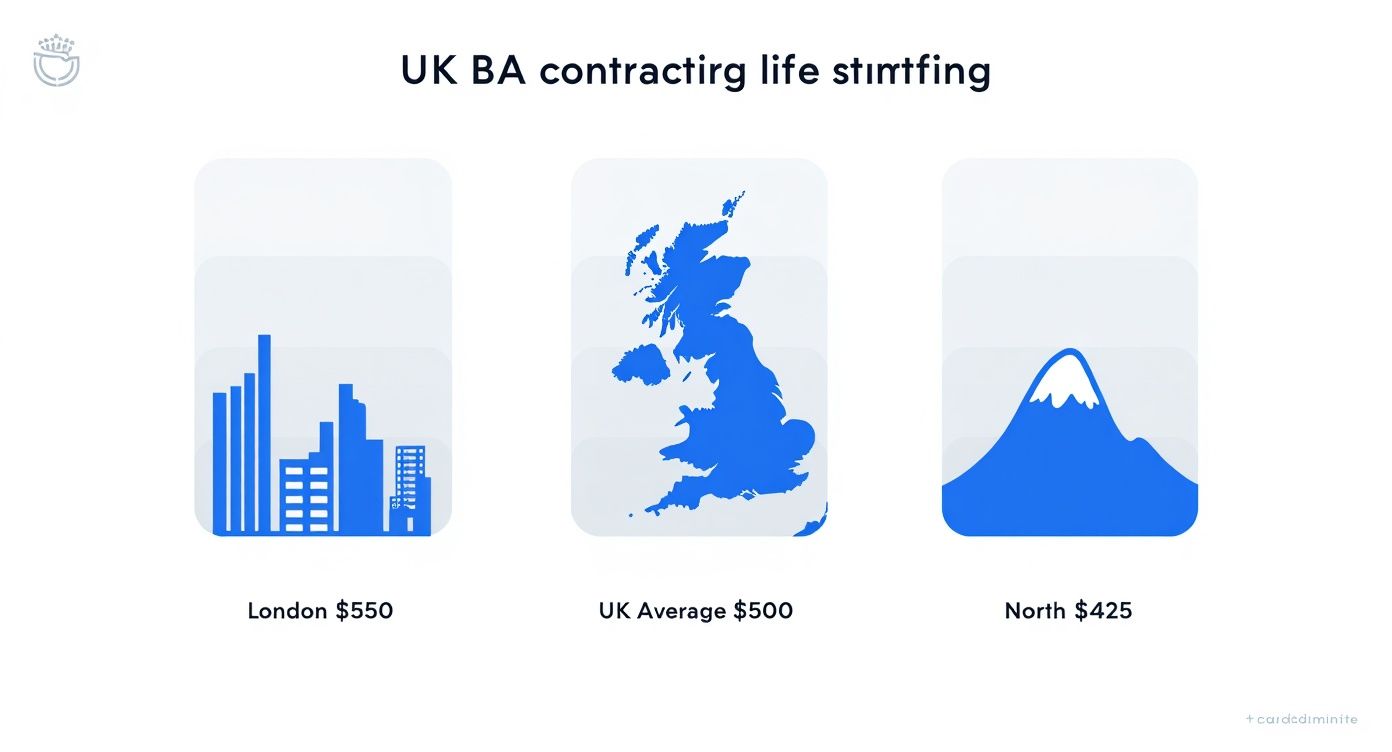
As you can see, there’s a clear financial incentive for landing contracts in London compared to elsewhere. This is a major point to consider when mapping out your contracting strategy.
What Are the Current Market Rates?
The good news is that the UK’s BA contracting market is looking healthy. The latest data from November 2025 shows the median daily rate for a Business Analyst in the UK sits at £500. This is a solid benchmark, but it’s just the start of the story.
Geography plays a huge role. For instance, London pushes the median up to £550 per day, whereas roles in the North of England are more likely to hover around the £425 per day mark. It really pays to know the local landscape.
Here's a quick look at how those median rates break down across the country.
Median Daily Rates for Business Analyst Contractors in the UK
| Location / Arrangement | Median Daily Rate |
|---|---|
| London | £550 |
| South East England | £525 |
| South West England | £488 |
| Midlands | £475 |
| North of England | £425 |
| "Work from Home" | £500 |
These figures give you a much clearer picture of what to expect depending on where you're looking for work. Even remote roles tend to stick close to the national average, reflecting the high demand for talent regardless of location.
Even better, the demand itself is climbing.
In the six months leading up to November 2025, there was an 18.4% increase in BA contract job postings compared to the same period in 2024. That’s a sign of a market that’s not just recovering, but thriving.
This tells us that businesses are actively investing in the skills BAs bring to the table. For contractors, this means more opportunities and stronger negotiating power.
Of course, your day rate is only one part of the equation. To get a realistic idea of what you could earn after tax, give our simple contractor rate calculator a try. It’s a brilliant way to plan your finances and see what your hard work translates to in your bank account.
Getting to Grips With IR35 as a BA Contractor
For any contractor working as a Business Analyst in the UK, understanding the off-payroll working rules, better known as IR35, is non-negotiable. Getting this wrong can lead to serious financial headaches, so it is vital to know exactly what it means for you and your contracts.

Think of IR35 as HMRC's way of looking past your company structure to see what your working relationship with a client truly looks like. The rules are designed to spot contractors who are, for all practical purposes, employees of their client. These arrangements are often called 'disguised employment'.
The legislation boils everything down to a simple outcome for your contract. You will be classed as either 'inside IR35' or 'outside IR35'. Each status dramatically changes how you are paid and how much tax you will owe.
Inside vs. Outside IR35: What’s the Real Difference?
So, what do these terms actually mean in practice?
Inside IR35: This means HMRC sees your contract as one of employment. As a result, your income is subject to standard PAYE tax and National Insurance Contributions, just as if you were a permanent member of staff. Your client (or the agency paying you) must deduct all this before you get paid.
Outside IR35: This is the status most contractors aim for. It means your contract and working practices prove you are in a genuine business-to-business relationship. You are treated as a self-employed professional, so you can receive your gross day rate and handle your own business taxes, typically through your limited company.
For a deeper dive into the details, our guide explains more about IR35 and contractors and how these determinations are made.
The Key Tests That Decide Your Status
To figure out where you stand, HMRC and your client will put your contract under the microscope, looking at a few key principles. These are often called the key tests of employment.
At its heart, IR35 asks a single question: "If the contractor's limited company did not exist, would they look like an employee of the client?" How you answer that question determines how you are taxed.
To get to that answer, they focus on three main areas:
Control: This is all about how much say the client has over how, when, and where you do your work. A true contractor has a great deal of autonomy over their methods. An employee, on the other hand, is usually told what to do and how to do it.
Substitution: Can you send someone else to do the job in your place? The right to provide a suitably qualified substitute (who you would pay yourself) is a powerful indicator of genuine self-employment and points firmly towards an outside IR35 status.
Mutuality of Obligation (MOO): This one is a bit more subtle. In a typical employment relationship, the employer is obliged to provide work, and the employee is obliged to do it. For a contractor, that obligation should not exist. Once your project is done, the client is not required to offer you more work, and you are not required to take it.
How to Find Your First BA Contract
Landing your first business analyst contract is a huge step, but with the right game plan, it is completely achievable. The trick is to stop thinking like a job seeker and start acting like a one-person business. This is your first marketing campaign, with the goal of winning the best contracts out there.

It all starts with a CV that does more than just list your old job duties. Your contractor CV needs to be a hard-hitting marketing document that screams value.
Crafting a Winning Contractor CV
A contractor's CV has one job: to make an instant impact. Recruiters and hiring managers scroll through dozens of applications, so you have seconds, not minutes, to grab their attention.
Here’s how to make your CV stand out from the pile:
- Lead with a powerful summary: Start with a punchy profile that highlights your core BA skills, any specialisms (like Agile or data migration), and the sectors you know inside out.
- Focus on achievements, not duties: Do not just say you were "responsible for gathering requirements." Instead, show your impact: "Delivered a comprehensive requirements document that slashed project scope creep by 15%." Numbers talk.
- Tailor it every single time: Tweak your CV to mirror the language and priorities in the contract description. This is about showing the client you are the perfect fit for their specific problem.
Where to Look for Opportunities
Once your CV is ready for action, you need to know where the fish are biting. The good news is the UK IT contractor market is healthy. Recent industry data from March 2025 showed a solid uptick in demand for IT contractors, with opportunities growing by 11% month-on-month. You can find more market insights over at ContractorUK.com.
Your network is one of your most valuable assets in the contracting world. Many of the best roles are filled through referrals and relationships before they are ever advertised publicly.
Building that network means getting active across a few key channels:
- Specialist Job Boards: Sites like JobServe, CWJobs, and Technojobs are your bread and butter. They are dedicated to IT and tech contracts, so you will not be sifting through irrelevant roles.
- LinkedIn: Get your LinkedIn profile optimised with keywords like "Business Analyst Contractor" and "Agile BA." Actively engage with recruiters and comment on posts related to business analysis to get yourself noticed.
- Recruitment Agencies: Find a few specialist IT recruitment consultants and build a proper relationship with them. They are your gateway to a huge number of unadvertised roles and can give you priceless intel on what the market is doing.
A final thought on interviews: clients are less concerned about your qualifications and more interested in whether you can solve their immediate problem. Be ready to discuss specific projects where you made a tangible difference. It is this focus on past impact that will truly set you apart.
Choosing How to Operate as a Contractor
Once you have landed your first business analyst contract, you have another big decision to make: how are you going to manage your money? In the UK, most contractors go down one of two paths. You can either set up your own limited company or join a compliant umbrella company.
Each route comes with its own set of rules and rewards, so understanding the difference is key to starting off on the right foot.
Limited Company vs Umbrella Company
Running your business through a limited company puts you firmly in the driver's seat. You are the director, which can be a very tax-efficient way to work if your contract is found to be outside IR35. The trade-off, however, is a hefty administrative workload. You are responsible for everything from company accounts to fulfilling your duties as a director.
An umbrella company, on the other hand, is a much simpler, more straightforward way to get paid. Think of it as being employed by the umbrella company for the duration of your contract. This setup is a perfect fit for contractors whose roles fall inside IR35, as it guarantees all your tax and National Insurance contributions are handled correctly.
An umbrella company takes the administrative headache out of contracting, leaving you free to focus on your client's project. It’s a compliant, hassle-free way to manage your earnings and make sure you are right with HMRC.
For many BAs, particularly those just starting out or taking on public sector roles, an umbrella company is the most practical and secure option. It perfectly bridges the gap between the freedom of contracting and the stability of traditional employment.
Here at UmbrellaCompany.com, we make this process completely seamless. We handle your payroll, tax deductions, and National Insurance, giving you total peace of mind. To help you weigh everything up, our detailed guide on umbrella company vs limited company gives you a crystal-clear breakdown.
So, Why Is an Umbrella Company a Smart Choice?
For many business analyst contractors, an umbrella company hits that sweet spot between the freedom of contracting and the stability of a traditional job. It’s a clean, straightforward, and compliant way to handle your finances, especially for those contracts that land inside IR35.
When you join us, UmbrellaCompany.com effectively becomes your employer. That one simple step gives you a continuous record of employment, which is absolute gold dust when you are trying to get a mortgage, loan, or credit. It smooths over a massive hurdle that trips up many independent contractors.
Getting the Best of Both Worlds
Working this way means you suddenly get access to statutory employment rights. We are talking about the kind of benefits that permanent staff often take for granted, like:
- Statutory Sick Pay: A financial safety net if you are too ill to work.
- Holiday Pay: You will accrue paid time off, meaning you can actually take those well-deserved breaks without watching your income grind to a halt.
- A Workplace Pension: We handle all the admin and get you auto-enrolled into a pension scheme.
We take care of all the payroll admin, calculating and deducting the correct PAYE tax and National Insurance contributions. It all goes straight to HMRC on your behalf, guaranteeing you stay compliant and giving you one less thing to worry about.
Partnering with a compliant umbrella company lets you focus on what you do best, delivering great work for your client, safe in the knowledge that all the financial and legal stuff is being managed properly.
It's also worth keeping an eye on how the market is moving. For instance, recent figures for Senior Business Analysts show the median day rate has settled around £550. While that is a slight dip from previous years, hiring activity is holding steady. This tells us that even with shifting rates, organisations still desperately need experienced BAs. You can see the full breakdown of Senior Business Analyst contract rates over on ITJobsWatch.co.uk.
To make sure you are properly protected, always choose a provider with accreditations from bodies like the FCSA or Professional Passport. Think of these certifications as a quality mark, your assurance that the company plays by the rules and will not drag you into any dodgy tax avoidance schemes.
Got Questions? We’ve Got Answers
Dipping your toe into the world of contracting is bound to bring up a few questions. It is completely normal. To help you get started with confidence, we have put together some straightforward answers to the queries we hear most often from new Business Analyst contractors.
Think of this as your quick-start guide to the practical side of things, from figuring out your day rate to making sense of your first payslip.
How Should I Price Myself as a New BA Contractor?
Setting your day rate for the first time is a balancing act. Your first step should be some market research. Jump on the major job boards, look at industry reports, and see what the going rate is for a BA with your skills, experience, and location. A contract in central London, for instance, will naturally command a higher rate than one based further north.
When you are just starting out, it is often smart to be competitive. Pricing yourself just a touch below the average can help you land that crucial first contract and start building your reputation. Once you have a couple of successful projects under your belt, you will be in a much stronger position to raise your rate for the next gig.
What’s the Difference Between a Timesheet and an Invoice?
This is a common point of confusion, but it is actually quite simple. As a contractor working through us, your main focus will be on timesheets. A timesheet is just a log of the hours or days you have worked for your client. You send it to us and the client for approval, and that’s it.
An invoice, on the other hand, is a formal bill for payment that a business sends its client. The good news? We handle all the invoicing for you. We use your approved timesheet to create and send the invoice to the agency or client, so you do not have to worry about it.
Can I Claim Expenses as a Contractor?
The rules around expenses for umbrella company contractors are pretty strict, thanks to HMRC's regulations on Supervision, Direction, or Control (SDC).
In short, you generally cannot claim tax relief on your daily commute to the client's office or for your lunch. However, some specific, work-related expenses might be allowable, but they must be incurred "wholly, exclusively, and necessarily" while doing your job. We will always give you clear guidance on what you can and cannot claim, making sure you stay on the right side of the rules.
How Does My Umbrella Company Payslip Work?
At first glance, your payslip from UmbrellaCompany.com will look a lot like one from a permanent job, but there are a few key differences. You will see the full contract value we received from the agency for your work right at the top.
From this figure, we deduct our margin, Employer’s National Insurance, the Apprenticeship Levy, and any pension contributions. What is left is your gross pay. Then, your own PAYE tax and Employee’s National Insurance are deducted from that, leaving you with your final take-home pay. We provide a full, transparent breakdown with every single payment.
Ready to kick off your business analyst contracting career with a partner who has got your back? UmbrellaCompany.com makes it easy to find and choose the right umbrella company for you.


