


Building and contents insurance in the UK averaged £385 a year in 2023. That’s a useful benchmark, but for contractors and freelancers it’s only a starting point because your home often protects both your living space and part of your livelihood.
If you’re working from the spare room, storing tech at home, or relying on one property to cover both personal life and business routine, insurance stops being a background bill. It becomes part of your wider risk planning.
That’s where many people get tripped up. They compare their quote with a national average, decide it looks high, and assume they’re overpaying. In reality, the quote may reflect where they live, the type of property they own or rent, what they keep inside it, and whether they’ve told the insurer about business use.
For contractors, that matters more than it does for many salaried employees. Your income can vary. Your equipment may be expensive. Your home office may contain the laptop, monitors, phone kit, paperwork, and client materials that keep work moving.
If you’re reviewing your wider setup, it can also help to understand how your trading structure shapes financial decisions more broadly, especially if you’re comparing different ways of working such as limited company arrangements.
Practical rule: Treat the building and contents insurance average cost as a benchmark, not a target. The right question is whether your cover matches your actual risks.
Claims handling matters too. Once you’ve bought cover, the quality of your evidence, inventory, and paperwork can make a big difference if something goes wrong. A practical example is Awesim's tips for insurance claims, which shows the kind of documentation and claim habits that make the process smoother.
Protecting Your Assets as a Contractor
A contractor’s home often carries more financial weight than people realise. It isn’t just where you sleep and keep your belongings. It may also be where you work between client visits, store equipment, hold confidential papers, or keep tools and devices that would be expensive to replace quickly.
The headline figure often quoted is £385 a year for combined buildings and contents insurance in 2023, up 7.2% from 2022, with Northern Ireland averaging £488 according to the ABI data cited by Insureon’s UK home insurance cost summary. That gives you a baseline, but it doesn’t tell you whether your own quote is reasonable.
Why contractors need a different lens
Most generic guides assume a straightforward household. They don’t always reflect the actual circumstances of home-based contract work, where a property may contain:
- Work equipment that goes beyond standard household electronics
- A dedicated office area with desks, screens, printers, and storage
- Business visitors such as clients, couriers, or collaborators
- Income pressure where replacing damaged items quickly matters
That last point is easy to overlook. If your sofa is damaged, that’s disruptive. If your work laptop is stolen and you can’t invoice for a week, the financial impact can spread further.
The three questions that matter first
Before comparing prices, pin down these basics:
| Question | Why it matters |
|---|---|
| Do you need buildings cover, contents cover, or both? | Owners usually need buildings cover. Renters usually focus on contents. |
| Does your policy recognise working from home? | Some policies are fine with clerical home working, others need disclosure or an add-on. |
| Have you valued your possessions properly? | Underinsuring can leave you short at claim time. |
For many contractors, the actual goal isn’t finding the cheapest policy. It’s finding cover that won’t let you down when a leak, theft, storm, or fire affects both home life and your ability to work.
UK Building and Contents Insurance Average Costs
It is Monday morning. A pipe leaks through the ceiling above your home office, your monitor is damaged, and you still need to deliver work by Wednesday. In that moment, the average price of insurance only matters for one reason. It helps you judge whether the cover you bought was realistic for your home and your work setup.
For UK contractors and freelancers, average cost figures are a starting marker, not a budgeting rule. A national average can tell you whether a quote looks broadly cheap, typical, or expensive. It cannot tell you whether that quote properly reflects a home office, higher-value tech, or the pressure to replace equipment quickly if a claim disrupts your income.
A useful benchmark from figures cited earlier in this guide is that combined buildings and contents cover often lands in the high hundreds per year, with regional variation around that midpoint. Treat that number like the list price on a van. It gives you a reference point, but the final figure changes once the insurer looks at the exact property, the location, and the risks attached to how you live and work from home.
A simple benchmark table
Below is the regional comparison already established from the verified data used earlier in the article.
| Region | Average Annual Premium | % Difference from UK Average |
|---|---|---|
| UK average combined policy | £385 | 0% |
| Northern Ireland | £488 | higher than UK average |
| South East | £376 | lower than UK average |
| Scotland | £341 | lower than UK average |
The practical lesson is straightforward. The phrase building and contents insurance average cost describes a range, not a single dependable number. Two contractors with similar incomes can pay very different premiums if one lives in a lower-risk part of Scotland and the other owns a property in a higher-risk part of Northern Ireland.
That matters even more if your income fluctuates month to month. A premium that is only moderately above average can still put pressure on cash flow if you are between contracts or waiting on invoices.
Why averages can mislead home-based contractors
Generic averages usually assume a standard household. Contractors often have a slightly different setup. A spare room may now hold dual monitors, backup drives, ergonomic furniture, a printer, and specialist tools. Even if some of those items fall under separate business cover, their presence can still shape how you assess the level of protection your home policy needs.
There is also a property side to this. Buildings insurance is tied closely to rebuild cost, not sale price. If that distinction feels fuzzy, Survey Merchant's reinstatement cost guide explains it clearly. That is especially useful if you own your home and want to avoid paying for the wrong level of buildings cover.
How contractors should read these averages
Use the average as a first filter, then test your quote against your real circumstances.
If your quote is above the benchmark, check whether the policy reflects things like a home office, accidental damage, or a property with higher rebuild costs. If your quote is below the benchmark, check the policy wording just as carefully. Lower cost can mean lower limits, tighter exclusions, or weaker protection for the way you use the property.
A good quote should fit your working life as well as your home.
If your insurance planning also needs to cover professional risks beyond the household policy itself, it helps to compare that with broader contractor insurance in the UK. The two types of cover solve different problems, and many freelancers need both looked at together before deciding what is affordable.
What the averages mean in practice
A regional average is useful for one job. It helps you ask better questions.
Ask whether your quote matches your area, your property, and your work-from-home setup. If it does, paying a little more than the headline average may be perfectly reasonable. If it does not, the cheaper number on the page can give false comfort.
What Really Drives Your Insurance Premium
A contractor can live in an ordinary semi, keep one office setup in the spare room, and still get a quote that looks surprisingly high. Another contractor in a similar house may pay less. The reason is usually not one single factor. Insurers price several risks at the same time, and each one changes the final number a little.
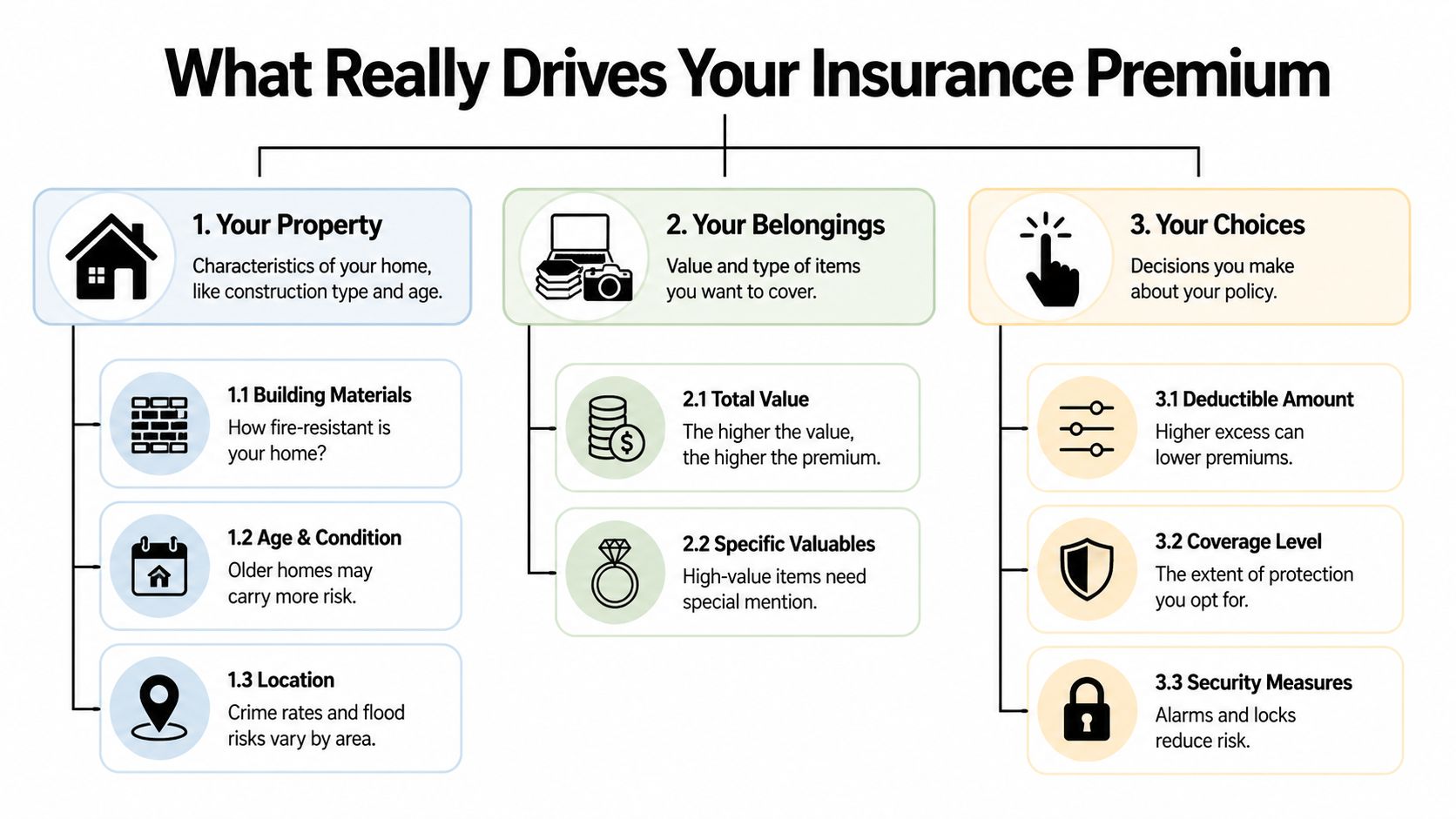
A useful way to read your premium is to treat it like a control panel. The insurer is looking at the home, the area, the value of what is inside, and the cover choices you make. If you work from home, they may also be pricing the extra risk of business equipment or regular business use.
Your property
Start with the building itself. Insurers want to know how likely it is to suffer damage and how expensive that damage would be to put right.
Construction type, age, and general condition all affect that judgement. A standard brick home is often viewed differently from a timber-frame property. An older home with dated wiring, worn roofing, or a history of subsidence concerns can also cost more to insure because repairs may be more likely or more expensive.
Rebuild cost matters just as much. Many homeowners are frequently mistaken here. The market value of your home is the price someone might pay for it. The reinstatement cost is the amount needed to rebuild it if it were badly damaged. For a clear explanation of that difference, Survey Merchant's reinstatement cost guide is worth reading.
Underinsuring the building creates a real budget risk. If the declared amount is too low, the insurer may reduce a future payout rather than covering the full repair bill.
Your location
Your postcode is more than an address on the form. It helps the insurer estimate the chance of claims linked to flooding, burglary, storm damage, escape of water, and even local repair costs.
Flood risk is a good example. As noted earlier, homes in higher-risk areas often face noticeably higher premiums, while some flood resilience measures may help improve terms. For a home-based contractor, this goes beyond the building itself. If a ground-floor office floods, the disruption can hit your income as well as your property.
Local crime patterns can matter too. If you keep a work laptop, monitors, camera kit, or specialist tools at home, the insurer may see a theft claim as more costly than it would be for a household with fewer high-value items.
Your belongings
Contents cover is priced around replacement cost. The more it would cost to replace what you own, the more the insurer may charge.
For contractors and freelancers, this part needs extra care because standard household contents are only half the story. You may also have:
- Laptops, screens, and docking equipment
- Phones, tablets, cameras, or audio gear
- Specialist tools or technical kit stored at home
- Office furniture used mainly for work
- Stock, samples, or client-related materials
Confusion often arises regarding this point. A desk and chair may fit neatly within normal contents cover. A high-spec editing setup, expensive test equipment, or tools used to earn income may not. Some policies allow limited home office equipment. Others exclude business items unless you add cover or tell the insurer how the property is used.
Your choices
Some parts of the premium are outside your control. Some are not.
The clearest examples are your excess, your level of cover, and the security features in the home:
| Choice | Typical effect |
|---|---|
| Higher voluntary excess | Can reduce the premium, but means you pay more yourself if you claim |
| Wider cover | Usually raises the premium because more risks or items are included |
| Better security | Can improve the insurer's view of the risk and sometimes lower the price |
This is the part to review carefully if cash flow changes from month to month. A lower premium can help in the short term, but a very high excess may be painful if you need to claim after theft, fire, or water damage.
One final point matters more for contractors than for many salaried employees. Regular business use at home can change how the insurer sees the risk. If you work there daily, store valuable equipment, or have clients visit, check the policy wording closely. Comparison sites do not always make that distinction clear, and a cheap quote can become expensive if it leaves your real working setup only partly covered.
Buildings vs Contents A Cost Breakdown
A contractor can have a house that is well protected on paper and still be exposed where it hurts most. The usual gap is simple. The policy covers the building, but not the full value of the items that keep the business running from home.

Buildings insurance and contents insurance do different jobs, and the cost of each reflects that difference. One protects the shell of the property. The other protects what you would physically take with you if you turned the house upside down.
What buildings insurance covers
Buildings insurance covers the fixed parts of the home. That usually includes the walls, roof, floors, windows, fitted kitchen units, bathroom suites, and other permanent fixtures.
For a homeowner, this is the part that deals with damage to the structure itself. If a fire damages the kitchen or a leak ruins built-in flooring, the claim usually sits under buildings cover. If you rent, the landlord normally arranges this policy because they own the structure.
As noted earlier, buildings cover usually costs more than contents cover because repairing the property itself is often a larger expense.
What contents insurance covers
Contents insurance covers the belongings inside the property. In plain terms, these are the items you would pack up if you moved home.
That often includes:
- Furniture
- Clothes
- Electronics
- Kitchenware
- Personal possessions
- Office furniture and home working items, depending on the policy
For contractors and freelancers, this is often the more sensitive part of the decision. A standard contents policy may be fine for everyday household items, but business-related equipment can sit in a grey area if the insurer has not been told how the home is used.
A personal laptop used for occasional admin is one thing. A room full of monitors, specialist tools, cameras, testing gear, or stock linked to paid work is another.
Side-by-side comparison
| Cover type | What it protects | Typical buyer |
|---|---|---|
| Buildings | Structure and permanent fixtures | Homeowners |
| Contents | Possessions inside the property | Homeowners and renters |
| Combined | Both parts under one policy | Many homeowners |
Why combined cover often suits home-based contractors
A combined policy can be easier to manage because there is one renewal date, one insurer, and one set of documents. It also makes claims handling clearer when one incident affects both parts of your home setup.
Take a burst pipe. The water may damage plaster, flooring, and fitted units. It may also ruin a desk, office chair, printer, and work laptop. With separate policies, you may have to deal with two providers and two sets of terms. With combined cover, the process is often simpler.
That administrative simplicity matters if you rely on steady cash flow and cannot afford weeks of confusion while trying to replace equipment and keep working.
Where contractors misjudge the cost split
The biggest pricing mistake is often on the contents side, not the buildings side. Contractors regularly estimate the value of the sofa, television, and bed fairly well, then miss the total value of the home office.
Items that are easy to overlook include:
- Dual-monitor setups
- Docking stations
- External drives
- Cameras or design equipment
- Storage cabinets and office furniture
- Tools stored in the house or garage
Each item may seem manageable on its own. Together, they can add up fast.
Your insurer can only price the risk you declare. If expensive work equipment is missing from the valuation or described inaccurately, the premium may look lower than it should, and a claim can become much harder.
A room by room inventory is usually the clearest way to avoid that problem. Start with larger household items, then move to drawers, shelves, cupboards, and your workspace. For many contractors, that exercise changes the decision entirely. Ultimately, the question is not only which cover is cheaper. It is whether the split between buildings and contents matches how you live and work.
Sample Premiums for Different Contractor Lifestyles
Numbers become more useful when you can see how they play out in real life. The examples below don’t invent fresh statistics. They use the verified averages and known pricing drivers to show how different contractor setups can sit above, below, or around the market benchmark.

The IT contractor in a suburban semi
This contractor owns a standard brick-built house and works from a spare bedroom several days a week. The property type helps because the verified data says brick-built homes are typically cheaper to insure than timber-frame alternatives.
Their premium could sit around the general market benchmark, provided the area is not high risk and the insurer is comfortable with home office use. The key issue isn’t only the price. It’s making sure the policy properly reflects the presence of work equipment and a regular home working pattern.
What usually pushes the quote in one direction or the other?
- A standard construction type tends to help
- Moderate contents levels can keep pricing steady
- Declared home office use may affect terms more than the base cost
- Extra accidental damage cover may increase the premium
The freelance designer in a city flat
This renter doesn’t need buildings cover, but contents cover becomes more important because expensive creative equipment sits inside the flat. A quote may still be manageable, but urban risk, shared access, and high-value items can all make insurers more cautious.
Many renters underestimate exposure. They focus on the laptop and camera, but the actual claim value may include furniture, clothing, kitchen items, software-linked hardware, and all the smaller accessories that are costly to replace together.
A contents policy should reflect replacement cost, not the price you hope the items are worth now.
For this contractor, the right question is often, “Would a standard contents policy recognise these items as personal possessions, or would some of them need special mention because they support paid work?”
The builder with tools stored at home
A self-employed builder who owns a house in a rural area may find the buildings part relatively straightforward, but the contents side becomes more nuanced if tools or specialist kit are stored in a garage or outbuilding.
That setup can raise several policy questions:
| Issue | Why it matters |
|---|---|
| Storage location | Garages and sheds may have stricter conditions |
| Nature of the tools | Personal possessions and trade equipment are not always treated the same way |
| Security level | Locks, alarms, and access points can affect insurer comfort |
| Business use disclosure | The insurer needs an accurate picture of how the property is used |
A contractor in this position may feel the quote is high compared with the national average, but part of that difference may come from the profile of the items being stored rather than the property itself.
What these examples show
The same headline average can lead to very different outcomes depending on:
- Whether you own or rent
- What the property is made from
- How much high-value equipment you keep at home
- Whether that equipment is clearly personal, clearly business-related, or somewhere in between
- How often you work from home and how you use the space
That’s why copying another person’s premium rarely helps. A contractor with a low quote might live in a different area, own a different property type, have fewer valuables, or hold a simpler working pattern from the insurer’s point of view.
Practical Ways for Contractors to Lower Insurance Costs
You can’t control every insurance factor, but you can influence several of them. The goal isn’t to strip cover back to the minimum. It’s to remove waste while keeping the parts that protect your home and your working life.

Start with the details you control
Some savings come from simple admin. Others come from reducing the insurer’s view of risk.
A useful checklist:
- Raise your excess carefully. A higher voluntary excess can reduce the premium, but only choose a level you could comfortably afford after a claim.
- Pay annually if the budget allows. Many policyholders prefer the lower monthly hit, but annual payment can reduce overall cost.
- Review your contents valuation. Overstating value can make the policy unnecessarily expensive. Understating it can create claim problems.
- Declare home working accurately. Hiding business use may seem harmless until the insurer questions a claim.
- Shop around at renewal. Insurers change pricing appetite, and a fair quote one year may not be the best fit the next.
Make your home less risky to insure
Insurers often respond well to practical risk reduction. Flood and escape-of-water risk are especially important in many areas.
The verified data says that recent UK flood events have driven premiums in at-risk areas up by 15% to 25% year-on-year, while some insurers offer discounts of up to 18% for smart home technology such as leak detectors, according to Insure.com’s insurance cost summary.
That means sensible upgrades can do two jobs at once. They may help prevent disruption and may also improve how an insurer prices your property.
Examples worth checking with insurers include:
- Smart leak detectors
- Approved locks
- Burglar alarms
- Security lighting
- Flood resilience measures where relevant
Here’s a helpful overview of insurance thinking in practice:
Don’t confuse cheap with efficient
A lower premium isn’t always a better deal if it means weaker protection around work equipment, accidental damage, or home office use.
Contractors often need to think about insurance as a bundle of decisions:
| Decision | Budget effect | Risk effect |
|---|---|---|
| Reduce cover | May lower premium | May leave important gaps |
| Improve security | May lower premium | Can reduce claim likelihood |
| Increase excess | May lower premium | Raises your out-of-pocket cost if you claim |
If your wider risk planning includes business-side cover, it may also be worth reviewing how household protection sits alongside contractor indemnity insurance, because property loss and professional risk are separate issues.
Insurance Questions Every Home-Based Contractor Asks
Many contractors ask the same handful of questions, usually after they’ve received a quote or just before renewal. That’s not surprising. General insurance guides rarely reflect contract work properly. The verified data says a ContractorUK survey found 62% of respondents struggled to benchmark insurance costs against irregular earnings, and highlighted the advice gap affecting 1.3 million contractors working through setups like umbrella companies, as noted by Progressive’s summary page.
Is my work laptop covered under normal contents insurance
Sometimes yes, sometimes not.
A standard contents policy may cover a laptop as a household possession, but the answer can change if the item is mainly used for paid work, taken away from home regularly, or part of specialist business equipment. The safest approach is to tell the insurer exactly what the item is and how you use it.
Do I need to tell the insurer I work from home
Usually, yes.
Many insurers are comfortable with clerical home working, especially if no clients visit and stock is not stored there. But “working from home” can mean very different things to different insurers. A software developer in a spare room is one profile. A consultant receiving client visits is another.
If your work changes how the home is used, tell the insurer before you need to claim.
What if a client visits my home office
That can move you beyond basic household insurance questions.
If visitors come to your home for business reasons, you may need to think about wider liability protection, not just buildings and contents cover. Physical safety matters too. If your workspace is part of a broader commercial or mixed-use setup, a practical background resource is this guide to commercial fire safety laws.
Can I treat home insurance as a business expense through an umbrella company
That depends on the nature of the policy and your working arrangement.
Household insurance is primarily personal cover. Even when it protects work-related items or a home office environment, that doesn’t automatically make the whole premium a business expense. Tax treatment and allowable expenses can be sensitive, especially for workers inside IR35 or operating through umbrella arrangements.
If you’re checking what counts as a legitimate home-related cost, a clearer starting point is this guide to working from home tax deductions.
Do I need a specialist policy
Not always. Often, a standard policy plus the right disclosures is enough.
But you may need extra help if you:
- Store high-value tools or specialist kit
- Have business visitors
- Use outbuildings for work-related storage
- Need cover for items away from home
- Run activity from home that goes beyond desk-based work
The practical rule is simple. If your home supports your income, don’t assume your insurer sees your setup the same way you do.
Taking Control of Your Insurance Costs
The building and contents insurance average cost gives you a starting point, not a personal answer. Your real premium depends on the property, the location, the value of what you own, and the way you use your home as a contractor.
The strongest approach is usually the simplest. Know your rebuild cost. Value your contents properly. Tell the insurer about home working. Check whether work equipment needs special treatment. Then compare policies on cover quality as well as price.
That kind of discipline matters for contractors because insurance isn’t just about replacing possessions. It’s about protecting the base you work from, the equipment you rely on, and the financial stability that keeps contracts running smoothly.
If you're weighing up umbrella options alongside the practical costs of contracting, Umbrella Company can help you compare trusted providers and make more informed decisions about how you work.


