


Finding the best UK umbrella company is about so much more than just a low weekly fee. It’s a decision that hinges on compliance, reliability, and ultimately, the security of your income. The top providers are almost always accredited by professional bodies like the FCSA or Professional Passport. This is your first sign that they meet the UK’s strict tax and employment regulations.
A great umbrella company will be transparent about its margins, provide robust insurance cover, and have a solid contractor support team you can actually talk to. In this guide, we will walk you through everything you need to know to choose a trustworthy partner for your contracting career.
How to Choose the Best UK Umbrella Company
Making the right choice of umbrella company is a critical move for any UK contractor. Think of them as your employer for the duration of your contract; they handle your salary, sort out all the tax deductions, and manage your employment rights. Get this decision right, and you are protected from financial headaches and can be confident you’re fully compliant with HMRC regulations, including IR35.

This guide is designed to walk you through exactly how to compare providers. We'll break down the essential factors to look for, explain how an umbrella actually processes your pay, and show you what to check for on your payslip. The goal is simple: to give you the confidence to pick a trustworthy partner for your contracting career.
Key Comparison Factors at a Glance
Before we get into the details, it helps to know the main points of comparison. A genuinely good, contractor-friendly umbrella company will perform well across all these areas, not just tempt you with a rock-bottom weekly margin.
Choosing a compliant umbrella company is completely non-negotiable. With HMRC set to introduce stricter regulations from April 2026, partnering with a fully accredited provider is the only sensible way to safeguard your finances and your professional reputation.
Here’s a quick look at what separates the good from the bad:
| Feature | Compliant & Accredited Provider | Non-Compliant or Basic Provider |
|---|---|---|
| Accreditation | FCSA or Professional Passport accredited | Lacks independent accreditation |
| Compliance | Adheres strictly to HMRC & IR35 rules | May promise high, unrealistic take-home pay |
| Transparency | Clear margin, no hidden fees | Opaque fee structures or surprise deductions |
| Support | Dedicated support team, HR services | Limited or unresponsive customer service |
| Insurance | Comprehensive cover included as standard | Minimal or no insurance provided |
By keeping these core elements, compliance, transparency, and support, at the forefront, you can cut through the noise and identify the best UK umbrella company for your specific situation, steering clear of any risky schemes.
Understanding How Umbrella Companies Really Work
Before you can pick the right umbrella company, you need to understand what they actually do. At its core, the process is simple: an umbrella company acts as your legal employer for your various contract jobs, putting you on their payroll.
This setup makes life much easier for contractors. Forget the hassle of running a limited company. You just become an employee of the umbrella, and they handle invoicing your recruitment agency or the end client for the work you do.
The main job of an umbrella company is to process your salary through the PAYE (Pay As You Earn) system. This means they are responsible for calculating and paying the correct income tax and National Insurance Contributions (NICs) before the money hits your account.
How Your Pay Is Calculated
At first glance, the way your take-home pay is worked out can seem a bit convoluted, but it follows a clear, compliant process. Getting to grips with this is your best defence against providers making promises they cannot keep.
The journey from your agreed contract rate to what lands in your bank involves a few key steps. The starting figure, often called the assignment rate or contract rate, is the total amount the agency pays the umbrella for your time. Crucially, this figure has to cover all employment costs, not just your salary.
Here’s how it typically breaks down:
- Gross Invoice Value: Your umbrella invoices the agency for the hours you’ve worked at the agreed assignment rate.
- Employment Costs are Deducted: Before your own pay is calculated, all the legal employment costs are taken from that invoice value. These are the costs any employer in the UK has to pay.
- Your Gross Pay is Calculated: What’s left over is your gross pay. This is the figure that’s subject to the usual PAYE deductions.
- Final Deductions: From your gross pay, they will deduct income tax, your employee's NICs, and any pension contributions.
- Net Pay: The final amount is then paid into your bank account, and you get a proper payslip detailing everything.
A common trip-up is thinking the umbrella company 'takes' the employer's National Insurance from your pay. That’s not quite right. The assignment rate is deliberately set higher to account for these statutory costs, making sure they’re paid to HMRC without coming out of the gross pay package you agreed to.
Decoding the Deductions on Your Payslip
Any compliant umbrella company will give you a transparent payslip that clearly lists every single deduction. Learning these terms will help you compare different providers and spot if something isn't right. For a more detailed walkthrough, you can learn more about how an umbrella company works in our complete guide.
You should always see these deductions listed:
- Umbrella Margin: This is the flat fee the umbrella company charges for their service. It’s usually a fixed amount each week or month and should be the only money they keep.
- Employer’s National Insurance: As your official employer, the umbrella has to pay employer’s NICs to HMRC, calculated on your gross earnings.
- Apprenticeship Levy: This is a UK tax on large employers to fund apprentice training. It’s charged at 0.5% of the annual pay bill for employers with a bill over £3 million.
- Holiday Pay: You’re legally entitled to paid holidays. This is usually accrued at 12.07% of your gross taxable pay. It will either be paid out with each payslip (known as 'rolled up') or kept aside for when you actually take time off.
- Workplace Pension: Under auto-enrolment rules, the umbrella must offer a pension scheme and pay employer contributions into it for you.
Understanding this structure is your first line of defence against non-compliant schemes. If any provider promises a take-home pay figure that seems too good to be true, it almost certainly is. A legitimate, trustworthy umbrella will always stick to these HMRC-mandated processes.
The Essential Checklist for Comparing Umbrella Companies
Picking the right UK umbrella company is about more than just finding the lowest weekly margin. To do it properly, you need to dig a little deeper into the things that genuinely protect your money and give you peace of mind. This checklist walks you through what really matters, ensuring you end up with a partner that’s not just cheap, but compliant and supportive too.
We'll look at the non-negotiables, like accreditation from bodies such as the FCSA or Professional Passport, the quality of their insurance cover, and how sharp their payment processes are. Asking the right questions now will help you find a company that actually fits your needs as a contractor.
This diagram shows how a compliant umbrella company should work: a straightforward process that manages your earnings and simplifies your tax obligations.
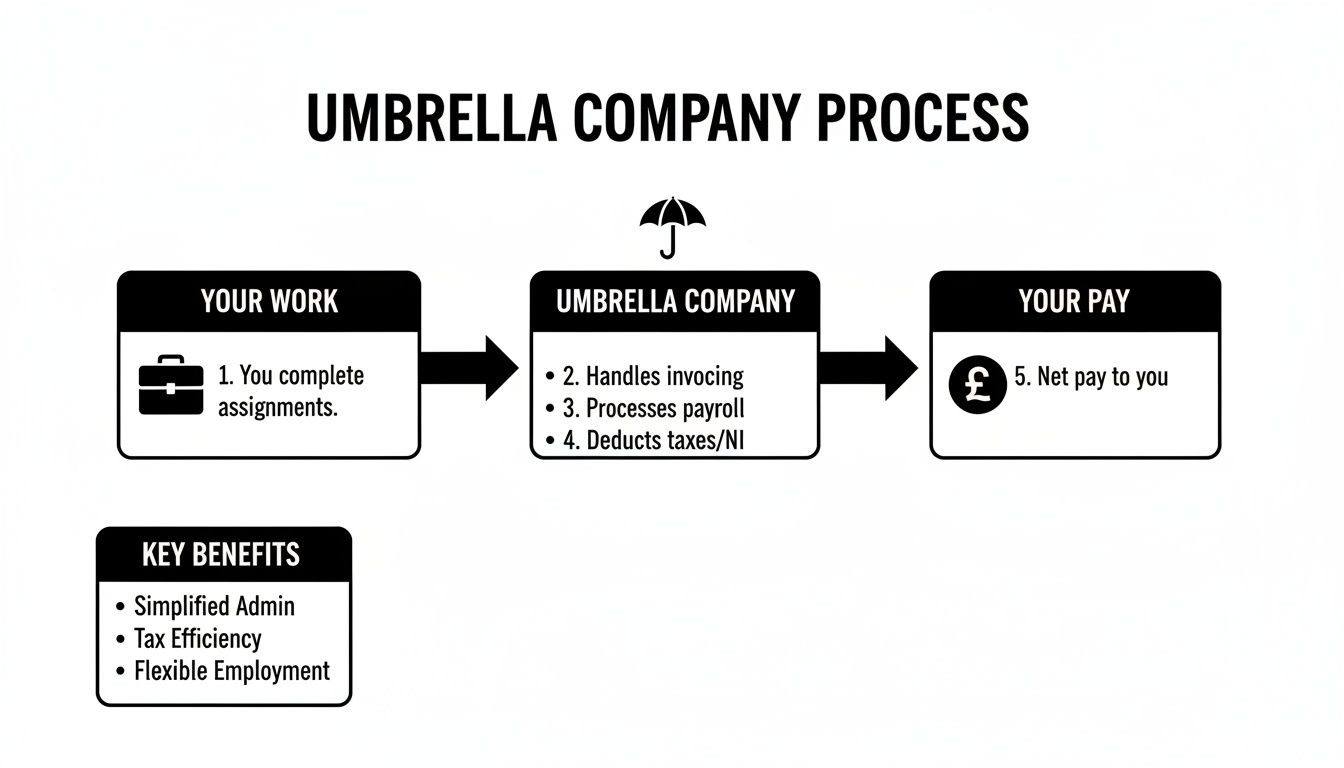
It highlights the umbrella's role as your employer, handling all the complex tax and NI calculations so you do not have to.
Accreditation and Compliance History
First on your list, and frankly the most important, is accreditation. This is your best guarantee that an umbrella company is operating by the book. You are looking for memberships with established, independent UK bodies.
FCSA (The Freelancer & Contractor Services Association): This is the gold standard in the UK. FCSA accreditation means the provider has been through tough, independent audits to prove they stick to a strict compliance code.
Professional Passport: This is another highly respected organisation providing a solid layer of compliance assurance. A Professional Passport accredited provider has been vetted to confirm their processes are legitimate and fall in line with HMRC rules.
Choosing a non-accredited provider is a huge gamble. Accreditation is a critical safeguard, showing a company’s commitment to ethical standards and protecting you from risky tax avoidance schemes.
Do not forget to check their history, either. A long-standing, positive reputation in the contractor community is often a reliable sign that you are in safe hands.
Fee Structure and Margin Transparency
The weekly or monthly margin is the figure everyone focuses on, but how it's presented tells you a lot. A compliant provider will be completely upfront about their fees, with no hidden charges or baffling deductions.
The margin should always be a fixed weekly or monthly amount. Steer clear of any company that calculates its fee as a percentage of your contract value, as this can lead to unpredictable and often higher costs. The margin is the only slice of your contract income the umbrella should keep.
Always ask for a detailed take-home pay illustration before you sign anything. It should clearly break down every single deduction, including:
- The umbrella's margin
- Employer’s National Insurance Contributions (NICs)
- The Apprenticeship Levy
- Your employee tax and NICs
- Holiday pay and pension contributions
This level of transparency is essential. It lets you accurately forecast your income and ensures you will not get any nasty surprises on your payslip.
Insurance Cover and Employee Benefits
As your official employer, the umbrella company must provide adequate insurance. This is a fundamental part of the service and should be included as standard, not offered as a pricey extra.
At a minimum, check that their policy includes:
- Public Liability Insurance: Covers you if you cause an injury or damage property.
- Professional Indemnity Insurance: Protects you against claims of professional error or negligence.
- Employers’ Liability Insurance: A legal necessity for any UK employer.
Beyond the basics, see what else they offer. Do they have a decent workplace pension scheme? Do they provide access to statutory benefits like Sick Pay or Maternity/Paternity Pay? These are the details that separate a simple payroll provider from a genuine employment partner. For a detailed breakdown, have a look at our umbrella companies comparison tool.
Technology and Contractor Support
Let's be honest, a clunky online portal can make life difficult. Submitting timesheets and expenses should be a quick, painless process. An outdated system is a recipe for delays and frustration.
But technology is only half the story. When you have a question about your pay, you need to be able to speak to a real person who knows what they are talking about. Find out what their customer support is like.
- Do they have a dedicated team for contractors?
- Can you actually get hold of them on the phone or by email?
- What are their response times like?
The best UK umbrella company will blend efficient tech with accessible, human support. It ensures you feel looked after throughout your contract. By running through this checklist, you can properly assess each provider and make a choice that secures your financial future.
Why Compliance and Accreditation Are Your First Priority
When you’re weighing up umbrella companies, it’s easy to get fixated on the weekly margin. But let's be clear: the single most important factor, by a long shot, is compliance. Choosing a fully compliant and accredited provider isn't just a box-ticking exercise; it's essential for protecting yourself from some serious financial and legal headaches down the line.
The fallout from picking a non-compliant umbrella can be devastating. HMRC is cracking down hard on tax avoidance schemes, and contractors are being hit with bills for thousands in unpaid taxes, interest, and penalties, sometimes years after they have been paid. These schemes often lure people in with promises of ridiculously high take-home pay, which should always set alarm bells ringing.
Your first job is to find a partner that operates completely above board and sticks to UK tax law. It’s not just about securing your income; it is about protecting your professional reputation.

Understanding the Role of Accreditation Bodies
So, how do you verify a company is legitimate? The simplest way is to check for accreditation from an independent professional body. In the UK, two names carry real weight and are considered the gold standard.
FCSA (The Freelancer & Contractor Services Association): This is the UK's leading professional body for the sector. To get and keep their stamp of approval, members have to pass a gruelling annual audit by independent, regulated accountants and solicitors. It is a rigorous process designed to ensure they meet the highest compliance standards.
Professional Passport: Much like the FCSA, Professional Passport conducts robust compliance audits. Their accreditation is a solid confirmation that an umbrella's processes have been thoroughly vetted against current UK tax and employment law, giving you real peace of mind.
Going with a provider accredited by one or both of these bodies is your best defence against risky schemes. It shows the company has invested serious time and money into proving its operations are ethical, transparent, and in line with HMRC’s rules. You can find out more on this in our guide to choosing an FCSA-accredited umbrella company.
Spotting Red Flags and Dodgy Schemes
Even with accreditation, it pays to stay sharp. Some non-compliant outfits use clever tactics to appear legitimate. Knowing what to look for will help you sidestep trouble.
As a rule of thumb, a compliant umbrella will process your income through PAYE, leaving you with a take-home pay of around 60-70% of your contract rate, depending on your tax code. Any promise of 80%, 85%, or even 90% is a massive red flag signalling a tax avoidance scheme.
Keep an eye out for these common warning signs:
- Unrealistically high take-home pay: If an offer seems too good to be true, it absolutely is.
- Complicated payment structures: Be wary if your pay is split into different parts, especially if they’re labelled as loans, grants, or investments. This is a classic disguised remuneration tactic.
- Offshore arrangements: Any mention of money being routed through offshore accounts should have you running for the hills.
- Vague payslips: You must receive a detailed payslip that clearly breaks down all deductions, including PAYE tax and National Insurance. No exceptions.
HMRC is crystal clear on this: if you get involved in a tax avoidance scheme, you are personally liable for the outstanding tax, not the provider who sold you the scheme.
Preparing for Upcoming Regulatory Changes
The world of umbrella companies does not stand still. Big changes are on the horizon for April 2026, when new legislation will shift some of the tax compliance debt from contractors to recruitment agencies. This means agencies will become jointly liable if they work with non-compliant umbrellas.
The government estimates that non-compliance costs the Exchequer around £500 million a year, which is what is driving this change. For contractors, this means agencies and clients will be even more diligent about working only with fully vetted, compliant partners.
By choosing a future-proof, accredited umbrella company today, you ensure you remain a low-risk, attractive option for the best contracts. It sets you up for long-term success, free from the stress of a potential HMRC investigation. Think of it this way: your choice of umbrella company is a reflection of your own professional standards. Make compliance your number one.
Finding an Umbrella Company That Understands Your Sector
The right umbrella company for a software developer on a day rate is not always the best fit for a supply teacher paid weekly. While any compliant provider will handle PAYE correctly, some industries have unique payment cycles, expense rules, and contract quirks. Partnering with a company that has genuine, proven expertise in your sector can make a world of difference to your contracting life.
A specialist provider just gets the rhythm of your industry. They already know the common headaches you face, whether it’s project-based invoicing in the creative industries or making sense of term-time pay in education. This built-in familiarity makes for a much smoother, more efficient service that actually fits your professional world.
Why Sector Expertise Matters in Practice
Think of it like this: an IT contractor needs an umbrella that can process high-value invoices without a hitch and understands complex project milestones. Their main concern is probably the speed and reliability of payments, plus having a slick online portal to manage their assignments.
A locum healthcare professional, on the other hand, is often juggling varied shift patterns, multiple NHS trusts, and very specific compliance paperwork. An umbrella with a deep background in healthcare is far better equipped to manage this complexity, ensuring payslips are always spot on and compliant with NHS agency frameworks.
A great umbrella company does more than just run your payroll. They act as a knowledgeable partner who understands the specific pressures and payment models of your industry, offering a service that feels intuitive and supportive.
This specialised knowledge simply removes friction from the admin side of contracting, leaving you free to focus on your actual work.
Specialists in Education
The education sector, especially for supply teachers, is a perfect example of where specialist knowledge is non-negotiable. Pay is often structured around term times, and holiday pay calculations can get messy. An umbrella company that works with thousands of teachers will understand the critical importance of accruing holiday pay correctly so it can be paid out during the school holidays.
The scale here is huge. In the 2023/24 academic year, UK schools spent £757.6 million on supply teachers, with a huge chunk of that flowing through recruitment agencies and their umbrella partners. This really underscores the need for providers who are completely on top of the compliance and regulatory duties specific to supply teaching. You can find out more about the supply teacher market from Workwell Contractor Solutions.
Tailored Support for IT and Tech Contractors
For contractors in the fast-moving IT and tech world, efficiency is everything. Projects often run on tight deadlines with demanding payment cycles. An umbrella that specialises in IT contracting will typically offer:
- A sophisticated online portal for submitting timesheets and expenses in minutes.
- Faster payment processing to keep pace with project-based invoicing.
- Dedicated account managers who speak the language of tech contracts and day-rate calculations.
This focus ensures the admin side of your work never lags behind the demands of your role. If you work in this field, you might find our dedicated guide on finding the best IT umbrella company for your needs useful.
Finding Your Ideal Partner
Ultimately, the best UK umbrella company for you will be one that not only ticks all the compliance and service boxes but also shows a real understanding of your professional world. When you’re comparing providers, do not be afraid to ask about their experience in your sector. Ask for case studies or even to speak to contractors in similar roles. A bit of due diligence now ensures you end up with a partner that can properly support your contracting career, whatever your specialism.
Finalising Your Choice and Getting Started
You’ve weighed up compliance, checked out their sector expertise, and got a feel for the quality of service. Now you’re ready to make a confident decision.
Getting set up with your chosen provider should be a painless process. This last part of the guide will walk you through it, from getting a proper pay illustration to signing on the dotted line and making sure your agency is in the loop. The goal is to get you up and running smoothly so you can get back to what you do best.
Step 1: Get a Detailed Take-Home Pay Illustration
Before you commit to anything, the very first thing you should do is ask for a personalised take-home pay illustration. This is not a rough estimate; it should be a detailed forecast based on your specific contract rate, tax code, and personal situation. It’s the only way to see exactly how your pay is calculated and check that the provider is being transparent. Any reputable company will provide this without obligation.
When you get the illustration, go through it carefully. It should clearly break down:
- The assignment rate (the total amount invoiced to your agency).
- All employment costs, including Employer’s National Insurance and the Apprenticeship Levy.
- The umbrella company’s margin.
- Standard deductions like PAYE tax and your employee NICs.
- Any contributions to your workplace pension and your accrued holiday pay.
Think of this document as the benchmark for your first payslip. If the numbers look off or a deduction is not clear, ask them to explain it right away.
Step 2: Review the Contract and Sign Up
Happy with the pay illustration? Great. The next stage is the sign-up process itself. Most of the best UK umbrella companies have a simple online portal to get you registered.
Here’s an example of a straightforward sign-up portal, designed to be quick and easy.
As you can see, a well-organised provider makes getting started a matter of minutes.
You will need to provide your personal details, proof of identity, and your P45 if you have one. They will also send you an employment contract. Make sure you read this document thoroughly before signing. It confirms your employment status with the umbrella company and spells out your rights and their responsibilities.
Your employment contract is a legally binding document. Pay close attention to clauses covering payment schedules, notice periods, and your entitlement to statutory benefits like sick pay.
Step 3: Connect with Your Agency
The final piece of the puzzle is linking your new umbrella company with your recruitment agency. Let your agency know who you’ve chosen and pass on the necessary contact details.
From there, the umbrella company will liaise directly with the agency to handle all the invoicing and payment arrangements. Getting this coordination right is crucial for ensuring you get paid accurately and on time. With these steps done, you are all set up and ready to start your contract with confidence.
Got Questions About Umbrella Companies? We Have Answers
Switching to contracting often throws up a lot of questions, especially when it comes to getting paid. If you’re trying to find the best UK umbrella company, you’re bound to have a few things you need clarifying. To help you get your head around it, we have tackled some of the most common queries we hear from contractors just like you.
How Much Tax Will I Pay Through an Umbrella Company?
This is the big one, but the answer is straightforward. When you work through an umbrella company, your tax liability is identical to any other UK employee. Your earnings are run through HMRC’s PAYE (Pay As You Earn) system, which means you’ll pay standard income tax and employee National Insurance Contributions (NICs) based on your tax code.
Be very wary of any provider promising to slash these deductions. If a company promises take-home pay figures like 85% or 90%, it is a massive red flag. They are almost certainly pushing a tax avoidance scheme, and getting involved could land you in serious trouble with HMRC down the line.
What’s the Difference Between an Umbrella and a Limited Company?
The real difference boils down to one thing: responsibility.
Umbrella Company: Think of it as contracting on easy mode. You become an employee of the umbrella, and they take care of all the admin, including tax, NI, and payroll. It’s a simple, hassle-free way to work, giving you continuous employment rights without the headache of running a business.
Limited Company: Here, you are the boss. You are the director of your own company, which opens up more possibilities for tax planning. But with that comes a hefty administrative load, from filing company accounts and paying corporation tax to managing your own payroll.
Is My Money Safe with an Umbrella Company?
It absolutely should be, provided you choose the right partner. The key is to look for a company with accreditation from a recognised body like the FCSA or Professional Passport. This is your assurance that they’ve passed some pretty tough financial and compliance checks.
It’s also worth asking how they handle your funds. Do they keep client money in a separate, ring-fenced account? A trustworthy provider will have no problem explaining the steps they take to keep your earnings protected.
Can I Claim Expenses Through an Umbrella Company?
The rules on this have tightened up considerably since 2016. Thanks to legislation around Supervision, Direction, or Control (SDC), most umbrella contractors can no longer claim tax relief on routine travel and subsistence expenses.
In simple terms, you generally cannot claim for your daily commute or lunch. There are some exceptions for specific business expenses, but only if they’re approved and reimbursed directly by your end client. Before you sign on the dotted line, make sure you get a clear explanation of the umbrella’s expense policy. Any of the best UK umbrella companies will be completely transparent about what is and isn’t allowed.


