


You’re contracting through an umbrella company, the work is steady, and your day rate looks healthy on paper. Then your back goes, your mental health dips, or a cycling accident leaves you unable to work for months. The invoices stop immediately, but the mortgage, rent, childcare, and food bills don’t.
That gap is where many contractors feel exposed. Permanent employees often have workplace benefits and employer sick pay to soften the blow. Contractors usually don’t. If you’re inside IR35 and paid through an umbrella, you may get basic statutory support, but it typically won’t come close to covering normal household spending.
The best income insurance is the policy that keeps your finances workable when your body or mind won’t let you work. For contractors, that means choosing cover that reflects variable income, short contracts, payroll through an umbrella, and the practical reality of IR35.
Protecting Your Income When You Cannot Work
A lot of contractors only think about income protection when something already feels wrong. A slipped disc. Stress that has gone past “just a busy month”. Surgery with a recovery period nobody can shorten. At that point, the question becomes painfully simple. How long could your household cope without your usual income?

For contractors using umbrella companies, the risk can feel odd at first. You’re employed by the umbrella for payroll purposes, but you still live with the ups and downs of contract work. That means your payslip may look like an employee’s, while your financial exposure still feels like self-employment. If you want to understand the basic support available first, our guide to how to calculate Statutory Sick Pay is a useful starting point.
Practical rule: If losing one month of income would force you to borrow, cut essentials, or miss a major bill, income protection is worth serious attention.
The best income insurance doesn’t remove the disruption of being ill or injured. It gives you breathing room. It helps protect the roof over your head, keeps direct debits moving, and stops a health problem turning into a financial crisis as well.
What Is Income Protection Insurance Really?
Income protection insurance pays you a monthly benefit if illness or injury leaves you unable to work and you meet the policy conditions. In plain English, it is private cover designed to replace part of your income while you recover.
For a contractor, that distinction matters. Your income often stops faster than an employee's would. If you work through an umbrella company, you may receive pay through PAYE and still have very little real protection beyond the legal minimum. If you work through your own limited company, the gap can be even more obvious because your earnings may come through a mix of salary and dividends.
What it means in practice
The easiest way to understand income protection is to focus on cash flow.
If a back problem, stress-related illness, or surgery stops you working for several months, the policy can pay a regular amount each month after the waiting period ends. That money is there to help with mortgage or rent, food, utilities, debt repayments, childcare, and the other bills that do not pause when a contract does.
It does not put your finances back to normal in full. It is there to keep your household stable while your earning ability is temporarily out of action.
A useful plain-English explainer from Wealth Collective on how income protection works also helps if you want a simple walkthrough of the mechanics before getting into UK contractor details.
Why this catches contractors out
Contractors often assume one of two things. Either umbrella employment means they are already covered properly, or insurance will match their usual income if they cannot work.
Neither assumption is safe.
Umbrella workers can have access to Statutory Sick Pay, but SSP is usually a thin safety net compared with a contractor's normal take-home pay. IR35 can add another layer of confusion because your tax position may look more like employment while your financial risk still looks like contracting. The result is a mismatch between how you are paid and how exposed you are.
That is why income protection needs to be read as "what arrives in your bank account if you cannot invoice, submit timesheets, or stay on assignment", not just as another insurance label.
What income protection is, and what it is not
Income protection is different from critical illness cover. Critical illness usually pays a one-off lump sum for specific named conditions in the policy.
It is different from life insurance too. Life insurance is built to pay out on death, or sometimes terminal illness, depending on the wording.
Income protection works differently. It is aimed at the much more common situation where you are alive, unable to work, and still facing monthly bills.
That distinction matters for contractors because time off work is often a direct hit to earnings. There is rarely a long runway of employer support behind you.
If you are weighing this against other forms of cover, our guide to contractor insurance in the UK shows where income protection fits alongside the rest of your protection planning.
A good way to picture it is this. Critical illness is built for a defined medical event. Life insurance is built for death. Income protection is built for the months in between, when recovery is slow and the bills keep coming.
Decoding Your Policy The Key Features Explained
When people search for the best income insurance, they often compare brands first. That’s understandable, but the actual value sits in the wording. Two policies can look similar in marketing and behave very differently when you need to claim.
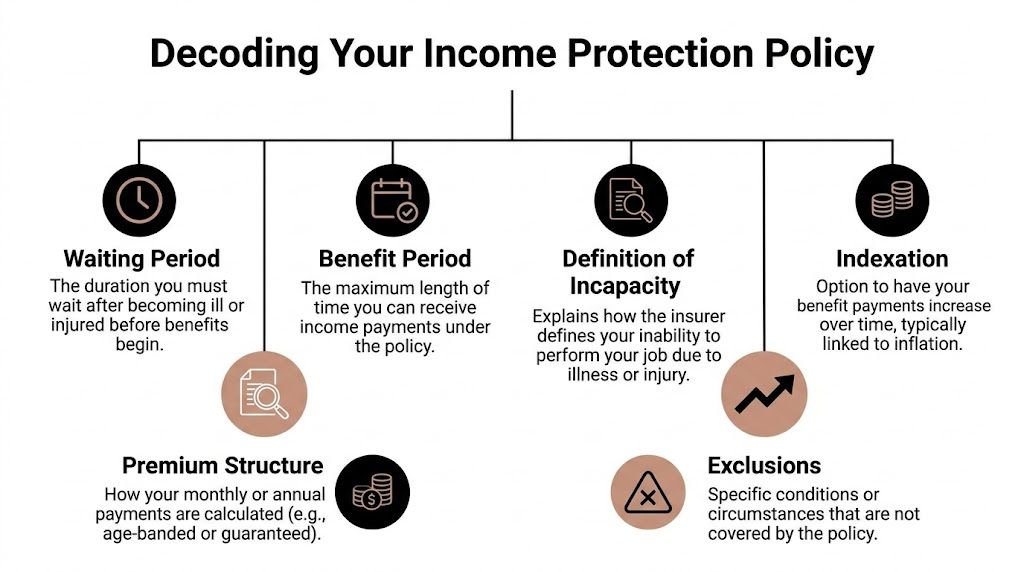
Waiting period
This is how long you wait after becoming unable to work before the insurer starts paying.
A longer waiting period usually lowers the premium. A shorter one usually costs more. The right answer depends on your emergency savings, any sick pay available through your umbrella arrangement, and how quickly your household would feel pressure.
If you have a healthy cash buffer, you might choose a longer wait. If your budget is tight, a shorter wait may make more sense.
Benefit period
This is how long the policy will continue paying once a valid claim is accepted.
Some policies pay for a limited period. Others are designed to pay for much longer, potentially until a specified end point in the policy if you remain unable to work. Contractors often focus on the monthly amount and forget this part, but it can be just as important.
A short benefit period may help with a temporary setback. It may be less useful if your condition lasts much longer than expected.
Definition of incapacity
This is one of the most important clauses in the whole policy.
There are different ways insurers define whether you are unable to work. The strongest option for many specialists is usually own occupation. That means the insurer looks at whether you can do your specific role.
For a contractor, that distinction can be huge.
- Own occupation can suit a specialist IT contractor, engineer, project manager, or consultant whose value sits in a particular skill set.
- Broader definitions may ask whether you could do some other work instead, even if it’s not the contract work you normally do.
- Practical impact matters more than the label. Always ask how the insurer would assess your actual role.
If your work depends on specialist judgement, technical concentration, or sustained computer use, a weak incapacity definition can undermine the whole point of the policy.
Premium structure
Premiums don’t all behave the same way over time.
Some policies aim for more stability. Others may change more as you get older or as the insurer reviews pricing. Neither approach is automatically wrong, but you need to know what you’re signing up for.
Ask these questions:
- Will the premium stay broadly predictable?
- Can the insurer change the pricing basis later?
- Will affordability still look sensible a few years from now?
Indexation
Indexation means the benefit can increase over time, often to help keep pace with inflation.
Without it, a benefit that looks fine today may feel less useful years later. Contractors with mortgages, rent commitments, or school-age children often underestimate how much this matters.
Exclusions
Exclusions are conditions or scenarios the insurer won’t cover.
Some exclusions are standard. Others may be specific to your medical history, past injuries, or occupation. This doesn’t automatically make a policy bad. It just means you need clarity before you buy.
Read this section carefully and ask for plain-English explanations of anything vague.
One more contractor-specific angle
If you already hold other professional cover, keep the policies distinct in your mind. Professional indemnity insurance protects you against work-related claims from clients. Income protection protects your own earnings if illness or injury stops you working. Our guide to contractor indemnity insurance covers that separate area in more detail.
How Much Does Income Insurance Cost for Contractors?
This is usually the first practical question. It’s also where online advice can become unhelpful, because people want a simple number and insurers price risk case by case.
The cost of the best income insurance for you depends on the shape of the policy, not just the insurer’s brand. Your age, health, smoking status, occupation, level of cover, and waiting period all affect price. So does the benefit period and any added features such as inflation linking.
What tends to move the premium up or down
A few broad patterns usually apply.
- Shorter waiting periods usually increase cost because the insurer may need to start paying sooner.
- Higher monthly cover generally means a higher premium.
- More generous incapacity definitions can cost more, but may be far more valuable at claim stage.
- Medical history and occupation risk often influence underwriting.
What confuses many contractors is that the cheapest quote can become the most expensive mistake if the cover doesn’t match how they work.
A simple way to budget for it
Before comparing quotes, work out the amount your household must have each month to stay stable. Start with the fixed commitments you can’t easily pause, then add the essentials. If you need help structuring that exercise, this guide on how to track and manage fixed expenses is a practical place to begin.
Then ask a more useful question than “What’s the cheapest premium?” Ask, “What level of protection keeps my household functioning without over-insuring me?”
Example monthly income protection premiums 2026
Because pricing varies by insurer and underwriting, it’s safer to compare policy design rather than present made-up sample quotes. The table below shows the structure you should use when gathering real quotations.
| Waiting Period | Example Monthly Premium |
|---|---|
| 4 weeks | Varies by insurer, age, health, occupation, and cover level |
| 13 weeks | Usually lower than a shorter waiting period, but quote required |
| 26 weeks | Often lower again, especially if you have savings to bridge the gap |
| 52 weeks | Typically among the lowest premium options, if you can self-fund a long wait |
Where contractors go wrong on price
They either buy too much cover because the day rate looks strong, or too little because they only focus on premium cost.
A better balance is to insure the part of your income that keeps life steady. Mortgage or rent. Council tax. Utilities. Food. Insurance. Travel costs you’d still face. Debt repayments. Childcare if it would continue. That’s the number to test first.
Income Insurance for Umbrella and PSC Contractors
You finish a contract on Friday, wake up on Monday with a slipped disc, and suddenly the question is not your day rate. It is how an insurer will read your income while you cannot work. For contractors, that answer often depends on whether you are paid through an umbrella company or your own PSC, and whether your current role sits inside or outside IR35.

Why umbrella contractors need a different approach
An umbrella arrangement can make your income easier to evidence because there is a payroll record, payslips, and an employer in the chain. That does not automatically mean cheaper cover or easier acceptance. It does mean the insurer may find your earnings simpler to follow than a PSC contractor whose income comes through a mix of salary, dividends, and retained profit.
That distinction matters at claim stage.
Income protection is really an argument you do not want to have later. You are trying to show, clearly and quickly, what you were earning before illness or injury stopped you working. Umbrella payroll can help with that because the paper trail is usually more straightforward.
If you want a clearer picture of how that employment structure works in practice, this guide to an umbrella company for freelancers explains what sits behind the payslip.
Proving your income to an insurer
Many contractors get caught out, especially after changing contracts, switching payment models, or spending time both inside and outside IR35.
Insurers usually want evidence such as:
- Recent contracts or assignment schedules, to show the type of work and the level of earnings
- Umbrella payslips, if you are employed through an umbrella company
- Bank statements, if the insurer wants to confirm income received
- Company accounts, tax calculations, or accountant figures, if you operate through a PSC
The practical point is simple. The insurer is not only asking what you can earn in a strong month. They are trying to work out what income is regular enough to insure.
A contractor with fluctuating invoices may be assessed over a longer period. An umbrella contractor with steady weekly or monthly payroll may find that process easier. Neither setup is better in every case. They are just documented differently.
Clean records usually mean fewer delays, fewer follow-up questions, and less room for disagreement if you need to claim.
Umbrella versus PSC
An umbrella contractor is often easier for underwriters to place because the setup looks closer to employment. You get payslips, deductions through payroll, and a visible income trail.
A PSC contractor often needs to explain more. If you pay yourself a low salary and take dividends, your company may be profitable while your personal payslip looks modest. What matters for your money is whether the insurer will cover only salary, or salary plus dividends where policy terms allow and evidence supports it. That point needs checking before you buy, not after you become ill.
This is one of the biggest differences between generic advice and contractor-specific advice. Two contractors can have the same annual income on paper, but the insurer may assess them very differently based on how that income reaches them.
IR35 and why it matters
IR35 is not an income protection rule, but it affects the evidence around your earnings.
If you are inside IR35, your tax treatment may look more like employment while your real-world security still looks like contracting. You may have no sick pay worth mentioning, no long-term employer benefits, and gaps between assignments. That makes income protection more relevant, not less.
If you are outside IR35, the insurer may need a clearer explanation of how your company income turns into personal income. The policy can still work well. It just needs to fit the way you are paid.
Contractors who move between umbrella roles and PSC contracts should say that early in the application. A policy works best when the insurer understands the full picture from the start.
This short video gives a useful overview of the contractor context around protection and planning.
The main takeaway is practical. Your work model changes how income is evidenced, how underwriting is handled, and what could happen if you need to claim. For umbrella and PSC contractors, the best policy is one that matches the way money reaches your bank account.
How to Compare and Choose the Right Policy
By the time you start getting quotes, the temptation is to compare monthly price and stop there. That’s understandable, but it’s not how you find the best income insurance. You find it by matching the policy to the way your household and contract income work.
Start with your essential monthly number
Work out the smallest monthly amount that would keep life stable if you couldn’t work.
That number usually includes:
- Housing costs, whether that’s mortgage, rent, or service charges
- Household essentials, such as food, utilities, and council tax
- Debt and finance commitments, including loans or car payments
- Family costs, such as childcare or regular support payments
- Core insurances, where missing a payment would create another risk
Don’t start with your best month of contracting income. Start with the amount your household needs.
Match the waiting period to your buffer
Many people can improve value without weakening protection.
If you have meaningful savings, you may choose a longer waiting period and lower premium. If your spare cash is limited, a shorter waiting period may be worth the higher cost because it protects your cash flow sooner.
A good rule is to line up the waiting period with whatever reliable financial buffer you already have. If there’s no real buffer, don’t pretend there is just to get a cheaper quote.
Compare wording before price
When reviewing policies, give extra attention to these points:
How incapacity is defined
If your work is specialist, weak wording can leave you exposed.How income is assessed
This matters if your earnings vary or you’ve moved between umbrella and PSC arrangements.How long benefits can continue
A policy that pays for a short period may not solve a longer absence.What exclusions apply
This is especially important if you’ve had previous injuries or medical issues.
Choose the right route to buy
There isn’t one perfect route for everyone.
Direct to insurer can be simple if your situation is straightforward and you already know what you want.
Comparison sites can help you scan the market quickly, but they may not capture contractor-specific complexity very well.
A specialist independent financial adviser is often the strongest route if your income is variable, you’ve changed working structures, or you want help understanding claim wording.
A good adviser doesn’t just find a cheaper premium. They help you avoid buying a policy that looks fine until you try to use it.
A contractor-friendly comparison checklist
Use this when you review any quote.
Occupation fit
Does the insurer clearly understand the work you do?Income evidence
Have they explained what documents they’ll rely on if you claim?Definition strength
Is the incapacity wording suitable for specialist contract work?Budget realism
Will you still be happy paying this premium during a quiet contract period?Exclusion clarity
Do you fully understand anything the policy won’t cover?Change resilience
If your contracts, sector, or work pattern shift, will the policy still make sense?
That last point matters more than many people realise. Contractors rarely have perfectly static careers. The best choice today should still be broadly sensible if your next assignment looks different.
Your Checklist for Getting Covered
Income protection is one of those products that feels optional until you picture a real interruption to income. For contractors, that interruption can become expensive very quickly because work often stops faster than household spending does.
The best income insurance usually has three qualities. It covers the amount you need, uses wording that suits specialist contract work, and stays affordable enough that you keep it in force.
Next steps that make sense
Calculate your baseline budget
Work out what your household must have each month to stay stable.Check the incapacity definition carefully
For many contractors, this is the clause that decides whether the policy is effective.Compare more than headline premium
Waiting period, exclusions, benefit period, and income assessment all matter.Speak to a specialist adviser if your setup is complex
This is especially helpful if you move between umbrella and PSC working, or your earnings fluctuate.Ask your umbrella company about any insurance relationships or guidance
Sometimes the route to suitable cover is clearer when your working arrangement is properly understood.
If you treat income protection as part of your business resilience, rather than just another household bill, the decision becomes much easier.
Frequently Asked Questions
Is income protection tax-deductible for contractors?
It depends on how the policy is arranged and who pays for it. Tax treatment can be nuanced, especially for contractors using a limited company or moving between PSC and umbrella work.
In practice, this is an area where personalised advice matters. Don’t assume a premium is deductible just because it relates to your income. Check with a qualified accountant or adviser before making decisions based on tax treatment.
Can I get cover with a pre-existing medical condition?
Often, yes, but the insurer may assess it differently.
They might offer standard terms, apply an exclusion for that condition, increase the premium, or ask for more medical information before deciding. The key is full disclosure. If you leave something out and it becomes relevant later, it can create serious problems at claim stage.
A pre-existing condition doesn’t automatically mean “no cover”. It usually means “expect more underwriting”.
How does a payout affect my umbrella company relationship?
Income protection usually pays the insured person under the terms of the policy. It isn’t normally the same thing as being paid through an active contract assignment.
That distinction matters because your insurance benefit is there to replace part of your income when you cannot work. It doesn’t usually operate like ordinary payroll for active work completed. If you’re using an umbrella, you should still understand how your employment status, assignment status, and any ongoing obligations with the umbrella are handled while you’re off work.
Is income protection worth it if I already have savings?
Savings help, and they may let you choose a longer waiting period. But savings and insurance do different jobs.
Savings are finite. Income protection is designed to support a longer interruption if recovery takes more time than you hoped. Many contractors use both. They keep a cash buffer for the first stage of absence, then use insurance to protect against the more serious hit.
Do I need income protection if I’m inside IR35?
Many inside IR35 contractors assume the “employee-like” tax treatment means they have employee-level security. Usually, they don’t.
That’s why this type of cover remains relevant. If your household depends on continued contract earnings and there’s no strong employer sick pay package behind you, income protection is still worth examining carefully.
If you’re comparing umbrella arrangements and want a clearer view of how your working setup affects protection, pay, and IR35 practicalities, Umbrella Company can help you compare trusted options and make a more informed choice.


