


Stepping away from the traditional 9-to-5 is not just a passing phase; for thousands of UK professionals, it is a smart career move aimed at gaining more control and better rewards. The biggest draws of self-employment are the clear financial perks, a level of flexibility you just cannot get in a normal job, and the simple satisfaction of being your own boss.
The Real Pull of Being Self-Employed in the UK
Deciding to work for yourself is one of the most significant career moves you can make. It is a complete switch from the predictable safety of a permanent job to a path where you call the shots. The idea of 'freedom' sounds great, but it is worth understanding what that actually looks like day-to-day.
For a lot of people, the money is the first thing that catches their eye. Specialist contractors and freelancers can often charge much higher day rates than their salaried equivalents, which has a direct impact on their earning potential. That financial control also extends to how you handle your taxes, opening up legitimate ways to lower your tax bill by claiming business expenses, something most employees cannot do.
But it is not all about the balance sheet. Going self-employed gives you an autonomy that can completely change your lifestyle. You get to build your work schedule around your life, not the other way around. This means you pick the projects that interest you, decide when you work, and create a work-life balance that genuinely suits you.
Of course, with great freedom comes great responsibility. You are now in charge of sorting out your own tax, National Insurance contributions, and pension. To help you weigh it all up, let's put the two options side-by-side.
Self Employment vs Traditional Employment At a Glance
Here is a quick rundown of how being your own boss stacks up against a typical permanent role.
| Aspect | Self-Employed (Sole Trader/Limited Co.) | Traditional Employee |
|---|---|---|
| Income | Potential for higher earnings; direct control over rates. | Fixed salary with potential for bonuses. |
| Flexibility | High degree of control over hours and work location. | Fixed hours and location set by the employer. |
| Tax | Responsible for Self Assessment; can claim expenses. | Tax and NI are deducted at source via PAYE. |
| Benefits | Must arrange own pension, sick pay, and holidays. | Entitled to statutory sick pay, holiday pay, and pension. |
| Job Security | Relies on securing contracts and managing workflow. | More stable, with employment rights and notice periods. |
As you can see, the trade-off is clear: you swap the security and simplicity of employment for greater control, flexibility, and earning potential. It is a choice that comes down to your personal priorities and how comfortable you are with managing your own financial and professional life.
Unlock Your Earning Potential and Tax Efficiency
Let's be honest, one of the biggest draws of going self-employed is the money. It is about having direct control over your finances and seeing a tangible reward for your skills. Talented contractors can often secure much higher day rates than their permanent equivalents, which gives an immediate boost to your earning potential. You are no longer just an employee; you are in the driver's seat of your own financial future.
But that increased earning power is only half the story. Being your own boss also opens up a world of tax efficiency. Unlike a typical employee, you can claim a whole host of legitimate business expenses. Every pound you spend on running your business directly reduces your taxable profit, which in turn lowers your tax bill. This is what financial control really looks like.
Maximising Your Income
The most obvious win is getting to set your own rates. If you have got skills that are in high demand or you operate in a specialist niche, you can charge a premium for your expertise. That direct link between what you can do and what you can earn is a huge motivator and a key reason so many professionals make the leap.
This is not just a hunch; the numbers back it up. A major benefit of self-employment in the UK is the potential for significantly higher earnings compared to being on the payroll. In the 2025-26 tax year, the effective tax rate for a self-employed person is projected to be just 17%. That is a world away from the 27% paid by employees. This gap means employees could end up paying a staggering 55% more tax relative to their income.
Claiming Legitimate Business Expenses
When you are the boss, many of the costs that come with doing your job become tax-deductible. This is a game-changer compared to being an employee, where claiming for these kinds of expenses is almost impossible.
So, what kind of things are we talking about? Here are a few common examples:
- Office Costs: This covers the essentials like stationery and your business phone bill. If you work from home, you can even claim a portion of your utility bills.
- Travel Costs: Journeys to meet clients or attend business-related events are claimable. This includes fuel, train tickets, and any necessary accommodation.
- Professional Development: Any courses, training programmes, or industry subscriptions that help you get better at your job count as legitimate business costs.
- Equipment and Software: Things like your laptop, specialist software licences, and other tools you need for your trade can be offset against your profits.
This chart really drives home the difference in control and reward between self-employment and a traditional job.
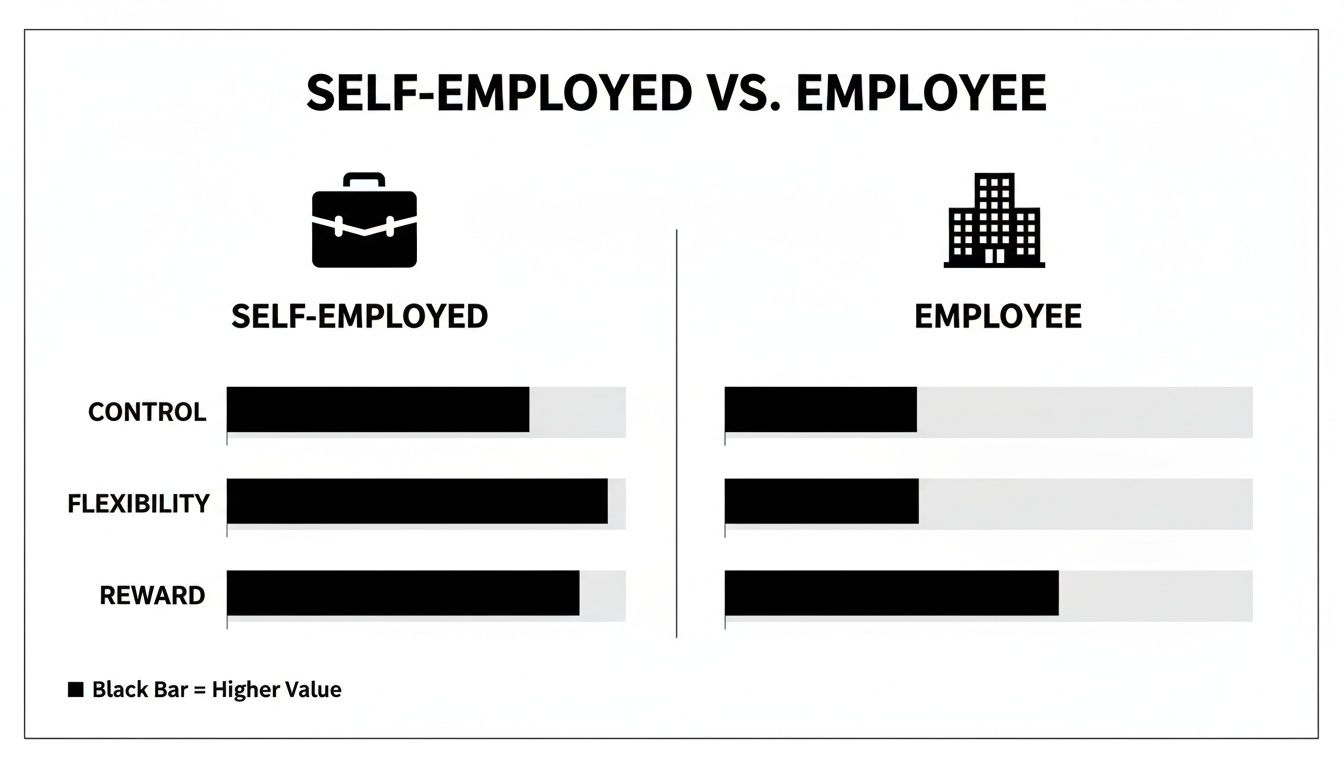
As you can see, self-employment clearly offers a higher degree of both control and potential reward, which are often the main reasons professionals decide to go it alone.
By diligently tracking and claiming these expenses, you make sure you only pay tax on your actual profit, not your total revenue. This is the essence of tax efficiency for the self-employed.
Of course, with this financial control comes the responsibility of managing your own tax affairs, which means completing a Self Assessment tax return. It can sound a bit daunting at first, but with a bit of organisation and the right help, it is perfectly manageable. Many contractors use accounting software or hire an accountant to make life easier, leaving them free to focus on what they do best.
To get a better grip on your finances, it is well worth exploring the pros and cons of taking a salary versus dividends in our detailed guide.
Designing Your Ideal Work-Life Balance
One of the biggest draws of self-employment is the power to build a working life that actually fits your personal priorities, not the other way around. It is about taking back control of your schedule and your environment, creating a career that genuinely supports the life you want to lead.
This freedom means you get to call the shots on when and where you work. Imagine tweaking your hours to handle the school run without the usual stress, or decamping to another city for a month just for a change of scenery. You can even build in proper breaks between demanding projects. This is not a fantasy; it is the day-to-day reality for many contractors and freelancers.

Building a Sustainable Career
Real work-life balance is not just a nice-to-have; it is about creating a sustainable and fulfilling career that keeps burnout at bay. When you are in the driver's seat, you can structure your workload to align with your personal goals, making your work an important part of your life, not the whole of it.
This level of control naturally leads to greater job satisfaction. You are no longer just reacting to endless demands but proactively shaping your professional journey. This can do wonders for your mental health, boost your motivation, and give you a much stronger sense of purpose.
Practical Examples of Flexibility
The idea of 'flexibility' really comes to life when you see how it plays out in the real world. For many, designing a schedule that truly works for them is a priceless advantage.
Here are a few common scenarios:
- The Working Parent: A freelance IT consultant might start their day early, block out a few hours in the afternoon to pick up the kids from school, and then log back on in the evening to wrap things up. This completely removes the classic tug-of-war between deadlines and family life.
- The Digital Nomad: A graphic designer could decide to spend a month working from a co-working space in Edinburgh, just for a change of pace. There is no need to ask for permission or disrupt client work. Their office is simply wherever their laptop is.
- The Project-Based Contractor: An experienced project manager might work flat-out on a six-month contract, then take a full month off to travel or focus on a hobby before looking for their next gig. This approach allows for proper, dedicated periods of rest and recovery.
By taking charge of your schedule, you transform work from a rigid obligation into a flexible part of a well-rounded life. This shift is central to achieving long-term career satisfaction and personal well-being.
Ultimately, this autonomy allows you to blend your personal and professional lives in a way that feels natural and sustainable. Instead of constantly sacrificing personal time for your job, you can organise your work to support your personal life, leading to a healthier, happier, and more productive career.
Taking Full Control of Your Career Direction
When you are self-employed, you are the one in the driver's seat. This is probably one of the biggest draws of contracting, you stop being a passenger in someone else's company and become the captain of your own professional ship. It is about gaining the entrepreneurial freedom to build a business that genuinely reflects what you want to achieve and what you stand for.

This control gives you the power to be picky. You get to choose clients that you actually want to work with and take on projects that genuinely interest you. It is your chance to build a personal brand and earn a reputation based on your specific skills and what you do best.
Specialise and Stand Out
A huge advantage here is the ability to carve out a niche you are passionate about. Instead of just doing whatever work lands on your desk, you can focus on becoming a recognised expert in a particular field. This not only makes the day-to-day more fulfilling but often leads to higher day rates and more exciting work down the line.
Your professional development is entirely up to you. You decide what skills to learn and when to invest in training, making sure your expertise stays relevant and in demand. There is no waiting around for an annual performance review to discuss your growth; you set the pace.
Forging Your Own Path
Forget the traditional career ladder. Your journey is not limited by corporate structures or office politics. You are free to pivot your services, expand what you offer, or even change direction entirely when it feels right.
This autonomy means your career progression is tied directly to your effort, skill, and strategic decisions, not someone else's approval. You build your own ladder, and you decide how high it goes.
This level of control is fundamental to feeling satisfied with your career long-term. For a practical look at the first steps, our guide on how to become a contractor breaks down how to get set up for success. By taking the reins, you create a career that is not just a job, but a true reflection of your professional identity.
Of course, being your own boss is not all sunshine and roses. It is important to go in with your eyes wide open.
When you step into self-employment, you leave the traditional safety net behind. That means no more automatic sick pay, paid holidays, or company pension contributions. It is a trade-off that requires a bit of planning, but it is far from unmanageable.
For every potential downside, there is a smart, practical solution.
Navigating the Risks with Smart Strategies
The biggest mental hurdle for many new contractors is the idea of a fluctuating income. Those first few months can feel a bit like a rollercoaster after years of a predictable monthly salary.
The key is to build your own financial buffer. We always advise setting up a separate business savings account and tucking away a slice of every single invoice you raise. This is not about restricting yourself; it is about giving yourself freedom. This pot of money becomes your personal safety net, covering your bills during quiet spells and giving you the confidence to turn down projects that are not the right fit.
Think of it this way: you are essentially paying yourself a salary, smoothing out the natural peaks and troughs of contract work. It is the single most empowering habit you can build as a self-employed professional.
Once you have your cash flow sorted, the next step is to create your own bespoke benefits package. This is where you replace the perks of permanent employment with something that works for you.
Here are the absolute must-haves:
- Business Insurance: At a minimum, you will need professional indemnity and public liability cover. These protect you if a client claims your work was negligent or if an accident happens. It is a small price to pay for massive peace of mind.
- Income Protection: This is your self-employed sick pay. If you are too ill or injured to work, an income protection policy pays you a regular monthly sum until you are back on your feet. It is a non-negotiable for safeguarding your finances.
- Pension Planning: You are in the driver's seat of your retirement. Setting up a personal pension or a SIPP (Self-Invested Personal Pension) is straightforward, and your contributions are incredibly tax-efficient.
Let's break down the common worries and how to tackle them head-on.
Common Self-Employment Risks and Mitigation Strategies
This table offers a practical guide to understanding the risks of self-employment and the effective solutions available.
| Risk | Description | How to Mitigate It |
|---|---|---|
| Fluctuating Income | Gaps between contracts can lead to inconsistent cash flow. | Build a financial buffer by saving a percentage of every invoice. Aim to have 3-6 months of living expenses saved. |
| No Sick Pay | If you cannot work due to illness or injury, you do not get paid. | Take out an income protection insurance policy to provide a replacement income. |
| No Holiday Pay | Time off for holidays is unpaid. | Factor holiday time into your day rate. A common method is to calculate your annual costs and desired profit, then divide by the number of days you plan to work. |
| Lack of Pension | You are solely responsible for saving for your retirement. | Open a personal pension or SIPP. You can make tax-efficient contributions directly from your limited company. |
| Administrative Burden | You handle your own taxes, invoicing, and compliance. | Hire an accountant who specialises in contractors. The cost is a tax-deductible expense and saves you countless hours and potential mistakes. |
| Professional Liability | You could be sued for mistakes or negligence in your work. | Get professional indemnity insurance to cover legal costs and any potential damages. |
Facing these risks is not about being pessimistic; it is about being a professional. By putting these simple structures in place, you build a resilient business that can thrive for years to come.
What About Using an Umbrella Company?
If the thought of all this admin still feels a bit daunting, an umbrella company offers a great middle ground.
By joining an umbrella, you technically become their employee. This means they handle all your tax and National Insurance deductions through PAYE, so you do not have to worry about it. Crucially, it also means you get statutory employment rights like sick pay and holiday pay, which immediately removes some of the biggest risks of contracting.
This is an especially popular route for contracts that fall "inside IR35," as it ensures full tax compliance without the headache. To get a better handle on this, our guide explains exactly how contractors and IR35 rules work together.
Choosing the Right Path for Your Contracting Journey
Deciding how to structure your contracting career is one of the biggest calls you will make. Now that you have seen the rewards and responsibilities laid out, you are in a much better position to choose a path that truly fits your professional goals and personal life. This decision will define how you handle your money, taxes, and legal duties day-to-day.
The key is to understand the trade-offs. There is no single "best" option that works for every contractor; each route has its own distinct flavour. Your choice really boils down to your appetite for admin, your financial ambitions, and how much you value the safety net of statutory employment rights.
Comparing Your Options
For many contractors, the goal is simple: maximum control and financial return. Setting up as a sole trader or your own limited company puts you squarely in the driver's seat. This is the path with the greatest potential for higher take-home pay, all thanks to smart tax planning and the ability to claim a whole host of business expenses. It is the route for those who really want to embrace the business-owner side of contracting.
On the flip side, the sheer simplicity of an umbrella company is a massive draw for contractors who just want to get on with the job. By becoming an employee of the umbrella, you hand over all the headaches of tax and National Insurance. In return, you get statutory rights like sick pay and holiday pay, which provides a welcome safety net.
The decision really comes down to what you value most: the complete autonomy and higher earning potential of running your own show, or the streamlined simplicity and built-in protections of an umbrella arrangement.
Ultimately, you can make self-employment work through different structures. If you are still weighing it all up, our detailed comparison of an umbrella company vs a limited company can bring everything into sharp focus. At UmbrellaCompany.com, we are here to give you the insights you need to choose your path with total confidence.
Your Questions Answered
Going self-employed for the first time throws up a lot of questions. It is completely normal. Here are some of the most common queries we see, with straightforward answers to help you get to grips with what it all means in practice.
What is the Biggest Financial Perk of Going It Alone?
It is really a powerful one-two punch: higher earning potential combined with much better tax efficiency. As a contractor, you are in the driver's seat when it comes to setting your day rate, which is often significantly higher than an equivalent salary. On top of that, you can legitimately claim a whole host of business expenses to reduce your taxable profit, something regular employees simply cannot do.
Can I Still Have a Pension If I am Self-Employed?
Absolutely, but you are the one who has to set it up. There is no employer to automatically enrol you or contribute to a workplace scheme. Instead, you can open a personal pension or a Self-Invested Personal Pension (SIPP). This puts you in full control of your retirement savings, and your contributions are still tax-efficient.
How Do I Cope Without Sick Pay or Holiday Pay?
This is where a small shift in mindset and some sensible planning make all the difference. It is one of the core disciplines of successful contracting.
- For holidays, most contractors simply factor this into their day rate. You calculate the rate you need to earn while you are working to cover the days you plan to take off.
- For sick leave, this is where income protection insurance becomes your best friend. It is a policy that pays you a regular income if you are too ill or injured to work. Think of it as your personal safety net.
Taking charge of these things yourself is what running a business is all about. You are not just replacing old employment benefits; you are building a more resilient, flexible financial setup that you control and that is designed around your life.
Once you have these plans in place, you can get on with enjoying the freedom and rewards of contracting without the worry of a sudden income drop.
Ready to explore your options with confidence? UmbrellaCompany.com makes it simple to compare trusted, compliant umbrella companies to find the perfect fit for your contracting journey. Find your ideal solution in just a minute. Compare umbrella companies now.


