


For many contractors, the most important pension number isn't the average uk pension. It's the gap between what retirement costs and what the State Pension provides.
A single person now needs about £43,900 a year for a comfortable retirement, while the full New State Pension is £11,978 a year in the current tax year, according to Charles Stanley's pension commentary. That gap is why headline pension averages can be misleading. They tell you what people have. They don't tell you whether that amount will be enough for your own life.
If you work on contracts, move between assignments, or switch between inside and outside IR35, that matters even more. Your pension path often looks very different from someone in a permanent role with steady employer contributions. What counts is understanding which pension income you can expect, what kind of savings pattern your work allows, and how to build a plan that still works when your income doesn't stay perfectly smooth.
What Is the Average UK Pension Really?
The phrase average uk pension sounds precise, but it often answers the wrong question.
For a contractor or freelancer, pension planning works less like a salary-based staircase and more like a series of stepping stones. Some years you contribute steadily. Some years a contract ends, IR35 status changes, or an umbrella arrangement alters what gets paid in for you. That is why one national average can be a poor guide for your own retirement picture.
What matters more is the shape of your pension income. You are usually building it from several parts, and each part can behave differently depending on how you work.
Why the average can mislead
A single average blends together people with very different careers, contribution histories, and retirement options. It puts permanent employees with regular employer payments in the same bucket as freelancers with uneven income and contractors moving between inside and outside IR35 roles.
For contractors, that creates three common blind spots:
- National Insurance gaps, which can reduce what you eventually receive from the State Pension
- Irregular pension contributions, because saving often rises and falls with contract income
- Multiple old pension pots, which can leave you with a scattered view of what you have built so far
An average is context. It is not a retirement target.
A better question is: what income am I likely to have later, based on the way I work now? That shift in thinking matters. If you are outside IR35 through your own limited company, you may have more control over how and when contributions are made. If you are inside IR35 or paid through an umbrella company, pension contributions may look more like an employee arrangement, but they still need checking. Auto-enrolment does not guarantee that the outcome will suit your long-term plans.
What contractors should focus on instead
Start with three checks.
How much State Pension am I on course for?
Your National Insurance record matters more when your work has included gaps, self-employment, or short contracts.What private pension savings am I building?
Look across workplace schemes, personal pensions, and any older pots from previous assignments.Will my plan still hold up in a lean year?
A pension strategy that only works when contracts are plentiful is weak by design.
This is the contractor's version of pension planning. You are not only choosing an investment. You are building a system that can cope with uneven invoices, role changes, and different tax treatments over time.
If you want more room in your budget for pension saving, review practical ways to reduce tax as a contractor so contributions fit into your wider pay strategy rather than feeling like a separate expense.
Decoding the Three Types of UK Pensions
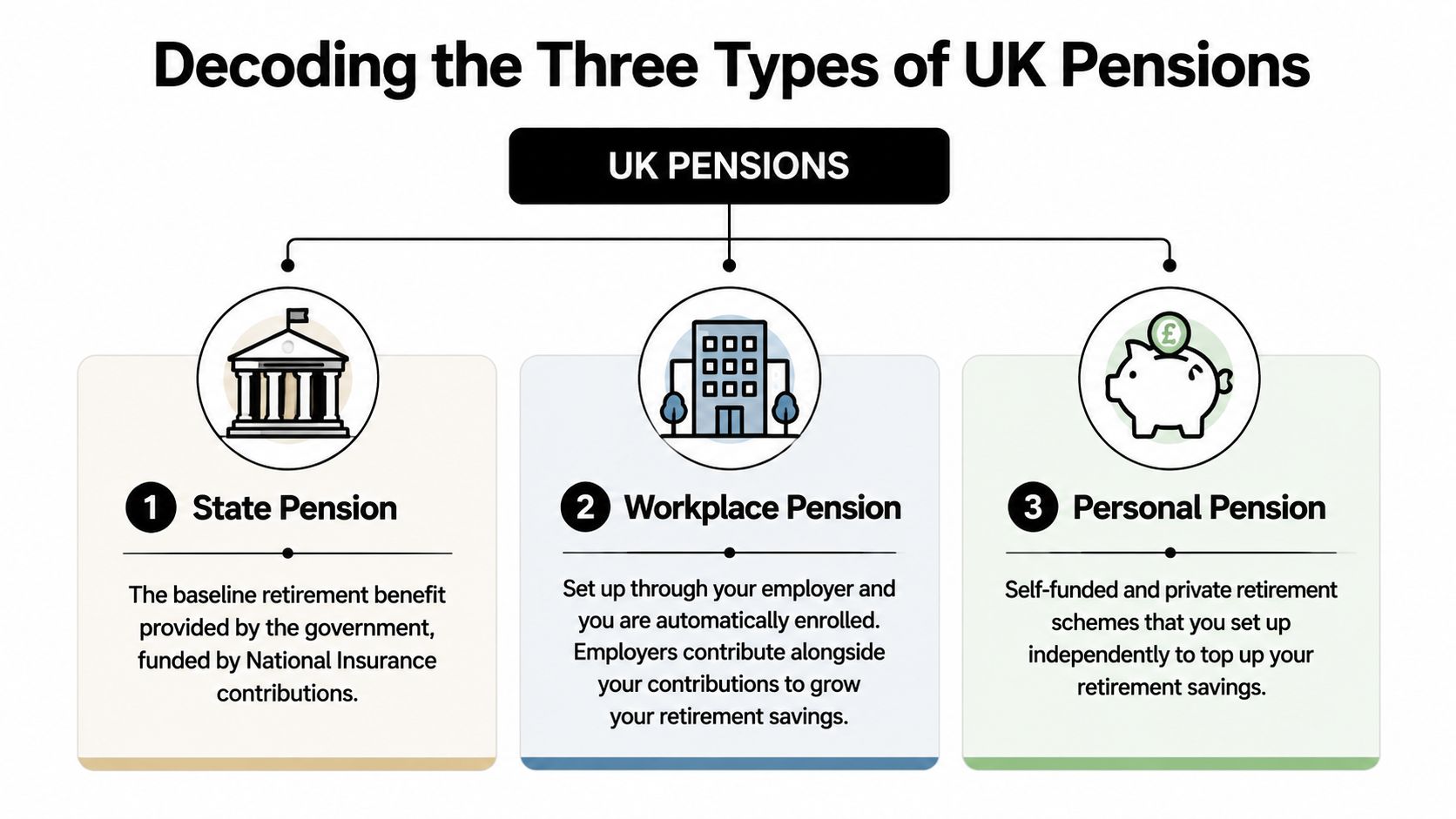
The phrase average uk pension makes more sense once you split it into the three pension types that exist in practice.
State Pension
The State Pension is paid by the government and is based on your National Insurance record. It's the starting point for many retirement plans, especially if your work history has included employed contracts, umbrella arrangements, or years of self-employment with qualifying contributions.
According to the DWP benefit statistics for February 2026, covering August 2025 data, 13.2 million people were receiving the State Pension, the mean weekly payment was £210.73, the new State Pension averaged £216.46 per week, and the pre-2016 system averaged £207.20 per week. The same government release says the standard State Pension age has been 66 since October 2020, with a further rise beginning from 2026.
For a contractor, the key point is simple. You don't build State Pension entitlement by accident. You need to keep an eye on your qualifying record over time.
Workplace pensions
A workplace pension is usually arranged through an employer. In a standard permanent role, that often means automatic enrolment and regular contributions through payroll.
Contractors can still access this kind of pension in some circumstances, especially when working through an umbrella company that employs them for payroll purposes. In that setup, pension deductions may appear on the payslip in the same way they would for another employee.
A workplace pension can be useful because contributions happen automatically. That reduces the temptation to delay saving when cash flow feels tight.
Personal pensions
A personal pension is one you arrange yourself. This can suit freelancers, limited company contractors, or anyone who wants more direct control over pension saving.
Common reasons people use a personal pension include:
- Irregular earnings, where fixed monthly habits don't always fit
- Old pension consolidation, so it's easier to track what you've built
- Extra saving on top of workplace contributions, particularly in stronger earning years
The average uk pension isn't one pot. It's a layered system, and each layer works differently depending on how you contract.
How Pension Averages Vary by Age
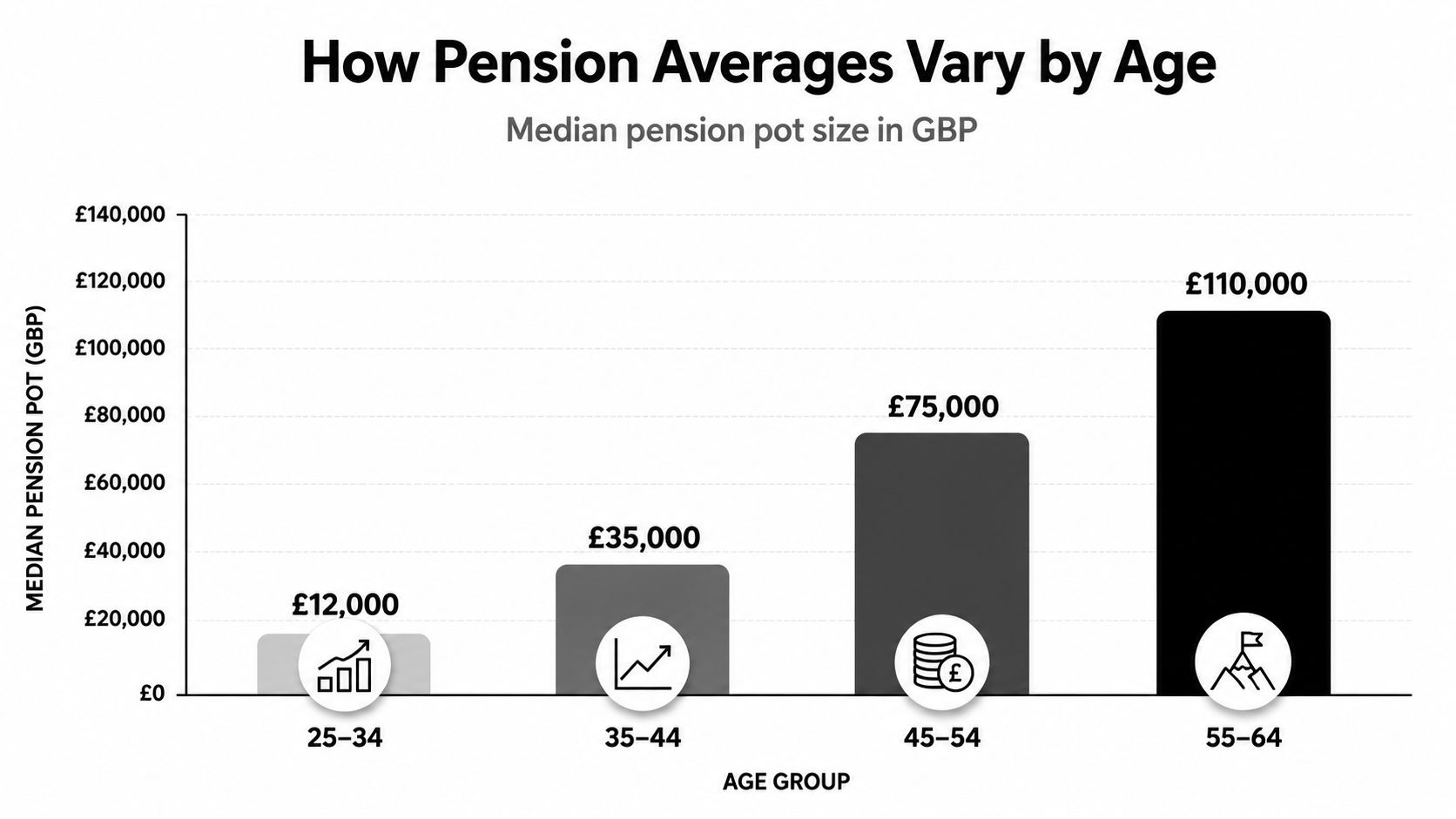
Many individuals do not realise how significantly age changes the picture. A pension pot that looks low for someone near retirement might be perfectly normal for someone early in their career.
What the age data shows
Figures cited by Standard Life from ONS-linked data show median pension wealth of £18,800 for ages 25 to 34, £39,500 for 35 to 44, £80,000 for 45 to 54, £137,800 for 55 to 64, and £145,900 for 65 to 74, as set out in Standard Life's pension wealth guide.
That pattern tells you two things.
First, pensions usually build slowly for years and then rise more sharply in mid-career. Second, comparing yourself with the wrong age group can create false panic.
How to use the numbers properly
If you're in your thirties, don't compare your pension with someone in their sixties. Compare your progress with people at a similar life stage.
A contractor's path can look less tidy than these age bands suggest. You may have periods of strong saving during well-paid contracts, then gaps when work changes, rates drop, or you move between payroll models.
A useful cross-check is to compare pension saving habits with broader long-term wealth habits. If you're interested in that wider benchmark, this Top Wealth Guide 401k guide offers a helpful age-based comparison from a different retirement system. The structure is different from the UK, but the idea of benchmarking by age rather than against one national average is still useful.
Consistency matters more than perfection. Small breaks in saving are common for contractors, but long stretches of doing nothing are what usually create the real problem.
The Contractor's Reality Pensions IR35 and Umbrella Companies
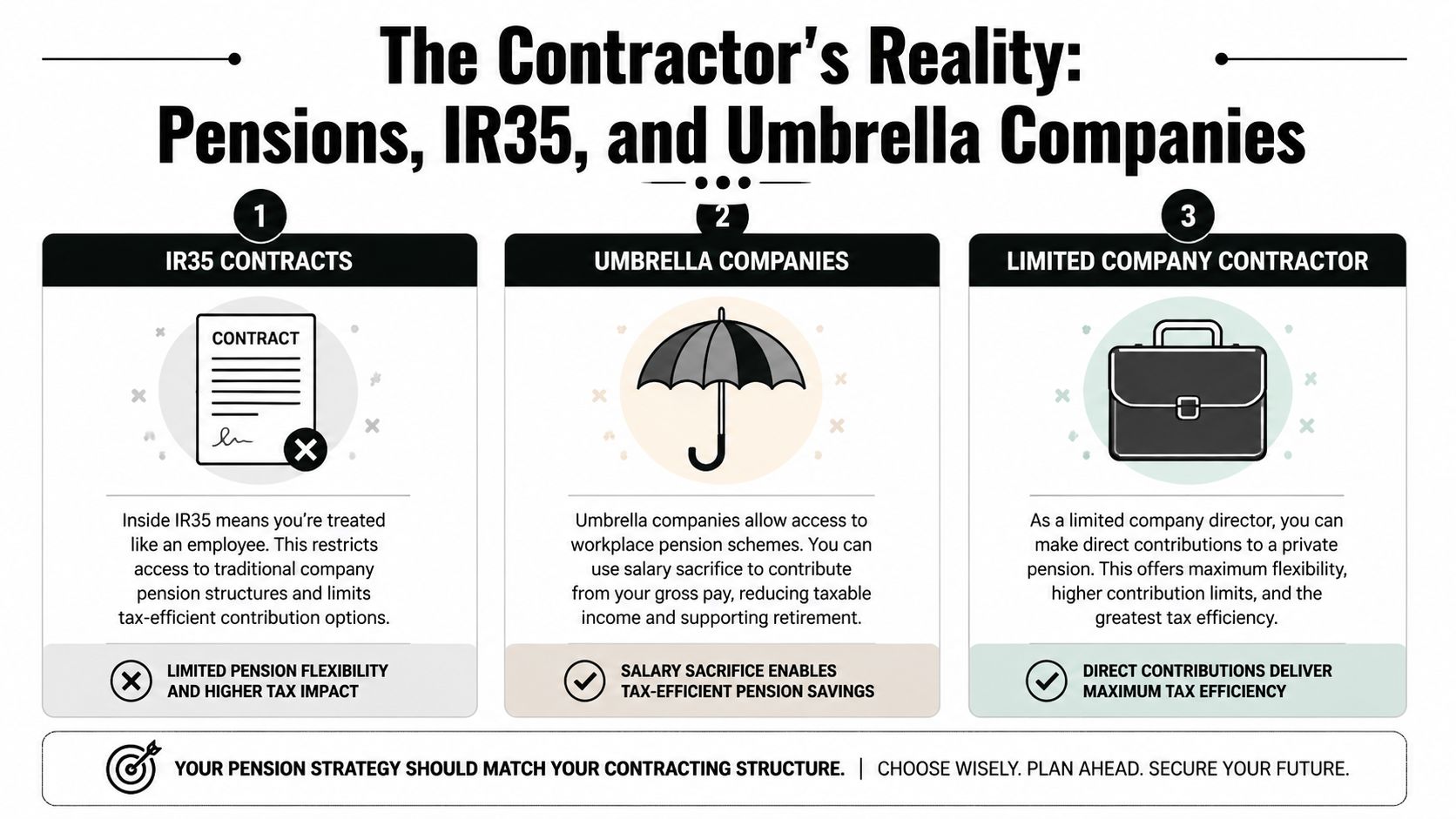
Generic pension advice often falls short for this reason. Contractors don't all save in the same way, because the way you're paid shapes the pension routes available to you.
Why contractors often fall behind
Many permanent employees save into a pension without having to think much about it. Contributions run through payroll. The scheme is already there. The process is automatic.
Contractors often need to make more active decisions. If you move between clients, payroll arrangements, and employment statuses, pension contributions can easily become inconsistent. That's one reason averages don't always help. They reflect many people with years of contribution continuity, while contractors may have had more stop-start patterns.
The issue isn't only motivation. It's structure.
Inside IR35 and umbrella working
If you're working inside IR35, your income is typically handled more like employment income for tax purposes. In practice, many contractors in this position work through an umbrella company.
That can make pension saving simpler than people expect, because an umbrella arrangement may include access to a workplace pension and salary sacrifice options, depending on how the provider operates. If you're trying to understand how these arrangements fit together, our guide to IR35 and umbrella companies explains the mechanics in plain English.
A sensible first check is your payslip and employment paperwork. Look for:
- Whether you're enrolled into a workplace pension
- How contributions appear on the payslip
- Whether salary sacrifice is available
- What happens to contributions if you leave one assignment and start another
Later in the process, many contractors also compare providers by pension features, payroll clarity, and compliance support. Umbrella Company is one option that lets contractors compare umbrella companies based on their role and circumstances, including inside IR35 working and umbrella employment arrangements.
This short video gives a useful overview of the contractor context before you choose a setup.
Outside IR35 and limited company planning
If you're outside IR35 and operating through your own limited company, your pension planning usually becomes more hands-on. You have more control, but you also carry more responsibility.
In broad terms, contractors outside IR35 often think about pensions as part of company-level planning, while contractors inside IR35 often deal with pensions through payroll. The right route depends on how you're engaged and how stable your contract income is.
What tends to help most is a repeatable process:
- Check your current working status, because pension options differ by setup.
- Review every active pension arrangement, including old workplace pots.
- Pick one main saving method, so contributions don't become random.
- Revisit the plan when contracts change, especially after a move inside or outside IR35.
A contractor who changes structure without changing their pension plan often ends up with gaps they didn't notice at the time.
Are You on Track? Practical Benchmarks and Tools
Averages become useful only when you turn them into an income estimate.
One practical benchmark comes from retirement pot data cited by PensionBee. A median pension pot of £152,000 at ages 60 to 65 would generate roughly £6,080 a year using a 4% withdrawal rate, and when that is added to the 2026 full new State Pension of £12,548 a year, the combined annual retirement income comes to about £18,628, according to PensionBee's UK pension statistics dashboard.
What that means in plain language
That figure helps because it turns a pension pot into something easier to picture, monthly or annual income.
It also shows why many contractors need to check progress sooner rather than later. A pot that sounds substantial can still produce a retirement income that's lower than expected once you translate it into annual spending power.
Simple ways to sense-check your position
You don't need a perfect forecast to get started. You need a rough but honest view of where you are now.
Try this checklist:
- Estimate your likely State Pension base, based on your National Insurance record and employment history
- Add up all private and workplace pension pots, including small legacy schemes
- Translate the total into income, not just a lump sum
- Stress-test your saving pattern, asking whether it still works when contracts pause
If you'd like a broader milestone check for earlier-stage saving, this guide from Fintrack can help you understand your savings milestone. It isn't a pension-specific UK benchmark, but it's a useful way to think about whether your overall long-term saving habit is developing in the right direction.
For contractors, it also helps to review take-home pay alongside pension contributions. Our payroll calculator and take-home pay tool can help you see how pension saving fits with day-to-day cash flow before you commit to a contribution level.
Your Next Steps to Boost Your Contractor Pension
The average uk pension can give you context, but it won't build your retirement for you. Your own plan matters more than any headline figure.
For contractors and freelancers, the main risk isn't just saving too little. It's letting pension decisions drift while your contract setup changes around you. A good pension plan should still make sense when rates fluctuate, assignments end, or your IR35 position shifts.
A practical contractor checklist
- Check your State Pension record: Make sure gaps in qualifying years don't surprise you later.
- Review every pension pot you already have: Old workplace schemes are easy to forget when you've changed contracts several times.
- Match your pension method to your work model: Inside IR35, outside IR35, umbrella working, and limited company contracting can all call for a different approach.
- Use stronger earning periods well: Contractors often have lumpy income, so good months can do a lot of the heavy lifting.
- Keep pension planning connected to tax planning: If you change how you pay yourself, revisit your pension strategy at the same time. Our guide to the tax-efficient way to pay yourself in the UK is a useful starting point.
Some contractors also review retirement plans alongside wider life goals, such as relocation, property, or stepping away from UK work later on. If that applies to you, this 2026 UK property investor guide is worth reading for the broader planning angles involved.
The key takeaway is simple. Don't ask only whether your pension is average. Ask whether it's heading towards the life you want.
If you're weighing up umbrella working and want a clearer view of how pension options fit with your contract setup, Umbrella Company helps you compare umbrella companies based on your role, pay arrangement, and inside IR35 needs.


