


Let's talk numbers. What does a typical engineer earn in the UK? The headline figure often quoted is around £64,869 a year, which sounds pretty healthy. And it is, it shows just how much demand there is for skilled technical minds.
But that single number does not tell the whole story. It is an average, and your reality could be quite different depending on your specialism, where you are in the country, and how many years you have got under your belt. For instance, a seasoned professional in the oil and gas sector can easily be looking at salaries north of £80,000.
This guide will explain the key factors that influence an engineer's salary, how to calculate a competitive contractor day rate, and what you can expect to earn at different stages of your career.
Your Guide to UK Engineer Salaries

Whether you're a permanent employee wondering if your pay is fair, or a contractor trying to set a competitive day rate, you must start with a solid understanding of the market. This guide is here to give you that practical, real-world overview of what engineers are actually earning today.
Here at UmbrellaCompany.com, we see contracts and pay rates every day. We know your value is not just one number. We will break down what you need to know, including:
- The going rates for different engineering specialisms.
- How much your experience and qualifications can add to your pay packet.
- The salary hotspots across the UK.
- The all-important calculation: turning a permanent salary into a contractor's day rate.
Getting this right is crucial. It is the key to walking into a negotiation with confidence and making sure you are properly rewarded for your expertise.
To get a clearer picture of what engineers are earning, it is helpful to look at the salaries being offered across various sectors and regions. The following table provides a snapshot of the mean average salaries you can expect in high-demand fields and key UK locations.
UK Average Engineer Salaries by Sector and Region 2026
| Sector / Region | Mean Average Salary |
|---|---|
| Oil and Gas | £81,559 |
| Energy/Renewables/Nuclear | £66,193 |
| Aerospace | £62,112 |
| Automotive | £59,875 |
| London | £71,500 |
| Scotland (incl. Aberdeen) | £68,200 |
| South East England | £65,100 |
| North West England | £58,900 |
These figures give you a solid baseline, whether you are benchmarking your permanent role or calculating a competitive day rate for your next contract.
Sector Specific Salary Benchmarks
It is no secret that some engineering fields pay better than others. Specialising in a high-demand sector can give your earnings a serious boost. For a bit of perspective, the 2024 survey from The Engineer magazine puts the mean average salary for professional engineers at that £64,869 figure. That is more than double the national average wage, which really drives home the value of engineering skills. If you want to dig deeper, you can explore the salaries of UK engineers.
For contractors, this is gold dust. Your day rate is directly tied to what permanent staff in your niche are earning. A quick look at the breakdown shows a clear pecking order:
- Oil and Gas: Still top of the pile, with senior roles averaging a massive £81,559.
- Energy/Renewables/Nuclear: Not far behind at £66,193, thanks to the huge push towards green energy.
It just goes to show, picking your specialism wisely can make a huge difference to your bottom line.
The Importance of Location and Experience
Of course, it is not just what you do, but where you do it and for how long you have been doing it. Your postcode and the letters after your name can have a massive impact on your earnings.
Big hubs like London and Aberdeen will almost always offer higher salaries. Part of that is to cover the higher cost of living, but it is also because that is where the big-money projects are, and they need the best talent.
On the experience side, getting your chartered engineer status (CEng) is a huge milestone. It is a rubber stamp on your competence and professionalism, and it almost always comes with a pay bump. As you climb the ladder from a fresh-faced graduate to a senior or principal engineer, your salary expectations should rise in step with your experience and the value you bring. This career progression is the bedrock for setting a powerful day rate when you make the leap into contracting.
Turning a Permanent Salary into a Contractor Day Rate

One of the most common questions we hear is, "How do I figure out my day rate?" It is the first real hurdle when you are thinking about making the leap into contracting. A lot of engineers make the mistake of just dividing a permanent salary by the number of working days in a year. Unfortunately, that simple maths could leave you seriously short-changed.
A contractor's day rate has to be higher than what a permanent employee earns per day. This is not about being greedy, it is about covering all the costs and benefits that an employer would normally handle for you. This crucial buffer is often called the 'uplift'.
What Is The Uplift and Why Does It Matter?
Think of the uplift as your personal safety net. It is the extra bit you add to your rate to replace the security and perks that come with a permanent job. Without it, you are effectively taking a pay cut once you factor in all the hidden costs of contracting.
Your day rate needs to cover things a permanent salary automatically includes:
- Holiday Pay: Contractors do not get paid for bank holidays or their annual leave. You have to build that cost into your rate.
- Sick Pay: If you are too ill to work, there is no sick pay from the client. Your rate needs to cover those rainy days.
- Employer's National Insurance: When you work through an umbrella company, your rate must cover Employer's NI contributions, which stand at 13.8%.
- Pension Contributions: You are in charge of your own pension pot now, so you need to fund it yourself.
- Time Between Contracts: It is rare to go from one contract straight into the next. Your rate needs to sustain you during those non-billable periods.
A good rule of thumb is to add an uplift of 20-30% to the equivalent permanent salary. This ensures you have enough to cover all your employment costs while maintaining a similar income.
A Real-World Example Calculation
Let's walk through an example to make this crystal clear. Imagine an engineer named Alex has been offered a permanent role with a £65,000 salary. To figure out a competitive day rate for a similar contracting role, Alex needs to do more than just divide by 365.
First, you have to work out how many days you can actually bill for in a year.
- Start with total weekdays: There are around 260 weekdays in a year (52 weeks x 5 days).
- Subtract non-billable time:
- Annual Leave: Let's budget for 25 days.
- Bank Holidays: There are typically 8 in England and Wales.
- Sick Days: It is sensible to plan for at least 5 days off.
- Training/Admin: Set aside another 5 days for professional development.
After subtracting all this time off, Alex is left with 217 billable days (260 – 25 – 8 – 5 – 5). Now we can start building the rate.
Building Your Day Rate Step-by-Step
Using Alex's £65,000 target salary and 217 billable days, we can calculate a rate that is both fair and realistic for the world of contracting.
Here is the simple formula:
- Add the Uplift: First, increase the permanent salary to cover all those extra costs. Let’s add a 25% uplift to the £65,000 salary.
- £65,000 x 1.25 = £81,250
- Calculate the Day Rate: Now, just divide this new annual figure by your billable days.
- £81,250 / 217 days = £374.42 per day
So, a fair and competitive day rate for Alex would be around £375 per day. This figure ensures they can cover taxes, save for retirement, take well-earned holidays, and still bring home an income comparable to their permanent colleagues.
If you need more guidance, you can learn more about converting a day rate to a salary in our detailed article. Getting this calculation right empowers you to negotiate your next contract from a position of strength, confident that your rate truly reflects your value and the realities of freelance life.
Diving Into Specialist Engineering Fields
While general engineering roles pay well, the real money is often in a specialism. Getting laser-focused on a high-demand niche can give your earning potential a serious leg up, especially in fast-moving tech sectors.
For contractors, this is where the game really changes. Deep expertise does not just make you more hireable; it turns you into a premium asset. Clients will happily pay top-tier day rates for an expert who can parachute in and solve a complex problem that a generalist would struggle with.
The Soaring Demand for Data Engineers
Right now, one of the most profitable specialisms is Data Engineering. As every business under the sun rushes to make data-driven decisions, the people who build and manage the plumbing for all that information have become indispensable.
These are the engineers who construct the "pipelines" that ferry massive amounts of data around, getting it into a state where it can be properly analysed. It is a crucial job that blends software engineering know-how with database management and a firm grasp of big data tech. That unique mix of skills is hard to find, and as any contractor knows, scarcity drives up rates.
You can see this demand reflected clearly in the market. The median salary for UK Data Engineers is currently sitting at a very healthy £70,000 per year, based on vacancies advertised in the six months to 24 February 2026. That is a 7.69% jump from the year before, which tells you just how quickly the demand is growing. If you are a contractor, particularly working inside IR35, that figure is a fantastic benchmark for what you should be charging. You can dig deeper into the numbers yourself by checking out the Data Engineer salary trends on IT Jobs Watch.
Why Niche Skills Mean Bigger Pay Cheques
Specialist roles in fields like Data Engineering, Biomedical Engineering, or AI and Machine Learning consistently attract higher pay for a few straightforward reasons:
- Skill Scarcity: There simply are not enough people with the right expertise to go around. That creates a fiercely competitive market for talent.
- Business Impact: These roles are often tied directly to a company's bottom line, whether through innovation or efficiency. They are not just a cost; they are an investment.
- Constant Learning: Specialists have to stay on their toes, constantly updating their skills. Employers know this and are willing to pay a premium for that dedication.
For a contractor, all this adds up to a much stronger negotiating position. When you have skills that are both in high demand and short supply, you can confidently set a day rate that is well above the market average.
Specialising is what takes you from being a commodity, just another pair of hands, to being a critical asset. That shift in perception is the key to maximising your income as a contractor, because clients pay for unique value, not just manpower.
How Location Affects Specialist Pay
Just like with general engineering roles, your postcode has a big impact on what specialists can earn. A Data Engineer based in London, with its concentration of finance and tech giants, will almost certainly earn more than one in Manchester or Glasgow.
That said, the gap can sometimes be narrower for these highly specialised roles. If a company in a smaller city desperately needs a specific skillset, they might have to offer a premium rate to lure talent away from the major hubs.
This creates some interesting strategic opportunities for contractors. By keeping an eye on job markets outside the usual hotspots, you can sometimes find incredibly lucrative contracts where your skills are in exceptionally high demand. A bit of flexibility on location can unlock earning potential you might otherwise miss out on. Understanding these regional quirks is a massive advantage when you are hunting for the most profitable contracts in the UK.
How to Figure Out Your Take-Home Pay as a Contractor
Seeing a juicy day rate on a contract offer is a great feeling. But as any experienced contractor knows, that headline number is not what you can actually spend. What really counts is your net pay, the money that lands in your bank account after everyone has taken their slice.
If you are new to contracting, an umbrella company payslip can look a bit baffling at first. Do not worry, we are here to demystify it. This section will walk you through a sample calculation, line by line, so you can see exactly where your hard-earned cash goes. It is all about giving you clarity so you can budget with confidence.
This flow shows how specialist skills, high demand, and the right location all feed into a healthier pay packet.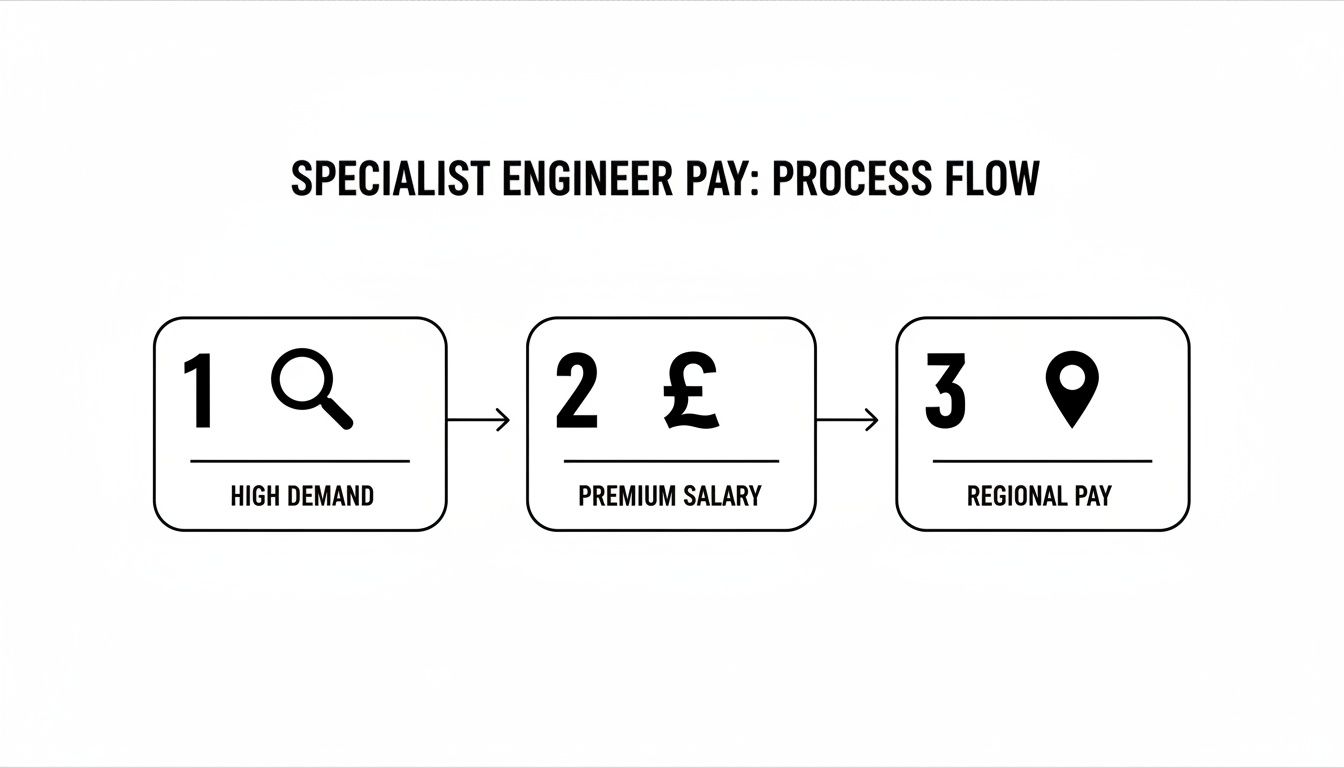
The main takeaway here is simple: pairing in-demand expertise with the right location is a direct route to boosting your average engineer salary.
Understanding the Key Deductions
When you join a compliant umbrella company, you effectively become their employee for tax purposes. This means they are legally on the hook for deducting tax and National Insurance from your earnings via the PAYE (Pay As You Earn) system, just like any permanent employee.
These are not random fees, they are your contributions to public services and state benefits. Here are the main items you will see on your payslip:
- Income Tax: Worked out based on your personal tax code and your earnings.
- Employee’s National Insurance: This is your personal contribution towards things like the State Pension.
- Employer’s National Insurance: A standard cost of employment that is covered by the assignment rate paid by the agency.
- Apprenticeship Levy: A UK-wide tax on employers that helps fund apprenticeship schemes.
- Umbrella Company Margin: The small, fixed fee the umbrella company charges for running your payroll and handling the admin.
It is really important to get your head around this: Employer’s NI and the Apprenticeship Levy are statutory employment costs. Any compliant umbrella has to deduct these from the total funds they receive from your agency before they calculate your personal gross pay. This is completely normal and above board.
A Sample Take-Home Pay Calculation
Right, let's make this real with an example. Imagine an engineer has just landed a contract at £400 per day. They work a five-day week, so the total weekly contract value is £2,000.
Here is a simplified breakdown of how that £2,000 gets processed down to the final take-home figure. Bear in mind these are just for illustration, your exact numbers will depend on your own tax code and circumstances.
A quick word of warning: A proper, compliant umbrella company will always give you a full payslip showing every single deduction. If a provider is cagey with the details or promises a take-home pay that seems too good to be true, it is a massive red flag for a tax avoidance scheme. Run a mile.
Okay, let's crunch the numbers.
Sample Take-Home Pay Calculation for an Engineer Contractor
This table breaks down how a £400 day rate becomes your final net pay for a week's work.
| Item | Calculation Example (£) | Description |
|---|---|---|
| Contract Value | £2,000.00 | The gross amount paid by the agency for one week's work (£400/day x 5 days). |
| Umbrella Margin | – £25.00 | The umbrella company's fixed fee for their payroll and administrative services. |
| Employment Costs | – £230.12 | Includes Employer’s National Insurance (13.8%) and the Apprenticeship Levy (0.5%). |
| Gross Pay (for tax) | £1,744.88 | The amount your personal taxes are calculated on, after employment costs are deducted. |
| Employee's Income Tax (PAYE) | – £358.98 | Deducted based on a standard tax code (e.g., 1257L). |
| Employee's NI Contribution | – £131.39 | Your personal National Insurance contribution. |
| Net Pay (Take-Home Pay) | £1,254.51 | The final amount transferred to your personal bank account. |
As you can see, the journey from a gross day rate to your actual take-home pay involves a few essential steps. While it might feel like a lot is being taken out, this whole process ensures you are fully compliant with HMRC and all your tax obligations are being handled correctly for you.
Getting to grips with these calculations brings financial clarity and, most importantly, peace of mind. For a more personalised estimate, you can use our online tool to see what you could be taking home. Have a look at our detailed guide and payroll calculator for take-home pay to get started.
Earning Potential for Graduate and Early-Career Engineers
Kicking off your engineering career is a huge achievement, and getting a clear picture of what you can earn is a smart first move. The great news for graduates is that engineering rewards you right from the start, offering a solid financial launchpad straight out of university.
Understanding the typical starting salary is crucial. It gives you a benchmark for your first job offer and helps you figure out if an early jump into contracting makes sense. While pay varies by discipline and location, the baseline is encouraging. This knowledge arms you with the confidence to negotiate your worth and plan your financial future.
What Is a Typical Starting Salary?
Graduate engineers in the UK start on a pretty solid footing. The data shows that average starting salaries for engineering and technology graduates are between £29,500 and £30,998 just fifteen months after finishing their degrees. This provides a strong financial base, whether you are eyeing up a permanent role or your first contract.
Certain specialisms can command even more. For example, electrical and electronic engineering graduates can pull in starting salaries around £36,115, which just goes to show how much demand there is for specific skill sets. You can dig into more detailed figures over on the average graduate salary in the UK on Standout-CV.
These are not just numbers on a page. They represent the high value the industry places on fresh talent and give you a fantastic springboard for a rewarding career.
Career and Salary Progression in Your First Few Years
Your first few years as an engineer are all about growth, in your skills and your bank balance. That initial salary is exactly that: a start. With every year of experience, you become more valuable, and your pay cheque should absolutely reflect that.
Your career progression is not just about putting in the hours. It is about actively pursuing chartership, taking on more complex projects, and proving your growing expertise. This is what separates a graduate from a senior pro with a much higher earning potential.
Typically, you can expect a steady climb in your salary as you move from an entry-level position to a mid-career role. This journey is your path to a higher average engineer salary and, eventually, a top-tier contractor day rate. If you are thinking about making that switch, our guide on how to become a contractor in the UK is a fantastic roadmap.
Contracting Early in Your Career
While many engineers wait until they have got a few years under their belt, contracting is a real option even in your early career, as long as you have skills that are in demand. It can offer more flexibility, a wider range of project experience, and often, higher earnings.
If you decide to go for it, make sure you start on the right foot:
- Negotiate a Fair Rate: Use those graduate salary benchmarks to work out a fair starting day rate. Just remember to add the uplift to cover things like holiday pay and employer's National Insurance.
- Build Your Network: Get out there and connect with recruiters and other professionals in your field. It is the best way to hear about new opportunities.
- Partner with a Compliant Umbrella Company: From day one, working with a trusted, accredited umbrella company ensures your payroll is handled correctly. It keeps you compliant with HMRC and leaves you free to focus on the actual work.
How to Negotiate a Higher Day Rate
Landing a great contract is one thing, but the rate negotiation is where you really cement your worth. It is a part of the process that makes many contractors a bit squeamish, but it does not have to be. With the right preparation, you can walk into that conversation confidently and secure the pay you deserve. Think of it as a skill, the more you do it, the better you get.
The trick is to reframe it. Negotiation is not a battle; it is a calm, professional discussion about value. You are a specialist bringing a sought-after service, and your day rate needs to reflect that expertise. The aim is to find a fair price for your skills that leaves the client feeling they got great value and you feeling properly rewarded.
Do Your Homework First
Never, ever walk into a rate discussion unprepared. That is the surest way to end up accepting a lowball offer. Your most powerful tool here is hard data, and you have already got a great starting point from the salary figures we have covered in this guide.
Use that market information to build a solid case for your rate. Pinpoint the average engineer salary for your specific role, experience level, and region. Use that as your baseline, then calculate a competitive day rate, remembering to add that crucial 20-30% uplift to cover the costs of being a contractor. For a more tailored figure, our contractor rate calculator can give you a personalised estimate.
Articulate Your Unique Value
A client is not just hiring an engineer; they are hiring you. Your day rate is not just a number pulled from a spreadsheet; it is a reflection of the unique value you bring that often does not show up on a CV.
So, what makes you stand out from the crowd?
- Soft Skills: Are you a brilliant communicator who can keep difficult stakeholders happy? Or perhaps you are great at mentoring junior team members?
- Industry Experience: Do you have years of deep-seated knowledge in a niche sector the client operates in?
- Problem-Solving: Can you recall specific times you went the extra mile to fix a critical issue on a past project?
Weave these points into the conversation. For instance, you could say something like, "My rate reflects not just my technical skills in X, but my decade of experience in the energy sector, which means I can get up to speed and start adding value from day one." This frames your rate as an investment in a successful project, not just a line-item cost.
Confidence is your most powerful negotiation tool. When you know your market value and can clearly explain the unique benefits you offer, you shift the dynamic from simply discussing price to demonstrating your professional worth.
Handling the Conversation and Counter-Offers
Timing is everything. The ideal moment to negotiate is after you have received a firm offer but before you have signed anything. At this point, the client has already decided they want you on board, which gives you the most leverage.
When you state your desired rate, do it clearly and without hesitation. If they come back with a lower counter-offer, do not panic, this is a completely normal part of the dance. Ask them to explain the thinking behind their figure and be ready to calmly restate your case, referencing your market research and unique skills.
If they will not budge on the rate, you can explore other possibilities. Could you negotiate a shorter notice period? Or perhaps a commitment to a contract extension? By staying professional and prepared, you put yourself in the best possible position to reach an agreement that works for everyone.
Common Questions About Engineer Contractor Pay
We often field questions from engineering contractors about everything from day rates to how umbrella companies actually work. It is a bit of a minefield if you are new to it. To give you some clarity and confidence, here are our answers to the questions that pop up most often.
How Much More Should a Contractor Earn Than a Permanent Employee?
A good rule of thumb is to aim for a day rate that is 20-30% higher than the equivalent permanent salary. That uplift is not just extra cash in your pocket; it is there to cover all the things an employer would normally pay for. Think of it as your safety net.
This extra buffer is essential for covering:
- Holiday and sick days, because when you do not work, you do not get paid.
- Your own pension contributions.
- Employer’s National Insurance, a cost you now have to shoulder.
Factoring this in from the start means your take-home pay is genuinely comparable to your permie counterparts once you account for those crucial benefits.
How Does IR35 Affect My Take-Home Pay?
IR35 is a huge deal for your finances. If your contract is deemed 'inside IR35', it essentially means you are treated as an employee for tax purposes. Your income will be subject to the usual PAYE tax and National Insurance deductions, just like any other salaried staff member.
For any contract that falls inside IR35, working through a compliant umbrella company is by far the simplest way forward. They handle all the deductions correctly, making sure you stay on the right side of HMRC’s rules without any of the headache.
Which Engineering Sector Pays the Highest Salary?
Right now, the big money is in highly specialised fields where demand outstrips supply. For instance, seasoned engineers in the Oil & Gas sector can often command salaries pushing past £80,000, reflecting the niche skills needed for those roles.
It is a similar story in booming areas like Data Engineering, where median salaries are already hitting the £70,000 mark and top talent earns much more. Of course, traditional disciplines like Aerospace and Chemical engineering still pay very well, especially for chartered engineers with a wealth of experience.
Choosing an umbrella company is not just about the weekly margin. The single most important factor is compliance. Partnering with a non-compliant provider could leave you exposed to a world of financial risk and nasty future tax bills from HMRC.
How Do I Choose a Good Umbrella Company?
To make sure your money is in safe hands, always look for providers with accreditations from independent professional bodies like the FCSA (The Freelancer & Contractor Services Association) or Professional Passport. These badges are a clear sign of reliability and compliance. They prove the company has been properly audited and meets the highest industry standards.
At UmbrellaCompany.com, we only list accredited and trusted providers. Our comparison service makes it easy for you to find a compliant partner that fits your specific needs as an engineering contractor.


