


You've accepted a contract, but the agency says the role is inside IR35 and wants you to choose an umbrella company before you can start. The assignment rate looks attractive, yet the amount reaching your bank account appears much lower once employer costs, PAYE, National Insurance and the umbrella margin are accounted for. You may be wondering whether an umbrella is a sensible solution or an expensive payroll wrapper.
The answer depends on your IR35 position, assignment rate, contract length, appetite for administration and confidence in the supply chain. An umbrella can make a short assignment straightforward and compliant, but it usually won't produce the same take-home pay or flexibility as an outside-IR35 limited company arrangement.
Introduction Are Umbrella Companies Worth It for You
The question “are umbrella companies worth it?” has no universal answer. For a contractor accepting a brief inside-IR35 engagement, an umbrella may be the most practical route. For an established specialist with several outside-IR35 clients, a personal service company, or PSC, may offer more control. Agency PAYE can also suit someone who wants employment without choosing a separate umbrella provider.
We'll explain how umbrella employment works, why the assignment rate isn't the same as your salary, and which deductions affect your final pay. We'll also compare umbrellas with PSCs and agency PAYE, then look at realistic contractor situations rather than treating every worker as if they has the same priorities.
The UK market has increasingly used umbrellas for inside-IR35 work. Following the private-sector reforms, IPSE reported that 34% of contractors who remained in contracting worked through umbrella companies and 36% were in engagements deemed inside IR35. Its follow-up found that 27% were still operating through an umbrella company, showing that umbrella employment became a lasting part of the contracting market rather than a short-lived response.
That growth doesn't mean umbrellas are automatically good value. The same IPSE research found that 80% of contractors inside IR35 reported a drop of up to 30% in quarterly earnings, while 25% reported a drop of more than 40%. Those figures help explain the trade-off: you may gain payroll simplicity and access to assignments, but you can lose net income and some commercial flexibility.
The practical question: what are you paying for, what risks are being managed, and what amount will actually reach your bank account?
How Umbrella Companies Work in Practice
An umbrella company acts as a payroll bridge between you and the recruitment agency or end client. You perform the work for the client, but the umbrella usually employs you, receives funds through the supply chain, processes payroll and pays your wages.
The arrangement normally works like this:
- You accept an assignment. The agency or client confirms the role, rate, dates and working arrangements.
- The umbrella employs you. You sign an employment contract and provide the information needed for payroll.
- The agency pays the umbrella. The payment reflects the agreed assignment rate, not necessarily your gross salary.
- The umbrella calculates employment costs. It accounts for employer National Insurance and other costs before calculating your taxable pay.
- PAYE payroll produces your payslip. Income Tax and employee National Insurance are deducted before the net amount reaches you.
The important distinction is between the assignment rate and your gross pay. The assignment rate funds the cost of employing you. It may need to cover the umbrella's margin, employer National Insurance, apprenticeship levy where applicable, holiday pay arrangements and your gross taxable earnings.
Under HMRC's PAYE rules for labour supply chains involving umbrella companies, the umbrella must operate PAYE, deduct employee Income Tax and employee National Insurance, and account for employer National Insurance. The employer National Insurance cost is economically taken from the assignment rate before net pay is calculated, which is why an umbrella comparison generally produces a lower take-home figure than a comparable outside-IR35 PSC structure.
For a straightforward explanation of the contractual and payroll relationships, see how an umbrella company works. A useful mental model is to separate the process into two stages: the assignment rate pays for the employment arrangement, then PAYE deductions apply to your taxable earnings.
The payslip should show enough information for you to follow the calculation. Don't rely only on a headline weekly or daily rate. Ask for a pay illustration that starts with the assignment rate and shows each cost and deduction until it reaches your expected net pay.
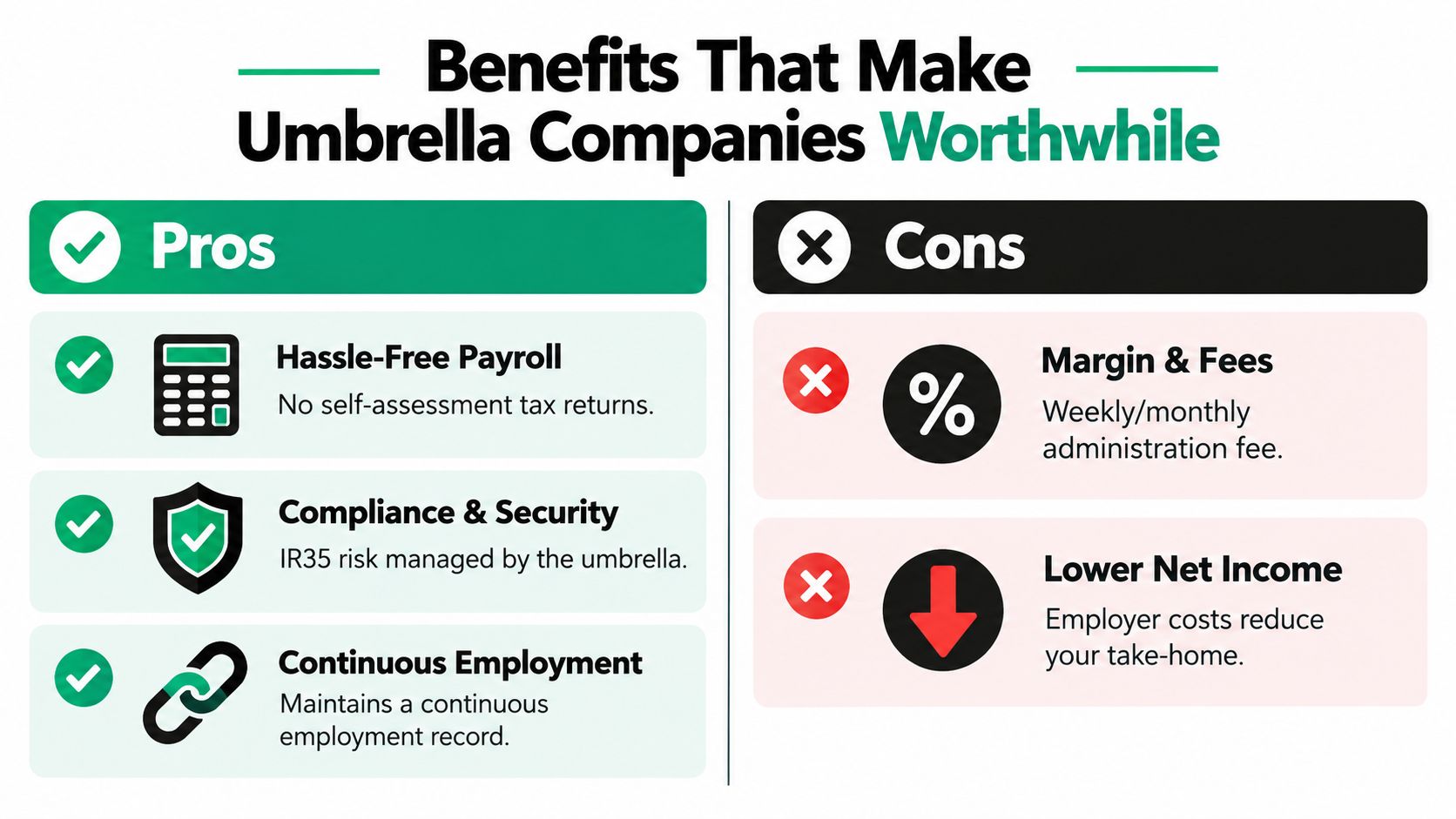
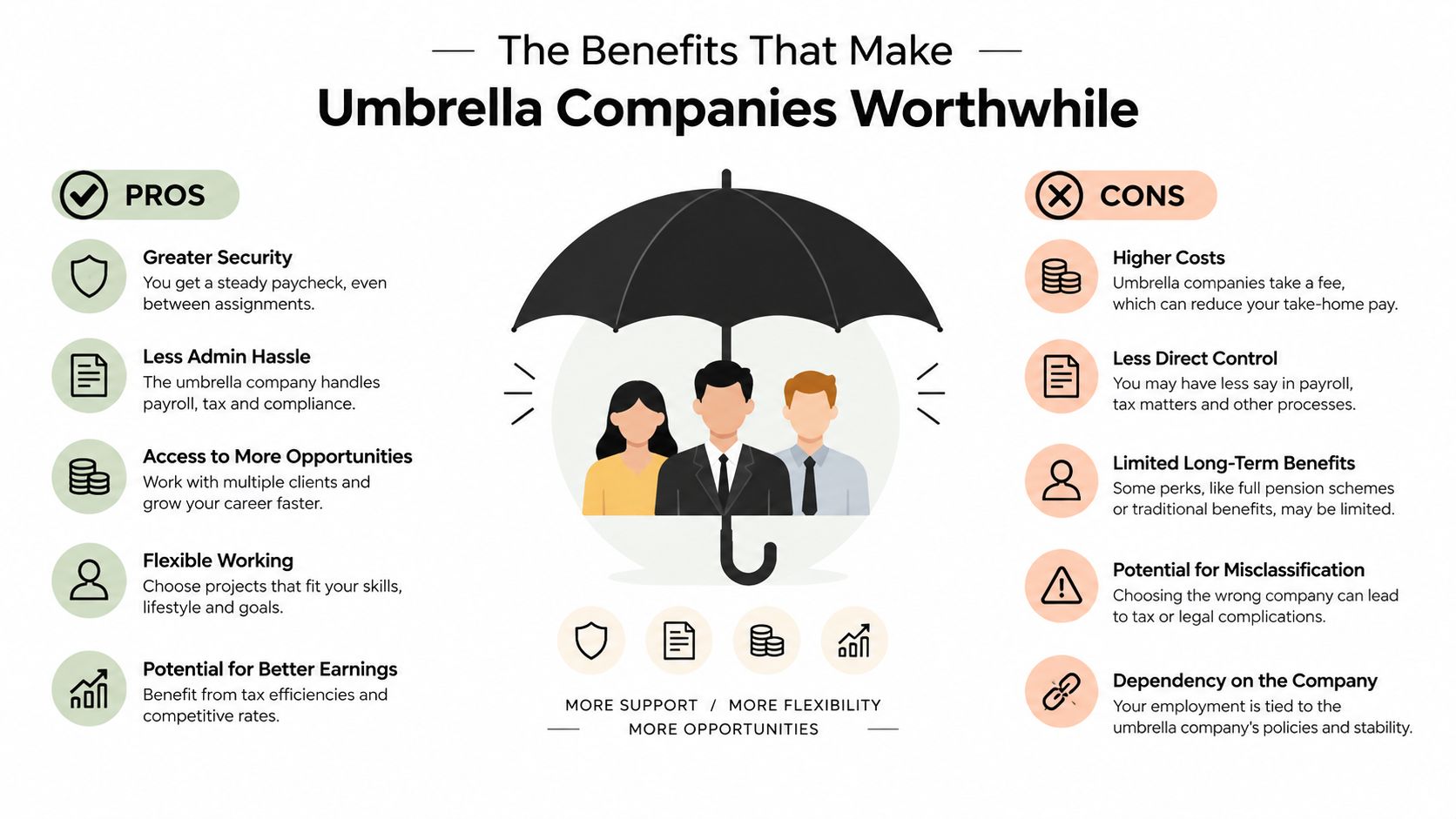
Benefits That Make Umbrella Companies Worthwhile
An umbrella can be worthwhile when the value of simplicity, compliance support and assignment access matters more than maximising net pay. That's particularly true for a first-time contractor who doesn't want to establish and administer a company for a short engagement.
Payroll without company administration
The umbrella handles payroll, PAYE deductions and payslips. You normally don't need to run payroll yourself, calculate employer liabilities or manage a company bank account. For someone moving from permanent employment into a brief contract, that reduction in administration can remove a significant source of uncertainty.
You'll still need to check your payslips and keep assignment records, but you won't have to build a full payroll process around one contract. The umbrella employment model can also provide statutory employment rights connected with employee status, subject to the terms and circumstances of the engagement.
Access to assignments that exclude PSCs
Some agencies and clients won't engage a contractor's PSC for inside-IR35 work. They may require an umbrella because it gives them a familiar payroll route and places the employment relationship with an organisation already set up to process temporary workers.
That can make an umbrella commercially useful even when it isn't the highest-net-pay option. An available assignment with a compliant payroll route may be preferable to delaying work while setting up a company that the client won't accept.
Continuity and convenience
An umbrella arrangement can suit contractors who value a single employer relationship while moving between assignments. The practical experience depends on the provider's contract and how gaps between assignments are handled, so you should read the employment terms rather than assume that every umbrella provides identical continuity.
A contractor taking a short inside-IR35 role might reasonably choose an umbrella because the alternative involves more administration for limited commercial benefit. A contractor with established clients, stronger negotiating power and longer-term outside-IR35 work may reach a different conclusion.
Before joining, review the provider's compliance credentials and operating details. Our guide to FCSA accreditation explains why recognised checks can help you assess a provider, although accreditation shouldn't replace reading the contract and verifying the legal entity named on your paperwork.
The wider market shows why this route has become so common. Independent UK market reporting estimated that the umbrella workforce reached about 700,000 contractors, with roughly 100,000 additional contractors moved onto umbrella payrolls because of private-sector IR35 changes. The same estimate put umbrella-sector HMRC receipts at about £11.8 billion in 2021/22, including about £7.7 billion attributed to the reform-driven expansion. These figures show scale, not universal preference. Policy and client practices helped create the demand.
Drawbacks and Costs to Weigh Carefully
The main drawback is that an umbrella arrangement converts the assignment rate into an employee payroll calculation. That process is compliant when operated correctly, but it can leave you with less net pay than you expected from the advertised rate.
Follow the rate from top to bottom
A useful pay illustration should help you trace the money in order:
- Assignment rate: The amount paid into the supply chain for your work.
- Employment costs: Employer National Insurance and other relevant employer costs come out before your gross pay is calculated.
- Umbrella margin: The provider deducts its administration fee according to the agreed terms.
- Gross taxable pay: This is the amount subject to PAYE.
- Employee deductions: Income Tax and employee National Insurance reduce the gross figure.
- Net pay: This is the amount transferred to your bank account.
Holiday pay may be paid with your wages or accrued for later payment, depending on the arrangement. Ask which method applies and whether the pay illustration shows it separately. A higher assignment rate doesn't automatically mean a higher take-home amount if the rate also has to fund additional employment costs.

Less flexibility than a PSC
A genuine outside-IR35 PSC can give an experienced contractor more control over invoicing, business expenses and retained profits, subject to professional advice and the actual facts of the engagement. An umbrella generally gives you an employee-style payroll outcome instead.
You also don't choose the tax treatment just because a provider advertises a higher net figure. HMRC has intervened in the umbrella market because of concerns about non-compliant arrangements. Promises of unusually high take-home pay, loans, grants or unexplained reimbursements deserve careful scrutiny.
Check the legal entity, not only the brand
Compliance checks apply to the specific company operating the payroll. Professional Passport's approved-provider information illustrates why registered company details matter when assessing approval. A brand name alone doesn't tell you which legal entity employs you or whether the entity on your contract matches the provider you researched.
Use the umbrella company comparison service to examine margin, accreditation, payslip clarity and support. Then confirm the provider's company number, contract terms, payment process and deductions before you sign.
Umbrella Company Versus Other Ways to Get Paid
The best route depends on the work, not just the rate. An umbrella, PSC and agency PAYE can all pay workers, but they place responsibility and risk in different parts of the arrangement.
| Feature | Umbrella Company | Limited Company PSC | Agency PAYE |
|---|---|---|---|
| Tax treatment | PAYE employee payroll, with Income Tax and employee National Insurance deducted | Company manages its own accounts and tax obligations, with the contractor's personal tax position handled through the company structure | PAYE employee payroll run by the agency |
| Administration | Provider manages payroll and payslips | Director manages or delegates company administration, accounts and payroll | Agency handles payroll |
| Employment relationship | Umbrella usually employs the contractor | Contractor is generally a director and employee of their own company | Agency employs or pays the worker under its PAYE arrangement |
| IR35 responsibility | Client status determination and payroll route apply to the engagement | Contractor and client must assess the off-payroll rules and operate the arrangement correctly | Agency payroll handles payment, while the engagement's status still matters |
| Flexibility | Lower administration, less control over commercial structure | Greater control where the engagement genuinely supports a PSC | Simple route where the agency offers it |
| Typical fit | Inside-IR35 assignments, client-mandated umbrella use and short contracts | Genuine outside-IR35 work with commercial independence and ongoing demand | Temporary work where the agency provides direct PAYE |
A PSC isn't automatically better. It brings accounting, company administration and compliance responsibilities, and it may be unsuitable where the client requires an umbrella or where the engagement falls inside IR35.
For a broader explanation of business structures, Grow My Acorn's UK business structure guide provides useful context for comparing how different structures affect responsibility and administration. The right choice should reflect the actual relationship with the client, not a desire to force a preferred tax outcome.
Read our comparison of an umbrella company versus a limited company before deciding. A short inside-IR35 assignment may favour an umbrella or agency PAYE, while a long-term outside-IR35 portfolio may justify professional advice about a PSC.
When an Umbrella Company Is and Is Not Worth It
Three common situations show why the answer changes from contractor to contractor.
A first-time contractor on a short assignment
A worker accepting a brief inside-IR35 contract may value speed and certainty. They don't want to create a company, appoint an accountant, manage payroll or negotiate a structure that the client may reject. An umbrella is often worth considering because it provides a recognised employment and payroll route with less setup.
An experienced contractor with outside-IR35 clients
A contractor serving multiple clients, controlling how work is delivered and managing genuine business risk may prefer a PSC. That route can provide more commercial control, but the contractor must maintain proper records and take advice on company and tax obligations. An umbrella may add cost without solving the contractor's main problem.
A specialist with a strong rate but a client mandate
A high-rate specialist may prefer PSC efficiency, yet the end client or agency may insist on umbrella payroll. In that case, the practical decision is whether the assignment remains worthwhile after the full PAYE calculation, or whether to negotiate the rate, use agency PAYE where available or decline the role.
There's also a new supply-chain question. Government policy moved in July 2025 to make agencies or end clients jointly and severally liable for PAYE on workers supplied through umbrella companies from 6 April 2026, according to HMRC's Agent Update. If an umbrella fails to operate PAYE correctly, responsibility may extend beyond the umbrella itself.
That changes how contractors should assess risk. IR35 status still matters, but so does the identity and compliance of the organisation handling PAYE.
Use this checklist before joining:
- Confirm status: Check whether the assignment is inside or outside IR35 and who made the determination.
- Request a full illustration: Trace the assignment rate through employer costs, margin, gross pay and employee deductions.
- Check the employer: Match the legal company name and registered details to your contract and payslip.
- Review deductions: Ask how holiday pay, employer costs and the margin appear in the calculation.
- Assess the client route: Find out whether agency PAYE or a PSC is available.
- Consider duration: A brief contract may favour simplicity, while repeated outside-IR35 work may justify reviewing alternatives.
- Test the risk: Avoid any arrangement that cannot explain its PAYE treatment clearly.
Final Verdict and Next Steps for Contractors
Umbrella companies can be worth it when you need a simple, compliant payroll route, particularly for an inside-IR35 assignment that the client won't offer through a PSC. They can reduce administration, provide payslips and make it easier to move into contracting without immediately running your own company.
They're less likely to be worthwhile when your priority is maximum take-home pay and you have clearly outside-IR35 work that supports a PSC. Agency PAYE may also be a sensible alternative where it's available and you want direct payroll without comparing umbrella providers.
The decision should start with the full pay illustration, not the headline assignment rate. Check the umbrella margin, employer costs, PAYE deductions, holiday pay treatment and the provider's legal entity. Accreditation and recognised compliance checks can help, but you should still read the contract and confirm who carries out payroll.
The April 2026 PAYE liability changes make supply-chain diligence more important for agencies and clients, and more relevant to contractors choosing where their pay will be processed. A compliant-looking brand isn't enough. You need a clear calculation, a traceable employer and straightforward answers about deductions.
Umbrella Company helps contractors compare umbrella providers and understand how factors such as assignment rate, contract status and provider support affect the decision. Visit Umbrella Company to compare your options and review practical guidance before accepting an umbrella arrangement.


