


Umbrella companies are legal in the UK when they operate PAYE correctly, and the sector grew from about 100,000 workers in 2007/08 to at least 500,000 in 2020/21. The catch is that umbrella companies have long sat in a regulatory gap, and that gap is now being closed by the Employment Rights Bill and the 6 April 2026 PAYE rules.
Most contractors ask, “Are umbrella companies legal?” when the better question is often, “How do I tell a lawful umbrella from a risky one?” That difference matters because the legal answer has never been a simple badge of approval from HMRC.
A proper umbrella can be a straightforward way to work. You become an employee, tax is deducted through PAYE, and you receive payslips. But the market has also attracted operators that blur costs, overpromise take-home pay, or rely on arrangements that don't stand up to scrutiny.
That's why the transition happening in April 2026 matters so much. It gives agencies and end clients a direct financial reason to care whether the umbrella in the chain is compliant. For contractors, that creates a more practical way to judge legality, not just by what the provider says, but by how seriously the whole supply chain treats PAYE, transparency, and worker protections.
The Short Answer on Umbrella Company Legality
Yes, umbrella companies are a legal way to be paid as a contractor in the UK, provided they operate payroll correctly and meet employer obligations.
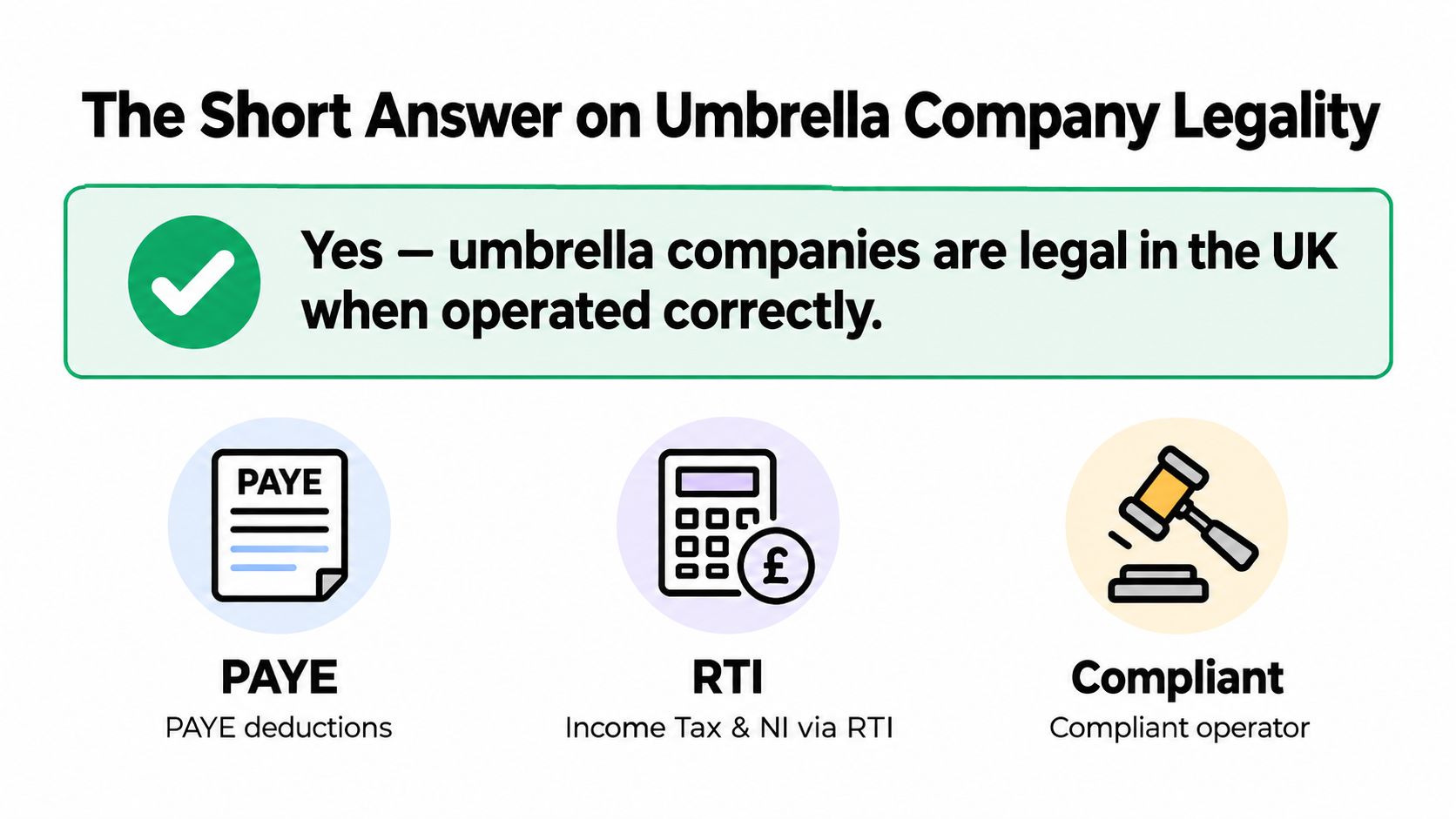
That's the reassuring part. The more nuanced part is that the UK has not had a clear statutory definition for umbrella companies, and HMRC says there is no statutory definition of an umbrella company in current guidance on umbrella companies and the changing legal framework. In practice, HMRC generally describes them as employment intermediaries that employ temporary workers on behalf of agencies or end clients.
Why the answer sometimes sounds muddled
People get confused because “legal” and “regulated” aren't the same thing.
An umbrella company can be lawful as a business model, while the sector itself still lacks a dedicated regime of the kind many people expect. There isn't an HMRC approval list. There isn't a single government licence that proves an umbrella is safe. A lawful umbrella is legal because of how it operates, not because it holds a special public badge.
Practical rule: If the umbrella employs you, pays you through PAYE, and handles employer obligations properly, you're looking at a lawful model.
What contractors need to focus on
The practical test usually comes down to four things:
- Employment status: You should be employed by the umbrella under a real contract.
- Payroll operation: Your pay should go through PAYE, with clear deductions.
- Employer duties: The umbrella should handle tax, National Insurance, and normal employment admin properly.
- Transparency: You should be able to understand your payslip without needing a decoder ring.
For many contractors, that's why using a comparison resource such as Umbrella Company options for contractors can help narrow the field before you sign.
The shift now is this. The old answer to “are umbrella companies legal?” focused on the umbrella itself. The newer, more useful answer also looks at whether the agency and end client are willing to stand behind that umbrella under the incoming rules.
How UK Law Currently Treats Umbrella Companies
The current UK position is unusual. Umbrella companies are generally lawful, but the law hasn't historically wrapped them in a neat, purpose-built definition.
Government material explains that umbrellas have often been outside direct scope unless other parts of their activity brought them within existing agency-law rules, which is part of why non-compliance has been hard to police under the government paper on the umbrella company market.
What an umbrella is in practical terms
In everyday payroll terms, the umbrella becomes your employer.
That usually means:
- You sign an employment contract: You are engaged as an employee of the umbrella.
- The umbrella runs payroll: It deducts Income Tax and National Insurance through PAYE.
- You receive payslips: Deductions should be visible and understandable.
- You get worker rights linked to employment: These can include holiday pay and pension enrolment, depending on the arrangement.
That is very different from working through your own limited company.
Umbrella vs PSC legal status compared
| Feature | Umbrella Company | Personal Service Company (PSC) |
|---|---|---|
| Legal relationship | You are employed by the umbrella | You usually own and run the company |
| Payroll | The umbrella operates PAYE on your earnings | The PSC handles its own payroll and company administration |
| Tax handling | Tax and National Insurance are deducted as employment income | The PSC structure interacts with company tax rules and IR35 considerations |
| Employment contract | Usually yes, with the umbrella | Not in the same way, because you contract through your own company |
| Worker rights | More closely linked to employee status | Not the same employee framework as an umbrella arrangement |
Contractors often compare these two routes when looking at contractor employment law basics, because the legal consequences are different even when the day-to-day contract work feels similar.
What a lawful umbrella cannot do
A lawful umbrella structure does not give anyone permission to sidestep tax law.
A real umbrella pays salary through PAYE. It doesn't replace wages with loans, opaque advances, or artificial arrangements dressed up as something else.
That matters because some schemes borrow the language of umbrella employment while operating in a very different way behind the scenes. The structure itself is permitted. The abuse of that structure is where legal and tax problems begin.
The HMRC Position and the Conduct Regulations Gap
HMRC's position is plain, but it often surprises first-time contractors. HMRC says umbrella companies are not approved or endorsed by HMRC, and workers remain responsible for checking that the right tax and National Insurance are paid under the guidance on working through an umbrella company.
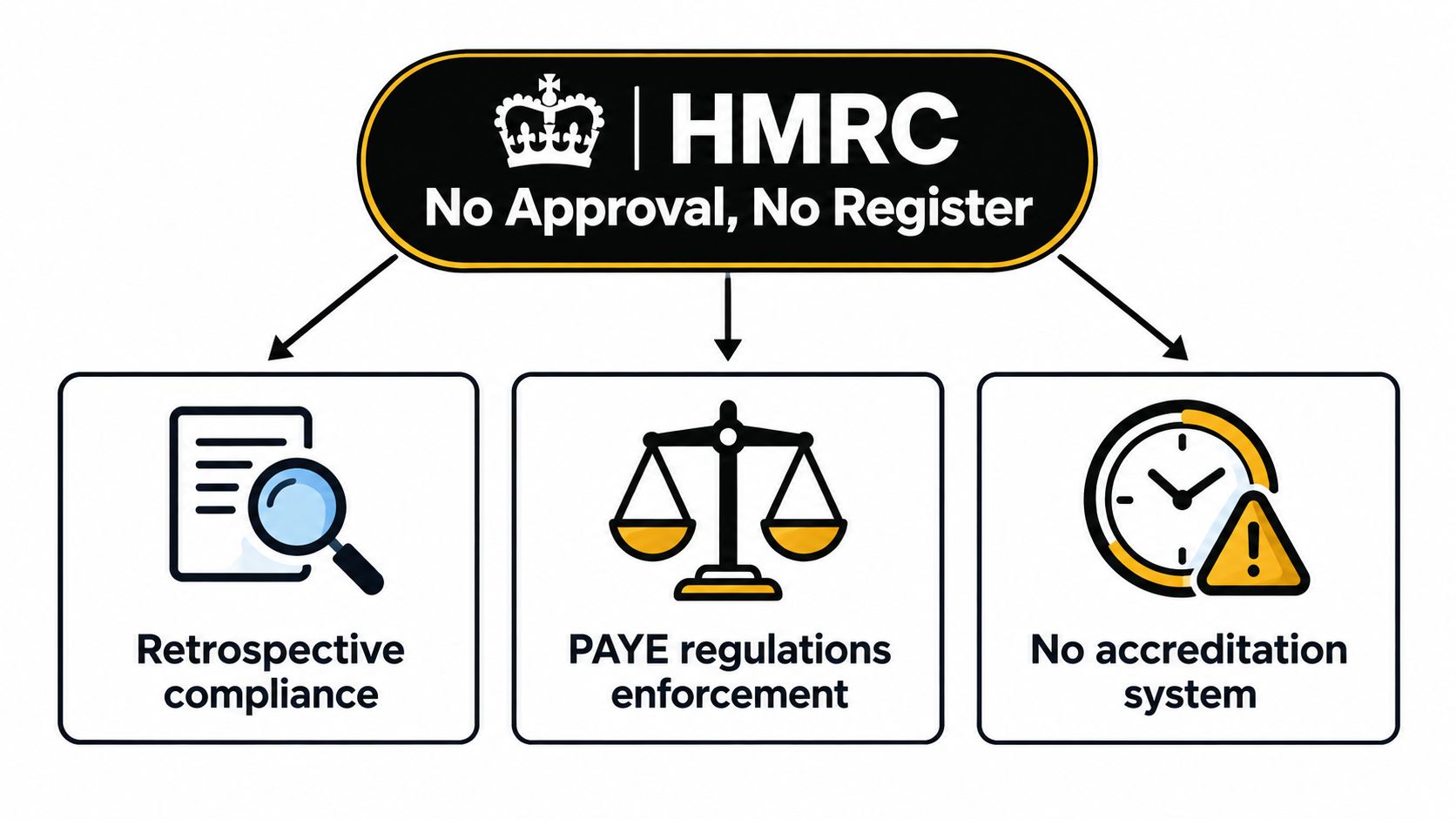
That means HMRC doesn't run a public “safe umbrella” register. It doesn't pre-approve operators before you join them. Instead, it sets rules about payroll and then enforces those rules when businesses get them wrong.
What HMRC actually does
In practical terms, HMRC cares about whether the umbrella is running a genuine PAYE operation and whether your deductions are being handled correctly.
You should expect the umbrella to:
- Run a real payroll: Your pay should be processed as employment income.
- Submit information to HMRC: PAYE reporting should happen as part of normal payroll compliance.
- Show deductions clearly: Payslips shouldn't hide what has been taken and why.
Many contractors assume there must be a regulator checking every umbrella in advance. There isn't.
Where the gap sits
The Conduct of Employment Agencies and Employment Businesses Regulations have historically focused more on agencies than on umbrella companies themselves. That has left a gap between what the market looks like in practice and what the law directly supervises.
To make that easier to visualise, here's a quick explainer.
Because of that gap, voluntary standards have become important. Contractors and agencies often look for names such as FCSA, Professional Passport, and APSCo when they want some independent sign that a provider has been reviewed against recognised compliance expectations.
If an umbrella talks as though HMRC has “approved” it, treat that as a warning sign. HMRC says it does not approve or endorse umbrella companies.
That's also why contractor vigilance has mattered so much up to now. In a market without a statutory approval badge, your payslip, contract, and the provider's willingness to answer hard questions do a lot of the heavy lifting.
How the April 2026 Reforms Change the Legal Picture
The most important change in the legality conversation lands on 6 April 2026. From that date, agencies, or end clients where no agency exists, become responsible for PAYE and Class 1 National Insurance in labour supply chains that use umbrella companies, according to the policy position referenced in the NASUWT response on the umbrella company market and reform timeline.
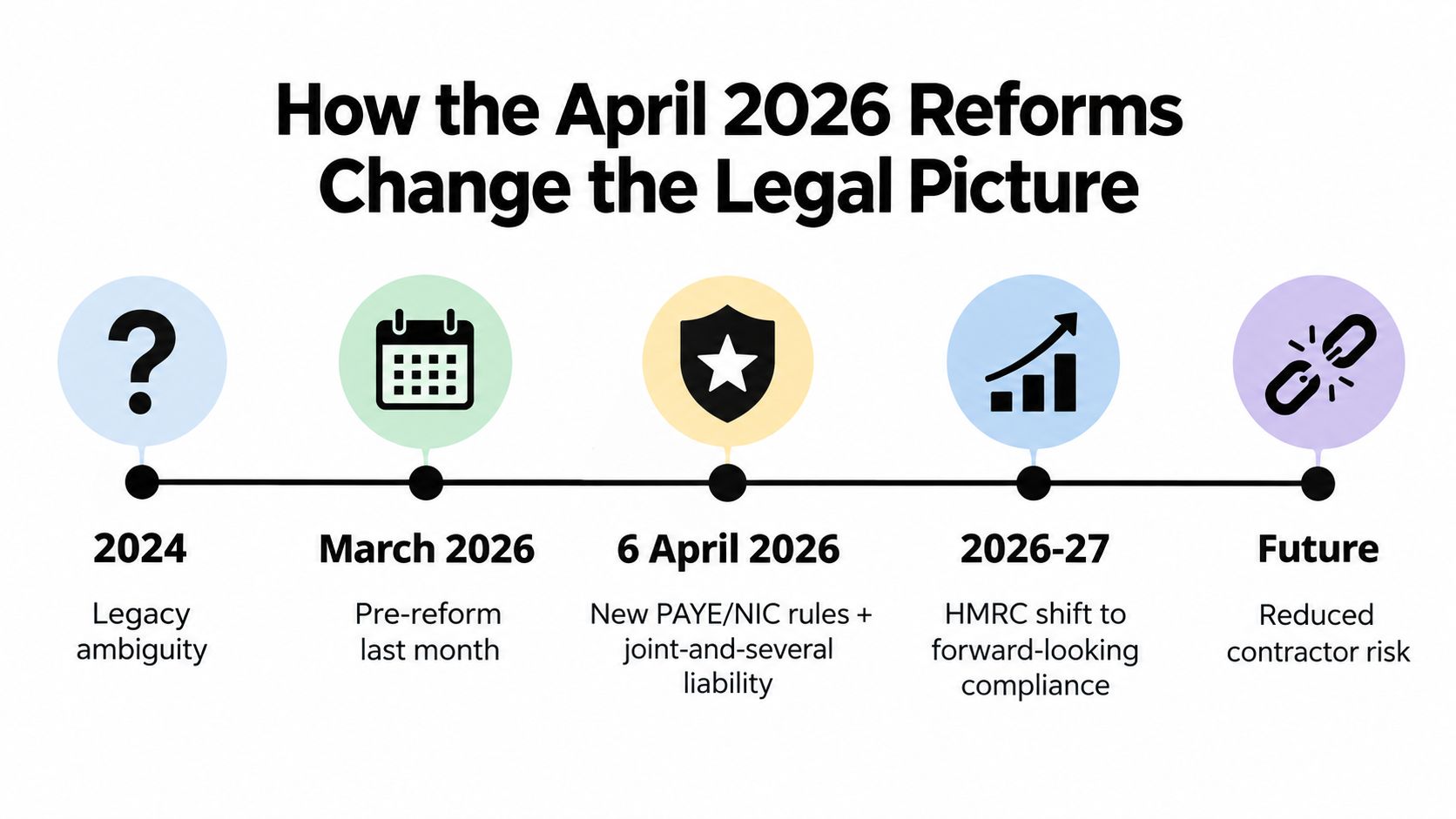
That's a major shift because it changes who carries the risk when payroll taxes aren't handled properly.
What changes on 6 April 2026
The new framework doesn't mean umbrellas stop being employers in the ordinary sense. HMRC's guidance on PAYE rules for labour supply chains that include umbrella companies from 6 April 2026 says the umbrella company has legal employer responsibilities including PAYE Income Tax, student loan repayments, and both employee and employer National Insurance contributions, with the rules applying to payments made to workers on or after that date.
The practical change is where liability can travel if those obligations aren't met.
Why joint liability matters
The legislation makes recruitment agencies jointly and severally liable for PAYE and Class 1 NICs when workers are supplied through umbrella companies, and extends similar NIC liability to specified businesses higher up the chain under the 2026 statutory instrument explanatory memorandum.
In plain English, HMRC won't be limited to chasing only the umbrella if payroll taxes go unpaid. It can look further up the labour supply chain.
That changes the market in three immediate ways:
- Agencies must do more due diligence: Choosing an umbrella on price alone becomes much riskier.
- End clients gain a stronger compliance interest: They can no longer treat umbrella choice as someone else's problem where the chain is structured that way.
- Contractors get a sharper signal: If an agency is reluctant to explain its umbrella checks, that tells you something.
Key shift: Before April 2026, many contractors had to judge compliance largely from the outside. After the reform, agencies and some end clients have direct legal incentives to judge it too.
The wider legal direction
Alongside the tax changes, the government has confirmed that umbrella companies will be brought into the legal definition of an employment business through the Employment Rights Bill, as set out in the earlier government collection linked above. That matters because it points toward more explicit statutory oversight instead of the old patchwork position.
For contractors navigating IR35 reform and off-payroll changes, this is the takeaway. The question is no longer just whether the umbrella says it is compliant. The question is whether the whole chain is prepared to stand behind that compliance under a tougher legal model.
How to Tell a Compliant Umbrella From a Risky Scheme
By the time you're reading contracts and comparing take-home estimates, legality stops being abstract. It becomes visible in the provider's behaviour.
A compliant umbrella usually looks ordinary. A risky scheme often tries to look clever.
Compliant Umbrella vs Risky Scheme Key Markers
| Marker | Compliant Umbrella | Risky Scheme |
|---|---|---|
| Pay model | Salary processed through PAYE | Part salary, part opaque payment, or unusual arrangement |
| Payslip clarity | Deductions are shown clearly | Deductions are vague, missing, or hard to follow |
| Contract | Genuine employment contract | Unclear paperwork or arrangements that avoid clear employment terms |
| Marketing language | Focus on payroll, rights, and transparency | Heavy focus on boosted take-home pay or “tax efficiency” |
| Margin | A visible umbrella margin | Costs are buried or difficult to explain |
| Questions | Provider answers technical questions plainly | Provider dodges detail or leans on sales language |
Red flags contractors should take seriously
Some warning signs come up again and again:
- Loan-style language: If part of your pay is described as a loan, advance, credit facility, or something similarly artificial, step back.
- Unclear deductions: If you can't see what has been deducted for PAYE and National Insurance, that's a problem.
- Pressure selling: “Sign today” and “everyone uses this model” are not compliance answers.
- Strange expense claims: If a provider encourages inflated or routine expenses without a solid basis, that should concern you.
- No easy paper trail: You should be able to find the company, review its documents, and understand who employs you.
A common point of confusion is this. A provider can still call itself an umbrella and still be operating in a risky way. The label alone tells you almost nothing.
What good looks like in practice
A good umbrella should be able to show you a sample payslip, explain its margin, and tell you clearly how holiday pay is handled. It shouldn't become evasive when you ask about employer costs or payroll process.
If you're comparing providers, a guide to warning signs among umbrella companies can help you spot patterns that repeat across poor operators.
The simplest rule is often the best one. If the arrangement sounds designed to reduce tax in a way you don't fully understand, you're usually looking at the wrong end of the market.
Verifying an Umbrella Company Before You Sign
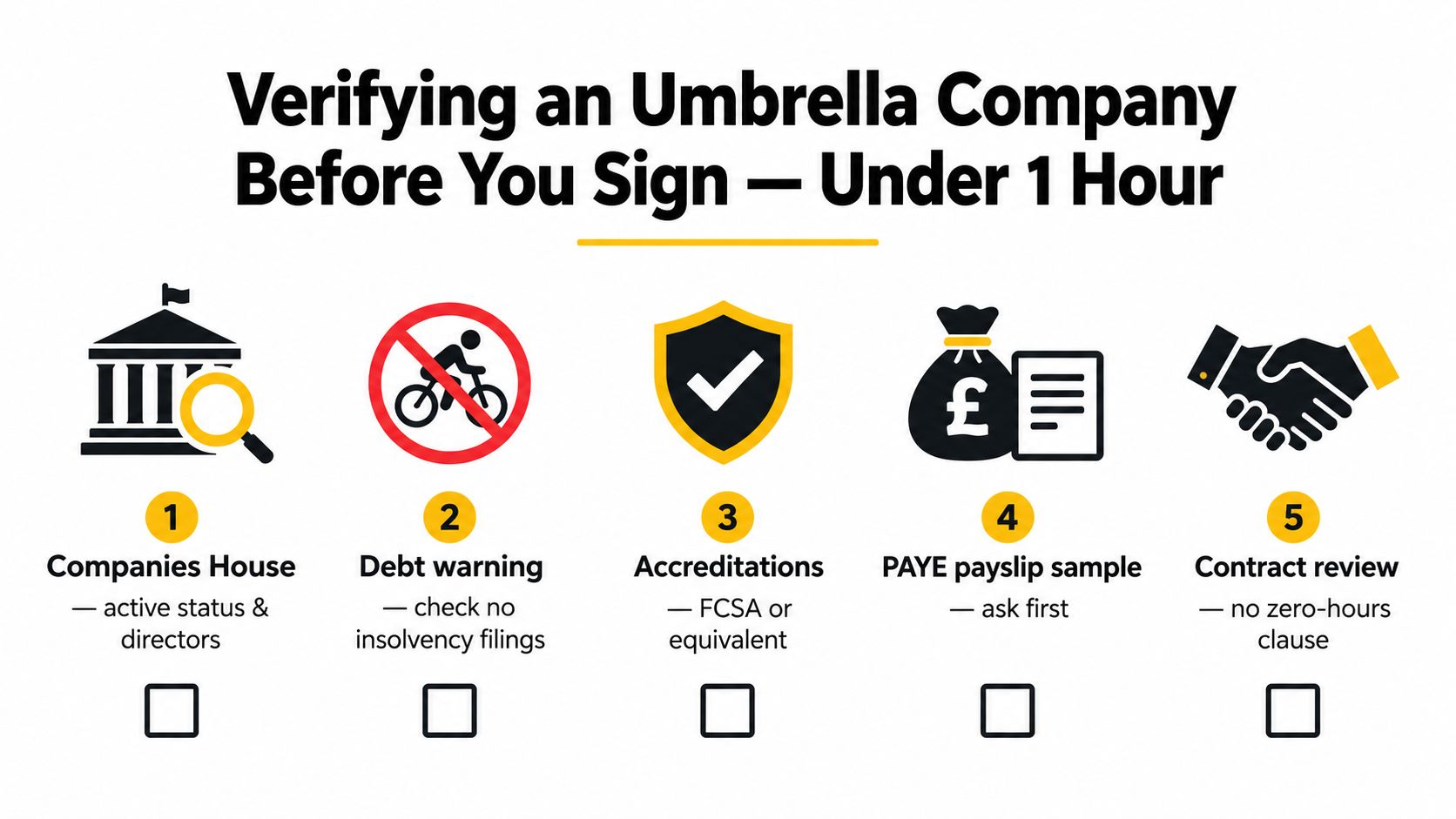
You can do a useful pre-signing check in under an hour if you stay methodical. The aim isn't to become a tax investigator. It's to make sure the basics line up before your first invoice is ever paid.
Your practical checklist
Start with the company itself.
- Check Companies House: Confirm the company is active, review the directors, and look for anything that feels odd, such as frequent name changes or signs of instability.
- Review the paperwork: Ask for the employment contract before you commit. You should know who employs you and on what terms.
- Ask for a sample payslip: This is one of the fastest ways to spot whether the provider is transparent.
- Look at accreditation claims: If the umbrella mentions FCSA or Professional Passport, verify that status directly with the relevant body.
- Review the recruiter too: If an agency is involved, its standards matter because referral practices can tell you a lot about the umbrellas it works with.
What to look for on the payslip
The payslip should let you follow the journey from gross amount to net pay without guesswork.
Check for:
- PAYE tax code: It should be visible.
- National Insurance details: These should appear in the normal way for employment pay.
- Employer costs and umbrella margin: You should understand what is being taken and why.
- Holiday pay treatment: Accrued or advanced holiday pay should be explained clearly.
Ask one simple question before you sign: “Will you send me a sample payslip and explain every deduction line?” A compliant umbrella should be comfortable doing that.
Useful questions to put to the provider
Not every question needs a long legal answer. You're listening for clarity.
Try these:
- Can you share a sample payslip before I sign?
- How do you show your margin?
- Are you accredited by FCSA or assessed by Professional Passport?
- Who will be my legal employer?
- How is holiday pay handled?
If you want a starting point for narrowing providers by transparency and contractor fit, Umbrella Company offers a comparison portal that helps users review umbrella companies by role and working arrangement.
Key Takeaways and Next Steps for Contractors
The legality question is simpler than it first appears. Umbrella companies are lawful when they operate as genuine employers and run PAYE properly. The difficulty has been spotting who does that in a market where HMRC does not licence providers in advance.
Five actions worth taking this week
- Pull your recent payslips: Check that deductions are clear and that the paperwork makes sense as employment pay.
- Ask your umbrella direct questions: Request a sample payslip if you're still choosing, or an explanation of any line you don't understand.
- Check claimed accreditations: FCSA and Professional Passport can be useful signals, but only if the membership or certification is real and current.
- Speak to your agency: Ask how it vets the umbrellas in its supply chain, especially with the April 2026 liability changes in mind.
- Trust plainness over promises: If the provider's main sales pitch is unusually high take-home pay, stop and scrutinise it.
What the 2026 shift really means for you
The incoming rules change the practical test of compliance. A contractor won't have to rely quite so heavily on marketing language or assumptions, because agencies and some end clients will have stronger reasons to choose transparent umbrellas.
That doesn't remove your need to check the basics. It does mean the market has more pressure pushing in the right direction.
The best umbrella arrangements are usually the least dramatic. Clear contract, clear payslip, clear deductions, clear answers.
If you keep those four things in front of you, the question “are umbrella companies legal?” becomes much easier to answer in practice.
If you want to turn that legal understanding into a shortlist, Umbrella Company helps contractors compare umbrella providers by working style, transparency, and practical fit. It's a straightforward way to review options, ask better compliance questions, and request the right payroll detail before you sign.


